18 Mar
2026
Energeks
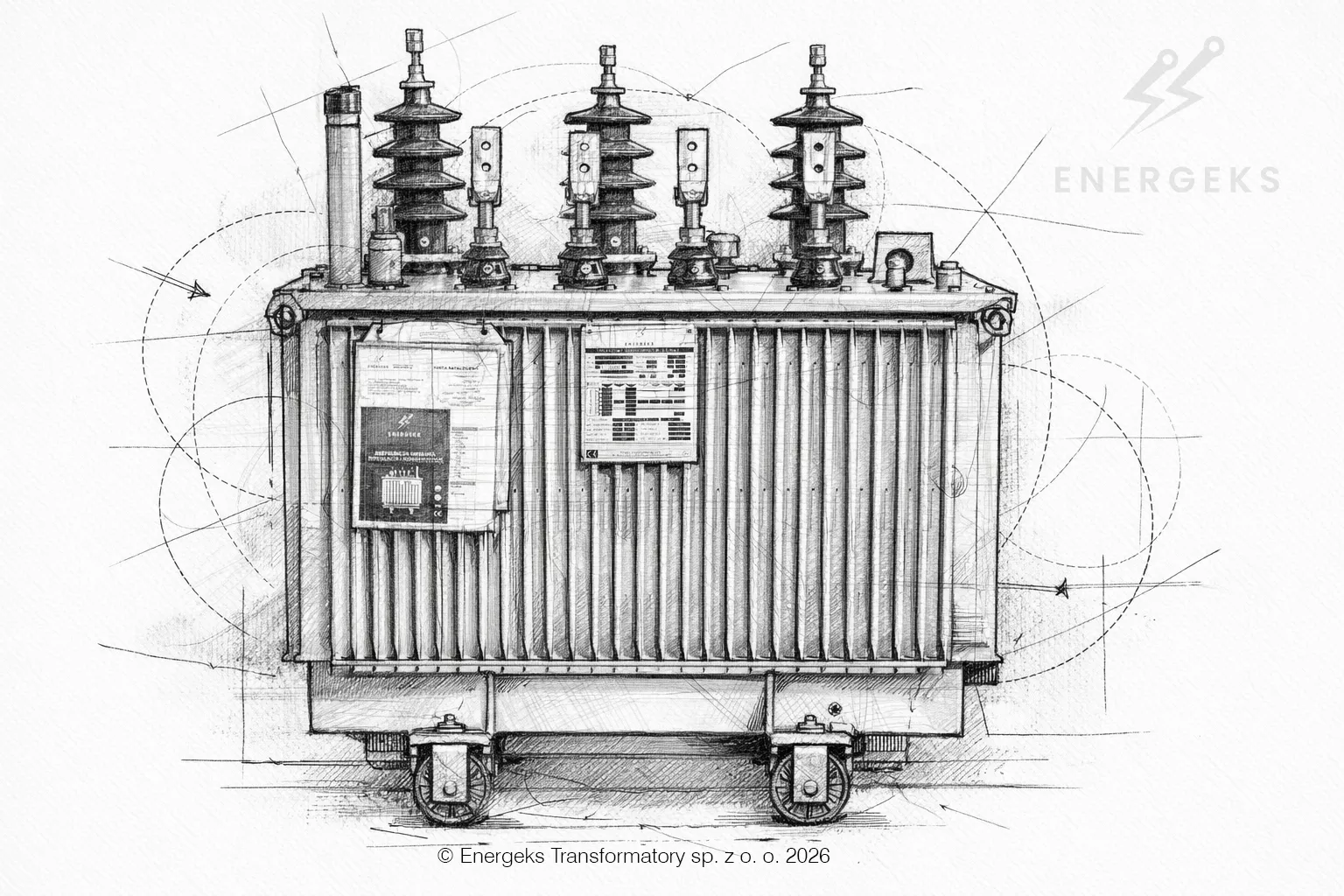
Sometimes the most interesting things in the power industry are surprisingly small.
You're standing by a medium voltage transformer, looking at a porcelain bushing, and you see a metal terminal.
On one phase, one hole.
On another, two. Someone asks: is this a mistake? Is something missing?
No. It's a conscious design decision.
In the world of MV transformers, such small details aren't just cosmetic.
They are elements that affect the installation's durability for the next 30 years of operation.
In the place where the cable meets the transformer, enormous currents, electromagnetic forces, and temperature also meet.
And right there, one additional hole can make a huge difference.
Today, we'll take a look at one of the most underestimated elements of an MV transformer.
The bushing terminal and why it sometimes has one hole and sometimes two.
If you design transformer stations, work with MV transformer installation, set up PV farms, or simply want to understand the power industry more deeply, this article will show you something important.
You'll understand why the construction of the bushing terminal isn't an accident.
You'll learn how the number of holes affects currents, temperature, and connection durability.
And why, in power engineering practice, one extra hole can save a transformer from overheating.
In this text, we'll discuss:
how an MV transformer bushing works and is constructed
why terminals have one or two mounting holes
how the number of bolts affects current, temperature, and contact resistance
what distribution grid operators require
which installation errors most often lead to connection overheating
It's worth reading, because the only thing truly worth accumulating in life is knowledge!
Reading time: ~12 minutes
Before we move on to the mounting holes themselves, it's worth understanding the role of the bushing.
A medium voltage transformer typically operates in the range from about 6 kV to 36 kV. The windings are inside a tank filled with transformer oil. This oil serves two functions. It cools the windings and provides electrical insulation.
The problem appears where the conductor has to exit the tank.
The current must pass from inside the transformer to the outside, to the cable or busbar. At the same time, electrical breakdown through the housing cannot be allowed. The potential difference is enormous.
That's why bushings are used.
A transformer bushing is an insulated element, usually made of porcelain or composite, that conducts the conductor through the transformer tank wall. Inside it, there is a conductive pin connected to the transformer winding.
On the outside of the bushing, there is a terminal.
The metal fitting to which the cable or busbar is connected.
And it's in this fitting that the topic of one or two holes appears.
The bushing terminal, a small element with great responsibility
The bushing terminal is the meeting point of two worlds.
On one side, we have the transformer. A device that can have a power rating from several hundred kilovolt-amperes to several megavolt-amperes.
On the other side, the medium voltage cable or busbar leading the energy further into the grid.
At this single point, currents in the order of hundreds of amperes, and sometimes over a thousand amperes, flow. At the same time, the metallic contacts must maintain very low resistance.
If the contact resistance increases even minimally, the Joule effect appears.
Electrical energy starts turning into heat.
And heat in the power industry is enemy number one.
The simplest and at the same time very common construction of a medium voltage transformer bushing terminal has one mounting hole.
At first glance, this may seem like a minimalist solution, but in reality, it is a conscious compromise between electrical requirements, mechanical needs, and installation practice.
In such an arrangement, the cable lug is bolted to the terminal with one bolt.
The bolt presses the lug eye against the flat metal surface of the bushing terminal. This creates an electrical connection through which energy from the transformer can flow further to the medium voltage cable.
For many installations, this solution is fully sufficient and has been used in distribution power engineering for decades.
To understand why, it's worth looking at the scale of currents on the medium voltage side.
In distribution transformers with a power of several hundred kilovolt-amperes, the currents on the MV side are relatively small. This follows directly from the relationship between power, voltage, and current.
For example, a 1000 kVA transformer operating in a 15 kV network generates a current of about 38 amperes on the medium voltage side. Even with a 2500 kVA transformer, this value increases to about 96 amperes.
These are values that, from the perspective of electrical connection construction, are relatively small.
A properly made bolted connection with one bolt and an adequate contact surface carries such currents without any problem for many years of operation.
That's precisely why, in transformers with lower power ratings, using a terminal with one mounting hole is a completely rational solution.
One bolt ensures adequate pressure on the contact surfaces.
If the surfaces are clean and the bolt tightening torque is correct, the contact resistance remains very low. This means that no significant energy losses or excessive heating appear at the connection point.
The connection is also simple to install. The installer needs to fit one cable lug and tighten one bolt with the appropriate torque. In the conditions of constructing or modernizing a transformer station, this has practical significance because it shortens installation time and reduces the risk of errors.
A terminal with one hole also has construction advantages.
First of all, it is more compact. In container stations, where space between transformers, switchgear, and cables can be very limited, every centimeter of space matters. A smaller terminal makes it easier to route cables and maintain the required insulation clearances.
The second advantage is the lower weight of the entire bushing assembly.
In distribution transformers, which are often installed in large quantities in the grid, every structural element is optimized for cost and simplicity of production. A simpler terminal means less material and fewer technological operations during manufacturing.
There is also the aspect of compatibility with typical cable lugs used in medium voltage networks. In many cable systems, standard lug eyes are designed specifically for single-bolt connections.
Thanks to this, installation is quick and requires no special intermediate elements.
In power engineering practice, a terminal with one hole is therefore a good solution in several typical situations.
The first is a transformer with relatively low power, where the currents on the medium voltage side are not large. Under such conditions, a single bolted connection provides sufficient contact surface and mechanical stability.
The second situation is cable installations where the transformer is connected directly to an MV cable terminated with a standard cable lug. The cable is flexible and does not generate large mechanical loads on the terminal, so one attachment point is sufficient.
The third situation is transformer stations with limited installation space. A compact terminal makes it easier to route cables and maintain safe distances between phases.
However, physics and operational practice remind us that every solution has its limits.
One bolt means one pressure point.
It also means that the entire contact surface is pressed in one place. If the connection is made imprecisely, the contact surface may be smaller than assumed.
As transformer power increases, currents increase, and with them, the requirements for the quality of the electrical connection increase.
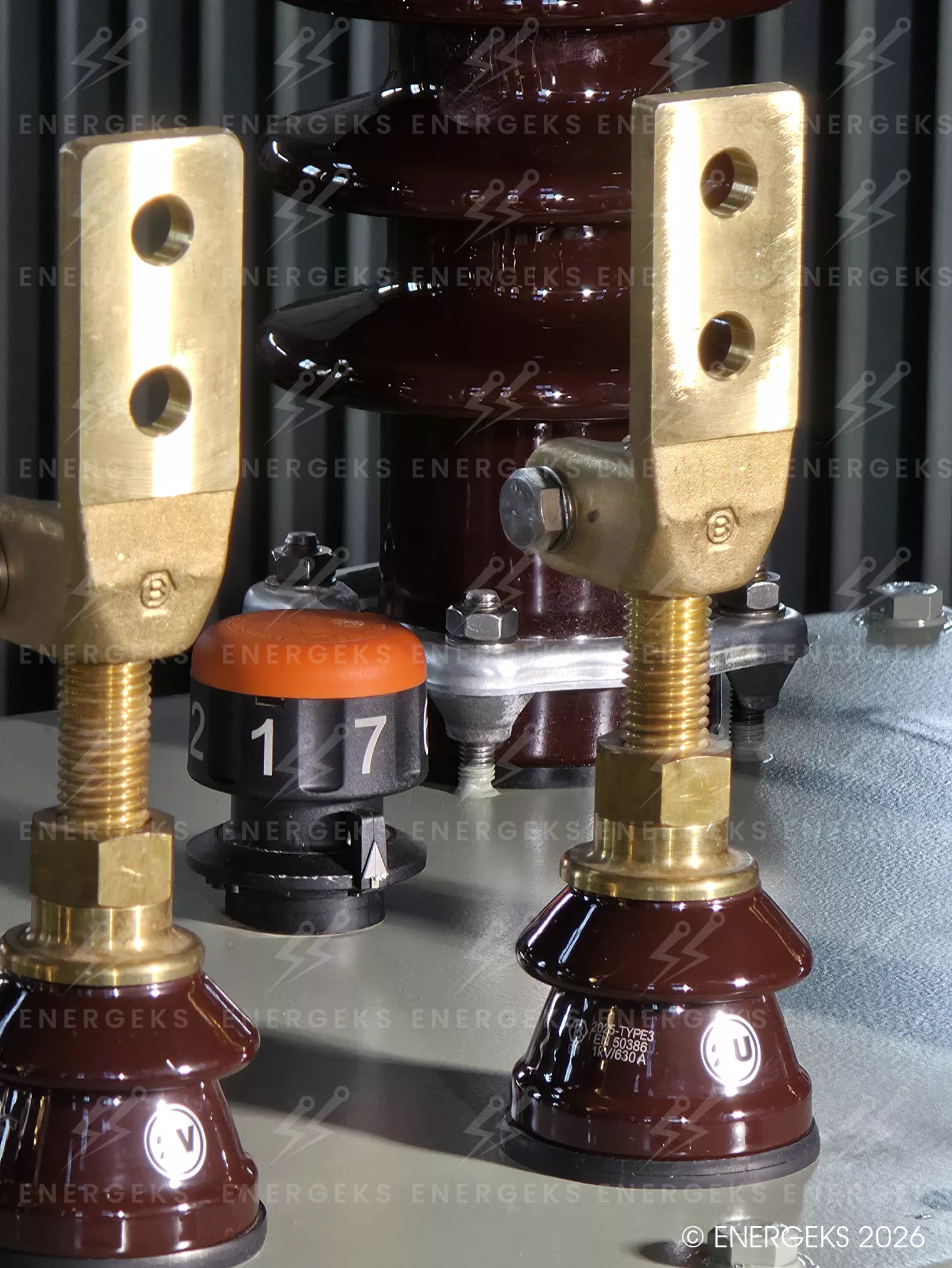
MV transformer bushing terminal with one mounting hole used in standard cable connections in MV transformer stations. The single-bolt construction enables quick and compact connection of the cable lug to the transformer bushing, ensuring adequate contact surface for typical operating currents in distribution transformers. This solution is often used in transformers with lower and medium power ratings, in cable installations, and in container stations where simplicity of assembly and limited connection space are important.
© ENERGEKS 2026
At a certain point, one bolt ceases to be the optimal solution.
That's when the construction with two mounting holes appears, which allows for increased mechanical stability and improved pressure distribution on the contact surface.
And it is this solution we will look at in the next step.
A terminal with two holes is a construction used where the electrical and mechanical requirements of the entire system increase. In transformers with higher power ratings and in industrial installations, a simple single-bolt connection ceases to be the optimal solution.
In such an arrangement, the cable lug or copper busbar is bolted to the bushing terminal with two bolts. At first glance, the difference seems small. In reality, it changes a great deal in the behavior of the entire connection during the transformer's many years of operation.
The first benefit concerns mechanical stability.
With one hole, the cable lug is pressed at a single point and can rotate minimally around the bolt axis. This movement isn't large, often fractions of a millimeter, but in power engineering, even such small changes matter. A transformer during operation is not a completely static element. There are magnetic core vibrations, temperature changes causing material expansion, and electromagnetic forces generated by fault currents.
If the connection has only one attachment point, the lug may shift slightly over time. Two mounting holes eliminate this problem. The cable lug becomes locked at two points, which practically prevents rotation and stabilizes the entire connection.
The second benefit is related to contact surface area.
Power connections work best when the contact surface area between metals is as large as possible. In practice, this means the conducting elements must be pressed together with adequate force over as large an area as possible.
Two bolts result in a more even distribution of pressure over the surface of the cable lug or copper busbar. Thanks to this, a larger part of the metal surface participates in conducting current. As a result, local current density decreases and energy losses at the connection point are limited.
The third benefit concerns one of the most important parameters of any electrical connection:
CONTACT RESISTANCE
Contact resistance always arises where two conductors are mechanically joined. Even very smooth metal surfaces actually only touch each other at many microscopic points. The better the pressure and the larger the contact surface, the lower the connection resistance.
If contact resistance increases, the phenomenon of heat generation appears according to Joule's law. Electrical energy starts being converted into heat at the connection point.
To illustrate the scale, it's worth looking at a simple example:
If the connection resistance increases by just 100 microohms, and a current of 600 amperes flows through the joint, the power loss will be about 36 watts at a single point.
On paper, this seems like a small value. However, in reality, this energy is released on a very small metal surface.
This means local heating of the joint to temperatures significantly higher than the ambient temperature. Over time, this can lead to surface oxidation, a further increase in resistance, and accelerated degradation of the connection.
Two bolts help keep contact resistance at a minimum level because they provide stable pressure and a larger effective contact area between metals.
In practice, terminals with two holes appear most often in several situations.
The first is a transformer with higher power.
As power increases, operating currents and requirements for the quality of electrical connections also increase.
The second situation is connections made using copper busbars instead of cables.
Busbars are rigid and heavy, therefore requiring more stable attachment.
The third situation is industrial installations or transformer stations operating in difficult operating conditions.
Vibrations, temperature changes, and high fault currents mean that the mechanical stability of the connection becomes critical.
In such cases, using two mounting holes in the bushing terminal is not a construction luxury.
It is a design element that significantly increases the reliability of the entire transformer over a long operating period.
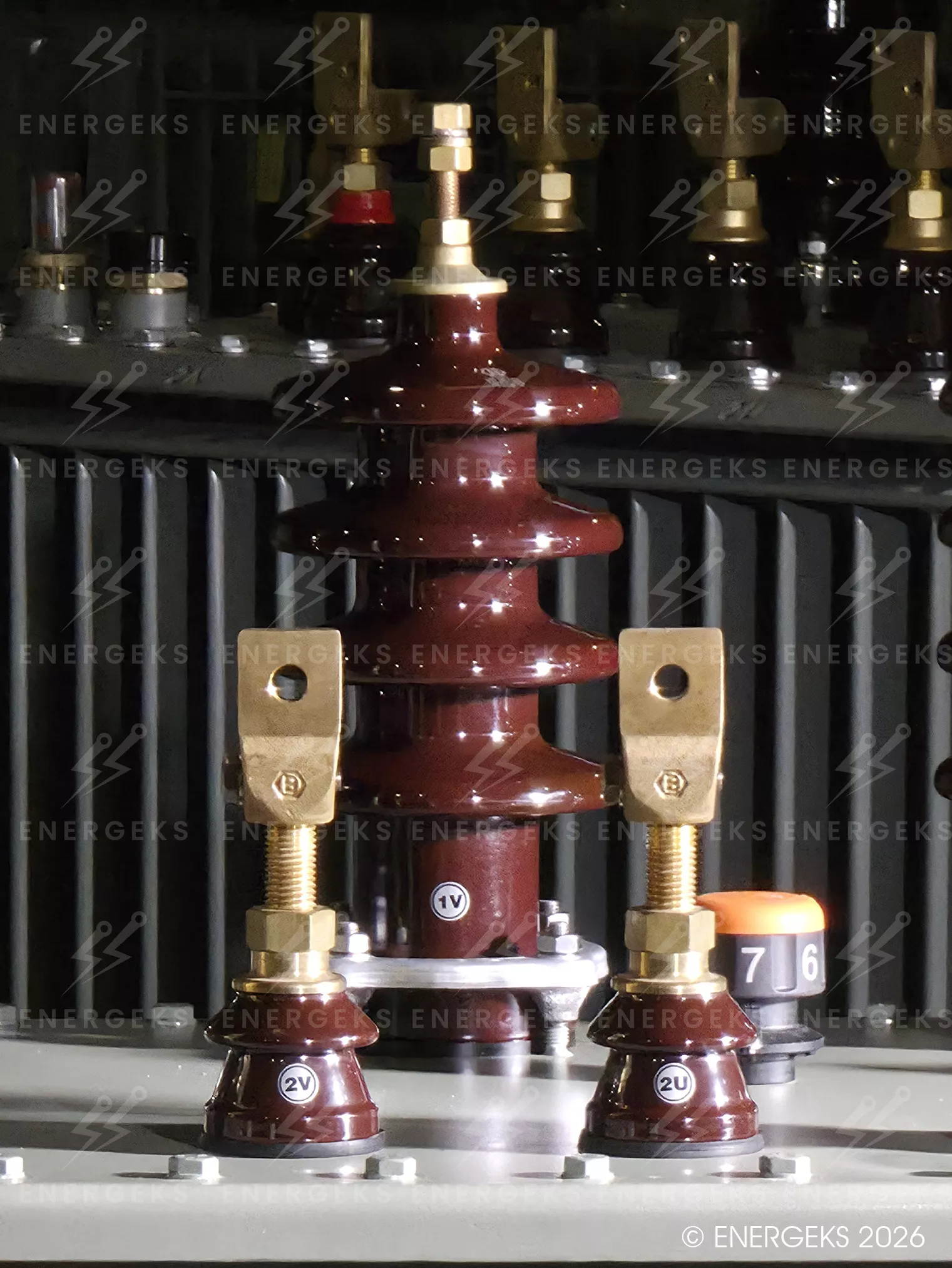
MV transformer bushing terminal with two mounting holes intended for connections with higher current loads. The double-bolt construction enables stable connection of the cable lug or copper busbar, increases the contact surface area, and limits contact resistance. This solution is most often used in transformers with higher power ratings, in transformer stations with busbar connections, and in installations meeting distribution system operator requirements, where long-term connection stability and minimization of joint heating are crucial.
© ENERGEKS 2026
At Energeks, we take such details seriously. Our MV transformers can be equipped with various bushing termination configurations, tailored to the station design, cable connection method, and grid operator requirements. This applies to both single-hole and double-hole terminals, as well as various types of connection clamps used in power engineering, such as TOGA-type solutions, selected depending on the connection configuration and design standards. If you want to see more examples of such solutions, check out our Energeks transformer offer,
or contact our advisors directly to match the solution precisely to your needs.
In power engineering, there is something beautiful in the details.
From the outside, a transformer seems like a massive, calm machine. Several tons of steel, a magnetic core, an oil tank. Meanwhile, its longevity is often determined by elements you can hold in your hand. One of them is the bolted connection at the end of the bushing.
At first glance, the difference between one and two bolts seems like a trivial detail.
In reality, it is a decision that affects three very important physical phenomena.
The flow of current, the temperature of the connection, and contact resistance.
And it is these three parameters that decide whether the connection will work calmly for 30 years or start showing signs of fatigue after a few seasons.
#1 Let's start with current.
The greater the transformer's power, the larger the currents appearing in the system. In distribution transformers with a power of several megavolt-amperes, currents on the medium voltage side can reach hundreds of amperes. Under such conditions, even a small imperfection at the contact point begins to matter.
Current does not flow uniformly through the entire metal surface. In reality, it flows through many microscopic contact points where the metal surfaces actually touch. Each of these points carries part of the total current.
If the contact surface is small, the current density at these points increases.
And when current density increases, temperature also increases.
#2 This leads us to the second phenomenon: Temperature.
In every electrical connection, contact resistance appears. Even in the best-made connections, there is a slight electrical resistance resulting from the microstructure of the metal surface.
Joule's law states that the power dissipated as heat equals the product of resistance and the square of the current. The formula is simple, but its consequences are enormous.
If the current is 500 amperes and the contact resistance is only 50 microohms, about 12.5 watts of heat is dissipated at the connection point. That's not much, as long as the heat is distributed over a large metal surface.
The problem begins when the electrical contact is limited to only a small fragment of the surface. Then this energy concentrates in one place and the temperature starts to rise.
Two bolts act here as a very simple but extremely effective engineering tool. They increase pressure and distribute it over a larger surface. Thanks to this, the number of microscopic contact points between metals increases, and contact resistance decreases.
#3 The third phenomenon is equally interesting: Electrical stability over time.
A bolted connection is not a perfectly rigid structure. During transformer operation, temperature changes occur. Metal expands and contracts. The transformer core generates slight magnetostrictive vibrations. During grid faults, powerful electromagnetic forces appear.
If the connection is held by only one bolt, the cable lug may move minimally. These are very small movements, often on the order of tenths of a millimeter. However, over many years of operation, such micro-movements can gradually degrade contact quality.
Two attachment points stabilize the connection in a completely different way. The cable lug becomes immobilized in two places, and pressure is distributed more evenly. The connection is less susceptible to geometry changes during device operation.
That's why, in transformers with higher power ratings, manufacturers very often use double-bolt terminals as standard. This applies especially to units above several megavolt-amperes, where operating currents are already large enough that every construction detail matters.
A similar situation appears in the case of connections with busbars.
Copper busbars are much heavier and stiffer than power cables. They introduce additional mechanical loads into the system resulting from their own weight and from electromagnetic forces during faults. Two attachment points allow these forces to be distributed and protect the transformer bushing from excessive stress.
In many projects, yes. Distribution system operators manage thousands of transformers working in very diverse environmental conditions. Every failure is analyzed, and conclusions later find their way into technical guidelines for new installations. Over the years, in many countries, this has led to the introduction of requirements for double-bolt bushing terminals in specific classes of MV transformers.
Power engineering is a field that learns from experience. Every overheated connection, every thermal imaging inspection report, and every grid event analysis becomes part of the knowledge that later influences design standards.
Therefore, when you look at a transformer bushing terminal and see two bolts instead of one, often behind it is not only the manufacturer's decision but also grid operator requirements and years of practical observation of equipment operation in real power systems.
Transformers such as MarkoEco2 are designed with real distribution grid operation in mind.
This means one thing: they must fit the operator's standards even before they reach the station.
That's why, already at the design stage, we consider the technical requirements of distribution system operators and investor specifications. This also applies to seemingly minor elements such as the configuration of MV bushings or the method of terminating cable connections.
In practice, this means the transformer arrives at the station prepared exactly for the conditions of a given project.
This approach is simple.
The transformer should not force the grid to adapt.
The transformer should be adapted to the grid.
That's why the bushing configurations, the arrangement of single-bolt or double-bolt terminals, and connection solutions in Energeks transformers are designed to seamlessly fit into operator requirements and the practice of working in real power stations.
In the operational practice of medium voltage transformers, very many problems do not start with the transformer itself. They start with the connection. The place where the cable or busbar meets the bushing terminal.
This is one of the most stressed points in the entire system. Large currents flow there, temperature changes occur, and at the same time, it is a mechanical connection dependent on installation quality. That's why minor installation errors can, after a few years, lead to overheating, metal oxidation, and in extreme cases, even failure.
Problem 1: Imprecise preparation of the contact surface.
Metal surfaces, in theory, should fit together perfectly. In practice, on their surface there are oxide layers, dirt, and sometimes even a thin layer of paint or residues from cable lug production. If such surfaces are bolted together without cleaning, electrical contact occurs only at a few microscopic points.
As a result, contact resistance increases, and the connection starts to heat up. That's why, in professional installation, contact surfaces are cleaned, and often also protected with a special contact paste that limits oxidation.
Problem 2: Incorrect bolt tightening torque.
Too little tightening causes insufficient pressure of the cable lug against the terminal. The metal surfaces then do not adhere properly, and contact resistance increases. After some time, connection heating appears.
On the other hand, too much tightening torque can deform the cable lug or damage the terminal thread. In extreme cases, it can also cause cracking of insulating elements in the bushing.
That's why transformer and cable lug manufacturers always specify the recommended bolt tightening torque. In professional installation, torque wrenches are used to achieve the proper pressure.
Problem 3: Using the wrong cable lug.
The lug must be matched both to the cable cross-section and to the construction of the bushing terminal. Too small an eye causes improper lug positioning, while too large an eye limits the contact surface. In both cases, connection resistance increases.
Sometimes a encountered problem is also a situation where the terminal has two mounting holes, but only one bolt is used during installation.
Superficially, the installation works correctly. Current flows, the transformer operates, and the installation passes technical acceptance. However, the connection lacks full mechanical stability. The lug may move minimally during temperature changes or transformer vibrations.
After a few years of operation, oxidation of the contact surface appears and connection temperature rises.
Problem 4: Improper cable routing.
A medium voltage cable has significant mass and specific stiffness. If it is routed at the wrong angle or is under tension, it can exert a constant force on the bushing terminal. Over a long period, this causes micro-movements of the connection and gradual deterioration of electrical contact.
That's why, in professional installations, cable supports and appropriate cable bending radii are used to eliminate stresses acting on the transformer terminal.
Problem 5: Lack of periodic connection inspection.
A transformer is designed for decades of operation. However, bolted connections can change over time under the influence of temperature, vibrations, and material aging. That's why, in many industrial installations, periodic inspections are performed using thermal imaging cameras.
Thermal imaging allows very quick detection of a point where the temperature is higher than in the other phases. Often this is the first sign that contact resistance is starting to increase and the connection requires inspection.
In power engineering, very often it is the small details that determine installation reliability. The cable connection at the transformer bushing is one of those places where installation quality has a direct impact on the operational safety of the entire station.
The story of one or two holes in a bushing terminal says more about power engineering than might seem.
Because this is not an industry of spectacular gestures. It's an industry of decisions that at first glance look like trivial details, but in practice work for decades.
An MV transformer doesn't get a second chance every few years. It stands and works. Day after day. In winter, in summer, under load, after faults, in silence and without attention. For 30, sometimes 40 years.
And that's precisely why details like the method of attaching a cable lug matter. Because they decide whether everything will work as it should, without unnecessary losses, without overheating, without surprises.
So when you look at a bushing terminal with one or two holes, you are looking at the result of an entire industry's experience. Physics, tests, errors, and conclusions that someone once had to draw.
At Energeks, we like this level of thinking.
Because we know that a well-designed transformer is not just parameters on paper, but a fit to the reality of operation.
That's why our MV transformers can be equipped with various bushing termination configurations, tailored to the station design, cable connection method, and grid operator requirements.
If you want to see how different solutions look in practice, check out our offer.
And if you appreciate a technical perspective on power engineering without unnecessary noise, we also invite you to our LinkedIn, where we regularly share knowledge from projects and work with transformers.
REFRENCES:
IEEE Power Transformer Handbook, IEEE Press
Electric Power Transformer Engineering, James H. Harlow, CRC Press
Shipped from our warehouse in Poland within 2–3 working days, 5-year warranty. Full range 25–2500 kVA in the shop (prices in PLN).
No reviews!