Electrical engineering
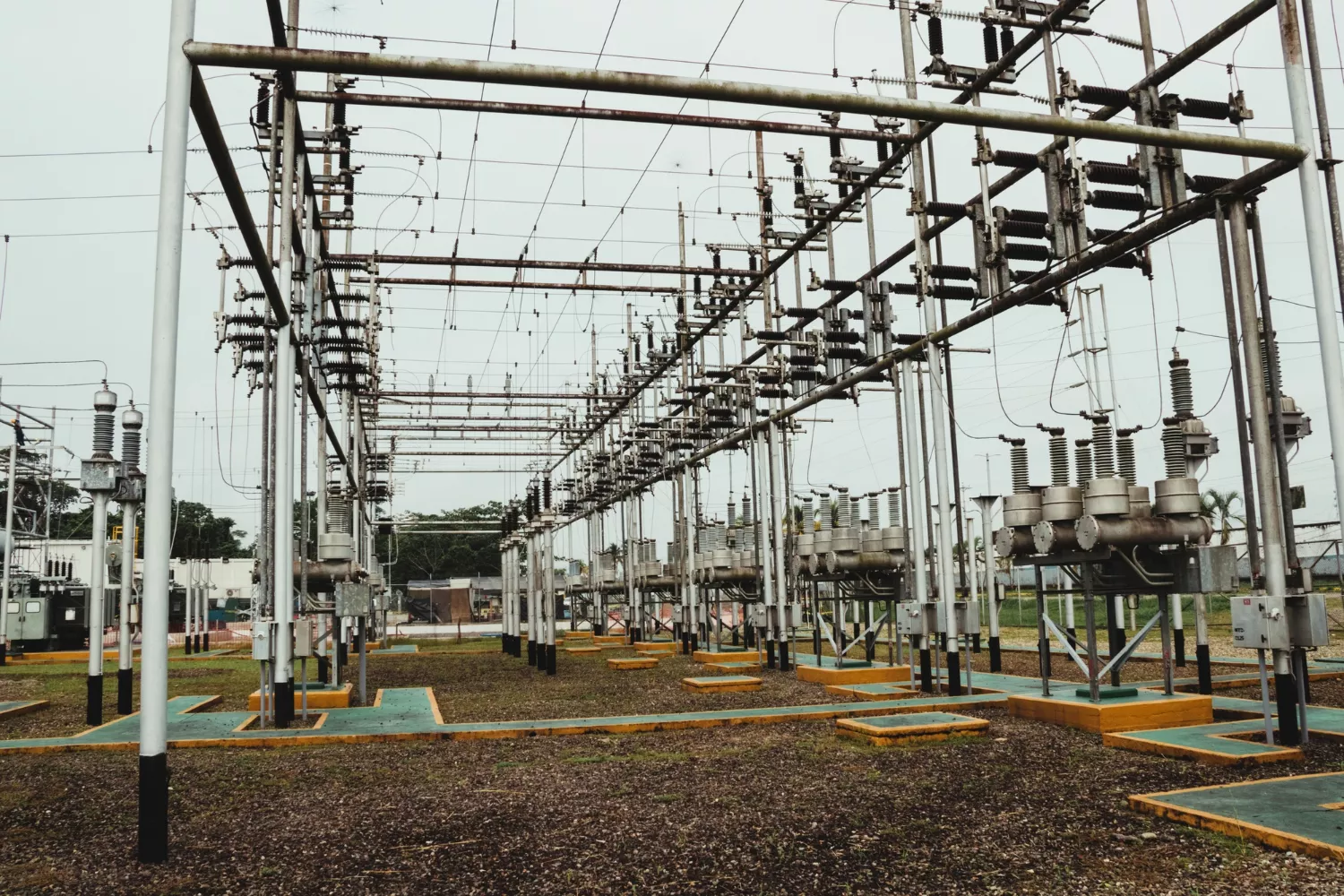
The decision on selecting a medium‑voltage (MV) transformer is usually made at an early stage of the project – when the investor knows the current power demand but rarely has certainty about what the installation will look like in five or ten years. Yet it is the MV transformer, as the heart of the transformer station, that largely determines whether the future expansion of a plant, PV farm, energy storage system or production line will be a simple engineering task or a costly rebuild of the entire power infrastructure. In this article, we answer the most frequently asked questions about selecting an MV transformer with future installation expansion in mind.
What is an MV transformer and what role does it play in an installation?
An MV transformer is a device that transforms voltage from medium level (most often 6, 10, 15 or 20 kV) to low voltage (0.4 kV) for use by consumers in a plant, or conversely – in the case of energy‑generating installations such as photovoltaic farms or energy storage systems (BESS) – steps up the voltage from low to medium level before feeding energy into the distribution grid. The MV transformer is therefore the boundary point between the distribution system operator's (DSO) grid and the consumer's or generator's internal installation.
From the perspective of expansion planning, the MV transformer acts as a bottleneck, it determines the maximum power that the installation can draw or feed into the grid at any given time.
As long as the demand is within the transformer's rated power, expansion mainly involves adding new loads or sources.
When demand exceeds the available power, the transformer must be replaced, an additional station built, or other usually costly modifications made to the power supply system.
How to select the MV transformer power with future expansion in mind?
The selection of MV transformer power should take into account not only the current load but also a realistic, justifiable scenario for the installation's development over the next 10–15 years – the typical service life of this type of device before its first major overhaul or replacement.
In practice, engineers use several approaches:
Analysis of investment plans – if the investor plans to expand the production hall, add a production line, EV charging stations or a PV installation within a few years, the transformer power should immediately account for these scenarios, even if implementation is staged.
Power margin factor – a margin of 20–40% above the current peak load is commonly adopted, although in facilities with dynamic growth (e.g., data centres, industrial plants in expansion), this margin can be higher.
Load character analysis – installations with a large share of non‑linear loads (inverters, variable frequency drives, EV chargers) generate additional harmonic loads, which should be considered at the power selection stage rather than only during modernisation.
Station modularity – transformer stations are increasingly designed so that the foundation, enclosure and MV switchgear bay allow for the future installation of a second transformer operating in parallel, without building a new station from scratch.
Excessive oversizing of the transformer, however, has its drawbacks, which are discussed in the next section.
Is it worth oversizing the MV transformer as a reserve?
This is one of the questions investors ask most often, and the answer is not straightforward. Oversizing an MV transformer – i.e., selecting a power significantly higher than the current demand – has both advantages and significant disadvantages.
Advantages of oversizing:
ability to connect new loads or sources without replacing the transformer,
lower total cost over many years compared to a double investment (buying a smaller transformer and then replacing it),
lower risk of installation downtime during future expansion, as work is limited to connecting new circuits rather than replacing the main device.
Disadvantages of oversizing:
a transformer operating continuously at low load (below 30–40% of rated power) has poorer energy efficiency – no‑load losses (core losses) burden the installation's energy balance regardless of power consumption,
higher investment cost frozen for years until expansion actually takes place,
larger dimensions and weight of the device, which may require a larger station, a stronger foundation and more expensive transport,
in RES installations – possible restrictions or different connection conditions from the DSO if the declared power significantly exceeds the actual demand at start‑up.
The recommended compromise is usually the previously mentioned 20–40% margin and, where possible, designing the station to allow a second transformer to be installed in the future, rather than a one‑time, significant oversizing of the first unit.
What are the costs of underestimating transformer power?
The opposite situation – selecting an MV transformer exactly for current needs, with no margin – also carries risk that only becomes apparent at the expansion stage.
The most common consequences of underestimation include:
the need to replace the transformer along with the associated infrastructure (MV cables, protection devices, sometimes also the MV switchgear if its rated parameters prove insufficient),
installation downtime during replacement, which in production plants means direct financial losses,
extended connection procedure – increasing the connection capacity with the DSO means a new application, new connection conditions, and often also modernisation of the grid infrastructure on the operator's side, which can take many months,
loss of value of the original investment – a transformer that has not yet reached the end of its service life must be dismantled and sold or scrapped, which rarely allows a significant portion of the costs to be recovered,
additional design and administrative costs – a new technical design, renewed consultations with a fire protection expert, updating the as‑built documentation.
In practice, the cost of replacing an MV transformer along with the associated work can be several times higher than the difference in purchase price between a unit selected "on the edge" and one with a reasonable power margin.
How much does it cost to replace an MV transformer with a larger one?
The cost of replacing an MV transformer depends on many variables, so it is difficult to give a universal figure, but it is worth knowing the cost structure to consciously compare it with the cost of appropriate oversizing at the start of the investment.
The total replacement cost typically includes:
the price of the transformer itself (depending on power, type – oil or dry, manufacturer and additional parameters such as connection group or noise level),
the cost of dismantling the old unit and disposing of or reselling the insulating oil (in oil‑immersed transformers),
possible modernisation of the MV and LV switchgear bays if the current parameters of the new unit require it,
the cost of transport and crane – MV transformers weigh from several hundred kilograms to over a dozen tonnes,
design costs, DSO approvals and, in many cases, a fee for increasing the connection capacity,
the cost of production downtime or a break in energy generation during the work.
For this reason, a TCO (Total Cost of Ownership) analysis at the transformer station design stage should consider not only the purchase price but also the probability and cost of any future replacement.
Which MV transformer parameters matter when planning expansion?
Beyond rated power, when planning installation expansion, several additional MV transformer parameters should be considered:
Short‑circuit voltage (uk) – affects voltage drops at high loads and protection selection; with planned expansion, it is worth checking whether the typical uk value will not limit the future connection of additional loads sensitive to voltage fluctuations.
Connection group – important especially for installations with distributed generation (PV, BESS), where incorrect selection can lead to synchronisation problems or protection selectivity after new sources are added.
Tap range (tap changer) – the ability to adjust the ratio within a certain range makes it easier to match the LV voltage as the load profile changes during expansion.
Insulation class and cooling type (ONAN, ONAF, AN, AF) – oil‑immersed transformers with forced cooling (ONAF) can temporarily operate at a power higher than the ONAN rating, which is sometimes used as a "buffer" during the implementation of the target expansion.
Dimensions and weight – if the transformer station is to accommodate a larger unit in the future, adequate space, foundation strength and door and transport route dimensions should be planned at the design stage.
How does the expansion of a photovoltaic installation or energy storage system affect MV transformer selection?
In RES installations and BESS systems, the expansion topic has a slightly different character than in classical industrial plants, because the MV transformer power determines not only the ability to draw energy but primarily the ability to feed it into the grid.
Key issues in this context:
Connection conditions issued by the DSO – the MV transformer's rated power should be consistent with the connection capacity specified in the conditions, while being flexible enough to allow future generation capacity increases without the need to apply for entirely new connection conditions from scratch.
Staged expansion of a PV farm – installations are increasingly being designed with future addition of further panel sections or inverters in mind; an MV transformer selected with adequate reserve avoids replacing the main connection point at each subsequent stage.
Integration of BESS with an existing PV installation – adding energy storage to an already operating PV farm increases the total power that must be transmitted through the MV transformer, especially in the mode of simultaneous storage discharge and panel production.
IRiESD requirements – the Distribution Grid Operation and Maintenance Instructions impose specific technical parameters on sources connected to the MV grid, including voltage and reactive power regulation requirements, which should also be considered when selecting a transformer with future expansion in mind.
What are the differences between oil‑immersed and dry‑type transformers in the context of expansion?
The choice between an oil‑immersed and a dry‑type (cast‑resin) transformer matters not only for current operation but also for the flexibility of future installation expansion.
Oil‑immersed transformers generally offer a better power‑to‑size ratio and lower unit cost at higher powers, making them a popular choice in large‑scale industrial and power installations. However, they require a dedicated oil compartment, a fire protection system and an oil containment basin, which limits flexibility if the station size needs to be increased in the future.
Dry‑type transformers are more often chosen in facilities where fire safety and the ability to install inside buildings close to loads (e.g., production halls, office buildings, data centres) are important. Their disadvantages can be a higher unit cost at high powers and usually slightly greater sensitivity to environmental conditions (humidity, dust), which should be considered at the selection stage when planned expansion is in more difficult industrial conditions.
From a future expansion perspective, good practice is to choose a transformer type consistent with the facility's long‑term development strategy – if expansion towards indoor installations is planned, a dry‑type transformer can facilitate later project stages.
How to plan an MV/LV transformer station for future expansion?
Planning a transformer station with expansion in mind goes beyond the transformer itself and includes the entire associated infrastructure:
Space reserve in the MV switchgear – designing an additional switchgear bay at the station construction stage significantly facilitates later connection of a second transformer or a new outgoing circuit.
Proper selection of supply cables – the cross‑section of MV and LV cables should be selected with the target, not just the initial, installation power in mind, because replacing cable routes can be as costly as replacing the transformer itself.
Foundation and station structure – providing in the building design the possibility of supporting a larger unit or adding another container module.
Protection and control system – protections selected with some setting margin are easier to adapt to increased power than to replace from scratch.
Transport and service access – planning access roads and manoeuvring space for the dimensions of the target, not just the first, transformer.
What formalities must be completed when expanding an installation requiring greater transformer power?
Expansion of an installation involving an increase in MV transformer power usually requires going through several formal stages:
Applying for new or updated connection conditions from the relevant DSO if the planned power exceeds the value specified in the existing connection agreement.
Updating the technical design of the transformer station, including protection selection, selectivity analysis and – if necessary – a short‑circuit analysis for the new parameters.
Fire protection approvals from a fire protection expert, particularly important for oil‑immersed transformers of increased power.
Technical inspections and measurements carried out by authorised entities before the modernised station is put into operation.
Updating the distribution service agreement and, for generation installations, amending the connection agreement with the DSO.
Early planning of these steps – ideally in parallel with the expansion design stage, not after its physical start – avoids delays resulting from the long processing times of applications by grid operators.
How to approach MV transformer selection with future expansion in mind?
Selecting an MV transformer is a decision that in practice goes far beyond the current power balance of the installation. Consciously considering an expansion scenario – whether in the form of additional production lines, a fleet of electric vehicles, PV farm expansion or energy storage integration – avoids a situation where an investment made a few years earlier becomes a barrier to further development.
Important principles worth applying when planning:
select transformer power with a reasonable margin (usually 20–40%), based on real investment plans rather than solely on current demand,
design the transformer station in a modular way, with the possibility of adding another switchgear bay or a second transformer,
analyse not only the purchase price but the full life‑cycle cost (TCO), including the risk and cost of any future replacement,
account for load characteristics – the share of non‑linear loads, planned distributed generation or integration with energy storage,
start the formal procedures with the grid operator early enough, as these most often determine the actual expansion schedule.
A properly planned MV transformer is not merely a device meeting current technical requirements – it is an investment in the flexibility of the entire installation for years to come.
If you have made it this far – respect, because that was a solid chunk of knowledge about a piece of equipment that usually stands quietly in the corner and simply does its job.
At Energeks, we like such topics and we like to talk about them, so if you are planning an installation expansion and are puzzling over MV transformer selection, we will be happy to help calculate and select it with a sensible reserve for the future – without oversizing for every possible eventuality and without underestimations that only hurt two years later.
The full range of MV transformers can be found here,
and if you need a unit ready to go, take a look at our shop with transformers available off‑the‑shelf – sometimes a transformer in stock is better than an ideal one in six months.
We also invite you to follow us on LinkedIn Energeks – no spam, just concrete content from the MV and LV world.
See you on the next project!
Sources:
WAGO Poland, Connection point to the grid – discussion of technical conditions, the role of IRiESD and requirements for MV installations when connecting consumers and generation units (PV, energy storage)
International Electrotechnical Commission (IEC), IEC 60076-7:2018 — Power transformers, Part 7: Loading guide for mineral‑oil‑immersed power transformers
Technical Connection Rules explained via vde.com
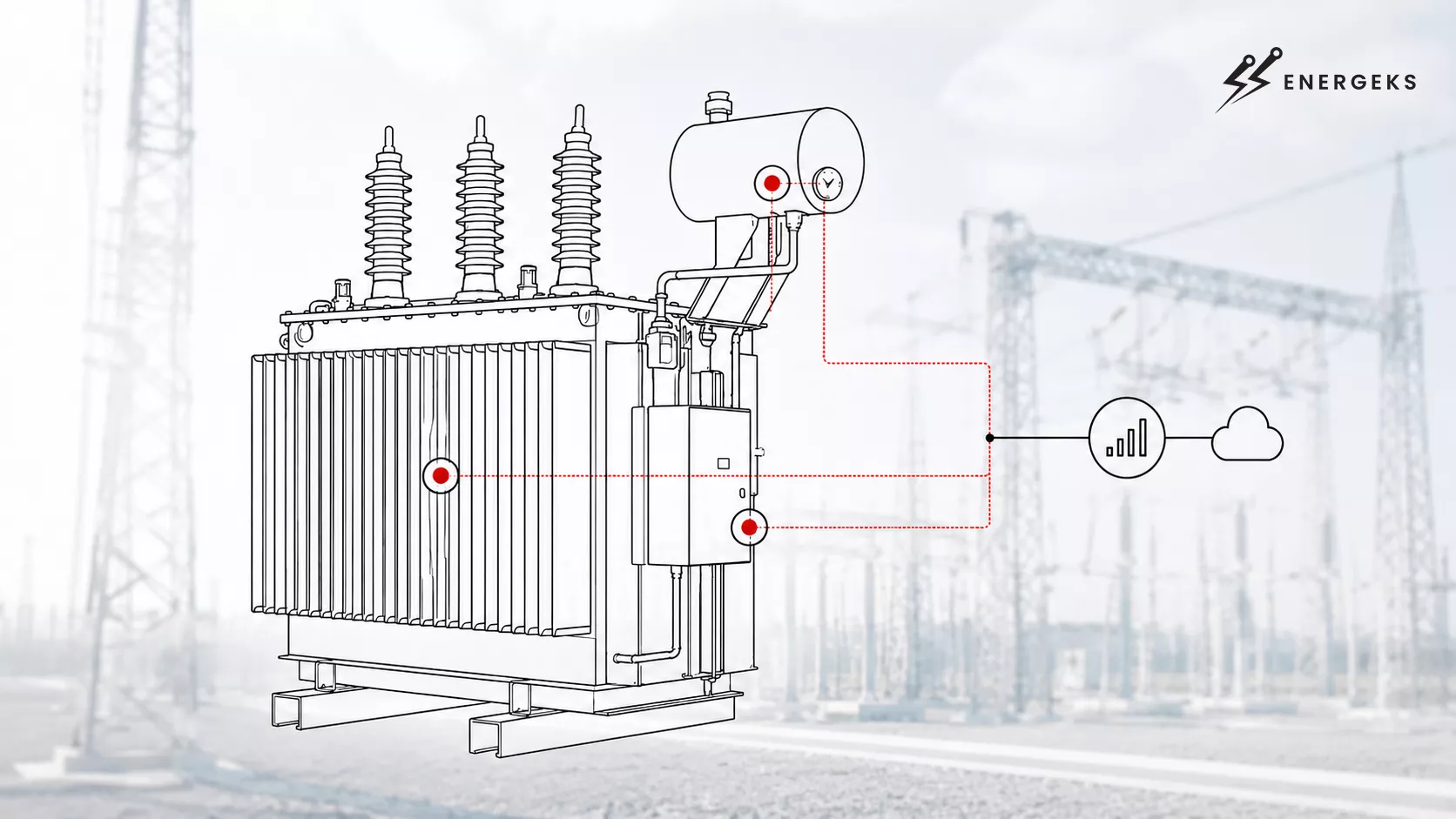
Online transformer monitoring is a solution particularly useful in industrial plants, power substations, photovoltaic farms, data centres and anywhere a transformer failure could stop a critical process. This article shows why to monitor a transformer online, which parameters matter most, and how to approach the topic for an entire fleet of devices. Special attention is given to temperature, moisture and load, because these three areas reveal a great deal about the actual operating conditions of a transformer.
Your transformer can operate for years without drawing particular attention to itself.
It stands in the substation, supplies a plant, a photovoltaic farm, a logistics centre or a bank of chargers.
It emits a characteristic, steady sound, its enclosure remains closed, and the operator checks on it during inspections and maintenance rounds.
Everything seems to be in order.
Inside, however, processes are constantly taking place that are invisible to the naked eye. Insulation ages under the influence of temperature. Load changes depending on the time of day and the nature of the installation's operation. Moisture can migrate between the oil and the cellulose insulation. The cooling system can gradually lose efficiency. A single deviation often does not yet indicate a serious problem, but a repeating trend should already interest those responsible for maintaining the device.
Transformer failure rarely comes out of nowhere. It usually sends warning signals beforehand. They just need to be collected, compared and properly interpreted.
That is what online transformer monitoring is about.
Energeks supplies medium‑voltage transformers – from the perspective of a manufacturer and supplier of energy solutions, we know that handing over a device for operation closes one stage of work.
After that, daily reality begins: variable loads, high ambient temperatures, operation in confined spaces, overloads, and decisions often made under time pressure.
Online transformer monitoring allows continuous tracking of temperature, load, moisture, oil level and other operating parameters. By analysing data in real time, it is possible to detect overloads, overheating, cooling problems and signs of insulation ageing earlier, reducing the risk of failure and unplanned downtime. In this article, we take a closer look at this topic.
Reading time: about 15 minutes.
What does online transformer monitoring mean?
Online transformer monitoring means continuously observing the device during its normal operation. The transformer does not need to be switched off, opened or visited by a technician every time we want to check what is happening with it. Sensors collect data, the system transmits it to the appropriate software, and the operator receives a picture of the device's operation along with history, trends and alarms.
It sounds simple, but in practice it is about much more than displaying a few numbers on a screen.
A transformer operates under changing conditions. In the morning, the load may be low; at midday, the plant starts up additional production lines; in the evening, power consumption drops again. In the case of a photovoltaic farm, the situation depends on insolation. In a logistics centre, the warehouse work rhythm matters, and for electric vehicle charging infrastructure, the load can increase sharply within a few minutes.
At the same time, oil temperature, ambient temperature, current flowing through the windings and the load on the cooling system change. If moisture, dirty radiators, unbalanced phase loading or deteriorating insulation condition are added to this, a single reading ceases to be sufficient. A history of the device's operation is needed.
And that history is what online monitoring creates.
Oil temperature shows how the transformer handles heat
Oil temperature is one of the most important parameters observed in oil‑immersed transformers. The oil insulates the live parts and removes the heat generated during core and winding operation. In short: the transformer produces heat, and the oil helps to carry it out of the device.
If the transformer operates under higher load, losses increase and oil temperature begins to rise. The phenomenon itself is completely normal. Concern arises when the temperature rises too quickly, persists for a long time, or reaches higher values than previously at similar operating conditions.
Let us imagine a transformer that operated for several months at a 70% load and maintained an oil temperature of around 55–60°C. If, after some time, at the same load, the temperature starts to reach 68–70°C, the system gives the maintenance team a very clear signal. The cause could be a dirty radiator, restricted oil flow, a fan problem, higher ambient temperature or changed installation conditions.
Without a history, such a reading is just a number. With a history, it becomes diagnostic information.
The duration of elevated temperature is also important. A fifteen‑minute load peak and eight hours of operation at high temperature have completely different implications for the insulation. Monitoring records both events and allows the actual operating profile to be reconstructed.
Winding temperature and the hottest point
Oil temperature says a lot about the conditions inside the tank, but it does not always show the hottest point in the transformer. Local areas of higher temperature, known as the hottest point, can occur in the windings.
The temperature of the hottest point is of great importance for assessing insulation ageing. Insulation materials do not age uniformly throughout the device. The most thermally stressed sections operate under more difficult conditions than areas where the temperature remains lower.
Depending on the transformer construction, the winding temperature or hottest point can be measured directly or determined based on oil temperature, load current and the device's thermal model. In both cases, the system needs data from several areas for the interpretation to make sense.
If the oil temperature looks correct but the model indicates an unusually high hottest‑point temperature, the team can check the load distribution, cooling condition and operating conditions. Such information is particularly valuable for devices operating close to their rated power limit.
The transformer does not have to trip immediately due to elevated temperature. However, the insulation can age faster, and subsequent overloads will gradually reduce the safety margin. Monitoring allows this process to be observed, rather than learning about it only after a failure.
Ambient temperature gives readings the right context
Ambient temperature may seem like a secondary parameter. In reality, without it, it is difficult to properly assess the cooling system's performance.
A transformer operating at an ambient temperature of 12°C has completely different heat dissipation conditions than a device located in a hot hall or container where the temperature exceeds 35°C. The same oil temperature can mean normal operation in one case and thermal overload in another.
High ambient temperature reduces cooling capacity. If the transformer is additionally located in a room with limited ventilation, heat can accumulate around the tank. Under such conditions, the device will heat up faster and return to its steady temperature more slowly.
Combining ambient temperature with oil temperature and load allows an assessment of whether the transformer's response is adequate to the conditions. The system can also capture seasonal changes. In summer, temperatures will be higher, in winter lower, but the device should behave according to a predictable pattern.
Current and voltage show the actual electrical conditions
Current monitoring allows checking how much energy is actually flowing through the transformer. The design documentation shows the rated power and expected operating conditions. Only operational measurements show what daily operation looks like.
Current can change very quickly. In a production plant, it increases when machines and production lines start up. In an installation with many inverters, it depends on energy production and load operation. In electric vehicle charging infrastructure, several simultaneous charging sessions can cause a short but intense peak.
The system records such events and allows determining whether they occur sporadically or repeat every day.
Voltage provides further information. Its fluctuations, asymmetry or unusual values may indicate problems in the grid, incorrect load configuration or conditions affecting the transformer load. When analysing voltage, power quality, harmonics and short‑term disturbances can also be considered.
Not every installation requires such an extensive power quality analysis. In the case of a plant with many drives, rectifiers, inverters and converters, however, such a measurement range can provide very important information about the transformer load.
Active and reactive power help understand the load character
Current alone tells you how much energy is flowing through the device. Active and reactive power help understand how that energy is being used.
Active power is responsible for the actual work of the loads: driving motors, powering machines, lighting, heating or charging batteries. Reactive power is associated, among other things, with the operation of inductive and capacitive devices. It does not perform useful work in the same way as active power, but it affects the current flowing in the installation and the transformer load.
In a plant, it may turn out that active power remains at a moderate level, but reactive power is high. The transformer must then conduct a higher current, which translates into losses and heating.
Monitoring allows these relationships to be observed over time. It can be checked whether specific devices or processes cause an increase in reactive power, whether the problem appears at a particular time, and whether compensation measures bring the expected effect.
Power factor shows how efficiently the infrastructure is being used
The power factor, denoted as cos φ, describes the relationship between active power and apparent power. The lower its value, the greater the share of reactive power in the total electrical load.
A high power factor means more favourable utilisation of the transformer's available capacity. A low power factor can cause current to increase, losses to rise and the available load margin to be reduced.
For a fleet operator, cos φ data can be useful when comparing locations. One plant may draw a similar active power to another, yet load its transformer more heavily due to a higher share of reactive power.
This type of information helps in making decisions regarding reactive power compensation, load distribution and future installation expansion planning.
Load imbalance between phases
In an ideal world, each phase would be loaded evenly. In real installations, however, loads are distributed differently, some operate cyclically, and some start up independently.
If one phase is significantly more loaded than the others, uneven heating and worsening operating conditions can occur. Long‑term asymmetry also affects voltage quality and can be a signal of a problem on the load side.
Monitoring each phase allows you to see whether the imbalance is temporary or permanent. In the first case, it may result from a normal work cycle. In the second, it is worth checking the load distribution, installation configuration and devices connected to individual phases.
This is particularly important in large plants where load changes with the operation of many independent loads.
Oil level and system tightness
In an oil‑immersed transformer, the oil level is directly related to insulation safety and cooling. A drop in level may result from a leak in the tank, pipes, bushings, radiators or the conservator system.
A small change does not always mean an immediate threat. If the level gradually drops over several weeks, the system can help determine the rate of loss. If the drop is sudden, the alarm should prompt a rapid inspection.
The influence of temperature is also important. Oil changes volume with temperature, so its level can naturally differ depending on operating conditions. Monitoring allows the oil level to be correlated with temperature and distinguishes normal volume change from a potential leak.
For transformers equipped with a conservator, level indicators and the breathing system play an additional role. Data from these elements can complement the picture and help assess whether the device is behaving correctly.
Moisture in oil and insulation
Moisture has a significant impact on the condition of a transformer's insulation system. It can accelerate paper ageing, reduce the dielectric strength of the oil and affect the device's behaviour under higher load.
Sources of moisture can include leaks, the breathing system, seals, transport conditions, storage and servicing. Water can also migrate between the oil and the cellulosic materials inside the transformer.
Interpreting the measurement requires taking temperature into account. Moisture is not distributed in the insulation in a completely static way. When temperature and load change, the equilibrium conditions between oil and paper also change.
Therefore, moisture monitoring is most valuable when data is analysed together with oil temperature, hottest‑point temperature and load. Then it is possible to observe whether the moisture level is stable, increasing, reacting to overloads or showing seasonal changes.
Gases dissolved in the oil
Gases dissolved in the oil are produced by processes occurring inside the transformer. Their presence does not always mean a serious fault, but specific gases and their rate of increase can indicate overheating, partial discharges, cellulose degradation or arcing.
DGA analysis can be performed in a laboratory based on oil samples. For transformers of high power or high criticality, an online analyser can be used to continuously monitor selected gases.
Such a system does not replace the laboratory or the engineer's experience. It does, however, provide information between successive tests. If the concentration of a particular gas starts to rise faster than before, the operator can plan additional testing, load reduction or device inspection.
In transformer diagnostics, the rate of change is of great importance. A single result can be difficult to interpret. A series of results showing a clear trend tells much more.
Fan and pump condition
The cooling system may have a very good design and adequate capacity, but its effectiveness depends on the actual operation of fans, pumps, thermostats, controllers and the power supply system.
Monitoring can show when fans were started, how long they have been running and whether the temperature changes as expected. If the fans run for a long time and the oil temperature continues to rise, the causes should be sought more broadly. There may be a problem with airflow, a dirty radiator, an oil pump or a sensor.
For a fleet of transformers, comparing cooling operation can be very interesting. If one transformer, at a similar load, starts its fans significantly more often than the others, the system shows a difference worth investigating.
Vibration and unusual noise
A transformer emits a characteristic sound related, among other things, to core operation, magnetostriction and load current. A change in noise or the appearance of unusual vibrations may indicate mechanical problems, loose elements, a change in core operation or abnormalities in the windings.
Noise alone is difficult to assess solely on the basis of subjective human perception. One operator may say the transformer "is humming a bit louder", another may consider everything normal. Vibration sensors and frequency analysis allow the current signal to be compared with previous measurements.
Not every change in sound means damage. What counts is repeatability, the direction of the change and consistency with other parameters.
Partial discharges
Partial discharges are local electrical phenomena occurring where the insulation is not working correctly. They may be associated with voids, contamination, damage to the insulating material or local overstressing of the electric field.
Their detection requires appropriately selected sensors and advanced interpretation. Partial discharge monitoring is used primarily for devices of high value, great importance to the system or with an increased risk of failure.
Early detection of such phenomena allows more detailed diagnostics and planning of actions. For a transformer supplying a critical industrial process, this can determine whether a shutdown takes place during scheduled downtime or in the middle of normal production.
Protection alarms and event history
Monitoring should also record alarms and protection operations. The information that an alarm is active is important, but the history is even more valuable.
It is possible to check whether the alarm appears for the first time or has been recurring for several months. It can be correlated with temperature, load and cooling status. It can be seen whether, after a specific event, the parameters returned to their previous level.
Thanks to this, every event is recorded and can be used in subsequent analyses. The device's memory does not depend on whether someone happened to be on site and wrote down the result in a notebook.
The scope of monitoring should match the actual risk
Not every transformer needs an extensive system with gas analysis, vibration and partial discharge monitoring.
A small distribution transformer working in an easily accessible hall may require monitoring of temperature, load and basic alarms. For a larger unit supplying a production line, oil level, cooling status and trend analysis should be added. A transformer operating in a hospital, data centre, steelworks or large power substation may require a much wider diagnostic scope.
The device's power, age, operating history, load character, reserve availability, delivery time for a new transformer, environmental conditions and the cost of downtime should all be considered.
For a fleet, a tiered model is particularly useful. The most important devices receive extensive monitoring, while the others are observed using a basic set of parameters. All data, however, goes to a common system, allowing comparison of individual units and quick identification of devices behaving differently from the rest.
Online monitoring makes sense when the data leads to action. The operator should know what an alarm means, who analyses it and what steps to take. Then the sensors, communication and software form a practical maintenance tool, rather than another tab in a system that no one looks at.
Why are transformer protections not enough?
Protections are essential.
They protect the transformer and the installation in situations where continued operation could lead to serious damage. They respond to specific fault conditions: short circuits, overloads, excessive temperature, oil level drop or other dangerous phenomena.
Their action is of an interventionist nature.
Monitoring provides a broader picture.
It records operating conditions before, during and after an alarm. It shows not only that the temperature exceeded a certain level, but also whether similar events have occurred over recent weeks. It can be checked at what load the problem appears, how quickly the temperature rises and whether the cooling system responds correctly.
A transformer can operate for a long time under conditions that do not immediately trigger a protection. Regular overloads, insufficient cooling or elevated moisture can gradually degrade the insulation. The device still supplies the loads, but its safety margin becomes smaller and smaller.
These are precisely the processes that are particularly important from the point of view of online monitoring. They allow a response to a change in the device's behaviour before the situation reaches a level requiring emergency shutdown.
How does temperature affect transformer operation?
Temperature is one of the easiest parameters to measure and one of the most useful diagnostic indicators.
In an oil‑immersed transformer, the oil insulates the windings and removes heat from them. Energy lost in the core and windings is converted into heat, which must be transferred to the surroundings. At higher load, losses increase and temperature rises with them.
The temperature rise itself during higher load is a natural phenomenon. What matters is how the device responds to changing conditions.
Suppose the transformer on Monday operated at 70% load and the oil temperature stabilised at 58°C. A week later, at a similar load, the temperature rose to 66°C. This does not yet mean a failure, but it is information that requires checking. The cause could be higher ambient temperature, a dirty radiator, restricted oil flow, a fan problem or changed installation conditions.
Monitoring allows the following to be correlated:
load,
oil temperature,
ambient temperature,
duration of elevated temperature,
cooling system status,
history of previous measurements.
Such a data set gives a much more complete picture than a single reading taken during a technician's visit.
High temperature accelerates insulation ageing. Every transformer has specified operating conditions, but long‑term operation at elevated temperature can shorten its actual life. Therefore, the system should also record the duration of load and temperature. A short‑term load peak and many hours of operation at high temperature have different implications for the device.
Is winding temperature monitoring more important than oil temperature?
Both measurements are needed because they show different elements of the same process.
Oil temperature indicates the thermal conditions in the tank. Winding temperature or the calculated hottest‑point temperature allows better assessment of the insulation load and local heating.
In many transformers, the hottest‑point temperature is not measured directly. It is determined based on oil temperature, load current, device characteristics and a thermal model. In more advanced systems, additional sensors or solutions for more accurate winding condition assessment can be used.
The hottest point is particularly important because the local temperature can be higher than the value read elsewhere in the tank. It is in the hottest fragments that insulation ages faster.
If the monitoring system knows the oil temperature, load and ambient conditions, it can assess whether the current operation is within the expected thermal profile. A deviation from this profile may indicate a change in cooling efficiency, a mechanical problem or an unusual load distribution.
How does load affect the transformer?
A transformer operates under conditions that can change very dynamically.
In a production plant, load increases when machines are started. In an automated warehouse, it depends on the intensity of transport system operation. In a facility with car chargers, power consumption can change depending on the number of vehicles charging simultaneously. On a photovoltaic farm, load and energy flow depend on inverter production and grid configuration.
Design assumptions about average power consumption may look reasonable on paper, but actual operation can bring a completely different profile.
Load monitoring shows:
when peaks occur,
how long they last,
how often they repeat,
whether the load is balanced between phases,
how the transformer responds thermally,
whether seasonal overloads appear.
For example, a transformer may have an average load of 65%, yet operate at 105% for two hours every day. The daily average looks safe, but the recurring peaks affect temperature and insulation ageing.
An additional issue is phase asymmetry. Uneven loading can lead to local temperature rises and worsen operating conditions. Monitoring each phase allows you to see that the problem concerns a specific part of the installation, not the entire transformer.
Why is moisture in a transformer so important?
Moisture affects the oil, paper insulation and the overall strength of the insulation system.
It can enter the transformer through leaks, the breathing system, damaged seals, incorrectly performed service work or improper transport and storage conditions. Water can also be generated or migrate within the insulating materials during operation.
Cellulosic insulation absorbs moisture. Its presence can accelerate paper degradation, reduce the dielectric strength of the oil and increase the risk of adverse phenomena during overload. At high temperature and with the right moisture concentration, the risk of gas bubble formation in the oil can also arise.
Moisture does not behave in a completely static way in a transformer. Its distribution depends on temperature, load, oil type and insulation condition. Water can migrate between oil and paper. The result of a sample taken at one moment does not always reflect the full state of the entire insulation system.
Therefore, moisture monitoring should be analysed together with temperature and load. Only then can it be seen whether a particular change is a permanent trend, a reaction to a change in operating conditions or the result of a measurement error.
CIGRE indicates that when interpreting moisture, factors such as oil temperature, hottest‑point temperature, load, cooling mode and breathing system type should be considered. This approach allows better assessment of insulation ageing and overload risk.
You may also be interested in this topic:
Water vapour condensation in a transformer tank. The silent killer in winter.
How are dissolved gases in the oil analysed?
Gases can accumulate in transformer oil as a result of processes occurring inside the device. Their type, concentration and rate of increase provide information about potential problems.
DGA analysis includes, among others, hydrogen, methane, ethane, ethylene, acetylene, carbon monoxide and carbon dioxide. Individual gases can be associated with oil overheating, cellulose degradation, partial discharges or arcing.
Traditional laboratory analysis involves periodic oil sampling. This is an important diagnostic method and remains the basis of many transformer maintenance procedures. Online monitoring allows changes between laboratory tests to be observed.
For a large transformer operating in a critical installation, continuous gas analysis can be particularly important. A rapid increase in a specific component can trigger additional inspection, sampling, load reduction or planned shutdown preparation.
DGA requires expert interpretation. It is not enough to look at one number and decide to replace the device immediately. The history, rate of change, gas ratios, laboratory results, temperature, load and other symptoms are analysed.
Gas laws in DGA: 5 physical rules that warn you before a transformer failure occurs
How does a transformer monitoring system work?
A monitoring system consists of several cooperating layers.
The first is the sensors. They record temperature, current, voltage, moisture, oil level, gases or vibration.
The second layer is responsible for data collection and transmission. A communication module or industrial gateway can perform preliminary processing of measurements, filter interference, store data locally and transmit it to the supervisory system. Depending on the infrastructure, Ethernet, Modbus TCP, MQTT, cellular network or integration with a SCADA system are used.
The third layer covers analysis. The software compares values with alarm levels, tracks trends and can detect deviations from the typical behaviour of a specific device.
The fourth layer is for presentation and alarm handling. The operator can receive information on a panel, by email, SMS or in an application. For distributed installations, remote access is particularly important.
The greatest value comes from a system that delivers information understandable to the maintenance team. An alarm should indicate the device, the parameter, the time the problem started, the rate of change and the urgency level.
1. Sensors and measurements
The first layer of the system is located directly at the transformer. Sensors record its key operating parameters: oil and winding temperature, current, voltage, load, moisture, oil level, dissolved gases and vibrations. This is where the data reflecting the actual condition of the equipment is generated.
2. Data collection and transmission
The collected measurements are sent to a communication module or industrial gateway. The device can initially filter out interference, store data locally and transmit it via Ethernet, Modbus TCP, MQTT, a cellular network or an existing SCADA system.
3. Analysis and interpretation
In the third layer, the data begins to provide meaningful information. The software compares current readings with alarm thresholds, analyses trends and checks whether the transformer is behaving in the same way as before. The system can detect a gradual rise in temperature, unusual loading or a change in parameters that has not yet exceeded the alarm threshold.
4. Presentation and response
The final layer delivers the information to the operator. Results can be displayed in a dashboard, application or SCADA system, or sent by email, SMS or push notification. An effective alarm identifies the specific unit and parameter, the moment the issue began, the rate of change and the level of urgency. This allows the team to determine whether observation is sufficient, additional diagnostics are required or immediate action must be taken.
Does online monitoring make sense for an entire fleet of transformers?
For a larger number of devices, online monitoring helps organise a huge amount of information.
For a single transformer, regular rounds, oil tests, thermography and inspections can provide sufficient control. For a dozen or several dozen units, the risk increases that the team will miss a change developing between visits.
The fleet may be dispersed across plants, substations, PV farms and charging points. Each transformer may have a different power, age, operating history and process significance. A central system allows information to be gathered in one place.
The operator can check the condition of the entire fleet and then go to a selected location and specific device. It is possible to compare transformers of similar power and construction. It is visible which devices have the most alarms, which operate closest to the load limit and where the temperature rises faster than in comparable units.
Such a system also helps to identify problems common to several devices. If transformers from the same location have similar temperature profiles, the cause may be the ventilation method, ambient temperature or installation conditions. If only one unit behaves differently, its individual technical condition is more likely to be the issue.
Does online monitoring make sense for an entire fleet of transformers?
For a larger number of devices, online monitoring helps organise a huge amount of information.
For a single transformer, regular rounds, oil tests, thermography and inspections can provide sufficient control. For a dozen or several dozen units, the risk increases that the team will miss a change developing between visits.
The fleet may be dispersed across plants, substations, PV farms and charging points. Each transformer may have a different power, age, operating history and process significance. A central system allows information to be gathered in one place.
The operator can check the condition of the entire fleet and then go to a selected location and specific device. It is possible to compare transformers of similar power and construction. It is visible which devices have the most alarms, which operate closest to the load limit and where the temperature rises faster than in comparable units.
Such a system also helps to identify problems common to several devices. If transformers from the same location have similar temperature profiles, the cause may be the ventilation method, ambient temperature or installation conditions. If only one unit behaves differently, its individual technical condition is more likely to be the issue.
How to design monitoring for a transformer fleet?
Fleet monitoring begins with a simple question: which devices really require constant attention, and which can operate calmly under basic supervision?
Because if we connect all possible sensors to every transformer, we will create an impressive amount of data. But what good is it if the operator has to look at hundreds of charts every day, most of which change nothing? The monitoring system is meant to help make decisions, not to give the maintenance team a digital marathon through dashboards.
A well‑designed fleet monitoring system should correspond to the infrastructure management structure. The person responsible for the entire energy asset needs a different view than a technician analysing a specific transformer. One looks at the whole map, the other looks into the details of a specific device.
Three levels of information
At the highest level, the manager should see the entire fleet quickly and clearly. How many transformers are operating correctly? Where have active alarms appeared? Which locations require a response? Does the problem concern one device, or perhaps several transformers operating under similar conditions?
Such a view should not resemble the cockpit of an aircraft preparing for a Mars landing. A clear location map, device status, number of alarms, urgency level and information on which units deviate from their typical behaviour are enough.
If ninety‑nine transformers are operating stably and one has been showing elevated temperature at similar load for several days, the system should bring that information to the foreground. The operator should not have to search for it among hundreds of green indicators. Green is pleasant, but in excess it can effectively hide a small red problem.
The second level concerns a specific substation, plant or location. Here, the mutual operation of several devices matters. Their load, temperatures, cooling system activity and alarm history can be compared. Such a view helps to see whether the load is distributed evenly and whether one transformer is not taking on too much of the work.
For example: three transformers in a plant operate at a similar ambient temperature. Two maintain an oil temperature of 55°C, and the third reaches 68°C at a similar load. This is not yet a ready technical verdict, but it is a very good reason to check the cooling, airflow, radiator dirt, sensor readings and actual operating conditions.
At the third level is the specific transformer. Here, details are needed: temperature, current and load charts, oil level data, moisture, fan operation, oil test results, inspection information, reported faults and a history of actions taken.
A technician should be able to check not only that an alarm occurred, but also when it started, how long it lasted and what was happening with the device at the same time. An alarm without context resembles a message: "something is wrong." The history already allows a specific question: what exactly changed and what could have caused that change?
First criticality, then sensors
Before selecting the scope of monitoring, a criticality analysis of each transformer should be performed. It sounds very formal, but in practice it is about determining how much a given unit can make life difficult for the company if it suddenly stops working.
Does the transformer supply one hall or an entire production line? Will its failure stop a technological process, a server room, a cooling system or charging infrastructure? Is there a backup transformer? How long would it take to deliver a new device? Can it be brought in without rebuilding the foundation and the entire installation?
Location should also be considered. A transformer located at a plant with 24/7 service availability is in a different situation than a device operating at a remote photovoltaic farm, in difficult terrain or in a substation that requires planning and outages to access.
History also matters. If the device previously had problems with temperature, moisture, leaks, the tap changer or the cooling system, it should not be treated the same as a new transformer that has been operating stably for years.
Add to this the cost of downtime. In one place, an hour‑long interruption means a few phone calls and a shift in the work plan. In another, it can mean production stoppage, loss of a batch of material, interruption of energy supplies or the need to start expensive backup power.
Not every transformer needs the same monitoring
After the criticality analysis, transformers can be divided into several groups.
The most important units receive extensive monitoring. For them, observation of oil and hottest‑point temperature, load, oil level, moisture, cooling status and protection alarms can be justified, and with sufficiently high power, also dissolved gases, vibration or partial discharges.
The second group includes devices important to the process but with partial reserve or easier service access. Here, monitoring of temperature, current, voltage, load, basic alarms and cooling operation may be reasonable. If the data shows a worrying trend, diagnostics can be expanded or additional tests planned.
The third group consists of units of lower criticality, operating under predictable conditions and easily accessible to personnel. In such cases, basic parameter monitoring, an alarm register and periodic trend analysis are often sufficient.
This approach helps avoid two extremes. The first involves equipping every transformer with the entire diagnostic catalogue, even though no one subsequently analyses the data obtained. The second reduces monitoring to a single indicator that lights up green for five years until one day it goes out together with the transformer.
Comparison matters, not just the number
For a fleet, the ability to compare devices is particularly valuable. A transformer should not be evaluated solely by a single universal limit. It is worth checking how it behaves relative to its own history and relative to similar units.
If all transformers in a given group respond similarly to a rise in ambient temperature, we are probably dealing with a normal phenomenon. If one of them starts heating up faster than the others, the situation is different.
The same applies to alarms. Two devices may have five alarms per month, but in one case they will be short warnings related to a temporary load peak, and in the other, repeating signals about rising temperature and cooling problems. The number of alarms alone is not enough. Their context, duration and correlation with other parameters are needed.
Monitoring must end with a decision
The best monitoring system is not the one that shows the most data. It is the one that helps decide what to do next.
An alarm should have a defined urgency level. For an informational signal, recording the event and observing the trend is sufficient. A warning may require analysis by the maintenance team or planning an additional measurement. A critical alarm should trigger a clearly defined procedure: load reduction, on‑site inspection, preparation for shutdown or switching to reserve.
Each alarm should indicate the specific device, the parameter, the time the problem started, the rate of change and the conditions under which it occurred. It is good if the system also suggests what actions were taken previously and whether a similar situation has occurred in the past.
Transformer fleet monitoring should therefore work like a well‑organised team. At the top, it shows a picture of the entire infrastructure. Lower down, it allows analysis of a specific substation. At the end, it leads the technician to one device, one trend and one decision.
Does online monitoring replace inspections and oil testing?
Online monitoring should work alongside existing diagnostic methods.
Visual inspection allows assessment of the tank, connections, bushings, radiators, valves and seals. Thermography shows the temperature distribution on the device surface. Oil tests provide information about its properties, water content, dielectric strength and dissolved gases. Electrical measurements allow assessment of selected elements of the insulation system.
A temperature sensor will not replace visual inspection. A monitoring platform will not perform a connection assessment for the technician. Online DGA does not eliminate the need for laboratory tests, especially when a worrying change appears.
The best results come from combining current data with documentation, the device's history and inspection results. Then it is possible to determine whether the current deviation is something new or has been recurring for some time.
How to implement transformer monitoring step by step
First, it must be determined what problem the system is intended to solve. In one plant, the most important factor will be overload control. In another, remote observation of dispersed devices will be a priority. For a large grid transformer, dissolved gases, moisture and hottest‑point temperature may be relevant.
Next, sensors, communication methods and the extent of integration with the existing automation system are selected. At this stage, it is worth checking which signals are already available and which require additional instrumentation.
After commissioning, the system should collect baseline data. A few weeks of normal operation help establish the typical temperature, load and cooling profile. Only on this basis can alarms be properly tuned.
The next element is the response procedure. Each alarm should have an assigned responsible person and a defined course of action. The team should know when observation is sufficient, when an additional test is needed and when the load should be reduced or a shutdown prepared.
A monitoring system without a response procedure remains merely a source of data. Its value appears when the data leads to a specific operational decision.
Is online transformer monitoring cost‑effective?
Cost‑effectiveness depends on the relationship between the implementation cost and the consequences of a failure.
Downtime can mean production stoppage, loss of energy sales opportunities, problems with contract fulfilment, costs of renting a replacement transformer, transport, service work and restarting the installation.
Monitoring is particularly well justified for transformers:
supplying critical processes,
operating under high or variable load,
located in difficult‑to‑access locations,
belonging to a dispersed fleet,
whose replacement involves a long delivery time,
with a history of faults,
lacking a backup unit.
For a smaller transformer of low criticality, basic temperature, current and alarm monitoring may be sufficient. For a large device operating in a key substation, the diagnostic scope will be much wider.
The best basis for a decision is a risk analysis. The price of the system should be compared with the value of the protected process and the possible cost of downtime.
Which parameters to monitor first?
For most installations, a good starting point is temperature, load and cooling system status.
Temperature shows the thermal operating conditions of the transformer. Load explains what these conditions result from. The status of fans, pumps and other cooling elements allows assessment of whether the device is properly dissipating heat.
For oil‑immersed transformers, oil level and moisture monitoring should also be considered. For units of high power or criticality, online DGA, partial discharge measurement and vibration analysis may be justified.
The choice should result from the device's construction, operating method and the consequences of a potential failure. Each additional function makes sense when the data will be used in the maintenance process.
What is worth remembering?
Online transformer monitoring provides the ability to observe the device during actual operation. It shows temperature, load, moisture and other parameters over time, making it possible to identify trends and respond to changes early enough.
For a single transformer, the system helps organise diagnostics and reduce the risk of missing a problem. For an entire fleet, it becomes an energy asset management tool. It facilitates comparing units, setting priorities, planning inspections and making decisions about further operation.
A transformer can operate correctly for many years, but its condition changes with temperature, load, moisture and environmental conditions. The more we know about these changes, the easier it is to plan service, reduce downtime and use the device safely.
Energeks supplies oil‑immersed and cast‑resin transformers, selected for the actual load, operating conditions and installation significance. When choosing a device, requirements regarding cooling, resistance to moisture and dust, fire safety, noise level, available space and the planned monitoring system can be taken into account.
If you are interested in solutions available off‑the‑shelf, explore the range of transformers currently in stock at Energeks.
Also join us on LinkedIn, where we are building a community of power engineering enthusiasts and professionals. Thank you and see you there!
Sources:
CIGRE – Online moisture monitoring of transformers for ageing assessment
IEC – The Establishment and Design of Standard for Condition Monitoring in Power Systems
Hitachi Energy – TXpert Ready CoreSense M10 online DGA analyzer
Transformers in stock
Shipped from our warehouse in Poland within 2–3 working days, 5-year warranty. Full range 25–2500 kVA in the shop (prices in PLN).
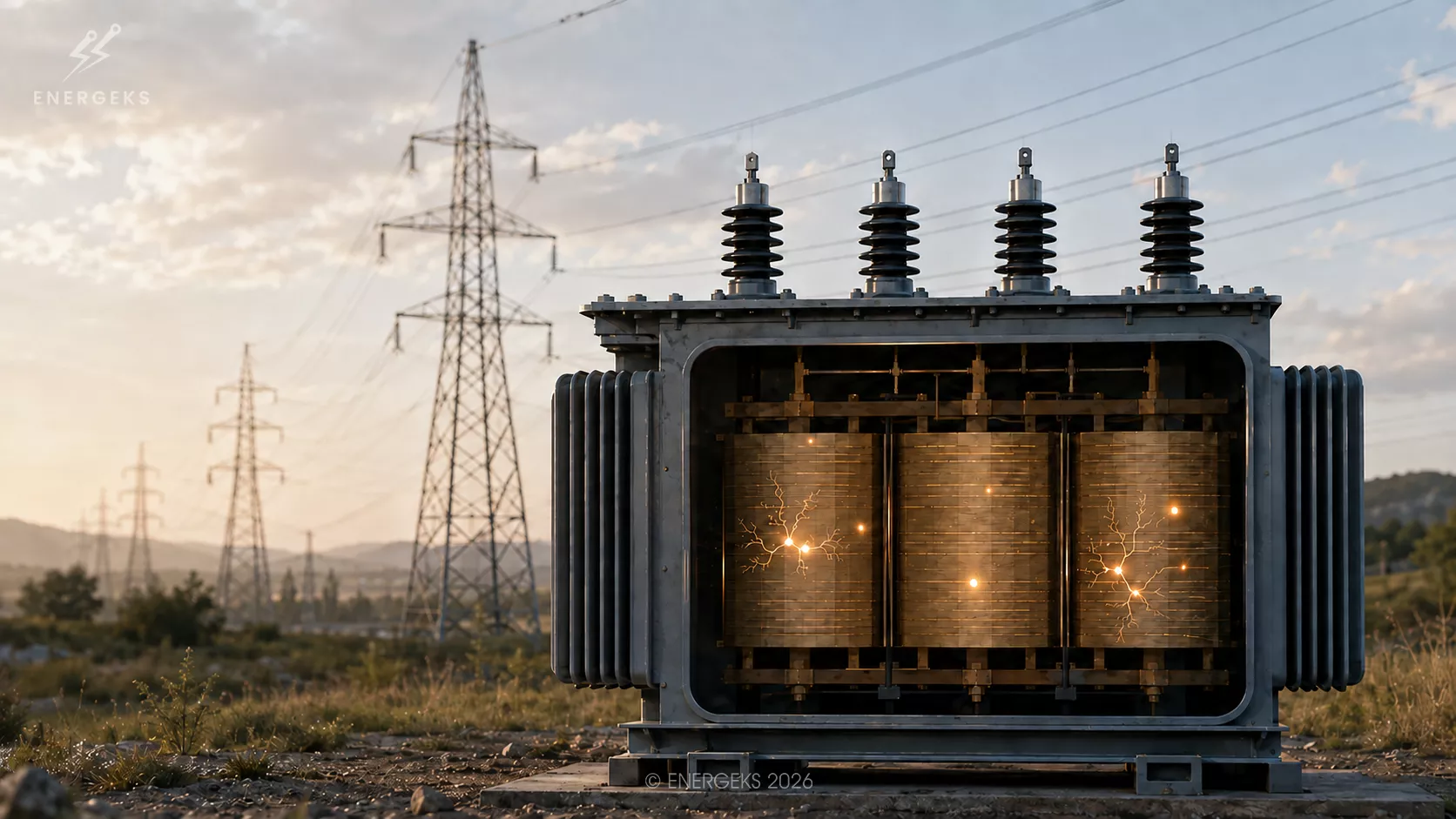
In this article, we explain what partial discharges are, why they occur, what symptoms they can cause, and how they are measured. We will also show why the value in picocoulombs alone is not enough to assess risk.
The light works.
The fridge cools.
The kettle boils water.
Nothing sparks, nothing smokes, no one runs for a fire extinguisher.
You could assume everything is fine.
Now imagine that in one socket, a very small, almost imperceptible sparking appears. Not every time. Sometimes under a higher load.
Sometimes when it is humid in the flat. Sometimes only for a fraction of a second.
Would you still assume there is no problem?
Probably not.
In a transformer, partial discharges—known as PD—can play a similar role. They are small, short-lived and often invisible during a standard inspection.
They do not immediately cause a spectacular breakdown or an instant trip of the device.
Instead, they gradually weaken the insulation.
A bit like a leak in a roof. One drop will not destroy the building. But if it drips every day for many months, the structure starts to soak. Moisture appears, mould, material damage and an increasingly large repair bill.
With partial discharges it is similar. A single pulse does not necessarily mean disaster. Repeated pulses, however, can indicate that a small, invisible degradation mechanism is at work inside the transformer.
And that is precisely why PD is worth detecting while the transformer is still running.
This material is intended for those responsible for maintaining transformers, transformer stations, switchgear and industrial installations. It will also be useful for designers, investors and anyone who wants to better understand what is happening in the insulation of high‑ and medium‑voltage equipment.
After reading, it will be easier to answer the questions:
Is every PD a failure?
Which symptoms should raise concern?
What is the difference between offline measurement and online monitoring?
Why does oil analysis not replace PD measurement?
How to distinguish a real discharge from interference?
What to do when results start to deteriorate?
Reading time: about 9 minutes.
Partial discharge – a small spark with great potential
A transformer works thanks to the controlled flow of energy between the windings. The insulation separates elements at different potentials and ensures that current flows where it should.
Under ideal conditions, the electric field is evenly distributed. The insulation retains its properties and the device operates without unwanted phenomena.
Reality is less elegant.
In the insulating material, there may be small gas voids. Delaminations, micro‑cracks, contamination or areas of incorrect geometry can appear. Sometimes the problem arises from ageing, moisture, mechanical stress or unfavourable operating conditions.
At such a point, the electric field strength can become locally too high. A brief discharge then occurs.
It does not cover the entire path between the electrodes. That is why we call it a partial discharge.
It is a bit like a spark jumping in a worn‑out charger. It is not yet a complete short circuit, but the material is already getting a signal that its best years may be slowly passing.
In a transformer, a single discharge lasts very briefly. The problem is the repetition frequency and the location where the phenomenon occurs. If the pulses appear in a critical area of the insulation, they can gradually destroy the material and create paths along which subsequent discharges can spread more easily.
Where in a transformer can discharges appear?
Partial discharges do not need a large hole or visible damage.
Sometimes a microscopic space is enough, where the local electrical conditions differ from those in the rest of the insulation.
One typical location is gas voids in the solid insulation.
Gas has a lower electrical strength than well‑made paper, resin or oil insulation. In a small void, a discharge can therefore occur, even though the entire insulation structure still appears to work correctly.
This can be compared to a pavement.
Most of its surface is stable, but under one fragment a small space has collapsed. A pedestrian may not notice it. A car will also drive over it without a problem. However, every subsequent load will deepen the damage.
The problem can also appear at sharp edges, incorrectly made connections and places where the electric field concentrates more than it should.
In high‑voltage system design, geometry is of great importance.
A sharp conducting element can act like the tip of a pin under pressure. The force is not distributed evenly. It concentrates on a very small surface.
In an electric field, this means a local increase in stress.
Discharges can also be associated with delaminations.
If a gap forms between insulation elements, the way the field is distributed changes. The material no longer works as a uniform barrier.
Over time, a place may develop where PD activity repeats with every voltage cycle.
Moisture also has a lot to say here. Under the influence of moisture, paper insulation loses some of its properties, and ageing processes can accelerate.
In oil‑immersed transformers, moisture moves between the oil and the solid insulation depending on temperature and operating conditions.
That is why a transformer does not always behave the same way under all conditions.
The same system can show different activity at low temperature, different at high load, and different again after a long period of operation in a humid environment.
Why does PD remain unnoticed for a long time?
Partial discharges have one particularly awkward feature: they can develop without spectacular symptoms.
The transformer can still transfer energy correctly.
Voltages can remain within permissible limits. Temperature can look normal. Protection devices do not have to react.
It is a bit like a car that loses air from a tyre very slowly.
For a few days, the driver notices nothing. The car drives. The steering works. The radio plays. Only after some time does information appear that something is wrong.
In the case of a transformer, the first signal may be a change in oil analysis results, an increase in the number of pulses recorded by the monitoring system, or the appearance of an unusual pattern in the phase‑resolved measurement.
Sometimes a characteristic sound, local vibrations or changes in the parameters of auxiliary devices can be observed. These are not, however, symptoms that always occur. The absence of audible noise does not mean the absence of PD.
A human hears part of the frequency spectrum. Measuring equipment can record phenomena lasting nanoseconds. It is a bit like trying to assess the operation of a server by listening to whether the computer makes the right sound. If nothing is heard, it does not yet mean that everything is working perfectly.
Therefore, the most valuable thing is not single observations, but data collected over time.
If the measurement result remains stable, the situation may be less worrying than for a device where activity is gradually increasing. The trend shows the direction. A single number shows only the moment.
DGA analysis, or what can be learned from the oil
In oil‑immersed transformers, an important diagnostic tool is the analysis of gases dissolved in the oil, known as DGA.
During some processes occurring inside the transformer, gases are produced. Their type and proportions can provide information about possible overheating, electric arcs, insulation ageing or discharge activity.
In this case, the oil can be treated as the device's chronicle.
It does not describe every event with minute‑by‑minute accuracy, but it retains traces of processes that took place inside the tank.
DGA is very useful, but it should not be treated as a direct substitute for PD measurement.
Oil analysis can suggest that an electrical phenomenon is occurring in the transformer.
It will not, however, always show its exact location. It will also not tell everything about the pulse frequency, their phase distribution, or whether the source is at the bushing, winding, connection or another part of the insulation.
The best results come from combining data. If DGA indicates electrical activity and PD measurement shows a repetitive pulse pattern, the diagnosis becomes more reliable. If additionally an acoustic or UHF method indicates a specific area, further actions can be planned more precisely.
One test is a clue. Several consistent tests begin to form a story.
How are partial discharges measured?
The basis of classic measurements is the electrical method described in IEC 60270. The current standard IEC 60270:2025 covers charge‑based measurement of partial discharges at AC voltages up to 500 Hz and at DC voltage. It describes, among other things, measuring quantities, test circuits, calibration and methods of distinguishing discharges from external interference.
One of the most commonly used parameters is the so‑called apparent charge, expressed in picocoulombs, i.e. pC.
Caution is needed here. Apparent charge is not a simple measurement of the energy of the entire process. It is a value determined on the basis of the response of a specific measuring system to a discharge impulse.
It can be compared to measuring noise in a building. A microphone placed against the wall will record a different value than a microphone placed directly at the sound source. If the room acoustics are also changed, the results will also differ.
PD measurement works similarly. The result is influenced by the transformer construction, the distance from the source, the connection method of the apparatus, shielding, system impedance and the level of interference.
The PRPD pattern is also important, i.e. the distribution of pulses relative to the voltage phase. It allows analysis of in which parts of the voltage cycle discharges appear.
Such an image can help recognise the type of phenomenon. Internal, surface, corona discharges and external interference often form different patterns.
The PRPD pattern should not, however, be treated as an automatic device that pronounces a verdict at a single glance. Interpretation requires comparison with other parameters and knowledge of the specific device.
Offline and online measurement – inspection test and live monitoring
Offline measurement is performed after the transformer is de‑energised. The device is isolated from the grid and the test conditions can be controlled.
This is like a car inspection in a workshop. The mechanic can lift the vehicle, check components from underneath, connect equipment and perform a test under conditions where many variables remain under control.
In the case of offline measurement, the voltage can be gradually increased, the PD inception voltage determined, the intensity of discharges observed and the voltage at which activity ceases checked.
Such a test provides valuable information, especially after transformer production, after repair or before the device is put into service.
It does, however, have a limitation. The transformer is not then operating in its everyday environment. There is no real load, all grid interference can be different, and the temperature and operating conditions differ from those occurring during operation.
Online measurement allows the transformer to be observed during normal operation. Sensors can record high‑frequency pulses, signals in earthing conductors or electromagnetic waves.
This is like observing a car during everyday driving. You can see how it behaves under acceleration, under load, in traffic and on a long journey. The workshop test is important, but daily operation sometimes reveals things that are not visible on the test bench.
Online monitoring allows changes in activity to be recorded during load increases, switching operations, temperature changes and system disturbances.
Its challenge is measurement noise. Switchgear, inverters, instrument transformers, automation systems and other equipment operate near the transformer. Each can generate signals resembling PD.
Therefore, an online system should analyse not only the amplitude but also the time of the impulse, its repeatability, its phase dependence, the differences between sensors and the direction of changes.
UHF, acoustic measurements and HFCT
Classic electrical measurement tells you that there is a certain activity in the system. In many cases, however, we need to know exactly where the source is located.
One method helpful in locating is UHF. Discharges generate high‑frequency electromagnetic impulses. Appropriate sensors can record these impulses at different points on the transformer.
If the signal reaches the sensors at different times, it is possible to estimate the position of the source. It is a bit like determining the location of a firework based on the difference between the moment the flash was seen and the moment the bang arrived. In a transformer, everything happens much faster, but the principle of comparing time remains similar.
Another method is acoustic measurement. A partial discharge can generate a mechanical wave propagating through the oil and the transformer structure. Sensors placed on the tank record signals, and their comparison helps indicate the area of activity.
Here one can use the example of tapping on a wall. If someone taps from one side of the building, the sound will be stronger near the source and weaker further away. A transformer is, of course, a much more complex object than a wall in a flat, because signals reflect off structural elements and can be attenuated along the way.
HFCT sensors mounted on earthing conductors are also used. They record high‑frequency pulses associated with discharge activity.
CIGRE indicates that conventional and unconventional methods can complement each other.
One method can detect a signal, another can confirm its character, and a third can help determine the location.
Does a high PD value always mean a serious threat?
This is one of the most frequently asked questions and at the same time one of those that is difficult to answer in a single sentence.
Partial discharges are assessed in context. The level in picocoulombs is important, but it does not tell everything.
The transformer construction, type of insulation, rated voltage, location of the discharges and the behaviour of the signal with voltage changes all matter.
Imagine body temperature. A result of 38 degrees can mean one thing in an adult after exertion, another in a child, and yet another in combination with other symptoms. The number alone is important, but without context it remains incomplete.
It is similar with PD.
A transformer with a moderate, stable level of activity may require observation and additional tests. A transformer with a lower level that clearly deteriorates over several months may pose a greater diagnostic challenge.
Concern should be raised by situations where activity increases, a new phase pattern appears, the signal location changes, or PD results are consistent with unfavourable changes in oil analysis.
It is also worth remembering that not every pulse is a real internal discharge. The signal source can be external interference, incorrect earthing, a loose element, the operation of nearby equipment or a measurement configuration error.
Therefore, result interpretation should resemble the work of a good detective. One trace is interesting. Several traces leading to the same place begin to form evidence.
How does PD destroy insulation?
A partial discharge is short, but it can be aggressive.
Repeated impulses cause local thermal, chemical and mechanical effects. Micro‑damage, decomposition products and areas of lower strength appear in the insulation.
The process can resemble a crack in a car windscreen. At first it is small and does not interfere with driving. But if the car regularly drives on uneven roads, the crack can lengthen and branch.
In insulation, a similar role is played by voltage cycles, temperature, vibrations and electromagnetic stresses.
At some point, paths appear along which subsequent discharges can spread more easily. The damage can cover an increasingly large area until eventually a breakdown occurs.
In oil‑immersed transformers, discharges can cause oil decomposition and gas generation. In paper insulation, an ageing process can develop that affects its mechanical and electrical strength.
The most important thing is that a failure often does not begin on the day the protection operates. The protection may be the last chapter of a story that began many months earlier with small, ignored impulses.
What to do after PD activity is detected?
The first step is to confirm the result. The measurement should be repeated or supplemented with another method, especially if the noise level was high.
Then the result should be compared with previous measurements. If the device's history is not available, the first measurement can be treated as a reference point for future tests.
The next stage is to determine the character and location of the activity. Depending on the situation, UHF measurement, acoustic method, HFCT, additional DGA analysis or a specialist offline test can be used.
Only then can operational decisions be made.
Sometimes increasing the measurement frequency will be sufficient. In other cases, it may be necessary to reduce the load, plan an inspection, check bushings, analyse the earthing system or prepare for a repair.
If the source is in a critical area of the insulation and shows increasing activity, further operation of the transformer requires particularly careful assessment.
It is not worth waiting for smoke, a smell of burning or a spectacular flash. Then diagnostics turn into a failure analysis, and the possibilities for planning are much smaller.
Diagnostics and practice
Partial discharges remind us that the condition of a transformer is worth assessing before a problem becomes a failure. A single pulse does not always mean an immediate need to de‑energise the device. It always, however, deserves attention, especially when its level increases, the signal character changes, or the result is confirmed by oil analysis and other diagnostic tests.
The right decision requires context, measurement history and knowledge of the specific device. The PD level, its trend, its phase dependence, its location and the influence of operating conditions all matter.
A transformer can still operate and at the same time send warning signals.
Just like a car can drive despite slowly leaking air from a tyre.
Just like a roof can look good even though it is starting to let water through in one place.
Professional diagnostics allow for an earlier response and for planning further actions with greater calm.
This is where the value of a good partnership begins.
If you are planning a new transformer station, modernising existing infrastructure or an investment involving photovoltaics, energy storage or electromobility, it is worth starting the conversation with technical parameters and the real needs of the project.
Check the available medium‑voltage transformers
Equipment availability can shorten the path from investment decision to installation commissioning.
See what transformers we have available off‑the‑shelf.
A good transformer should not be a random item in an order.
It should fit the entire system, its load, its mode of operation and its planned development.
Because in power engineering, the most valuable alarm is the one that appears early enough to plan a response calmly.
And the best cooperation starts even earlier, with the proper selection of the device.
Sources:
IEC 60270:2025, High voltage test techniques, Charge based measurement of partial discharges
CIGRE, Guidelines for partial discharge detection using conventional and unconventional methods
Transformers in stock
Shipped from our warehouse in Poland within 2–3 working days, 5-year warranty. Full range 25–2500 kVA in the shop (prices in PLN).
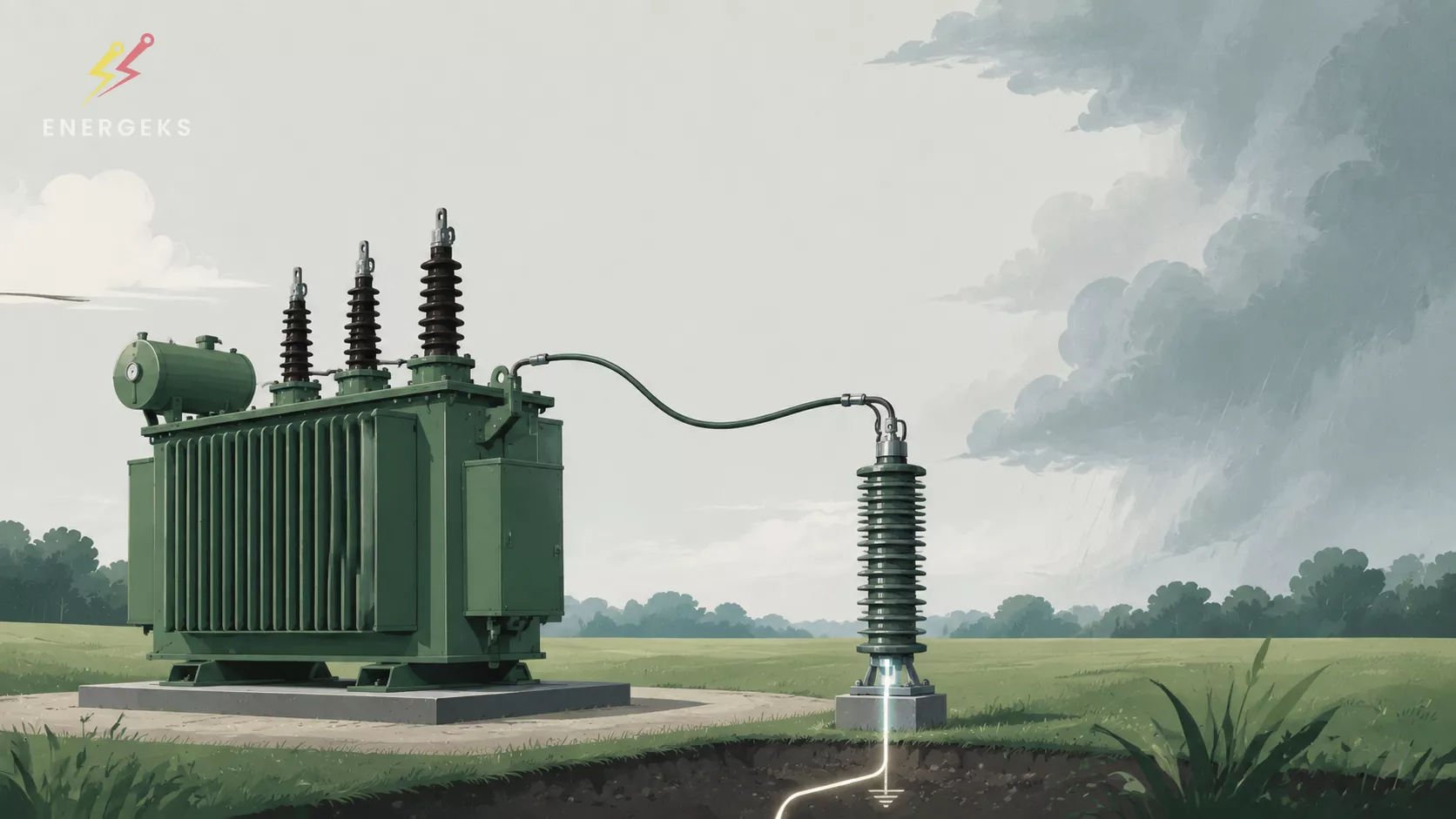
Heat melts people. Thunderstorms test transformers.
And it does it in microseconds.
The heatwave season has its own physics. The air stands still, asphalt softens, and we all slowly change our state of matter. A person starts treating shade like premium real estate, and every fridge opening sounds like a strategic decision.
And then the storm comes.
For a moment, it brings relief. The temperature drops, the wind picks up, the air regains its meaning. Except that for the power grid, that same storm is not a pleasant break from the heat. It is a test whose outcome can be decided in less time than a blink of an eye. Much less.
0.000001 seconds. That is how long one microsecond lasts.
It is on this scale that the front of a lightning surge develops. Does the transformer have a chance to survive it? Yes, provided that the right decisions were made before the first flash appeared in the sky.
The overvoltage reaching the transformer develops in microseconds. The operator will not have time to react. The controller will not call a meeting. The transformer also does not have a moment to "prepare" its insulation. The outcome is decided by solutions chosen earlier: insulation coordination, the type and parameters of the surge arrester, its location, the length of the connections, and the quality of the entire surge current discharge path.
This is why lightning protection for a transformer is a good topic right now. Not because a thunderstorm is spectacular, but because it reminds us of a simple rule in power engineering: the most important protections do their work when no one has time left to make a decision.
What really threatens the transformer during a thunderstorm?
A lightning strike does not have to hit the transformer directly to cause a dangerous overvoltage. A surge can enter the system through several paths.
A direct strike on an overhead line introduces a very high current with a steep change over time. A strike near the line can induce voltage in the conductors. Another possibility is a strike to a structure, a lightning protection system or the ground, which causes a sudden change in the potential of the earthing system. A surge wave can also arrive from another part of the grid, travelling along conductors and cables.
The transformer therefore sees not so much the flash itself, but the voltage wave appearing at its terminals.
If the value and steepness of this wave exceed the insulation's ability to withstand the electrical stress, a flashover on the bushing, breakdown of the main insulation or damage to the turn‑to‑turn insulation can occur. Not every event ends with an immediate short circuit. Sometimes the impulse leaves behind a weakening, local damage or the beginning of a degradation process that will manifest itself later.
This is precisely why the absence of a failure immediately after a storm is not automatically proof that the protection system worked perfectly. Insulation can remember electrical stress, even though it does not keep an event log.
Why do we talk about microseconds?
In high‑voltage engineering, the resistance of equipment to atmospheric overvoltages is assessed, among other things, using a standardised voltage impulse. The designation 1.2/50 µs describes a waveform whose nominal rise time is 1.2 microseconds and whose time to fall to half the value is 50 microseconds.
This is a test model, not a photographic portrait of every lightning strike. It does, however, allow the insulation strength of equipment to be compared and consistent principles of insulation coordination to be established.
One microsecond is one millionth of a second. In 1.2 microseconds, an electromagnetic wave can travel hundreds of metres, depending on the propagation medium. From a human perspective, nothing has happened yet. From the transformer's perspective, the voltage has already reached a level that can determine the fate of its insulation.
The steepness of the impulse is as important as its peak value. For fast‑changing currents, every fragment of conductor has inductance. The voltage on such a connection can be described by the relationship:
UL = L × (di / dt)
The faster the current rises and the greater the inductance of the connection, the greater the additional voltage drop. This voltage can add to the residual voltage of the arrester and appear at the terminals of the protected device.
The example is illustrative. If the connection has an inductance of about 1 µH and the surge current changes at a rate of 10 kA/µs, the connection itself can contribute about 10 kV. This does not mean that every metre of conductor always "costs" exactly 10 kV. It does, however, show the scale of the phenomenon and explains why, in surge protection, a short path is an electrical parameter, not an installer's aesthetic preference.
Does a lightning rod protect the transformer?
Yes, but not by itself and not against every scenario.
The external lightning protection system is designed to intercept a direct strike on the protected structure, conduct the current along a designated path and disperse it into the ground. It thus limits the risk of physical damage to the structure and the danger to people. The scope of this protection is described by the IEC 62305 series.
A surge arrester works on a different part of the problem. Its task is to limit the overvoltage on the device and direct the surge current to the earthing system. In medium‑voltage networks, it protects, among other things, transformers, bushings and switchgear against atmospheric and switching overvoltages.
Insulation coordination connects both worlds with the transformer itself. It consists of selecting the insulation strength, the protection level of the arresters and the system configuration so that the stress reaching the device remains below its assumed withstand level, with an appropriate margin.
So you can build a correct lightning protection system for the building and still leave the transformer with insufficient protection against a wave arriving via a conductor. You can also choose a good arrester and weaken its effectiveness with excessively long connections. Protection works as a system. The logo on one component does not replace the physics of the entire surge path.
How do arresters work, i.e., metal‑oxide surge arresters?
In modern AC networks, gapless metal‑oxide surge arresters with metal‑oxide resistors are widely used. Their requirements are specified in IEC 60099‑4 for systems with the highest voltage for equipment above 1 kV.
In everyday language, they are often called lightning arresters. In industry jargon, the more precise term is surge arrester, because the device does not catch lightning like a baseball glove. It limits the voltage and creates a controlled path for the surge current. A small linguistic difference, perhaps, but behind it lies the entire principle of operation.
The heart of the arrester is a non‑linear block, most often based on zinc oxide. Under normal conditions, the arrester has a very high resistance and only conducts a small leakage current. When the voltage rises sharply, its characteristic changes dramatically. The arrester begins to conduct the surge current, directing it to earth and limiting the voltage on the protected device.
After the overvoltage subsides, it returns to a high‑resistance state. It does not "swallow" the entire lightning strike and does not make the voltage disappear. It limits it to a specific level, called the residual voltage or protection level, and absorbs and dissipates part of the energy.
The whole process involves the appearance of the overvoltage, the rapid increase in the arrester's conductivity, the discharge of the surge current and the device's return to a high‑resistance state. For it to actually protect the transformer, the residual voltage, together with additional drops on the connections, must remain safely below the impulse withstand voltage of the insulation.
ZnO, spark gap or a special solution?
Different constructions can be found on the market and in older installations. Not all of them should be lumped together in the same drawer.
The modern standard for transformer protection is gapless arresters with ZnO blocks. They react thanks to the strongly non‑linear characteristic of the material and can withstand successive surges within their declared capability.
Older spark‑gap constructions, often with silicon carbide resistors, are still operating in some facilities. When modernising, ZnO is usually considered, but a "one‑to‑one" replacement without checking the network parameters and insulation coordination is not a good shortcut.
There are also special solutions, for example arresters with an external spark gap used on lines, and constructions for GIS. Their application is determined by the function, the insulation system and the overvoltage analysis, not by a catalogue power ranking.
The most effective therefore does not mean the most impressive in the catalogue. It means properly selected for the voltage, the network earthing method, the expected energy, the transformer's LI level and the environmental conditions.
Insulation coordination: the most important conversation between the transformer and the arrester
IEC 60076‑3 specifies the insulation requirements, dielectric tests and minimum test levels for transformers. The IEC 60071 series sets out the principles of insulation coordination for equipment and installations above 1 kV.
In design practice, at least two levels must be compared:
the rated lightning impulse withstand voltage of the transformer, often abbreviated as LI
the protection level provided by the arrester under specific current and impulse shape conditions
A margin should remain between them, taking into account uncertainties, the installation configuration, the distance from the transformer, the inductance of the conductors, wave phenomena and actual operating conditions.
It is not enough to check whether the number on the arrester data sheet is lower than the number on the transformer documentation. The voltage seen by the insulation can be higher than the residual voltage itself. Inductive drops and the effect of distance from the device must be added.
The shortest version of this rule is: the arrester does not protect the transformer's catalogue. It protects a specific transformer in a specific installation.
How to select a surge arrester for a transformer?
Selection begins with the system data, not with one voltage printed on the housing.
✅ Continuous operating voltage
The Uc value, i.e., the permissible continuous operating voltage, must correspond to the highest voltage that can occur on the arrester for a long time. The neutral earthing method and the voltage rise of healthy phases during an earth fault are important.
Too low a Uc can expose the arrester to overload during a temporary overvoltage. Too high a Uc usually means a higher protection level, which can reduce the margin for the transformer insulation.
✅ Rated voltage and temporary overvoltage withstand
The Ur and TOV parameters must be assessed together with the duration of the possible overvoltage. The arrester must survive a real fault scenario or other disturbance in the given network, not just the nominal operating point.
✅ Protection level
The residual voltage must be compared with the transformer's impulse withstand level. The influence of connections and location must also be taken into account. A low value in the table is useful only when the installation allows it to be exploited.
✅ Energy and charge capability
The exposure depends on the network configuration. Different requirements may apply to a station supplied by a long overhead line in an area of high lightning activity than to a device operating in a cable system. Switching overvoltages, the repeatability of surges and the nature of the protected facility also matter.
✅ Environmental and mechanical conditions
Altitude above sea level, pollution, UV radiation, temperature, humidity and mechanical loads influence the choice of design. The selection of a silicone or porcelain housing should result from the project conditions.
✅ Behaviour in the event of failure
The short‑circuit class, the method of safe venting or disconnection, and the risk to people and adjacent equipment must be considered. Protection of the transformer must not create a new problem at the moment when the arrester itself reaches the end of its service capability.
Why is the installation location just as important as the selection?
The best arrester placed too far from the transformer can provide weaker protection than a properly selected device mounted at the protected terminal.
Three principles decide:
the smallest possible distance between the arrester and the transformer bushing
short, straight connections on the phase and earthing side
avoiding loops, sharp changes of direction and unnecessary conductor sections
During surge current flow, the impedance of the entire path matters, not just the earthing resistance measured at power frequency or by a method suitable for static conditions. A fast impulse "sees" the inductance of the conductors, the geometry of the system and the mutual position of the connections.
Therefore, a larger conductor cross‑section does not automatically fix the problem of excessive length. Cross‑section remains important for thermal, mechanical and short‑circuit reasons, but for a very steep impulse, the path geometry can determine the induced voltage.
It is here that theory meets execution detail. An extra metre of conductor may look innocent. For an impulse measured in microseconds, it is a fully‑fledged circuit element.
Earthing: where should the energy actually flow?
A surge arrester does not remove energy from the system. It provides a controlled path for it. If this path has a high impulse impedance or is routed in a way that creates significant potential differences, the voltage on the protected device can still reach a dangerous level.
An effective system requires continuity of connections, correct connection of the transformer tank, the structure, cable screens and the other elements covered by the earthing design. Equipotential bonding is also important. During a discharge, the potential of the local earth electrode can rise sharply. The goal is not to magically keep the entire station at perfect zero potential, but to limit dangerous potential differences and ensure a predictable current path.
The earthing resistance value alone does not tell the whole story. Proper geometry, connections of adequate durability, corrosion control and compliance with the lightning protection design and network requirements are also needed.
Earthing is a bit like an evacuation route. Knowing that it exists is not enough.
It must lead where it should, be clear and work exactly when things get crowded.
Does a cable line eliminate the risk of atmospheric overvoltages?
No. It changes the risk profile but does not cancel it.
A cable is less exposed to a direct strike than an overhead line. A wave can, however, enter at the transition point from an overhead line, be caused by a rise in earth potential, or arrive from another part of the grid. Reflections at the boundaries of different impedances also change the voltage. Therefore, terminations, cable length, screens, earthing and surge limitation points must be analysed. A cable underground does not receive immunity from thunderstorms.
Is it enough to protect the MV side?
An arrester on the MV side protects the transformer against a wave arriving from that grid, but an impulse can transfer between windings. On the LV side, today there are controllers, inverters, measurements, communication and automation. Therefore, protection should be layered: include MV, coordinated SPDs on the LV side, auxiliary and signal circuits, and equipotential bonding. Protection of the transformer and of the electronics are related but not identical tasks.
7 mistakes in transformer lightning protection
A poorly selected arrester is a bit like a solid door installed next to the entrance.
It looks professional, but lightning has no obligation to use it.
❌ The first mistake is selection based solely on the rated network voltage.
Omitting the neutral earthing, the earth‑fault clearing time and TOV can give an incorrect Uc value. Too low a value exposes the device to overload, while too high a value can worsen the protection level.
❌ The second is installation far from the bushing.
In a surge, there is no such thing as "just a piece of conductor". Every section contributes inductance.
❌ The third is running long, looped connections to the earthing system.
A neatly routed conductor does not always mean a good surge path.
❌ The fourth is treating earthing resistance as the only measure of protection quality.
The measurement result is important, but it does not replace the assessment of continuity, geometry and impedance for fast transients.
❌ The fifth is the lack of coordination with the transformer insulation level.
The arrester cannot be selected in isolation from the LI, bushings, cables and switchgear.
❌ The sixth is neglecting the low‑voltage side and auxiliary circuits. A surge usually does not read the scope of delivery.
❌ The seventh is assuming that the arrester is permanent.
Multiple surges, moisture, damage and deteriorating connections can change its condition.
This does not mean replacement after every storm, but regular inspection instead of a wishful "it still looks fine".
Lightning vs. the budget: why protection simply pays off
The price of the arrester and correct installation is easy to see in the cost estimate. The price of a transformer failure has many more items, and some of them only appear when the device stops working.
The bill may include diagnostics, transport of heavy equipment, service work, equipment rental, repair or replacement of the transformer, emergency actions and loss of supply continuity. In a production plant, the cost of a stopped process is added. In an infrastructure facility, service availability matters. On a photovoltaic farm, every hour of downtime can mean energy that cannot be produced later.
Depending on the transformer power and the effects of the downtime, the total cost of an event can quickly reach tens or hundreds of thousands of PLN, and for large units much more. It is not worth promising, however, that any arrester will solve this problem. Savings only appear when the device is part of a properly coordinated system.
The investment therefore includes not only the purchase of the device. It includes selection, proper positioning, short connections, effective earthing, protection of subsequent levels and later inspection. This is less spectacular than a slow‑motion lightning video. It does, however, look much better in the installation availability report.
How to check protection after station commissioning?
Surge protection requires inspections adapted to the type of equipment, the manufacturer's recommendations and the importance of the facility.
During an inspection, it is worth considering:
the condition of the arrester housing, contamination, signs of discharge and mechanical damage
the quality of the terminals, phase and earthing connections
the continuity of equipotential bonding and the condition of the earthing
the readings of operation counters, if fitted
the trend of leakage current or its resistive component in installations equipped with monitoring
compliance of the station configuration with the design after modifications
A surge counter informs about events, but does not diagnose the arrester. Leakage current monitoring also requires interpretation. The greatest value comes from trends and comparison with the manufacturer's criteria. After a severe storm or protection operation, a targeted inspection based on the device condition and exposure history is advisable.
Good protection does not fight the storm. It manages its effects.
We cannot stop lightning discharges, and we are unlikely to persuade July to lower its temperature out of respect for infrastructure. We can, however, decide how the surge energy will pass through the station and what voltage the transformer insulation will see.
Effective protection is created when the transformer, arrester, connections, earthing and other protection levels are treated as one system. The arrester must have parameters appropriate for the network. It should be located close to the protected terminal. The current path must be short and consciously designed. The protection level should maintain an appropriate margin relative to the insulation strength.
That is a lot of dependencies for an event that lasts a few dozen microseconds.
That is precisely why it is worth resolving them calmly at the design stage, before the first summer storm appears over the station. If you are selecting a transformer, a transformer station or a surge protection system, let us compare the device parameters and the network configuration as a whole. Good questions asked today can do very concrete work during the next flash.
Energy deserves a good path
We cannot stop a storm. We cannot ask a lightning discharge to wait for the end of an inspection, and we are unlikely to persuade August to lower its temperature out of respect for infrastructure. We can, however, decide what happens at the moment the surge wave reaches the station.
We can give it a short, predictable path to earth. We can match the protection level to the actual insulation strength. We can look at the transformer, arrester, bushings, conductors, cables and earthing as one system, not seven separate items in an order.
And that is good news. In power engineering, we do not have influence over everything, but we have enormous influence over the quality of design decisions.
Thank you for taking the time to enter the world of microseconds with us. We know that surge protection does not sound as spectacular as lightning itself. In practice, it is precisely this protection that allows the transformer to continue doing its job after the flash: without drama, without downtime and without costly improvisation.
If you are selecting a transformer for a new station, modernising an existing system or want to verify parameters before submitting an enquiry, take a look at the oil‑immersed and cast‑resin transformers in the Energeks range. It is worth starting the conversation not only with the power in kVA, but also with the voltages, the LI level, the network operating mode, the environmental conditions and the entire protection concept.
Do you have a project where the arrester, cable and transformer must finally start talking to each other? Contact the Energeks team. We will look at the data, organise the technical questions and seek a solution matched to the real installation.
And if you like power engineering told concretely, with technique, experience and a touch of humour, follow Energeks on LinkedIn. There we share knowledge about transformers, stations, renewables and everything that makes energy go exactly where it is needed.
Thank you for your trust, your questions and every technical conversation. They help create better projects.
A thunderstorm may have the last flash.
But it does not have to have the last word.
Sources:
IEC 60071-1:2019, Insulation co-ordination, definitions, principles and rules
IEC 60099-4:2014, Metal-oxide surge arresters without gaps for AC systems
IEC 60076-3:2013 with Amendment 1:2018, Power transformers, insulation levels and dielectric tests
IEC 62305-1:2024, Protection against lightning, general principles
Hubbell Power Systems, The Importance of Lead Length for Arrester Applications
Transformers in stock
Shipped from our warehouse in Poland within 2–3 working days, 5-year warranty. Full range 25–2500 kVA in the shop (prices in PLN).

Sometimes an entire investment is stopped by the lack of a single piece of paper.
The EU Declaration of Conformity, the Operation and Maintenance Manual, the factory test report and the acceptance documentation are not add-ons to the transformer but part of the entire delivery. In this article, we show which documents should be checked before commissioning the device, who is responsible for their completeness, and how to avoid a situation where a ready transformer station is stopped not by a technical failure, but by a missing signature, serial number or proper test report.
Let us imagine a simple situation.
The transformer is already standing on its foundation. The cables have been prepared, the protections set, the assembly team is finishing the last measurements, and the energisation date is approaching faster than Monday after a quiet weekend. Everything looks good – until during acceptance someone asks:
– We will need the Declaration of Conformity, the factory test report and the current installation manual.
Silence falls.
Someone starts searching through emails. Someone else calls the supplier. After a moment, it turns out that the documentation "was probably in the inbox", "should be with the site manager" or "the manufacturer will definitely send it".
And it is at that moment that the multi-tonne transformer ceases to be the biggest problem on site. The bigger problem becomes the ring binder that no one can find.
Does this sound trivial? Unfortunately, only until the acceptance of the station is delayed due to incomplete documentation – a production line, a photovoltaic farm, an energy storage system or an entire facility. A transformer's technical documentation is not an extra thrown into the delivery out of the manufacturer's courtesy. It is part of the product – just like the nameplate, bushings, tap changer, temperature sensors or cooling system.
The most important rule is simple: a transformer without complete documentation may be a functional device, but for the investor it remains an unrecognised technical, contractual and financial risk.
This article is intended primarily for investors, designers, general contractors, transformer station integrators, maintenance managers and those responsible for accepting power equipment.
After reading it, you will know:
• what the EU Declaration of Conformity actually means in practice and what the CE mark really proves,
• what a good transformer Operation and Maintenance Manual (DTR) should contain,
• the difference between routine tests, type tests and special tests,
• where the manufacturer's responsibility ends and the designer's, contractor's and user's responsibility begins,
• how to check the documentation before signing the acceptance protocol.
Reading time: approximately 11 minutes
Technical documentation does not supply power to the plant. Until its absence shuts down the entire investment.
In power engineering projects, attention naturally focuses on the device parameters. We analyse the rated power, the MV and LV voltages, the level of no-load and load losses, the short-circuit voltage, the connection group, the cooling method, the noise level, the insulation class and the environmental conditions.
This is a correct approach. The problem begins when we treat the documentation as elegant packaging for the actual technology.
Yet the documents are needed at every stage of the transformer's life.
The designer uses them to prepare the foundation, ventilation, electrical connections and protections.
The contractor needs them during transport, unloading and installation.
The person performing measurements checks the reference parameters.
The maintenance staff base their inspection schedule on them.
The service team compares the results of periodic tests with the initial values.
The insurer or expert may analyse the documentation after a failure.
A well-prepared set of documents therefore creates something like a technical biography of the device. It shows what the transformer was like when it left the factory, what condition it arrived in, how it was installed and what happened to it over the years.
Without this history, diagnosing a problem is like visiting a doctor without test results, medication information and a previous diagnosis. Of course, you can start from scratch – it is just usually more expensive, slower and much more stressful.
The CE mark is not a quality medal or a magic sticker
One of the most commonly misunderstood elements of documentation is the CE marking.
CE does not mean that the device received a quality award, passed one universal European test or was "approved by the central CE authority". The marking indicates that the manufacturer declares the product's conformity with the applicable EU regulations and has carried out the appropriate conformity assessment procedure.
This is an important difference.
The manufacturer cannot simply stick on the CE symbol because it looks nice next to the serial number. They must determine which legal acts apply to the product, prepare the technical documentation, carry out the required assessment and issue a Declaration of Conformity. The CE mark relates to the product's conformity at the time it is placed on the market in the European Union.
For power transformers, one of the key acts is Commission Regulation (EU) No 548/2014 on ecodesign requirements for small, medium and large power transformers. It was amended by Regulation (EU) 2019/1783.
The regulations specify, among other things, requirements for efficiency and maximum energy losses, and the second-stage requirements, known as Tier 2, have been in force since 1 July 2021.
This does not mean, however, that the same list of directives found in the first declaration template from the internet should automatically be copied to every transformer.
Which regulations may apply to a transformer?
The scope of regulations depends on the construction, rated voltages, equipment and the way the device is placed on the market.
The Low Voltage Directive 2014/35/EU applies to electrical equipment designed for operation at voltages from 50 to 1000 V AC and from 75 to 1500 V DC. The main medium-voltage side of an MV/LV transformer is therefore outside the LVD voltage range, but the directive may be relevant for certain low-voltage circuits and auxiliary equipment.
The same applies to electromagnetic compatibility. A classic transformer is a largely passive device, but electronic temperature indicators, ventilation controllers, communication modules, monitoring systems or switch drives may require assessment for EMC.
The RoHS directives or the Machinery Directive should also not be included in the declaration "just in case". Their application requires an analysis of the product's scope, equipment and intended use.
A good declaration is not a document with the longest list of legal acts.
It is a document with a correct list.
It is a bit like seasoning a soup. More does not always mean better, and emptying the entire spice drawer rarely proves the chef's professionalism.
The EU Declaration of Conformity: what should it really contain?
The EU Declaration of Conformity should answer three very simple questions: who is responsible for the transformer, which exact device the document concerns, and on what basis the manufacturer confirms its conformity with the requirements.
This sounds trivial, but during acceptance, this is precisely where it is easiest to stumble.
The nameplate shows one model, the test report shows a slightly different one, and the Declaration of Conformity vaguely describes "transformers of the X series".
Each document individually looks professional.
Only when placed side by side do they start to resemble a family photo where no one is quite sure who the person in the last row is.
Therefore, the declaration should clearly indicate the manufacturer and their address, and if an authorised representative is involved, also their details.
It must also allow unambiguous identification of the product, for example by type, model, batch number, series or serial number.
It should contain a statement that it is issued under the sole responsibility of the manufacturer, indicate the relevant directives and regulations, and cite the applied standards or technical specifications. Finally, the place and date of issue, the details of the authorised person and their signature are needed.
The serial number deserves special attention here.
In many projects, it is expected to be visible not only on the nameplate but also in the declaration, the product test report, the warranty card and the transport documents.
This immediately confirms that all the papers refer to exactly the unit standing on the foundation, not to its cousin from the same series produced three weeks earlier.
This does not mean, however, that a declaration without a serial number is always automatically invalid. The key is whether the product can be unambiguously identified.
Depending on the production method, this can also be achieved by type, series, batch or another consistent identifier.
From the investor's point of view, however, it is best not to leave room for legal puzzles.
The same number on the nameplate, declaration, test report, warranty and delivery documents means fewer questions, faster acceptance and significantly less risk that someone during commissioning will ask:
"But are these documents definitely for this transformer?"
Five documents, one number and zero guessing. In power engineering, that is luxury.
Factory tests, type test reports, routine tests… one piece of paper, many terms
Let us imagine that a transformer arrives on site.
It looks impressive: a fresh paint coating, a legible nameplate, protected bushings, signed delivery documents. The project manager looks at the device with satisfaction, because this time everything has arrived on time.
An innocent question, however, is asked:
– And where is the test report for this unit?
The driver shrugs. The supplier searches through emails. The manufacturer sends a report after a moment, but the serial number does not match. The power is similar, the voltages are almost the same, and the production date differs by only a few weeks. Almost a success.
Unfortunately, in power engineering, "almost the same transformer" works like "almost the same key to the apartment". It may look right, but the door still remains locked.
The EU Declaration of Conformity confirms that the manufacturer takes responsibility for the product's conformity with the applicable requirements. It is not, however, proof that this exact transformer standing before us achieved the parameters on its nameplate.
For that, a report from tests on the specific unit is needed, most often referred to as the Routine Test Report. It may also form part of the FAT documentation – Factory Acceptance Test.
The declaration therefore says: "this type of device has been designed to meet the requirements". The test report adds: "and we actually checked this particular unit".
This is a small linguistic difference, but a very large technical one.
The basic reference point for power transformers is the IEC 60076 series of standards. Its first part specifies the general requirements for single-phase and three-phase transformers. The mere information that the device was made "in accordance with IEC 60076" does not yet say, however, which specific tests were carried out, whether they applied to every unit, and whether the investor will receive the results for their unit.
This is why it is worth distinguishing three groups of tests.
1. Routine tests – checking a specific unit
Routine tests are performed on every manufactured unit to the extent required by the applicable standard and order specification. Their purpose is to confirm that the specific transformer has been correctly manufactured and achieves the declared parameters.
The report may include, among other things, winding resistance measurement, ratio and phase displacement checks, no‑load and load loss measurement, no‑load current, short‑circuit voltage and the relevant dielectric tests.
For the investor, it is particularly important that the report contains identification of the unit – ideally the serial number matching the nameplate. Without this, we receive test results for some transformer. Perhaps a very good one. Just not necessarily ours.
2. Type tests – can this design do what it promises?
Type tests confirm specific properties of the design or an entire family of devices. They do not have to be performed separately for every transformer produced.
They may concern, for example, temperature rise, noise level or other characteristics that would be time‑consuming, costly or require a special test bay to test every time.
One could say that routine tests check a specific unit, while type tests ask whether the design as a whole passed a more important exam.
It is a bit like with a car. Every unit should pass a final inspection, but not every newly produced vehicle is crashed into a wall again as part of a crash test. That would be an extremely thorough approach, though rather unfavourable for the delivery schedule.
3. Special tests – when the standard package is not enough
Special tests are performed when required by the contract conditions, the operator's standard, the nature of the installation or particular operating conditions.
They may include, for example, extended short‑circuit withstand tests, frequency response measurements, additional environmental tests, specialist noise measurements or in‑depth construction diagnostics.
Such requirements appear especially in projects where the transformer will operate in an unusual environment, with a high share of harmonics, with power electronic converters, or in an installation with exceptionally high requirements for supply continuity.
An energy storage system, a photovoltaic farm, a data centre and a small production plant may need transformers of the same power, but that does not mean they need an identical scope of testing.
A complete test package – two words, five different interpretations
Problems often begin already in the tender specification.
The investor writes: "Complete transformer testing package required."
The manufacturer understands this as standard routine tests.
The designer has in mind routine tests and current type test reports.
The operator expects additional tests according to their standard.
The laboratory, meanwhile, asks whether "complete" also includes special tests.
Everyone uses the same term, but each orders something different.
This is an extremely efficient way of producing later disputes.
That is why it is not enough to rely on a general requirement that the transformer should have a "full package" or "complete testing" in the procurement documentation.
You should clearly specify:
• which tests are to be performed for each unit,
• which type test reports the manufacturer should present,
• whether special tests are required,
• according to which standard and its parts the tests should be carried out,
• whether the investor will participate in the FAT,
• in what form and language the results should be delivered,
• which serial number the report should be linked to.
This way, the transformer arrives not only with a declaration that everything should be fine, but also with specific results showing that it really is fine.
The transformer “DTR”(..wth(eck?)), manual or instruction – what is the difference?
Nothing.
In Polish projects, a requirement often appears: "the transformer must be delivered with a DTR."
A foreign manufacturer replies that they do not have any "DTR", but can send an Installation, Operation and Maintenance Manual, Operating Instructions or the German Betriebsanleitung.
And the paper ping‑pong begins.
The investor waits for the DTR, the manufacturer sends the manual again, and someone in the middle tries to establish whether another document should be ordered.
Most often, it is not necessary, because DTR is a somewhat older, established name in Poland for the documentation describing the method of transport, assembly, commissioning, operation and maintenance of the device.
Modern regulations and technical documents more often use terms such as "instruction manual", "user manual" or "operating instructions".
Polish regulations concerning power equipment also use the term "operating instructions" and do not require a document necessarily titled "DTR".
What counts is therefore not the name on the cover, but the content.
The manufacturer's manual should allow unambiguous identification of the transformer and give its most important parameters. It should also explain how to transport, lift, store, position, connect and prepare the device for first energisation.
Basic information on operating conditions, earthing, cooling, tightening torques, pre‑commissioning checks and subsequent inspections is also needed.
It does not have to be a 400‑page saga about the life of transformer oil and its descendants.
It should be a document from which the designer, installer and user can learn what to do to avoid damaging the device and to operate it safely.
If a foreign manual contains this information, it is in practice the equivalent of the traditionally understood manufacturer's DTR. There is no point in requiring a second document just so that three familiar letters appear on the cover.
You must, however, distinguish the manufacturer's manual from the operating instructions for the entire station or installation, prepared by the user for a specific facility.
Such a document may take into account the local grid layout, work organisation, protections, switching procedures and emergency response rules.
Then it is indeed no longer just a translated transformer manual.
Simply put: the transformer DTR, manual and Betriebsanleitung can be one and the same document. A separate operating instructions document is needed only when it is to describe not only the device but also its operation in a specific installation.
The name is secondary.
The transformer will not be offended that its instructions are called a "manual".
The person receiving it, however, may rightly be frustrated if under an elegant cover they do not find the information needed for installation and commissioning.
Manufacturer, importer, designer, contractor and user – each holds a different piece of the puzzle
When the transformer is working correctly, the boundaries of responsibility are rarely the subject of exciting conversations. The situation changes after a failure, an acceptance delay or a warranty dispute.
Then, suddenly, everyone starts reading specifications, protocols and emails from two years ago very carefully.
Manufacturer
The manufacturer is responsible for designing and manufacturing the device in accordance with the applicable requirements.
Their duties include carrying out the appropriate conformity assessment procedure, preparing the technical documentation, performing the required tests, issuing the declaration and providing instructions enabling safe use.
Their responsibility may include, among other things, material defects, design errors, non‑conformity of parameters with the order, incorrectly made windings, tank leaks or incorrect information in the documentation.
If the manual gives the wrong connection diagram or incorrect tightening torque values, the problem does not cease to be the manufacturer's problem just because it is on paper instead of in steel.
Importer and distributor
An importer introducing a product from outside the European Union should not limit their role to organising transport and issuing an invoice.
They must verify whether the manufacturer carried out the required conformity assessment, whether the device has the proper marking and whether the required documents are available.
This does not automatically mean that the importer in every situation "becomes the manufacturer" in the full legal sense.
They may, however, be treated as the manufacturer if they place the product on the market under their own name or trademark, or modify it in a way that may affect conformity.
A distributor should also act with due diligence.
If they see that the documentation is incomplete, the markings are inconsistent, and the device numbers do not match the test report, they should not pretend that the transformer has a mild paper hiccup.
The obligations of manufacturers, importers and distributors, and the principles of product traceability, are described in the EU "Blue Guide" on the implementation of product rules.
Designer
The designer is responsible for selecting the device for the grid, the load and the environmental conditions. They should take into account, among other things, voltage levels, short‑circuit currents, protections, ventilation, fire resistance, floor loading, service access and the operator's requirements.
A transformer may be perfectly manufactured and still operate incorrectly if it is placed in a compartment that is too small, poorly ventilated, or selected without considering the harmonics generated by inverters, rectifiers and converters.
Good equipment does not automatically fix a bad design.
Contractor and installer
The contractor is responsible for how the device was transported to the site, unloaded, positioned, connected, earthed and prepared for commissioning.
Common problems include damage during unloading, incorrect support, stress on bushings from rigid busbar connections, omission of protective conductors, incorrect connection of sensors or lack of functional protection tests.
The contractor should also hand over to the investor the as‑built documentation: measurement protocols, test results, diagrams after changes and confirmation that the protections have been checked.
Without this, acceptance is like buying a house without knowing where the cables, pipes and valves run. Theoretically, you can live in it. Practically, the first failure turns into a treasure hunt.
Investor and user
After acceptance of the device, responsibility for its correct operation passes largely to the user.
They should ensure adequately qualified personnel, maintain operating documentation, carry out inspections, monitor operating conditions and respond to abnormal temperatures, noise, leaks, contamination or protection operation.
The manual should not lie in a cupboard for the next 23 years in its factory‑fresh condition, still smelling of the print shop. It should be a document that is used, supplemented with inspection results and accessible to those responsible for the device.
What about Poland’s technical inspection authority, the DSO and the insurer?
These three parties are often mentioned in the same breath, although they perform completely different jobs. Put simply: one supervises selected categories of technical equipment, another decides whether an installation meets the requirements for connection to the distribution network, and the third becomes particularly interested when something has already gone wrong.
Poland’s Office of Technical Inspection
The Office of Technical Inspection, known in Poland as Urząd Dozoru Technicznego or UDT, is a state institution responsible for supervising technical equipment that may pose a risk to people, property or the environment.
A standard power transformer does not automatically become equipment requiring UDT registration simply because it is installed inside a substation. However, other devices used at the facility — such as lifting equipment or certain pressure devices — may fall under technical inspection rules.
The practical rule is simple: check the actual equipment installed at the site rather than assuming that the entire transformer station is either “subject to UDT” or completely outside its scope.
Distribution System Operator
In Poland, the abbreviation OSD means operator systemu dystrybucyjnego. In English, the correct term is Distribution System Operator — DSO. Polish DSOs include companies such as PGE Dystrybucja, TAURON Dystrybucja, Enea Operator, Energa-Operator and Stoen Operator.
The DSO may define technical parameters, protection requirements, tests and documents needed before a transformer installation can be connected to the distribution network. These requirements are not identical in every project. They depend on the operator, the connection conditions, the ownership structure and the design of the installation.
A missing test report or a transformer that does not meet the relevant DSO standard may delay acceptance. This is why the required documentation should be agreed with the designer, contractor and operator before the transformer is ordered — not when it is already standing in the substation and everyone is searching through old email attachments.
Insurer
The insurer has yet another role. It does not approve the connection and does not perform technical inspection of the transformer. After a failure, however, it may examine the policy terms, the cause of the damage, the maintenance history and the records showing how the equipment was operated.
Incomplete documentation or missing inspection records do not automatically mean that compensation will be refused. Much depends on the wording of the policy, the circumstances of the event and whether any negligence contributed to the loss. Regular inspection and maintenance nevertheless make it much easier to demonstrate that the transformer was operated responsibly. Insurers themselves emphasise the importance of systematic transformer maintenance as part of industrial risk management.
In practical terms, the difference is straightforward: UDT deals with technical inspection obligations, the DSO deals with network connection requirements, and the insurer deals with the financial consequences of a loss.
They may all ask for documents, but definitely not for the same reason.
Two transformers, two failures and completely different outcomes
Let us consider two hypothetical plants.
In the first, an oil‑immersed transformer has been operating for six years. Since the day of delivery, a history of test results, temperatures, inspections and minor repairs has been kept. During a periodic oil analysis, an alarming change appears. The service compares it with previous results, extends the diagnostics and detects a developing problem before a major failure occurs.
The transformer is de‑energised on a planned date. The plant arranges backup power. The repair is costly, but controlled.
In the second plant, a similar transformer has also been operating for six years. The documentation is in several places, some protocols were lost after a change of service company, and the last oil analysis was "probably done".
A temperature alarm appears, but no one knows whether the sensor previously indicated similar values. There is no trend, no reference values and no complete load history. Every decision requires additional tests, and the plant does not know whether it can safely continue production.
In both cases, the device may have the same power, manufacturer and year of production. The difference is made by information.
In power engineering, historical data is often cheaper than steel, copper and oil. The problem is that its value is usually appreciated only when it is already missing.
What to check before accepting a transformer?
Before signing the acceptance protocol, you must ensure that the documents actually refer to the device standing before you.
The type, model, power, voltages, connection group, short‑circuit voltage, tap range and above all the serial number should match the nameplate, the design, the EU Declaration of Conformity, the test report and the warranty card.
The package should also contain the current dimension drawing, the connection diagram and the manufacturer's manual describing transport, installation, commissioning and basic operating principles. If the order included additional type tests or special tests, their reports must also be delivered.
At the commissioning stage, measurement protocols, confirmation of correct tap setting and the results of protection, alarm and signalling tests should be collected.
It is also worth recording the initial values, which will later serve as a reference point during inspections.
If any of these elements is missing before acceptance, it is better to clarify the matter immediately.
After the protocol is signed, lost documents and unfinished arrangements have a remarkable talent for turning into "the investor's scope".
Documentation should be selected together with the transformer, not after delivery
Most problems arise when the transformer is ordered as a device, and documentation is only discussed during acceptance.
Yet its scope should be included already in the request for quotation or specification. It is worth specifying the required language, file format, number of paper copies, scope of testing, operator's standard, drawing approval procedure and the document delivery deadline.
In projects carried out for industry, renewables, BESS and critical infrastructure, a good solution is to prepare a document register. Each item receives a number, status, version, acceptance date and information on who is responsible for its approval.
Does this sound corporate? Perhaps.
But it still sounds better than: "No one knows where the final drawing is, but I think we installed according to version three."
A good transformer arrives with a full history from day one
A transformer without documentation is a bit like a car without a registration certificate, manual and service history. It may look excellent. It may even work. But at the first inspection, failure or attempt to sell it, the show begins – and no one bought a ticket.
The EU Declaration of Conformity confirms the manufacturer's responsibility for the product's conformity with the applicable requirements. The test report shows the parameters of the specific unit. The DTR explains how to transport, install, commission and maintain the device. The as‑built documentation, in turn, proves that the transformer has been correctly integrated into the installation.
Only together do they form a complete system of technical and organisational safety.
At Energeks, we look at transformer delivery more broadly than just through the lens of rated power. We help select a solution for the grid conditions, environment, load character, investor's requirements and project standards.
Our offer includes MarkoEco2 oil‑immersed transformers as well as TeoEco2 cast‑resin transformers intended, among other things, for industry, photovoltaic installations, energy storage systems, containerised stations and critical infrastructure facilities.
Selected units are available off‑the‑shelf, which helps reduce waiting time without compromising the full documentation package and technical support. We invite you to contact the Energeks team – together we will deliver every project.
Because a transformer should change voltage levels – not the stress level of the project team ;)
sources:
European Commission, The Blue Guide on the implementation of EU product rules 2022
EUR-Lex, Commission Regulation (EU) No 548/2014, amended by Commission Regulation (EU) 2019/1783
International Electrotechnical Commission, IEC 60076-1:2011 – Power transformers, Part 1: General
This article is technical and informational in nature and does not replace legal analysis, contract terms, manufacturer documentation or the requirements of the relevant distribution system operator.
Transformers in stock
Shipped from our warehouse in Poland within 2–3 working days, 5-year warranty. Full range 25–2500 kVA in the shop (prices in PLN).
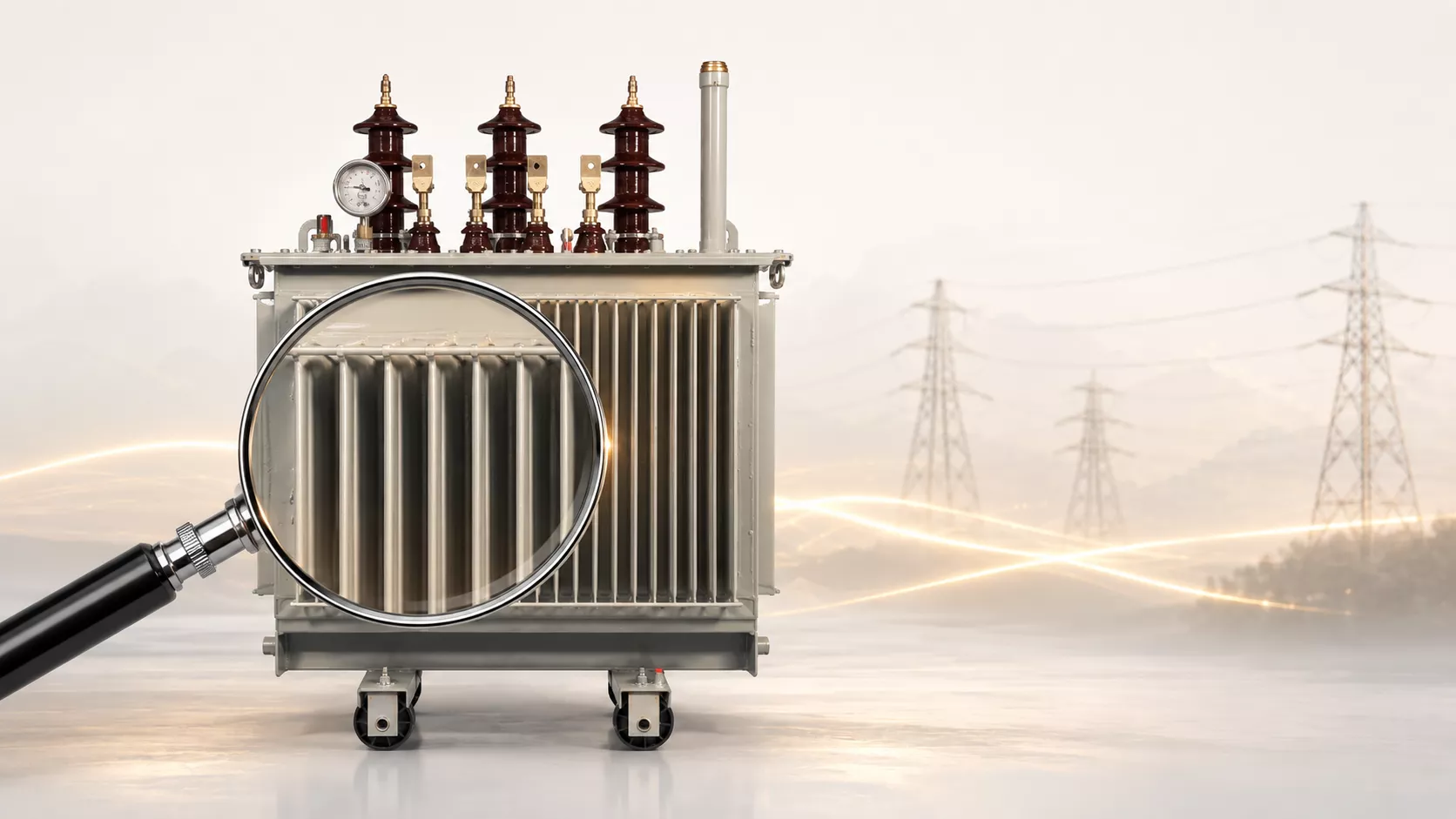
An oil-immersed transformer can stand in one place for decades and transfer energy almost continuously to an industrial plant, a housing estate, a photovoltaic farm, an energy storage system or an electric vehicle charging station.
It has no pistons, shafts or gearboxes that spectacularly rotate during operation.
From the outside, what is most often visible is the steel tank, bushings, radiators, a nameplate and a few control elements.
One might get the impression that not much is happening inside either.
In reality, the transformer is constantly working in a changing magnetic field, carrying large currents and fighting the heat generated in the core and windings.
Every additional ampere, high ambient temperature, and every hour of operation under high load increase the amount of thermal energy that must be effectively removed.
This is precisely why an oil-immersed transformer needs oil.
It is not used to lubricate moving parts, because there are practically none.
Transformer oil performs much more important tasks. It insulates parts under high voltage, absorbs heat from the windings and core, and then transports it to the tank and radiators.
⚡ A transformer does not age solely because the years pass. Its actual durability depends to a very large extent on the temperature at which those years were worked.
This article has been prepared for designers, contractors, investors and those responsible for selecting a transformer for an industrial plant, a renewable energy installation, an energy storage system, a commercial building or critical infrastructure.
We will explain how a transformer transfers energy, where losses come from, how oil can simultaneously cool and insulate, and what distinguishes ONAN and ONAF cooling systems.
We will also show why overloading a transformer by 20% can generate significantly more than 20% additional heat.
Estimated reading time: 9 minutes.
A transformer does not produce energy. It changes its parameters.
Energy cannot be created from nothing or destroyed irreversibly.
It can, however, be transformed, transmitted, stored and dissipated in various forms.
A power plant therefore does not "produce" energy in the literal sense of the word.
It converts the chemical energy of fuel, solar radiation, wind, water or nuclear reactions into electrical energy.
A transformer performs the next stage of this energy relay.
It does not create new kilowatt-hours, but transfers energy from one circuit to another and changes its parameters so that it can be safely transmitted, distributed and used.
The basic task of a transformer is to change the voltage value of alternating current.
In a typical distribution network, it can step down the medium voltage, for example 15 kV or 20 kV, to the level of 400 V used by machines, building installations, switchgear and other low-voltage consumers.
In other applications, the transformer works in the opposite direction and steps up the voltage. This happens, among other things, in power plants, photovoltaic and wind farms, where the electricity must be transferred to the grid at a level that allows it to be efficiently transported over long distances.
A transformer can be compared to a gearbox in a car. The gearbox does not increase the engine's power, but changes the relationship between rotational speed and torque. A transformer similarly changes the proportions of voltage and current, matching the energy to the conditions prevailing in a given part of the installation.
When the voltage is stepped down, a higher current can flow on the secondary side. When the voltage is stepped up, the current decreases accordingly. In an ideal transformer, the input and output power would be the same. However, a real device always causes some losses, because part of the transmitted energy is dissipated as heat.
A loss of one percent may sound harmless, but for a transformer transmitting 1 MW of power, it corresponds to about 10 kW of heat. That is as if several electric heaters were working inside the steel tank around the clock.
The heat must be removed from the windings and core, and then transferred to the surroundings. Without effective cooling, the temperature of the hottest elements of the transformer would rise quickly, accelerating insulation ageing and shortening the expected service life of the device.
What happens between the windings?
Inside a classic transformer there are the primary winding, the secondary winding and a common magnetic core. The primary winding is connected to the power source, while the secondary winding transfers energy to the rest of the installation.
Both windings are close to each other but are not directly electrically connected. Energy does not flow between them through an ordinary conductor.
Its carrier is the changing magnetic field.
When alternating voltage is applied to the primary winding, current begins to flow through it. A changing magnetic field is created around the winding, which is concentrated and guided by the core. This field also covers the secondary winding and induces a voltage in it.
This phenomenon is called electromagnetic induction.
The most important word here is "changing". A constant magnetic field would not allow continuous induction of voltage in the second winding. That is why a classic transformer works with alternating current.
In the European power grid, the frequency is 50 Hz. The magnetic field in the core therefore constantly changes its value and direction. The core is remagnetised dozens of times every second.
The value of the voltage on the secondary side depends primarily on the turns ratio of the two windings. If the medium-voltage winding has more turns than the low-voltage winding, the transformer steps down the voltage.
For example, changing the voltage from 15,000 V to 400 V corresponds to a voltage ratio of approximately 37.5 to 1. This does not mean, however, that the entire transformer design can be reduced to simple division. The designer must also consider voltage drops, short-circuit voltage, tap regulation, current density, magnetic flux, operating temperature and insulation requirements.
Why is the core not made from a single piece of steel?
At first glance, a solid steel block might seem a simpler and more durable solution. In a transformer, however, it would cause very large losses.
The changing magnetic field induces currents not only in the secondary winding. Currents can also appear inside the core material. They are called eddy currents.
They can be imagined as small electrical vortices circulating in the steel. They do no useful work. Instead, they heat the core and increase energy consumption.
To limit this phenomenon, the transformer core is made of thin, mutually insulated electrical steel laminations. Each layer interrupts the path along which large eddy currents could circulate. As a result, the amount of heat generated is significantly reduced.
This is not, however, the only source of core losses. The magnetic material must be constantly remagnetised. Its structure does not react to the change of field completely without resistance. This phenomenon is called magnetic hysteresis.
For this reason, a transformer draws a certain amount of energy even when no significant consumer is connected on the secondary side.
What are no-load and load losses in a transformer?
The losses occurring in a transformer can be divided into two main groups:
no-load losses and load losses.
No-load losses occur when the transformer is energised.
It does not matter much whether the production plant is running at full capacity or whether all machines have been switched off. As long as the primary winding is energised, the core is remagnetised and losses occur in it.
This can be compared to a car left with the engine running. The vehicle is stationary, but it still consumes fuel.
In the case of a transformer, this means that energy is drawn around the clock, also at night, on weekends and during production stoppages. Therefore, no-load losses are particularly important in facilities where the transformer operates at low load for most of the time.
Even a few hundred watts drawn continuously throughout the year translates into thousands of kilowatt-hours of energy. For larger units, these values can be even higher.
Load losses, on the other hand, occur primarily in the windings and increase with the current flowing through them.
They result from the resistance of the conductor, regardless of whether the winding is made of copper or aluminium.
In the industry, they are often referred to as copper losses, even when the winding is aluminium. The name refers to the type of phenomenon, not always to the actual conductor material.
Why does an additional 20% current mean about 44% more losses?
Load losses increase approximately in proportion to the square of the current. This is one of the most important relationships to understand when selecting and operating a transformer.
If the current increases by 20%, the losses do not increase by 20%. The value 1.2 must be squared, which gives 1.44. This means about 44% more current-dependent losses.
With a current increase of 30%, the result is already 1.69, i.e., about 69% more losses.
In practice, this means that a seemingly small overload can cause a much faster rise in winding temperature. Therefore, a transformer should not be selected "on the edge", considering only the sum of the rated powers of the loads.
The load profile, duration of peaks, ambient temperature, cooling method and the possibility of future system expansion should also be checked.
You might also be interested in this topic:
Inside an oil-filled transformer
Why does a transformer need oil?
Transformer oil performs two tasks that at first glance seem completely different.
It must be a good electrical insulator and at the same time effectively transport heat.
In a transformer, there are high voltages and relatively small distances between elements at different potentials. Air also has insulating properties, but oil allows high electrical strength to be achieved in a compact construction.
The liquid fills the spaces between the windings, core, bushings, solid insulation and structural components. It limits the risk of electrical flashover and partial discharges.
At the same time, the oil reaches very close to the surface of the windings – exactly where a significant part of the heat is generated during loading.
It can be described as the transformer's circulatory system.
It absorbs heat from the interior, transports it towards the tank and radiators, releases it to the surroundings, and then returns to the windings for another portion of thermal energy.
Without this circulation, the local temperature of the windings would rise, and the paper insulation and other insulating materials would age much faster.
Oil works well only when it is clean and dry
Properly prepared transformer oil has very good dielectric properties. The problem begins when water, contaminants, solid particles or ageing products appear in it.
Moisture can lower the oil's breakdown voltage and accelerate the degradation of cellulose insulation. High temperature additionally accelerates undesirable chemical reactions.
Inside the transformer, the oil works together with the solid insulation, most often made of paper and pressboard. Cellulosic materials can absorb water. Under the influence of temperature changes, moisture migrates between the paper and the oil.
Therefore, an oil sample is more than just a fragment of liquid taken from the tank. It can be a source of information about the condition of the entire insulation system.
During diagnostics, among other things, the water content, breakdown voltage, acidity, dielectric dissipation factor and gases dissolved in the oil are examined. In some cases, furan compounds are also analysed, which can provide information about the degree of ageing of the cellulose insulation.
Particularly useful is the analysis of dissolved gases, abbreviated as DGA. During local overheating, partial discharges or arcing, characteristic gases can form.
A single result rarely gives a complete answer. What tells the most is the observation of changes over time. If the concentration of certain gases is systematically increasing, it may indicate a developing fault, even if the transformer is apparently still operating correctly.
How does the oil circulate if the transformer has no pump?
In many distribution transformers, the oil circulation is completely natural.
The oil near the windings and core absorbs heat. As its temperature rises, the density of the liquid decreases slightly. The warmer oil therefore begins to rise upwards.
Its place is taken by cooler and denser oil.
In this way, natural circulation is created. The phenomenon is similar to the movement of water heated in a pot. The water at the bottom heats up, rises, and the cooler part of the liquid sinks.
In a transformer, the flow is directed by appropriately placed oil ducts. The heated oil reaches the upper part of the tank, the corrugated walls or the radiators. There it gives off heat to the metal, which transfers it to the surrounding air.
After cooling, the oil sinks and flows again towards the windings.
The whole process can take place without pumps, provided that the transformer construction, cooling surface and ambient conditions ensure adequate heat exchange performance.
The infographic explains the natural circulation of oil in an oil-immersed transformer without the use of a pump. It shows how heated oil rises around the windings and core, releases heat through the radiators, cools down and sinks, creating a continuous cooling cycle. CC:ENERGEKS 2026
A radiator is no help if it has no access to air
Radiators increase the surface area through which heat can pass from the oil to the air. The larger the heat exchange surface, the more effectively the transformer can cool itself.
Even the best-designed radiator will not work properly, however, if it is deprived of free air flow.
This is one of the problems that appear after the transformer has already been installed.
The device may be positioned too close to a wall. The station room may have too small ventilation openings. Air flow may be restricted by cable routes, additional switchgear or materials stored near the transformer.
In such a situation, the transformer starts to cool itself with air that it has previously heated.
This can be compared to a computer with its ventilation holes taped shut. All the cooling components are still in place, but the hot air cannot be effectively removed.
The temperature inside the station gradually rises, and the difference between the oil temperature and the ambient temperature ceases to be sufficient to dissipate the required amount of heat.
How does ONAN cooling work?
ONAN is one of the most common cooling systems for oil-immersed transformers. The abbreviation comes from the English term Oil Natural Air Natural.
The first word indicates that the insulating and cooling medium is oil. The term "Natural" means that the oil moves inside the transformer due to the natural density difference, without pumps.
The second "Natural" refers to the air flow around the tank and radiators. The air also moves naturally, without fans.
Such a system is simple, quiet and reliable. The absence of fans means fewer elements requiring power, control and maintenance. There are also no motors, bearings or ventilation system protections that could fail.
The limitation is cooling performance. The transformer can only release as much heat as the naturally flowing air can absorb.
Therefore, the same transformer will operate differently in an open space and differently in a tight station with limited ventilation. The ambient temperature also matters. On a hot day, the heat dissipation capability is lower than in winter.
ONAF does not increase the transformer's power. It increases cooling capability.
ONAF stands for Oil Natural Air Forced.
The oil inside the transformer still circulates naturally. What changes is the way air flows through the radiators. It is forced by fans.
The fans increase the amount of air flowing over the cooling surfaces, allowing the transformer to release heat to the surroundings more quickly.
They do not, however, change the transformer's ratio, do not increase the winding cross-section and do not create additional electrical energy. They only allow more heat to be removed, which is generated at higher load.
For this reason, some transformers have two power ratings given. The lower one refers to operation in the ONAN system, and the higher one to operation after the fans are switched on in the ONAF system.
This can be compared to a computer processor. An additional fan does not change the number of cores and does not rebuild the electronics. It does, however, allow high performance to be maintained for longer without exceeding the permissible temperature.
The ONAF system requires auxiliary power, temperature sensors, control automation and regular fan checks. If a transformer constantly uses the power available only with forced cooling switched on, a fan failure can quickly become a problem for the entire installation.
You might also appreciate one of the best articles on our blog:
How a transformer is made: 10 stages of oil-immersed transformer production
The hottest point can be deep inside the winding
Oil temperature is an important parameter, but it does not always show the full picture.
The highest temperature can occur locally inside the winding. This place is called the hot spot.
It is the hot-spot temperature that is crucial for insulation durability. The oil in the upper part of the tank may still have an acceptable temperature, while in one fragment of the winding the insulation is already significantly hotter.
The temperature distribution is influenced by the winding construction, the arrangement of oil ducts, the load, ambient temperature, the presence of harmonics and the condition of the cooling system.
Two transformers can have a similar oil temperature but a different hottest spot temperature. Therefore, a professional load assessment should not be limited to reading one indicator.
Can an oil-immersed transformer be overloaded?
Short-term overload does not necessarily mean immediate failure.
A transformer has a large thermal inertia. The core, windings, tank and oil do not heat up in an instant. If the device was previously operating at a low load, it may have some thermal reserve.
This does not mean, however, that every transformer can be safely overloaded by any value.
The ambient temperature, the initial temperature of the oil and windings, the duration of the overload, the previous operating profile, the device construction, the cooling method and the insulation condition all matter.
A transformer that has operated at 30% load for several hours will behave differently. A unit loaded at 95% all day, enclosed in a hot station during a summer afternoon, will behave differently.
During overload, the losses in the windings rise quickly. First, local fragments of the conductor and insulation heat up. Later, the temperature of the oil, tank and other elements rises.
The most insidious consequence is not always an immediate trip. The transformer may still work, but the elevated temperature accelerates the ageing of the cellulose insulation.
This can be compared to regularly driving a car at very high revs.
The engine does not have to break down on the same day, but its components wear out faster.
Inverters and chargers can change operating conditions
In modern installations, rated power does not tell the whole story.
Energy storage systems, photovoltaic farms, inverters, UPS systems, data centres, variable speed drives and electric vehicle charging stations can generate current harmonics.
Harmonics increase additional losses in the windings and metal structural components. They can also cause greater heating of neutral conductors and change the actual temperature distribution in the transformer.
Therefore, the statement "the loads draw 900 kW, so a 1000 kVA transformer will suffice" may be too much of a simplification.
The power factor, load character, harmonic level, simultaneity, load peaks and the planned development of the installation must be checked.
A transformer selected solely on the basis of power may formally meet the requirements and yet operate under unfavourable thermal conditions.
Oil-immersed or dry-type transformer?
An oil-immersed and a dry-type transformer perform the same basic function.
They use electromagnetic induction to change the voltage value.
They differ primarily in the way the insulation and cooling are implemented.
In an oil-immersed transformer, the core and windings are in an insulating liquid.
The oil increases the electrical strength of the system and dissipates heat directly from the interior of the device.
In a dry-type transformer, the windings are protected by a solid material, often resin, and cooling is mainly by air.
Oil-immersed transformers are often chosen for outdoor operation, at higher powers, and where high efficiency and effective heat dissipation are important.
For their power, they can also have a relatively compact construction.
Dry-type transformers are readily used in buildings, public facilities, shopping centres, hospitals and industrial plants, especially where limiting the amount of insulating liquid is important.
It cannot be said, however, that one technology is always safe and the other always problematic.
An oil-immersed transformer requires proper oil retention, fire protection, an appropriate installation location and fluid condition monitoring.
A dry-type transformer needs effective ventilation, protection against dust and moisture, and suitable thermal conditions.
The choice should result from an analysis of the entire installation, not from a single parameter or a sales slogan.
More on this age-old dilemma can be found in our article:
What is the difference between an oil-immersed and a dry-type, cast-resin transformer?
The transformer works correctly, and yet the station overheats
Let us imagine a plant where the transformer was correctly selected in terms of power. After a few years, production is expanded, but the load still does not exceed the device's rated value.
New cable routes, additional switchgear and structural elements appear in the station room, however. Part of the ventilation openings are restricted, and materials begin to be stored near the radiators.
In winter, the system operates without major problems. In summer, however, the temperature in the station begins to rise.
The transformer is formally not overloaded. Nevertheless, it has an increasing problem with heat dissipation, because the temperature of the cooling air is higher and the flow around the radiators has been restricted.
In such a case, the problem may not be the device's power being too low. The source of the trouble may be the station ventilation.
Replacing the transformer with a larger model without improving the air flow does not solve the cause. The larger device will also have to release heat somewhere.
Therefore, before making a decision, it is worth analysing the actual load profile, the temperature inside the station, the condition of the radiators, the operation of the fans, the freedom of air flow and the presence of harmonics.
kVA power is the beginning of the conversation, not the ready answer
Rated power is one of the most important parameters of a transformer, but it cannot be the only selection criterion.
You need to know how long the device will operate close to maximum load, whether short-term peaks occur, what the ambient temperature is, and whether the transformer will be placed inside a building, in a containerised station or outdoors.
It is also important whether the installation includes inverters, chargers, UPS systems and other non-linear loads. The planned expansion, ventilation conditions, permissible noise level and the cost of energy lost over many years of operation should be taken into account.
A transformer may have sufficient power, but at the same time the wrong connection group, short-circuit voltage, loss level, dimensions, terminal arrangement or equipment.
That is why correct transformer selection begins with understanding the installation, not with picking one value from a catalogue.
A good transformer should simply work calmly
An oil-immersed transformer can supply factories, housing estates, photovoltaic farms and energy storage systems almost continuously for decades. Although it remains motionless from the outside, inside it the magnetic field, windings and oil – which simultaneously insulates and dissipates heat – are constantly at work.
The best transformer operation is not spectacular.
Conscious transformer selection begins not with browsing a catalogue, but with understanding how the device will operate in a specific installation.
If you have reached this point, you already know that behind the seemingly simple power value also lie losses, temperature, cooling method, installation conditions and the actual load profile.
It is this approach that allows you to avoid random decisions and select a transformer that will operate stably not only on the day of commissioning but also after years of operation.
If you are preparing a new investment, modernising a transformer station or want to verify a previously selected solution, we invite you to contact our team. We will help translate the project's technical requirements into specific device parameters and select a solution appropriate for the operating conditions.
See our full range of oil-immersed and dry-type transformers.
Also check the transformers currently available off-the-shelf – without waiting for the standard production lead time.
And if you are interested in practical materials on transformers, power engineering and installation design, also follow us on LinkedIn. We regularly publish technical knowledge, application examples and tips useful when preparing investments.
sources:
Guide for transformer maintenance – 2025 Edition
Transformers in stock
Shipped from our warehouse in Poland within 2–3 working days, 5-year warranty. Full range 25–2500 kVA in the shop (prices in PLN).

Transformers, transformer stations, MV/LV switchgear and infrastructure for renewables are all part of the same puzzle. An energy storage system is not a lonely island. It is an element of a system that must communicate with the grid, the inverter, protection devices, automation, and the operator's requirements.
This article is for renewable energy investors, designers, general contractors, industrial plants, PV+BESS farm developers, and everyone who wants to understand why a transformer for an energy storage system should not be selected like a standard transformer from a catalogue.
We often imagine an energy storage system as one large battery: containers, lithium‑ion modules, a cooling system, inverters, monitoring, algorithms. But in practice, all this technology is of little use if the energy cannot safely enter the grid and return from it.
And this is where the transformer enters the stage.
It is the gateway between the world of batteries, inverters and the PCS system, and the medium‑voltage grid. A bit like a lock in a canal: on one side we have the dynamic, fast, electronic world of the energy storage system; on the other – the stable, demanding and unforgiving power grid.
If the lock is poorly chosen, the whole project begins to lose efficiency, reliability and predictability.
The energy storage market is growing very rapidly.
According to the IEA, energy storage was the fastest‑growing commercially available energy technology in the power sector in 2023, with global battery storage additions reaching 42 GW.
This means one thing: more and more investors will have to ask themselves not only "which energy storage system to choose?" but also: "which transformer to select so that this storage system really works well?"
In the text, we will cover:
the role of the transformer in a BESS system,
the differences between a transformer for PV, industry and energy storage,
power rating selection in kVA/MVA,
the choice between oil‑immersed and dry‑type transformers,
the impact of harmonics, cyclicity and bidirectional operation,
the mistakes that most often cost the most,
a practical checklist for RFQ specifications.
Reading time: about 10 minutes
Energy storage is not a "large UPS"
The biggest mistake at the start?
Treating energy storage as a larger version of a backup installation.
Yes, a storage system can serve an emergency function. It can supply a facility when the grid is not working.
It can stabilise voltage, reduce peak power demand, or cooperate with photovoltaics. But a modern BESS, or Battery Energy Storage System, is not just a battery.
It is a power system with its own dynamics.
IEC TS 62786-3:2023 describes the requirements for stationary battery energy storage systems connected to distribution networks, including connection schemes, switchgear, operating range, active and reactive power response, power quality, protection, monitoring, control and grid‑connection tests.
The very list of these areas shows that an energy storage system is an active participant in grid operation, not just a consumer or a simple source.
A transformer in such a system must therefore do more than the classic "step up the voltage".
It must work with inverters, withstand variable load profiles, respond to bidirectional operation, and function in an environment where power electronics generate different phenomena than a traditional industrial consumer.
What exactly does a transformer do in an energy storage system?
In simple terms: the transformer matches the voltage of the PCS/inverter system to the grid voltage or the facility's internal installation.
On the battery side, we have direct current. The PCS system converts it to alternating current.
Then the transformer steps up the voltage to the level required by the LV or MV grid, most often in industrial and renewable projects to medium voltage.
But that is only the simplest description.
In reality, a transformer in a BESS system performs several functions simultaneously:
it galvanically isolates the storage system from the grid,
it matches voltage levels,
it affects the earthing method and protection operation,
it limits the transfer of some disturbances,
it must withstand loads resulting from inverter operation,
it operates both during charging and discharging of the storage system.
In a classic PV farm, the energy flow is essentially unidirectional: from the panels through the inverters to the grid. In an energy storage system, energy flows in both directions.
In the morning, the storage system may charge from the grid or from PV; in the afternoon, it may discharge; in the evening, it may operate in price arbitrage; and at night, it may provide a system service.
The transformer therefore does not have one "calm" operating profile.
It has a daily rhythm resembling breathing: inhale, exhale, pause, fast response, repeat.
The infographic shows a simplified diagram of a transformer's operation in an energy storage system. On the left is a battery container, from which energy goes to a PCS inverter that converts DC to AC. The central element is the transformer, which matches voltage levels, isolates the storage system from the grid, supports earthing and protection, and limits some disturbances from the power electronics. On the right, the power grid and industrial infrastructure are shown. Bidirectional arrows symbolise charging and discharging of the storage system, i.e., the flow of energy both from the battery to the grid and from the grid to the battery.
CC: ENERGEKS 2026
First question: what is this storage system for?
We do not select a transformer "just because".
We select it for a function.
A different transformer will make sense for an industrial plant that wants to reduce its contracted capacity. Another for a PV farm with a 10 MW/20 MWh storage system.
Another for a large grid‑scale storage system that is to provide balancing and regulation services or support a local grid node.
Before selecting a transformer, several questions must be answered:
Will the storage system operate mainly behind the meter, i.e., on the consumer's side?
Will it be connected as an independent unit to the grid?
Is it to cooperate with a photovoltaic farm?
Will it charge from the grid, from PV, or from both sources?
Will it frequently switch from charging to discharging?
Is it to supply reactive power?
Does the operator require a specific voltage regulation range, communication and observability?
These are not formal questions. They are questions that determine winding temperature, losses, power margin, connection group, cooling type and insulation durability.
Transformer power: kVA, MW and MWh are not the same thing
This is the point where it is easy to fall into a trap.
An energy storage system is usually described by two parameters: power and capacity.
Example: 5 MW / 10 MWh. The first value tells you how much power the system can charge or discharge. The second tells you how long it can maintain that power.
We do not select a transformer directly based on MWh.
The transformer "sees" primarily apparent power, i.e., kVA or MVA, and the load profile over time.
If the storage system has a PCS power of 5 MW and is to operate at a power factor of 1, the minimum apparent power is theoretically about 5 MVA.
But if reactive power supply or absorption is required, operation at cosφ = 0.9, or a wider regulation range, the apparent power increases.
For example:
5 MW / 0.9 = 5.56 MVA
This means that a 5 MVA transformer may be too tight if the system is to operate dynamically and provide additional grid services. In practice, the designer may consider a 6.3 MVA unit, but the final choice depends on the PCS requirements, the operator, the operating profile, environmental conditions and the overall system architecture.
Similarly for a 2 MW storage system:
2 MW / 0.9 = 2.22 MVA
Here, a natural point of analysis may be a 2.5 MVA transformer, but not as an "automatic answer", only as a result of calculations and coordination with the rest of the system.
⚡ The most important rule: MWh capacity tells you how large the "energy tank" is.
MW power and operating requirements tell you how wide the "pipe" through which this energy flows must be. We select the transformer for the pipe, not for the tank itself.
Oil‑immersed or dry‑type transformer?
This is one of the most common questions from investors.
The answer is: it depends on the location, power, fire risk, environmental conditions and the facility's requirements.
Oil‑immersed transformer for energy storage
An oil‑immersed transformer is very often a natural choice for larger energy storage systems, PV+BESS farms and outdoor transformer stations.
It has high heat dissipation capability, good overload capacity, a wide range of available powers, and performs well in outdoor applications.
In containerised projects and MV stations, an oil‑immersed transformer can operate as part of a compact infrastructure: energy storage, PCS, switchgear, transformer, metering and protection system. For larger powers, oil gives the designer greater thermal flexibility.
It is worth remembering, however, the requirements for oil containment basins, environmental protection, clearances, fire protection and site approvals.
In special environmental conditions, the use of esters can be considered, but this too should result from the design, not from fashion.
Dry‑type transformer for energy storage
A dry‑type transformer, especially cast‑resin, is a good solution where fire safety, indoor operation, limiting the risk of insulating liquid leakage, or location near utility infrastructure are important.
In energy storage systems installed at industrial plants, logistics centres, commercial facilities or technical buildings, a dry‑type transformer may be more acceptable from the point of view of health and safety, the insurer and the building designer.
However, it is more sensitive to cooling conditions.
It does not like being "closed in a cupboard" without airflow and expected to work like a transformer in an ideal test hall.
Ventilation, ambient temperature, dust, humidity and service space are of great importance here.
BESS is bidirectional operation. The transformer must be ready for it
In a typical industrial consumer, energy flows from the grid to the plant. In a classic PV farm, it flows from the source to the grid. In an energy storage system, it flows in both directions.
During charging, the transformer works as an element supplying the storage system. During discharging, it becomes part of the energy export path. This affects:
protection selection,
directionality of measurements,
automation,
MV/LV protection settings,
operator requirements,
active and reactive power flow analysis.
For this reason, the transformer for an energy storage system should be designed together with the PCS system, switchgear, protection and connection scheme. It should not be added at the end like a missing piece.
CIGRE, in its guidelines for BESS connection stations, indicates that the design of such infrastructure covers the entire life cycle: from design and development, through commissioning, to asset management, including output power assessment and parameters at the PCC. This is important because the transformer is not a separate product in a vacuum. It is part of the entire storage system's capability to operate at the point of connection.
Harmonics: the silent enemy of the transformer
Inverters and power electronic converters are the heart of an energy storage system. Without them, the battery could not cooperate with the AC grid. But power electronics generate phenomena that cannot be ignored.
One of them is harmonics.
Harmonics can increase additional losses in the windings and structural components of the transformer. They can cause additional heating, affect insulation durability and require appropriate thermal margin. It is a bit like driving a car on a smooth motorway and on cobblestones. The average speed may look similar, but the suspension load is completely different.
Therefore, when selecting a transformer for BESS, it is worth requiring data on:
the harmonic spectrum generated by the PCS,
current and voltage THD,
switching frequency,
filtering requirements,
permissible power quality levels,
operation under partial load.
IEC TS 62786-3:2023 covers, among other things, power quality, EMC, interface protection, active and reactive power response, and grid‑connection tests. This shows that the transformer for an energy storage system must be selected in the context of the entire electrical environment, not only voltage and rated power.
Transformer losses: small watts, big money
In energy storage systems, much attention is paid to battery, inverter and cooling system efficiency. The transformer is often treated as an obvious element. That is a mistake.
A transformer has no‑load and load losses. No‑load losses occur when the transformer is energised, even if the storage system is not operating at full power. Load losses increase with current flow.
A simple example like a power bill:
If a transformer has 3 kW of no‑load losses and is energised all year round, that gives:
3 kW × 8760 h = 26,280 kWh per year
That is over 26 MWh of energy lost annually on no‑load alone. For larger units, several transformers or a long project life, the difference between an average and an optimised solution can mean tens or hundreds of megawatt‑hours of losses over the entire operating life.
In an energy storage system that earns money from price differences, flexibility services or peak demand reduction, every unnecessary loss is like a leak in a tank. Small, seemingly. But it works every day.
Voltage, connection group and earthing – technical details that determine system operation
The selection of a transformer for BESS starts with voltages.
On one side we have the PCS voltage, often at LV level. On the other side we have the MV grid, e.g., 15 kV, 20 kV or another level specified in the connection conditions. The transformer must match these worlds not only in voltage but also functionally.
Important parameters are:
primary and secondary voltage,
rated power,
connection group,
short‑circuit voltage,
tap‑changing range,
insulation level,
neutral earthing method,
parallel operation requirements,
compatibility with protections.
The connection group is not cosmetic. It affects phase shift, behaviour during earth faults, zero‑sequence current flow and protection coordination. In projects with multiple PCS units, an architecture with several block transformers instead of one large unit can be considered. This can improve modularity, serviceability and availability.
Operator requirements: the transformer must fit the grid, not just the storage system
In Poland, an energy storage system does not end with the container and the detailed design. It ends when it can be safely connected, commissioned and operated in accordance with the operator's requirements.
TAURON Dystrybucja indicates that, in agreement with the DSOs associated in PTPiREE, procedures for obtaining a permit for use for type D electricity storage systems were developed, effective from 31 March 2026. The same page gives the maximum power thresholds for types B, C and D: 0.2 MW, 10 MW and 75 MW respectively.
This is important because, as the project power increases, not only the transformer power increases. The number of requirements regarding documentation, observability, controllability, tests, protections and connection conditions also increases.
URE also informed about new "General Application Requirements" resulting from NC RfG, which came into force on 1 December 2025 for type B, C and D units for which connection conditions are issued from that date. In practice, this means that BESS projects, especially hybrid PV+BESS or those connected as active grid resources, should be analysed not only from the equipment side but also from the formal‑technical requirements side.
Transformer for PV+BESS: one system, two operating profiles
A photovoltaic farm and an energy storage system look like a natural pair. PV produces energy when the sun shines. The storage system allows its use to be shifted in time, reduces curtailment, smooths the generation profile or increases self‑consumption.
But for a transformer, such a system can be more demanding than the PV farm alone.
Why?
Because PV generates energy in a specific daily profile, dependent on insolation. BESS can charge and discharge according to market, grid or industrial strategy. Sometimes the energy from PV feeds the grid, sometimes it charges the battery, sometimes the battery discharges to the grid, and sometimes the whole system operates with export power limitation.
The transformer must be selected for the real power flow scenario, not just the sum of nameplate powers.
Example:
A 20 MWp PV farm and a 10 MW / 20 MWh storage system do not automatically mean that the transformer must be 30 MVA. If the connection conditions limit export to 20 MW and the EMS strategy monitors the operating profile, the selection may look different. However, if the system is to have the ability for fully independent operation of the source and the storage system, the transformation power requirement may be greater.
This is the moment when simulations, connection conditions and a clear EMS strategy are needed. Without this, transformer selection is like choosing a bridge without knowing how many trucks will cross it and in which direction.
Transformer for industrial energy storage
In industry, energy storage often has a very practical function: to reduce peak demand, improve PV self‑consumption, provide reserve, stabilise the operation of loads or reduce contracted capacity costs.
Here, the transformer may be part of an existing plant station or new infrastructure dedicated to the storage system. The choice between a dry‑type and oil‑immersed transformer depends on the location.
If the storage system is located next to a production hall, in a technical building or close to people, a dry‑type transformer may be the natural choice. If the system is larger, installed outdoors and operates in a containerised station, an oil‑immersed transformer may be more advantageous in terms of thermal performance, power and cost per MVA.
For industry, the following are particularly important:
noise,
installation location,
fire safety,
service access,
compatibility with existing switchgear,
operation with sensitive loads,
expandability.
An energy storage system in a plant should not be designed as a gadget for invoice optimisation.
It is a new active element of the internal power network.
Transformer for a large grid‑scale storage system
In large grid‑scale projects, the transformer becomes part of a block architecture.
Instead of one huge unit, several blocks are often used: PCS + block transformer + MV switchgear, followed by a power take‑off to the main station.
Such architecture gives greater flexibility, facilitates servicing and limits the consequences of failure of a single component.
For a 50 MW / 100 MWh storage system, several blocks of 5 MW, 10 MW or more can be considered, depending on the PCS used and the connection concept. Then the question is not only "which transformer?" but "which transformation architecture gives the best compromise between efficiency, availability, cost and risk?".
This is especially important when the storage system is to earn money from system services. Failure of one transformer in a modular system can limit the power of part of the system. Failure of one central element can stop a much larger part of the project.
How to prepare a RFQ for a transformer for a BESS energy storage system?
Selecting a transformer for an energy storage system does not start with the question: "how much does a 2.5 MVA transformer cost?"
It starts with a much more interesting question: how will this storage system really operate?
Because BESS is not a fridge that simply draws power from a socket. It is an active power system that sometimes draws energy, sometimes gives it back, sometimes supports the grid, sometimes charges from PV, and sometimes does everything so dynamically that the classic approach of "let's choose a transformer with some margin and it will be fine" starts to resemble driving a sports car on wheelbarrow tyres.
We advise on the selection of transformers for energy storage systems based on actual operating parameters, not just a single power value from a table.
Below, we show what data is worth preparing and why each item matters.
PCS power in MW – how wide the energy flows
PCS power determines how much power the storage system can charge and discharge. This is one of the most important parameters for transformer selection, because the transformer must handle the actual power flow between the inverter and the grid.
If the PCS has a power of 2 MW, 5 MW or 10 MW, the transformer must be selected not only for that value but also for the system's operating mode. Will the storage system operate continuously? Will it respond to demand peaks? Will it provide grid services? Will it frequently change the direction of energy flow?
PCS power is not just a number. It is the rate at which energy "breathes" through the transformer.
Storage capacity in MWh – how large the energy tank is
Storage capacity, expressed in MWh, tells us how much energy the system can store. We do not select the transformer directly based on MWh, but this value helps to understand how long the storage system can operate at a given power.
A 5 MW / 10 MWh storage system can operate at full power for about 2 hours. A 5 MW / 20 MWh storage system can do so for about 4 hours. For the transformer, this means a completely different thermal profile.
A short power pulse is one thing. Several hours of regular operation under high load is another conversation. The transformer does not get offended immediately, but the winding temperature remembers everything.
Maximum charging and discharging power – because BESS works in both directions
In a classic consumer, energy flows from the grid to the consumer. In a PV farm, most often from the source to the grid. In an energy storage system, we have bidirectional movement.
Therefore, we need to know the maximum charging power and the maximum discharging power. Sometimes they are the same, sometimes different. This affects the selection of transformer power, protection, measurement and the whole system logic.
A transformer in BESS does not have the quiet life of a retiree. It is more like a goalkeeper at an airport: sometimes it lets energy through in one direction, sometimes in the other, and all the time it has to keep order.
Required cosφ or reactive power range – not only active power keeps the grid alive
Active power, expressed in MW, does useful work. But the power system also needs control of reactive power. That is why we ask about the required power factor cosφ or the range of operation with reactive power.
Why is this important?
Because the transformer is selected for apparent power, i.e., kVA or MVA. If the storage system is to operate at cosφ = 1, the situation is simpler. If it is to operate at cosφ = 0.9 or supply/absorb reactive power according to the operator's requirements, the required apparent power increases.
Example:
5 MW at cosφ = 1 means about 5 MVA.5 MW at cosφ = 0.9 already means about 5.56 MVA.
The difference is not academic. It can decide whether the transformer will operate with a comfortable margin or whether it will ask the designer every day: "did you really think that about me?"
PCS side voltage – the starting point for transformation
The PCS, or Power Conversion System, operates on a specific voltage side. The transformer must be matched to the inverter's output voltage and safely step it up to the grid or facility installation level.
This is a basic parameter, but it should not be treated routinely. A different PCS voltage means a different winding configuration, different currents, different losses and different protection requirements.
Simply put: before the transformer steps up the voltage, it must know which step it is starting from.
Grid voltage on the MV/LV side – where the energy is to go
On the other side of the system, we have the low‑voltage or medium‑voltage grid. In industrial and renewable projects, we most often talk about connection to medium voltage, e.g., 15 kV, 20 kV or another level specified in the connection conditions.
This parameter determines the transformer ratio, insulation level, MV switchgear, surge protection and compliance with the operator's requirements.
The transformer is the interpreter between the language of the PCS and the language of the grid. And in power engineering, the interpreter must know both languages perfectly.
Frequency – a simple but mandatory detail
In Poland and most of Europe, we operate at 50 Hz, but for international projects or unusual applications, this parameter must be clearly specified.
Frequency affects the core design, magnetic losses and transformer operation. For standard projects, this is an obvious point. For a good technical enquiry – still mandatory.
Number of PCS units and their connection method – one large system or several blocks?
An energy storage system can have one central PCS or several smaller units operating in parallel. It can also be built modularly: PCS + block transformer + switchgear.
This has a huge impact on the architecture of the entire installation. Several smaller transformers can improve serviceability and limit the consequences of failure of a single block. One larger unit may be more cost‑effective and simpler in layout, but it increases the importance of a single element for the availability of the entire system.
There is no one answer for all. But there is good engineering.
Required transformer short‑circuit voltage – the parameter that keeps short‑circuit currents in check
Short‑circuit voltage affects short‑circuit currents, voltage drops, parallel operation of transformers and protection coordination.
Too low a short‑circuit voltage can mean higher short‑circuit currents. Too high a value can cause greater voltage drops and affect system operation. Therefore, this parameter is not "fine print" in the specification. It is one of those values that decides whether protections work elegantly or start improvising.
And protections in power engineering should not have a talent for improvisation.
Connection group – phase geometry matters
The transformer connection group determines the winding connection method and the phase shift between the primary and secondary sides. It affects the system's behaviour during faults, zero‑sequence current flow, cooperation with protections and the possibility of parallel operation.
In BESS systems, where we have power electronics, measurements, directional protections and operator requirements, the connection group must be selected consciously.
It is a bit like setting the choreography in a three‑phase dance. If one side takes a step sideways and the other a step forward, the system may look spectacular only for the first few seconds.
Tap range – a small correction with a big impact on voltage
Transformer taps allow the ratio and voltage level to be adjusted to the grid operating conditions. In energy storage systems, this is particularly important when the installation operates under variable conditions, at different load levels, and with the possibility of exporting energy to the grid.
The tap range should correspond to the connection conditions and voltage requirements. A well‑chosen transformer gives the designer a regulatory margin. A poorly chosen one leaves them with a problem that later returns in measurements, complaints and nervous phone calls.
Insulation level – resistance to reality
The insulation level must correspond to the grid voltage, overvoltage conditions and operational requirements. This applies to both oil‑immersed and dry‑type transformers.
In practice, it is about the device's ability to operate safely in an environment where overvoltages, disturbances, switching operations, faults and all that energy weather that is not visible but which the transformer feels very well occur.
Insulation is no place for creative savings. It is the foundation of durability.
DSO/TSO requirements – because the grid has its rules
The distribution or transmission system operator specifies requirements regarding connection, protection, measurement, control, power quality parameters and system operation.
Therefore, when enquiring about a transformer, it is worth attaching the connection conditions or at least information on what stage the project is at. The operator's requirements can affect the voltage, connection system, protection, automation, measurement and station architecture.
An energy storage system can be modern, intelligent and beautifully described in a presentation. But if it does not fit the grid requirements, it is still only a very expensive container with ambitions.
Expected operating profile – the transformer also has a daily rhythm
Will the storage system operate every day? Will it charge at night and discharge during the peak? Will it cooperate with PV? Will it provide system services? Will it operate rarely but intensively?
The operating profile tells us how the transformer will be loaded over time. This is key for assessing temperature, losses, insulation durability and possible overload capacity.
Two storage systems of the same power may require a different approach if one operates calmly for several hours a day, while the other responds dynamically many times a day. On paper, they look similar. In the windings – not necessarily.
Harmonic spectrum from the PCS – because the inverter does not sing a pure sine wave
The PCS converts energy between DC and AC. It is the heart of the BESS system, but like all power electronics, it can introduce harmonics.
Harmonics cause additional losses, heating and loads for the transformer. Therefore, it is worth knowing the THD, harmonic spectrum, switching frequency and filtering requirements.
This is one of the most important reasons why a transformer for BESS should not be selected like a standard transformer for a calm consumer.
A sine wave from an inverter can be like a conversation after three coffees: essentially understandable, but full of nervous tremors.
Loss requirements – efficiency works all year round
Transformer losses have a real impact on the economics of an energy storage system. No‑load losses occur when the transformer is energised. Load losses increase with current flow.
In a BESS that is to earn money from price arbitrage, flexibility services, peak reduction or PV self‑consumption, every unnecessary loss reduces the financial effect.
That is why we ask about loss requirements and recommend analysing not only the purchase price but also operating costs over the entire life cycle. The cheapest transformer on the invoice is not always the cheapest in operation.
Location: indoor or outdoor?
The installation location influences the choice of transformer type, cooling, enclosure, protection, fire protection, noise, service access and building requirements.
Oil‑immersed transformers are often a good fit for outdoor installations, especially at higher powers. For indoor, industrial installations and facilities with increased fire safety requirements, cast‑resin dry‑type transformers are often worth analysing.
This is not about a fashion for "dry" or "oil". It is about the working environment, risk, power and technical common sense.
Environmental conditions – the transformer does not work in a catalogue
Ambient temperature, altitude above sea level, humidity, dust, salinity, ventilation, solar radiation, risk of flooding, aggressive industrial atmosphere – all of this matters.
A transformer from a catalogue lives in a beautiful world of even temperatures and ideal assumptions. A transformer in the field lives next to dust, heat, frost, rain, containers, cables and people who sometimes block ventilation grilles because "it's just for a moment".
That is why environmental conditions must be stated at the beginning. Then a device can be selected that will operate not in theory but in a real location.
Noise requirements – silence is also a technical parameter
A transformer generates noise. For industrial installations, this may not be a problem. For commercial, residential, office buildings or close to property boundaries – it can be very important.
Acoustic requirements should be specified at the enquiry stage. This allows the construction, location, enclosure or solutions to limit noise emissions to be selected.
Because a transformer should operate stably. It does not also need to give a nightly concert for the neighbours.
Oil‑immersed transformer, dry‑type transformer or an analysis of both variants?
At Energeks, we can advise on an oil‑immersed transformer, a dry‑type transformer, or compare both variants.
An oil‑immersed transformer usually works well for higher powers, outdoor installations, containerised stations and renewable projects. It has very good cooling properties and a wide range of applications.
A dry‑type transformer is often chosen for indoor installations, facilities with increased fire safety requirements, industry, logistics centres and places where limiting insulating liquid is an important argument.
The best choice does not come from an advertising slogan. It comes from the place of work, the power, safety requirements, ventilation, costs and the maintenance plan.
Temperature monitoring – because it is better to know earlier than by smell
Temperature monitoring of the windings and core allows the transformer's condition to be controlled, overloads to be responded to and operation to be better managed.
In BESS, where the operating profile can be dynamic, temperature monitoring is not a luxury. It is a practical tool for maintaining reliability.
Temperature sensors, protection relays, alarm signals and integration with the supervision system help to avoid situations where the first diagnostic message is "something is heating up".
Dimensional and transport limitations – because the transformer also has to get there
Power and electrical parameters are one thing. But the transformer must be delivered, unloaded, positioned and connected.
Therefore, we need information about dimensional limitations, weight, access road, foundation, room height, gate width, crane capabilities and service space.
This is very down‑to‑earth data. Literally. But without it, even the best transformer can become the hero of a logistical comedy that no one wanted to produce.
Planned system expansion – think about the second stage before the first stage sets in concrete
Energy storage systems are often designed in stages. Today 2 MW, in two years 5 MW. Today cooperation with PV, tomorrow additional grid services. Today one PCS, tomorrow additional blocks.
If the investor plans expansion, it is worth saying so immediately. This allows for a power margin, space in the station, switchgear configuration, cable cross‑sections, parallel operation capability and future connection strategy to be considered.
Power engineering likes planning. Improvisation is great in jazz, but in a transformer station we prefer notes, diagrams and protection selectivity.
What we advise at Energeks
We advise that the transformer for an energy storage system should be selected not as a separate device but as part of the entire BESS system: batteries, PCS, switchgear, protection, automation, transformer station and operator requirements.
We analyse:
whether an oil‑immersed or dry‑type transformer is better,
what rated power gives a safe margin,
what voltages and connection group suit the project,
how the operating profile will affect temperature and losses,
whether harmonics from the PCS require special attention,
what DSO/TSO requirements must be met,
how to prepare the transformer for future expansion.
⚡ The better the input data, the less guesswork.
And in power engineering, guesswork can be expensive, heavy and very awkward to transport.
Therefore, if you are planning a BESS energy storage system, a PV+BESS installation or an industrial energy optimisation system, it is worth starting with a well‑prepared technical enquiry.
We will help translate it into a specific transformer, station and MV/LV infrastructure selection.
Because an energy storage system starts with the battery only on a slide.
In reality, it starts where the energy must safely meet the grid.
A good transformer means a more relaxed energy storage system
A BESS energy storage system can do really beautiful things: charge when energy is available, discharge when it is needed, support photovoltaics, stabilise plant operation and help better manage energy costs.
But all this magic needs a solid gateway to the grid.
That gateway is the transformer.
We like to look at transformer selection not as a table of power, voltage and price, but as a conversation about the future operation of the whole system. About whether the storage system will charge calmly like a phone at night, or operate dynamically like an espresso machine on a Monday morning. About whether energy will flow in one direction, in two directions, often, rarely, stably or impulsively. About whether the transformer is simply "there" or truly supports the reliability of the investment.
We help select oil‑immersed and dry‑type transformers for energy storage systems, PV+BESS installations, industry, renewables, and MV/LV transformer stations. We advise, analyse operating parameters, operator requirements, PCS power, losses, harmonics, environmental conditions and future system expansion.
Because the transformer for an energy storage system should not be selected "by eye".
The eye is great for admiring the sunset over a PV farm.For BESS, it is better to use calculations, experience and a proper technical specification.
If you are planning an energy storage system or modernisation of power infrastructure, see our range of Energeks transformers.
If time is of the essence, also check the transformers available off‑the‑shelf in our warehouse.
Thank you for making it to the end of this technical walk through the world of BESS. If after reading you have more questions than at the beginning – that is a very good sign. In power engineering, good questions are often worth more than quick answers from a catalogue.
And if you want to stay up to date with technical analyses, market examples and a practical dose of power engineering knowledge, follow our profile on LinkedIn.
A well‑chosen transformer does not make noise around itself.
It simply works.
Stably, safely and exactly as it should.
Sources:
International Energy Agency, „Batteries and Secure Energy Transitions” via https://iea.blob.core.windows.net
DNV-RP-0043, „Safety, operation and performance of grid-connected energy storage systems”
Cover Photo: DC Studio/magnific.com
Transformers in stock
Shipped from our warehouse in Poland within 2–3 working days, 5-year warranty. Full range 25–2500 kVA in the shop (prices in PLN).
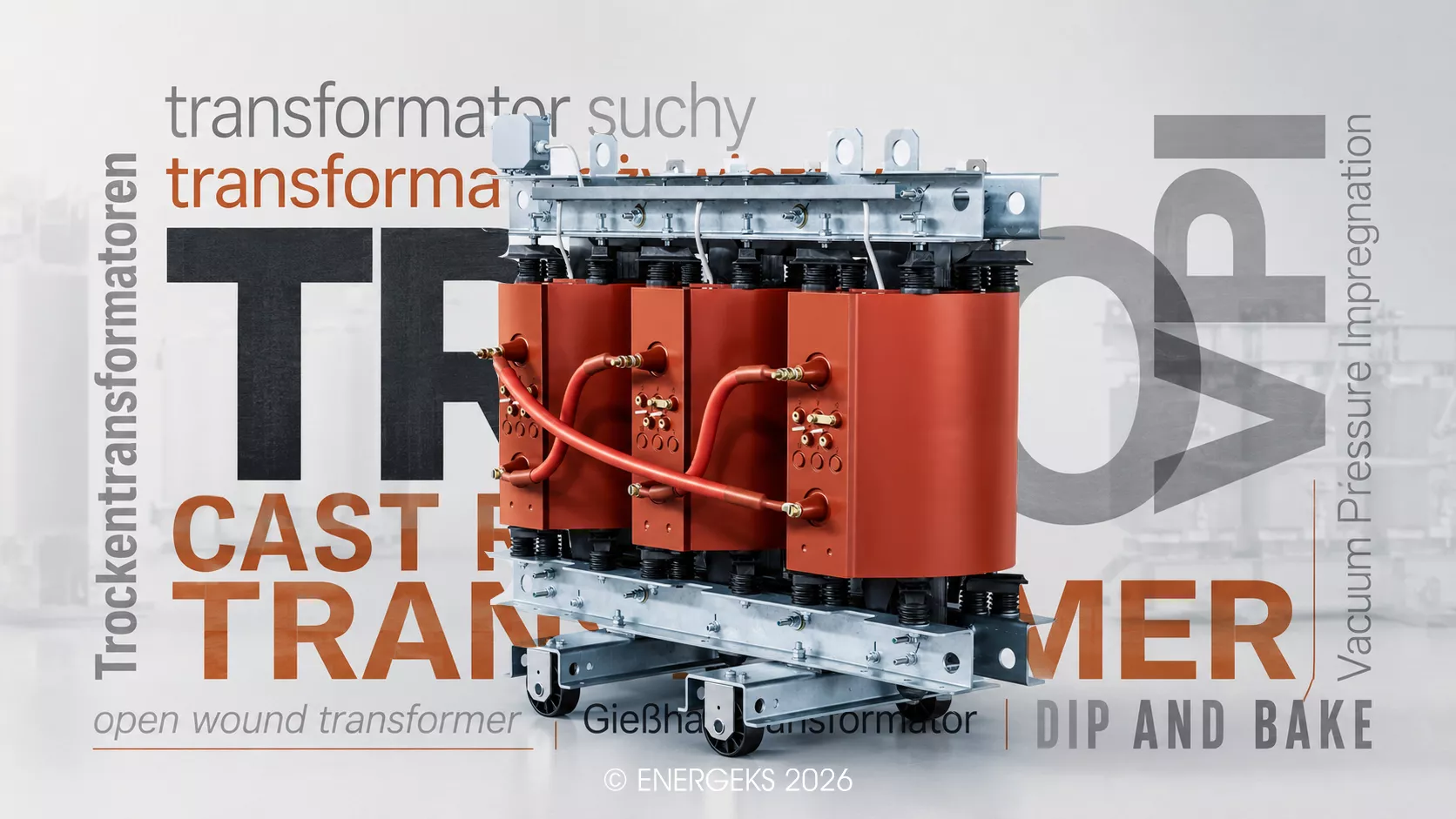
What does "dry‑type transformer" mean, and why is it not always cast‑resin?
A dry‑type transformer is not one type of device, but a group of transformers without insulating liquid. It can have air insulation, open‑wound windings, VPI impregnation, composite insulation, or full cast‑resin encapsulation with epoxy resin. The choice depends on the working environment, humidity, dust levels, fire safety requirements, cooling method, and ease of servicing.
A dry‑type transformer sounds simple. So simple that it is almost suspicious.
In the industry, a mental shortcut very often works: dry means cast‑resin.
Someone says "dry‑type transformer", and the other person immediately pictures windings cast up to the brim with epoxy resin. Solid, shiny, compact coils. No oil. No tank. No risk of leakage. Case closed.
Only technically, the case is not closed at all.
A dry‑type transformer is not one technology. It is a whole family of constructions where insulation and cooling are not based on an insulating liquid. There is no mineral oil or ester to remove heat while also providing insulation. Heat is dissipated mainly by air, and the winding insulation can be achieved in several ways.
And this is where the most interesting part begins.
A dry transformer can have air insulation.
A dry transformer can be VPI‑impregnated.
A dry transformer can be of the open‑wound type.
A dry transformer can have composite insulation.
A dry transformer can finally be cast‑resin – the most well‑known type – cast with epoxy resin.
Each of these belongs to the world of dry‑type transformers, but not all behave the same. They differ in resistance to moisture, dust, temperature, vibration, contamination, overloads, cooling method, and ease of servicing.
Therefore, the question "which dry‑type transformer to choose" should not start with the price.
It should start with the place of work.
Will the transformer stand in a clean technical room?
In an industrial hall with dust?
In a public building?
In an indoor substation? Near people?
In a humid environment?
In a place where low noise level matters?
Where any failure means costly downtime?
Only then does it make sense to discuss whether epoxy, VPI, air insulation or a special construction will be best.
This text organises the subject without unnecessary hype.
It will cover what a dry‑type transformer really means, what its types are, how air insulation differs from VPI and cast‑resin, where open‑wound works, and why epoxy resin is not always the only sensible answer.
Reading time: ~ 8 minutes
A dry‑type transformer is not one box, but several different design philosophies
Simply put, a dry‑type transformer is a transformer that is not immersed in an insulating liquid. In an oil‑filled transformer, the windings and core operate in oil or another insulating fluid. In a dry‑type transformer, this fluid is absent.
But the absence of oil does not mean the absence of insulation. This is very important.
The insulation must still withstand operating voltages, overvoltages, heating, ageing, vibrations, and mechanical stresses during short circuits. The difference is that this function is taken over by solid materials, air, varnishes, resins, insulating tapes, spacers, distancing elements, impregnation systems, and the design of cooling ducts.
That is why two dry‑type transformers of the same power can look similar in a table but behave completely differently in operation.
One will dissipate heat better but tolerate contamination less well.
Another will be more resistant to moisture but heavier and more expensive.
A third will be easier to service but will require a clean, well‑ventilated room.
A fourth will perform where a standard design would age too quickly due to chemicals, vibrations or elevated temperatures.
It is a bit like technical clothing. A sports shirt, a softshell, a rain jacket and a work coverall can all serve to protect the body, but no sensible person treats them as interchangeable. Each solution makes sense in a different environment.
The same is true for dry‑type transformers.
Which dry‑type transformer to choose – is every dry transformer an epoxy one?
Every epoxy cast‑resin transformer is a dry‑type transformer, but not every dry‑type transformer is epoxy.
This sentence is worth remembering, because it resolves half of the industry misunderstandings.
Epoxy, i.e. cast‑resin, is only one type of dry‑type transformer.
Very popular, often very good, but not the only one.
If a request for quotation only says "dry‑type transformer" without specifying the winding technology, offers for different constructions may appear.
One company will propose cast‑resin – a dry transformer with windings cast in resin.
Another will propose VPI – a dry transformer with vacuum‑pressure impregnated windings.
A third will propose an open‑wound construction – a dry transformer with open, ventilated windings.
A fourth, most interestingly, might propose dip and bake – a dry transformer with windings impregnated by dipping and baked in an oven.
Formally, all will be dry‑type transformers, but technically they will not be the same product.
This is where the risk of comparing apples to oranges begins.
The price may differ not because someone exaggerated their margin, but because different insulation systems, different environmental resistances, different cooling methods and different capabilities for working in harsh conditions are being compared.
Therefore, in a well‑prepared specification, it is not enough to write "dry‑type transformer 1000 kVA. It is worth specifying the winding technology, environmental, climatic and fire classes, cooling method, noise level, degree of protection of the enclosure, ambient conditions, room ventilation, temperature sensors and operational requirements.
A dry‑type transformer does not work in a vacuum.
It works in a specific building, a specific substation, a specific hall and specific air. And the air can be clean, dry and calm. Or it can carry moisture, dust, salt, chemical vapours and everything that electrical insulation very much dislikes.
Dry‑type transformer with air insulation
The simplest variant is a dry‑type transformer with air insulation.
In such a construction, air remains one of the basic elements of the insulation and cooling system. The windings are not fully encapsulated in a solid resin block. They are usually protected with an insulating varnish or resin in an impregnation process, for example by VPI or the simpler dip and bake method.
In practice, this means the winding is protected but not enclosed in a thick, solid mass of resin.
This gives several important advantages. Such a transformer can be lighter. It can dissipate heat well because air has easier access to the winding surfaces. It can also be easier to inspect and service because the construction is more open.
But there is another side.
If the working insulation largely remains air, the quality of that air becomes enormously important. Dust, moisture, conductive contaminants, aggressive chemical compounds and condensation can become real problems. This type of transformer needs a clean, dry and controlled environment.
This is not a flaw in itself.
It is simply a condition for correct application.
In a clean technical room, such a construction can work very well.
In a harsh industrial hall where dust is airborne and temperature and humidity change dynamically, much more caution is needed.
A transformer with air insulation is like a device that breathes well.
But since it breathes, it should not breathe dirt.
The illustration shows a dry transformer construction where the spaces between windings, insulators and supporting elements are clearly visible. This explains the principle of a dry transformer with air insulation: air participates in cooling and electrical separation, and the windings are not completely enclosed in a solid resin mass. Such a transformer likes clean, dry technical rooms.
Dry‑type VPI transformer
VPI stands for Vacuum Pressure Impregnation.
In this technology, the windings are saturated with resin or insulating varnish in a controlled process. First, air is removed from the spaces between turns, then the impregnating material is introduced under pressure. After curing, a structure is formed that is stronger, more stable and better protected than with simple varnishing.
The key point, however, is that VPI does not create the same effect as cast‑resin encapsulation.
In a VPI transformer, the windings are impregnated with insulation but are not completely sealed in a solid resin block. There is no uniform, massive epoxy block. Rather, we have an impregnated, reinforced and protected structure that still retains a more open character.
This gives an interesting compromise.
VPI can be more cost‑effective than cast‑resin.
It can dissipate heat well because the winding is not covered by a thick layer of resin. It can be lighter and more flexible in certain applications. It works well in many technical buildings, industrial facilities, switchgear rooms and applications where conditions are relatively controlled.
However, it is not a technology for every environment.
If the transformer is to operate in a place with high humidity, in air with conductive dust, in a chemical atmosphere or in an area exposed to salt, you need to check very carefully whether VPI is sufficient. Sometimes it will be. Sometimes VPE, cast‑resin or a completely different solution will be better.
Simply put: VPI is a reasonable compromise between price, cooling and resistance. But like any compromise, it works best when you know the operating conditions well.
he illustration shows a dry transformer with visible windings, supporting frame and insulators, which fits the VPI technology well. In a VPI transformer, the windings are saturated with varnish or resin in a vacuum‑pressure impregnation process, but are not completely cast in resin like cast‑resin. This gives a good compromise between insulation protection, cooling and cost.
Dry‑type open‑wound transformer
Open‑wound is a construction with open, air‑cooled windings.
Sometimes such transformers are described as AN (air natural) when cooling is by natural air movement without fans. In other cases, forced cooling (AF) with fans may appear.
In an open‑wound transformer, the windings are visible, ventilated and protected by electrical insulating materials. They are not enclosed in a resin mass.
Airflow is very important here, because it is responsible for heat dissipation.
The greatest advantage is effective cooling.
The open construction allows air to flow through the ducts and around the windings. This allows the transformer to dissipate heat efficiently to the surroundings. An additional advantage can be lower weight and simpler inspection.
The biggest limitation is sensitivity to the environment.
Open‑wound does not like moisture, dust, contamination or aggressive air.
In a clean indoor environment it can work very well. In a place where dust settles on the insulation, moisture creates conductive paths, and ventilation draws contaminants from the hall, problems can begin.
This solution is rather for interiors with controlled conditions.
Not for a random corner of a hall where "it will be fine".
In power engineering, "it will be fine" often later means "why is the protection tripping" or "why is the temperature rising faster than in the documentation".
The illustration shows a dry transformer with strongly exposed winding elements, insulators and air ducts. This captures the idea of an open‑wound construction – a transformer with open, ventilated windings. Such a design dissipates heat very well because air can flow more freely around the active parts. The price for this openness is simple: the transformer does not like moisture, dust and aggressive environments. It is a more precise technical piece of equipment than a "shovel‑for‑everything".
Dry‑type dip and bake transformer
Dip and bake is a simpler method of winding impregnation.
The windings are dipped in varnish or insulating resin, then dried and cured in an oven. Hence the name: dip and bake.
This is a well‑known, relatively simple method used in various electrical devices.
Compared to VPI, however, it usually has a lower ability to penetrate deeply into the winding structure. There is no such intensive air removal and pressure‑driven material injection.
Does this mean dip and bake is bad? No. It means it has its place.
It can be used in less demanding applications, at lower powers, in auxiliary devices, or where operating conditions are stable and do not require a higher level of protection. However, if the transformer is to operate in a more difficult environment, VPI or cast‑resin may provide a greater safety margin.
In practice, the difference between dip and bake and VPI is like the difference between painting wood on the surface and deep impregnation. Both protect. But not to the same degree.
Here we see a simplified representation of a dry transformer in a technical view that well illustrates the dip and bake method: the windings are protected by insulating material, but do not form a solid, full resin block like cast‑resin. In this technology, the windings are dipped in varnish or resin and then baked in an oven. The result is simpler, lighter and more economical, provided the transformer works in a clean and predictable environment.
Dry‑type cast‑resin transformer: resin rules
Cast‑resin, an epoxy‑cast transformer, is the most recognisable type of dry transformer. In this construction, the windings are cast in a resin medium which, after curing, forms a compact, mechanical and dielectric shield.
This is the type that many people have in mind when they say "dry‑type resin transformer".
Its greatest advantage is resistance. Epoxy resin protects the windings against moisture, contamination and mechanical damage. The construction is stable, compact and performs well in facilities where fire safety, absence of insulating liquid and operation inside a building are very important.
Such a transformer is often chosen for commercial buildings, hospitals, data centres, production halls, urban infrastructure, indoor substations, public buildings and installations where the risk of oil leakage would be hard to accept.
But cast‑resin is not magic ;-)
It is usually heavier and more expensive than simpler dry constructions.
The thick resin layer increases resistance but can also affect heat dissipation. Servicing the windings is more difficult because the coil is not open.
If serious damage occurs, repair can be less flexible than in more accessible constructions.
Therefore, a cast‑resin transformer is often a very good choice, but not always the optimal choice.
If the environment is clean, dry and controlled, and fire safety requirements are not particularly strict, VPI may be technically sufficient and economically sensible.
If the environment is very harsh, just the word "cast‑resin" does not exempt you from analysing environmental and climatic classes, enclosure, ventilation and the manufacturer's documentation.
The illustration shows a cast‑resin dry transformer – a construction with massive resin‑encapsulated windings. The red, compact winding blocks show what is most important in this technology: high protection against moisture, contamination and mechanical damage. This solution makes sense where the transformer cannot be a delicate princess of the infrastructure but must work calmly in a building, indoor substation or facility with higher safety requirements.
Dry‑type transformer with composite insulation
There are also dry transformers with composite insulation other than classical epoxy resin.
These can be solutions based on polyurethane resins, silicone resins or other special materials. They are used where standard solutions do not fully match the operating conditions.
This is a niche, but technically very interesting.
Such constructions can make sense in environments with elevated temperatures, strong vibrations, special chemical requirements, or where a certain flexibility of the insulating material is needed. It is not always about the insulation being as hard as possible. Sometimes it is more important that it withstands stresses, thermal cycles, vibrations or contact with a specific environment well.
In practice, such solutions require detailed agreement with the manufacturer. They are not chosen on the basis of "let's take something unusual because it sounds modern". They are chosen when the application truly requires it.
It is a bit like specialised tools. Most screws do not need to be turned with surgical instruments. But when you encounter an unusual problem, an ordinary wrench may not be enough.
The diagram presents a dry transformer as a modular construction where the windings, insulators and metal frame form a coherent system resistant to operation in demanding conditions. Such an image fits a dry transformer with composite insulation, where insulating materials are selected not only for voltage but also for temperature, vibration and chemical environment. It is a technology for situations where standard insulation says "I'm only here for a while", but the project needs something more robust.
Dry‑type transformer for a building. Air, VPI or epoxy?
In buildings, the topic of dry‑type transformers appears particularly often. The reason is simple. The absence of insulating liquid makes design easier in places where the transformer operates close to people, utility rooms, technical installations and high‑value infrastructure.
But not all buildings are the same.
In a clean, well‑ventilated technical room where humidity is controlled and dust is minimal, an air‑insulated or VPI transformer can be a sensible solution. It can dissipate heat well, be easy to inspect and cost‑effective.
In a building with high safety requirements – for example a hospital, data centre, shopping mall or infrastructure facility – a cast‑resin epoxy transformer can provide greater operational peace of mind, especially when resistance to moisture, contamination and limitation of fire risks are important.
In an industrial building, you need to look even more broadly. Is there dust in the air? Is it conductive? Is the transformer room separated from the production process? Does the ventilation draw clean air or air from the hall? Are there vibrations? Are there temperature spikes? Can condensation occur in winter?
Sometimes the difference between a good and a bad choice lies not in the transformer itself, but in the room where it is to operate.
A dry‑type transformer needs air. But not just any air.
Cooling of dry‑type transformers
In dry‑type transformers, heat must be dissipated to the surroundings. Most often by air. And this is a topic that is often underestimated at the purchase stage.
A transformer can have natural cooling, designated AN. This means that air flows by natural convection. Warm air rises, cooler air flows in from below, and the transformer dissipates heat to the room.
It can also have forced cooling, designated AF. Then fans support the airflow, increasing the cooling capacity and allowing temporary increases in load or improved thermal conditions.
Only a fan does not solve everything.
If the room is too small, poorly ventilated or hot, the fan will just mix warm air with even warmer air. If the air is dusty, the fan can deposit contaminants on the windings more quickly. If the ventilation grilles are poorly sized, the transformer may operate at a higher temperature than assumed.
And higher temperature means faster insulation ageing.
Insulation does not usually fail spectacularly on the first day. It ages quietly. Day after day. Cycle after cycle. Overload after overload. And then comes the moment when the system no longer has a margin.
Therefore, with dry‑type transformers you need to ask not only about the rated power, but also about losses, ventilation, ambient temperature, permissible overloads and how the winding temperature is monitored.
Insulation and the working environment
The biggest mistake when choosing a dry‑type transformer is thinking that because there is no oil, the environmental problem is smaller.
Sometimes it is smaller. But it does not disappear.
A dry‑type transformer can be very sensitive to the air that surrounds it. If the air is clean and dry, the situation is comfortable. If it contains dust, moisture, salt, metal particles, chemical vapours or conductive contaminants, the insulation has a much more difficult task.
In a cast‑resin transformer, the windings are better protected by the resin. In VPI, the protection is good but less massive. In open‑wound, the protection is more dependent on the cleanliness and stability of the environment. In composite solutions, everything depends on the specific material and purpose.
Therefore, environmental conditions are one of the most important selection criteria.
It is worth checking whether condensation can occur. Whether the room will be heated. Whether the station doors open directly to the outside. Whether the transformer will be periodically switched off, which can promote moisture absorption during temperature changes. Whether there are production processes nearby that generate dust or fumes. Whether the enclosure has the appropriate degree of protection but at the same time does not excessively restrict cooling.
There is no sense in buying a transformer resistant to everything if it works in ideal conditions. But there is even less sense in buying a more delicate construction if the environment is harsh.
Serviceability and access to windings
In dry‑type transformers, construction differences also affect service.
Open, air‑insulated and VPI constructions can be easier to inspect. More elements are visible. It is easier to assess contamination, hot spots, signs of partial discharges, the condition of the insulation surface and mechanical damage. In some cases, cleaning may also be easier.
Cast‑resin is more enclosed. This gives protection but limits access. If the winding is embedded in resin, it cannot be treated the same way as an open construction. In the event of serious damage, repair may be difficult or economically unviable.
This does not mean that cast‑resin is worse. It means it is different.
In many applications, higher resistance and lower environmental risk are more important than easier access to the winding. In other cases, service accessibility may be very important, especially when the transformer operates in a less critical application but requires regular maintenance.
Selecting a transformer is always a trade‑off. More protection may mean less access. More openness may mean better cooling but greater sensitivity to dirt. A lower purchase price may mean higher requirements for the room.
There is no free lunch. There is only a well‑calculated lunch.
When does which type make sense?
If the transformer is to operate in a clean, dry, well‑ventilated room and the application does not require high environmental resistance, an air‑insulated, open‑wound or VPI construction can be considered. Such solutions can be lighter, cost‑effective and thermally efficient.
If the environment is still controlled but the investor expects better winding protection and greater insulation stability, VPI is often a very sensible compromise. It gives better impregnation than simple varnishing and can perform well in industry and technical buildings.
If there is higher humidity, risk of contamination, higher safety requirements, or the transformer is to operate in a facility where reliability and resistance are particularly important, cast‑resin should be considered. This solution is more expensive and heavier, but often gives a greater safety margin.
If the application is unusual, for example involving high temperature, vibrations or a specific chemical environment, composite insulation or special designs agreed with the manufacturer may make sense.
The most important thing is not to select a transformer by its name alone.
"Dry" only tells you that there is no insulating liquid. It does not tell you how the windings are protected. It does not tell you how the transformer will withstand dust. It does not tell you how it will cope with moisture. It does not tell you whether it will be easy to service. It does not tell you whether it will be cost‑optimal.
That is just the beginning of the conversation.
The 6 most common mistakes when choosing a dry‑type transformer
The first mistake is assuming that dry means cast‑resin.
This leads to misunderstandings in offers, tenders and technical discussions.
The second mistake is comparing only power and price.
A 1000 kVA VPI transformer and a 1000 kVA cast‑resin transformer can have completely different properties. Power alone is not enough.
The third mistake is ignoring ventilation.
A dry‑type transformer dissipates heat to the air. If the room does not remove that heat, the problem will return as temperature, alarms and faster insulation ageing.
The fourth mistake is underestimating dust.
Dust in a house is annoying. Dust on electrical insulation can be much more serious, especially if it contains conductive particles or binds moisture.
The fifth mistake is choosing on the basis of "take the cheapest dry".
The cheapest variant may be good if it fits the conditions. If it does not, it becomes an expensive compromise.
The sixth mistake is not talking about service.
A transformer is supposed to work for years. Access, cleaning, temperature measurement, sensors, inspections and documentation are part of the real cost of ownership.
A simple decision map for the investor and designer
First, define the working environment.
Is it clean, dry and stable, or does moisture, dust, aggressive air or condensation risk occur?
Then, define the safety requirements.
Does the transformer operate in a building, near people, in critical infrastructure, in a public facility, in a production plant or in a separate station?
Next, check the thermal conditions. What is the ambient temperature? How does the ventilation work? What are the transformer losses? Is airflow provided for? Will the enclosure restrict cooling?
Only then comes the technology choice.
If conditions are mild, open‑wound, air‑insulated or VPI can be considered.
If conditions are moderately demanding, VPI often makes very good sense. If the environment is harsher or safety requirements are high, cast‑resin may be more appropriate.
If the application is special, composite insulation or a custom design must be considered.
Finally, price – but not as the only criterion.
Price should be compared only when comparing solutions with similar purpose and similar levels of resistance.
Otherwise, the tender table looks elegant, but the decision may be technically random.
FAQ in a nutshell
Is every dry‑type transformer cast‑resin?
No. Every cast‑resin transformer is a dry‑type transformer, but not every dry‑type transformer is cast‑resin. Dry means no oil or other insulating liquid. The windings can be protected by air, varnish, VPI impregnation, composite insulation or full epoxy encapsulation.
What is the difference between a VPI and a cast‑resin transformer?
A VPI transformer has windings impregnated with varnish or resin in a vacuum‑pressure process. A cast‑resin transformer has windings fully encapsulated in epoxy resin. VPI usually dissipates heat better and can be more cost‑effective. Cast‑resin gives higher protection against moisture and contamination but is heavier, more expensive and harder to repair.
When is a VPI dry‑type transformer a good choice?
A VPI transformer is a good choice when it operates in a clean, dry, well‑ventilated technical room. It is a reasonable compromise between price, cooling and resistance. It works well in many buildings, industrial plants and installations with controlled operating conditions.
When is a cast‑resin epoxy transformer better?
A cast‑resin transformer is a better choice where higher resistance to moisture, contamination and fire safety requirements matter. It fits indoor substations, public buildings, data centres, hospitals, shopping malls, production halls and facilities where operational stability is highly valued.
What is an open‑wound dry‑type transformer?
An open‑wound transformer is a dry transformer with open, ventilated windings. It dissipates heat very well but is more sensitive to moisture, dust and contamination. It works best in clean, dry, controlled technical rooms.
Which dry‑type transformer to choose for a building?
For a building, the transformer should be selected after analysing the working conditions. In a clean technical room, VPI or an air‑insulated construction may suffice. In a facility with higher humidity, risk of contamination or high safety requirements, a cast‑resin transformer more often makes sense.
Summary
A dry‑type transformer is not only the one cast to the brim with epoxy resin.
That is a convenient mental shortcut, but technically too narrow for this whole family of devices.
Dry primarily means the absence of insulating liquid.
It does not mean one single winding technology.
The simplest constructions use air insulation and varnish or resin impregnation.
VPI strengthens the windings through vacuum‑pressure impregnation.
Open‑wound gives very good cooling but requires a clean environment.
Composite insulations make sense in special conditions.
Cast‑resin provides high resistance thanks to full epoxy encapsulation, but usually means higher price, greater weight and more difficult service.
Therefore, the selection of a dry‑type transformer starts with one practical question:
Where will this transformer work?
Only the answer to this question leads to a sensible decision.
Will air insulation be enough?
Would VPI be better?
Is it worth choosing resin?
Is a special construction needed?
Or perhaps, for this application, an oil‑immersed transformer would be a better solution because the operating conditions, cooling, power or operational economics point to that technology.
In power engineering, a good decision rarely consists of choosing the most well‑known name.
More often, it consists of calmly matching the technology to the real life of the device.
And a transformer, like any device in infrastructure, has its own life. It breathes the air of the room. Well‑chosen, it works quietly and predictably. Poorly chosen, it quickly reminds you that mental shortcuts are convenient only until the first problem appears.
If you are at the stage of designing, modernising a substation or comparing offers, it is worth looking more broadly than just at power and price. At Energeks, we are happy to help select a solution for real operating conditions, without automatisms and without forcing one technology into every case.
You can check our offer for cast resin dry‑type transformers and oil‑immersed transformers, and if you want to follow more technical explanations about transformers, substations and power infrastructure, we also invite you to our Energeks LinkedIn profile.
Thank you for reading our technical articles.
Such topics are important because good power engineering begins not with flashy slogans, but with well‑asked questions.
SOURCES:
IEC 60076 11, Power transformers, Part 11, Dry type transformers.
GEAFOL® – Gießharztransformatoren in Schutzgehäusen mit Luft-Wasser-Kühlsystem by SIEMENS
Vacuum Pressure Impregnated (VPI) Transformers: All You Need to Know
Transformers in stock
Shipped from our warehouse in Poland within 2–3 working days, 5-year warranty. Full range 25–2500 kVA in the shop (prices in PLN).
The power industry loves paradoxes.
The largest devices in the power system very often depend on the smallest details. A transformer can weigh several tons, have a power rating of several megavolt-amperes, and operate continuously for 30 years. Yet the part that often decides its reliability is only a few centimetres in size.
It is the transformer terminal.
More precisely, the component that connects the medium voltage cable to the transformer bushing.
To someone outside the industry, it looks like an ordinary piece of metal with a few bolts. A detail that few people pay attention to, as long as everything works.
For a power engineer, it is a completely different story. It is one of the most critical points in the entire installation. Right here, high currents meet, mechanical forces from heavy cables act, temperature changes occur, and the very practical question arises: will this connection safely withstand years of operation in real conditions?
Transformer terminals are connection components mounted on the bushings of a medium voltage transformer. They enable safe connection of MV cables, increase the contact surface area of the conductors, and improve the mechanical stability of the connection.
This brings very concrete benefits.
Lower contact resistance.
Lower risk of connection overheating.
Greater predictability of transformer operation over a long service life.
That is why TOGA-type transformer clamps are often used in medium voltage transformers. They are not an aesthetic detail or a marketing add-on. They are a solution born from a very practical need. The need to better manage current, temperature, and connection mechanics in a place that looks unremarkable but in practice is of enormous importance.
And this article is about those issues.
We will show what TOGA-type transformer clamps are and how they are built.
We will look at why conventional cable connections at transformer bushings can be problematic.
We will explain how the clamp construction affects current, temperature, and contact resistance.
We will also examine why grid operators increasingly require stable connection solutions.
We will show, through examples, in which installations transformer clamps become fundamental to the reliability of the entire station.
Reading time: ~11 minutes
TOGA-type transformer clamps – the small component that keeps hundreds of amperes in check
Anyone who has ever stood next an open medium voltage transformer knows that moment.
You look at the massive machine. Several tonnes of steel, a magnetic core, oil, windings. Everything looks calm, heavy, almost majestic.
Then your eyes stop on something the size of a hand.
The clamp.
And this is where real engineering begins.
Because this is not an ordinary piece of metal.
It is a component that must flawlessly carry hundreds of amperes, withstand temperature changes, vibrations, and mechanical forces from cables, while maintaining very low contact resistance for years.
A TOGA-type transformer clamp acts as an adapter between two worlds.
On one side we have the transformer and its bushing – the point where energy exits the tank.
On the other side we have the medium voltage cable, often thick, heavy, and not very flexible.
The clamp introduces an additional conducting element between them, most often made of copper or its alloys. This element increases the contact surface, stabilises the conductor, and distributes mechanical forces over a larger area.
From the point of view of physics, three important things happen:
The current has a larger surface area through which to flow.
The metal-to-metal contact pressure is more even.
The connection is less susceptible to movement and stress.
The effect is simple: less heat, fewer problems, more operational peace.
The photo shows a set of medium voltage transformer clamps mounted on the porcelain bushings of an oil‑immersed transformer. Each clamp serves as the connection point for the MV cables, enabling safe and stable connection of the conductors to the transformer winding. The massive construction of the metal connection blocks increases the contact surface area and allows even current flow, which limits local heating and reduces the risk of energy losses. At the same time, the clamps take up the mechanical loads from the heavy cables, protecting the bushings from stress.
It is in this unremarkable place that all the physics of the transformer’s operation comes together – current, temperature and connection durability – which must remain stable for decades of service.
Photo CC: ENERGEKS 2026
Why conventional cable connections at transformer bushings can be problematic
Cable lug, bolt, tighten – done.
On paper, it works perfectly.
In reality, three very concrete problems appear.
The first is the weight and stiffness of the cable.
Medium voltage cables with large cross-sections are not delicate. They are heavy, springy constructions that very often do not want to go exactly where the design intended. If the cable comes in at an angle or is under tension, it starts acting like a lever and loads the bushing terminal.
The second problem is the contact surface area.
Metal does not make ideal contact with metal. Current flows through microscopic contact points. If there are few such points, current density increases, and along with it, temperature.
And suddenly, a small resistance starts turning into a local heat source.
The third problem is time.
A transformer does not operate in a perfect vacuum. There are vibrations, temperature changes, material expansion and contraction, short-term overloads. If the connection relies on only a single pressure point, micro‑movements can occur over time.
And micro‑movements in power engineering have a bad reputation.
Because they always end with degraded contact.
And this is precisely where the need for better solutions begins.
But even then, the story is not over.
Because once we have improved the mechanics and the electrical connection, another level of challenges appears. One that does not arise solely from current, bolts and cable geometry, but from the fact that the transformer works in the real world, not in a sterile laboratory. In an open station, in an environment full of moisture, dust, temperature variations and all that unwanted biological activity that power engineering knows all too well.
MV bushing covers – what they are and what they really protect against
At first glance, they look a bit like little black hoods.
And that is why they are easy to dismiss. Someone looks at the transformer, sees the bushings, clamps, porcelain, metal, and treats these covers as an extra. A technical trifle that just happens to be there.
Yet in power engineering, such trifles very often do the dirty work that allows everything else to operate calmly.
MV bushing covers are installed to protect the most sensitive area of the transformer connection point. This is where we have live parts, metal components, and relatively small insulation clearances. Exactly the kind of combination we do not want to expose to chance, weather and the creativity of nature.
Most often they are referred to as bird guards. And this is no exaggeration or industry legend. Birds really can cause trouble in a transformer station. All it takes is for one to perch in an unfortunate spot, brush a wing, come close to two points at different potentials, and physics immediately takes over. An arc appears, protection trips, and suddenly we have an outage that nobody planned.
It sounds unremarkable, but this is exactly what some of the most irritating operational problems look like. Not a major failure from a movie. Just a small incident that stops the equipment.
And this is where bushing covers come in.
All black, without any unnecessary fanfare. 😎
Their role is very simple. They make accidental contact with live parts more difficult and reduce the risk that something or someone creates a bridge between potentials.
A bird, a small animal, a branch, a metal object, and sometimes even a tool during service work – all of this can become a problem if it gets too close to where theory ends and medium voltage begins.
A cover does not, of course, make the transformer armoured and indifferent to the whole world. But it very effectively reduces the risk of the simplest, most absurd and, unfortunately, entirely real events. The kind after which one looks at the report and thinks: really? because of that?
Well, yes.
That is why MV bushing covers are no gimmick. They are a practical safeguard that supports the reliability of the transformer from its most mundane side. They do not improve the catalogue glamour of the device. They improve its chances of calm, long-term operation in the real world.
And the real world, as we know, does not always cooperate.
The photo shows medium voltage bushing covers installed on an oil‑immersed transformer. These unassuming black covers protect the critical connection points against accidental contact with live parts and reduce the risk of flashovers caused by birds, small animals and other external factors. They are a simple but very important protective element that supports the safety and operational reliability of the transformer in daily service.
Photo CC: ENERGEKS 2026
From a project perspective, the most sensible approach is when the entire connection system can be selected as a coherent solution, rather than assembled later from random components. Depending on the needs of the investment, these can be transformers equipped with terminal clamps, clamps for a specific type of connection, or MV bushing covers that increase operational safety. Such solutions are available in the Energeks offer; therefore, for a specific project, it is best to simply discuss the configuration and match it to the real operating conditions of the station – and the easiest way to do this is to contact us directly.
How the clamp construction affects current, temperature and contact resistance
Here begins that part of power engineering that looks unremarkable from the outside but is pure physics on the inside.
And as is the case with physics, you can disagree with it, but it will do its job anyway.
At first glance, a transformer clamp is simply a metal component that connects the cable to the transformer. Except that current does not behave as politely as we would like to imagine. It does not flow ideally through the entire contact surface like a beautifully spread sheet of water.
In reality, it flows through those places where metal truly touches metal. And there are far fewer of those contact points than intuition suggests.
That is exactly why the construction of the clamp matters so much.
If the contact surface is larger and the pressure is more evenly distributed, more actual contact points appear. This in turn lowers contact resistance. And lower contact resistance means one thing: less heat where we least want to see it.
Because resistance and temperature are a pair that very quickly show their claws. Joule’s law clearly states: the power dissipated in the connection increases with the square of the current. This means that even a small resistance, under a high operating current, can turn into a local source of heating. First, a few extra degrees appear. Then the material starts to operate hotter, ages faster, and the connection gradually loses its original parameters.
A transformer clamp does three very important things at once.
First, it increases the contact surface area, so the current has more space to flow calmly.
Second, it distributes the contact pressure better, so the connection does not rely on only one small fragment of metal.
Third, it stabilises the whole assembly over time, reducing the risk of micro‑movements that, over the years, can degrade the quality of the contact.
The effect is simple, though extremely valuable from an operational point of view. The current does not concentrate in one tight spot but spreads over a larger area. The temperature of the connection remains lower. And a lower temperature means calmer, more predictable transformer operation.
It can be compared to traffic. The same number of cars squeezed onto a single narrow street quickly creates chaos. When they are given a wide road, everything flows much more calmly. Current behaves similarly. It also likes to have space.
That is why a well‑designed clamp is not a technical detail for the sake of principle. It is a component that helps keep three things in check at once: current, temperature and connection durability. And for a transformer operating for decades, that is truly no small matter.
Why grid operators increasingly require stable connection solutions
Grid operators have one big advantage over the rest of the market.
They do not see a single transformer; they see a whole repeated picture of operation.
For the designer, a transformer is a device selected to meet technical parameters. For the investor, it is an element of a larger puzzle. For the grid operator, it is part of a system that must operate calmly not for one or two years, but for 30, sometimes 40 years.
And it is this perspective that changes everything.
Because when you look at thousands of devices operating in different locations, under different weather conditions and different loads, you very quickly see which solutions age well and which only look good on the day of acceptance.
Every failure, every thermal imaging report, every overheated connection and every case of degraded contact goes into the analysis. At first, it is a single event. Then a second. A third. A tenth. And suddenly it becomes clear that this is no longer a coincidence, but a recurring pattern.
And power engineering does not like recurring problems.
That is why operators are increasingly looking not only at the transformer’s power, loss levels or insulation parameters, but also at how the cable connections are designed. Whether the connection is mechanically stable. Whether the contact surface is sufficient. Whether the arrangement can withstand the stresses from heavy cables, vibrations, temperature changes and years of operation.
Because practice shows something very interesting.
In many cases, the transformer itself, as a machine, works flawlessly. The windings are in good condition, the oil maintains its parameters, the core operates stably. The problem does not begin in the heart of the device.
The problem begins at its interface with the outside world.
Exactly where the cable connects to the transformer.
And that is the moment when a detail ceases to be a detail.
It becomes an element of the entire station’s reliability.
It is from this logic that the operators’ technical requirements arise. The more operational experience, the more attention is directed to the construction of bushings, the method of making cable connections, the stability of clamps and the resistance of the whole connection system to real operating conditions.
Because ultimately, the operator does not buy just the transformer.
The operator buys operational peace.
The photo shows a set of medium voltage transformer connection components: a transformer clamp, a porcelain bushing and a bushing cover that protects the critical point from environmental influences. It is here that current, mechanics and operating conditions meet, which is why each of these components must be consciously selected and work as a coherent system. In practice, this means one thing: reliability begins with a detail, and a well‑designed connection is not an accident but the result of properly selecting all the components that together create a safe and durable connection.
Photo CC: ENERGEKS 2026
Where transformer clamps show whether the project was truly well thought out
There are installations where the transformer has a rather comfortable life. It runs steadily, the cable arrives without too much acrobatics, the load does not do a rollercoaster every day, and everything looks as neat as in the nice drawing from the project.
But there are also places where reality quickly verifies whether the connection at the transformer was designed with intelligence or simply so that it could be bolted together and the matter closed.
And there, transformer clamps cease to be a technical curiosity.
They become a very practical test of the quality of the whole solution.
Take photovoltaic farms.
Everything seems simple.
There is energy production, there is a transformer, there is a power output to the grid. End of story. Except that the transformer in a PV farm operates under conditions that like to test the patience of materials. In the morning the system wakes up, then power rises, then full sun comes, a cloud passes, sun again, ambient temperature does its thing, and along with it the operating conditions of the connections change. This is not the calm, uniform life of an old distribution transformer that does roughly the same thing for half a day. Here current and temperature can change dynamically, and each such cycle means work for the material, the contact pressure and the contact interface.
Add to this the cables. Thick, heavy, serious, with character. Cables that have no intention of lying down gently just because someone drew a nice route on the plan. If the connection at the bushing is weak or too sensitive to stress, the PV farm will show it quickly. And it will do so without sentiment.
Very similar is the case in industrial installations.
Here the emotional stakes rise even higher, because on the other side of the cable there is often a process that really does not like downtime.
Steelworks, foundries, chemical plants, large logistics centres, data centres, plants with production lines operating in continuous mode. In such places, the transformer does not supply an abstract power from a table. It supplies concrete work, concrete machines, concrete money that either flows or stops flowing. If the connection at the transformer starts to heat up, age or lose stability, it is no longer a minor technical defect. It is the beginning of a problem that can affect the entire facility.
That is why, in industry, no sensible person wants the critical point of the system to behave like a moody paving stone after the first winter. The connection has to be stable, predictable and boring in the best possible sense. It simply has to work.
There are also container stations.
The place where theory very quickly meets tight reality.
Here every centimetre matters. Cables enter from below, the switchgear stands close, the transformer has its dimensions, and the person responsible for installation suddenly discovers that the planned geometry was beautiful until the real cable appeared. Not the one from the brochure, but the real one – stiff, heavy and moderately interested in cooperating.
Under such conditions, even a good connection can get out of breath if it does not have adequate stabilisation. The cable rarely comes in perfectly straight, the manoeuvring space is limited, and every unnecessary stress‑inducing twist later affects the terminal and the quality of the contact. This is where a well‑designed clamp shows its true value. Not in a folder, but when you have to manage physics, space and cable weight all at once.
There are also installations that are more environmentally demanding.
For example facilities with large temperature variations, outdoor infrastructure, or locations where the transformer has to operate in an environment of dust, moisture and constant changes of conditions. There, every detail of the connection matters even more, because the connection does not work in a comfortable laboratory but in a world that regularly checks whether everything was done properly.
That is precisely why solutions that increase the contact surface and mechanical stability are not a luxury for hardware aesthetes. They are simply a sensible response to operating conditions.
Because the truth is rather amusing, though for operation it is less amusing.
The transformer can be excellent.
The core solid, the windings well‑made, the oil within spec, everything looks as it should.
And then all that majesty of several tonnes of equipment can be put to the test by a few centimetres of metal at the connection point.
A related topic worth knowing:
Why an MV transformer bushing terminal has one or two holes?
f you want to better understand why even such a small detail as the cable attachment method matters, take a look at our article about the construction of MV bushing terminals. We show there where the difference between one and two mounting holes comes from and how it affects the stability of the connection and its durability over time.
Where to get such a transformer, clamps and those hoods?
And here we come to a very practical question.
Because theory is theory, physics is physics, and temperature curves look beautiful in an article, but in the end someone has to close the topic.
You need to select the transformer.
You need to select the clamps.
You need to plan the bushing covers. You need to make sure that everything fits together not only in the catalogue but also later on the real station, with the real cable, real installation and real operator requirements.
And this is where the difference begins between assembling a system from random components and designing a solution that makes sense as a whole.
You can look at the transformer as a separate product, the clamps as separate hardware, and the covers as yet another add‑on to order. But in power engineering practice, these things do not work separately. They meet at the same place, on the same connection, under the same current, temperature and the same pressure of reality.
That is why the most sensible approach is to think about them together.
In the Energeks offer you can find both low‑loss medium voltage oil‑immersed transformers and cast‑resin dry‑type transformers. You can contact us about selecting transformer clamps and medium voltage bushing covers.
In this way, the entire system can be selected coherently, for a specific project, for the cable routing method, for the installation conditions and for the requirements of a given installation. Without guessing, without improvisation at the end of the investment and without nervously wondering whether all the components will really work together as they should.
And that really matters in power engineering.
Because sometimes the reliability of a transformer is not only decided by what is inside the tank.
What happens on the outside can be just as important. On the bushings, on the clamps, at the interface between the cable and the device. In all those places that do not make a great impression in a long‑distance photo, but which can make a great difference after several years of operation.
If you like technical stories from the power industry told without pomposity but with respect for detail, we also invite you to our LinkedIn.
Referencje:
IEEE Power Transformer Handbook
Pfisterer – Technical documentation (MV connection technology)
Transformers in stock
Shipped from our warehouse in Poland within 2–3 working days, 5-year warranty. Full range 25–2500 kVA in the shop (prices in PLN).