Power Systems

A transformer clamp is a small part that carries the full LV current – on a 630 kVA transformer that is over 900 A per phase. If it is the wrong size, it overheats, works loose and can eventually damage the bushing. Choosing one comes down to four questions: what current flows on the LV side, what thread the bushing stud has, how many conductors you connect, and whether the clamp sits on a phase or on the neutral.
1. Work out the LV current
The rated current on the low-voltage side follows from the transformer's rated power:
I = S / (√3 × U)
S is the rated power in VA (kVA × 1000) and U the rated LV voltage – usually 400 V or 420 V for distribution transformers. Example for 400 kVA at 420 V: 400,000 / (1.732 × 420) ≈ 550 A.
2. Check the thread of the LV bushing stud
The clamp screws directly onto the bushing stud, so its internal thread must match the stud. LV bushings of oil-immersed transformers are made to EN 50386, and the stud diameter grows with the bushing current. On distribution transformers up to 630 kVA you will mostly find three sizes:
| Transformer rating | LV current at 400 V | LV current at 420 V | Stud thread | Clamp rating |
|---|---|---|---|---|
| 63 kVA | 91 A | 87 A | M12 | 250 A |
| 100 kVA | 144 A | 138 A | M12 | 250 A |
| 160 kVA | 231 A | 220 A | M12 | 250 A |
| 250 kVA | 361 A | 344 A | M20 | 630 A |
| 400 kVA | 577 A | 550 A | M20 | 630 A |
| 630 kVA | 909 A | 866 A | M30 | 1000 A |
The table shows the typical case, but manufacturers do not always follow it – so we always check the thread on the stud itself or in the transformer documentation (datasheet, dimension drawing). Above 630 kVA the current exceeds 1000 A and larger studs or busbar connections are used – that calls for an individual selection.
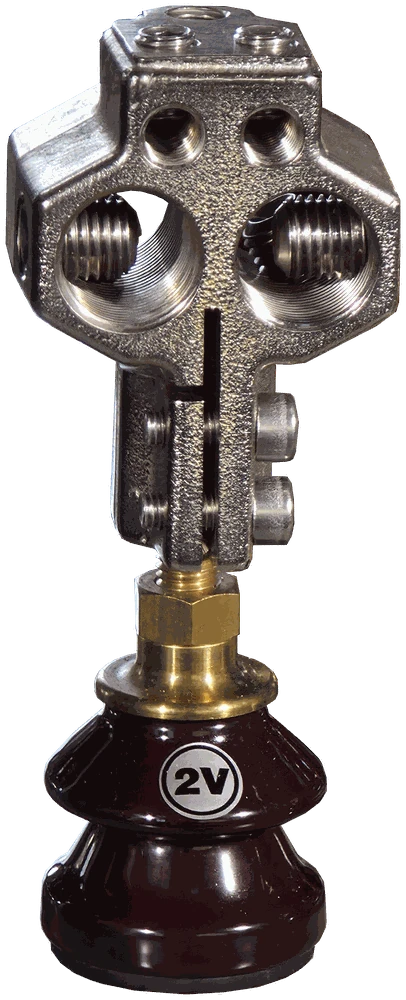
TOC-1 clamp screwed onto the LV bushing stud of a MarkoEco2 transformer.
3. Count the conductors per phase
Horizontal clamps take two main and two auxiliary conductors per phase. For TOC clamps that means:
- main conductors: 2 × 95–240 mm² (RE, RM, SM conductors) or 2 × 300 mm² RMC – aluminium or copper,
- auxiliary conductors: 2 × 2.5–50 mm² – e.g. for metering, the substation's auxiliary supply or an LV surge arrester.
Conductor codes: RE – solid round, RM – stranded round, SM – stranded sector-shaped. The conductors go straight into the sockets and are clamped by screws, with no crimped cable lugs. Grid operators see it the same way – the Polish DSO TAURON Dystrybucja, in its standard for MV/LV transformers, specifies LV clamps for direct conductor connection without crimped lugs, in a cable or a busbar version.
Cable size and number are the designer's call – based on current-carrying capacity, installation method, voltage drop and short-circuit conditions. The clamp has to physically accept them. If you need more than two main cables per phase, or the transformer is connected to the LV switchgear by busbars, choose a busbar clamp. See our overview of types of transformer clamps.
4. Phase or neutral – /U and /N versions
One transformer needs a set of four clamps: three for the phases and one for the neutral. In the TOC series, /U is the phase clamp and /N has an extra stud (two on TOC-2/N) for the neutral or earthing conductor or an earthing strip. Some operators require that a 25 × 4 mm earthing strip can be connected to the neutral clamp – Energa-Operator's requirements for MV/LV transformers are one example. TOC clamps in the /N version allow this.
TOC-1 or TOC-2?
Both clamps share the same thread, current rating and connection capacity – they differ in shape and in how much room they take on the tank cover.
| TOC-1 | TOC-2 | |
|---|---|---|
| Design | body with offset foot, two locking screws under the head | compact head, slotted stem, locking screws on the side |
| When to choose | thick cables, easy access to the sockets | LV bushings close together, little room on the cover |
| Catalogue no. | DP 5100–5300, DP 5100N–5300N | DP 6100–6300, DP 6100N–6300N |
Product pages: TOC-1 transformer clamp and TOC-2 transformer clamp.
Selection in practice – three examples
- 160 kVA, two 120 mm² cables per phase: M12 stud, approx. 231 A → 3 × DP 5100 + 1 × DP 5100N (TOC-1).
- 400 kVA in a container substation, little space between bushings: M20, approx. 577 A → 3 × DP 6200 + 1 × DP 6200N (TOC-2). How to select the transformer itself for such a station is covered in how to select an MV transformer for a container substation.
- 630 kVA, two cables per phase as per design: M30, approx. 909 A → 3 × DP 5300 + 1 × DP 5300N (TOC-1).
What to include in your enquiry
- transformer rating and type, or the LV stud thread,
- number and size of cables per phase, plus auxiliary conductors,
- version: TOC-1 or TOC-2 (if unsure – we will advise),
- whether you need OZNN insulating covers,
- number of sets and delivery date.
The full range is in our transformer clamps category. We ship clamps from stock in Poland – separately or fitted to a MarkoEco2 transformer before dispatch. How to install a clamp so that it does not overheat is explained in why transformer clamps overheat.
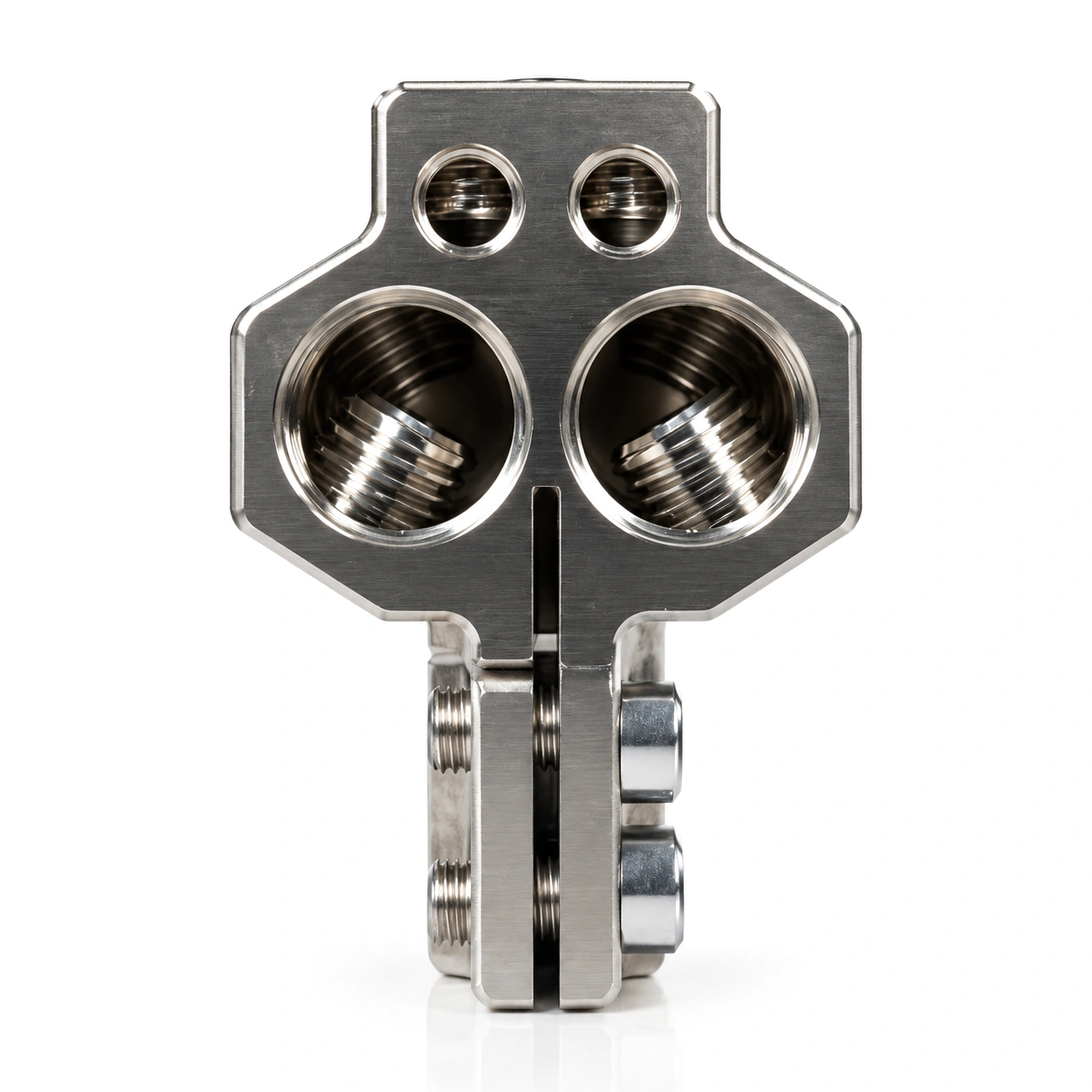 TOC-1 – horizontalM12 / M20 / M30, 250–1000 A, 2 × 300 mm²
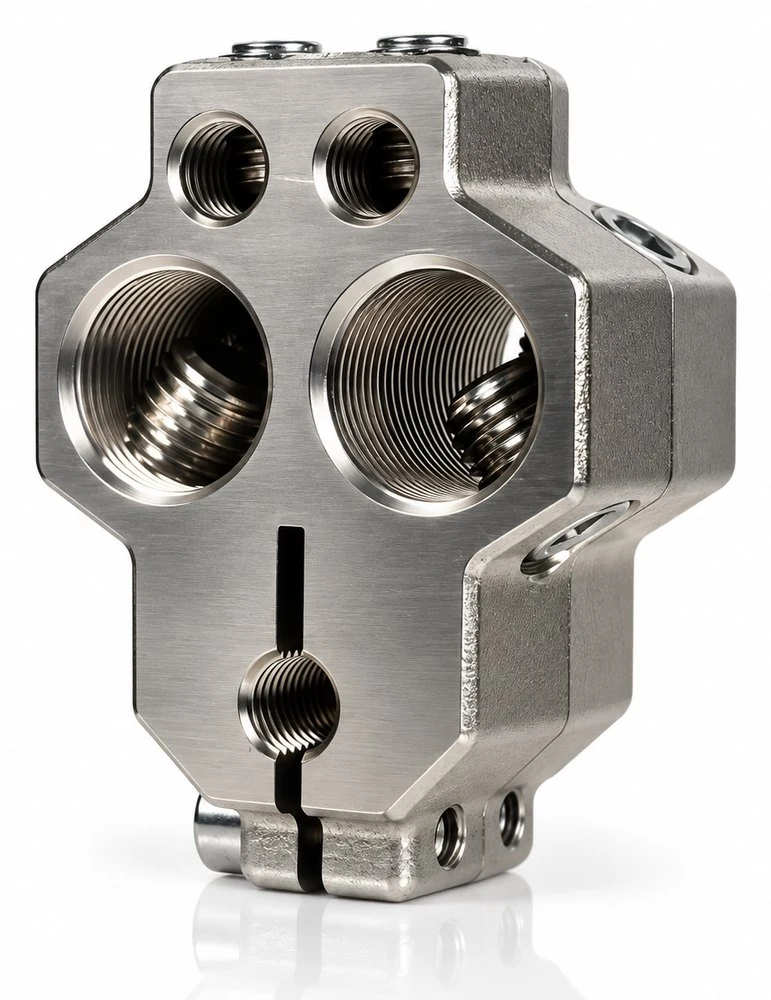 TOC-2 – compactsame connection capacity, smaller footprint
A “transformer clamp” is in practice several different products. On the LV side they connect cables or busbars to the bushing studs; on the MV side they connect conductors to the high-voltage bushings, sometimes together with a surge arrester. Below is an overview of the types you will find in MV/LV substations and tips on when to use which.
Where a transformer clamp works
The clamp screws onto the threaded stud of the bushing insulator and is locked with one or more screws. On the other side it has sockets for the cable conductors or a flat face for a busbar. Grid operators' standards – for example that of the Polish DSO TAURON Dystrybucja for MV/LV transformers – provide two LV variants: clamps for conductors or cables and clamps for a busbar connection, in both cases without crimped lugs, in a set of three phase clamps and one neutral clamp.
Horizontal cable clamps (LV)
The most common type in substations with transformers up to 630 kVA. They take the cables out horizontally from the stud and accept two main and two auxiliary conductors per phase – aluminium or copper. At Energeks this is the TOC series: M12, M20 or M30 thread, 250, 630 or 1000 A, main conductors 2 × 95–240 mm² (RE, RM, SM) or 2 × 300 mm² RMC, auxiliary 2 × 2.5–50 mm².
TOC-1 – with an offset foot
Two locking screws on the foot under the head, sockets higher above the cover. Convenient with thick cables – it is our standard for MarkoEco2 transformers. TOC-1 clamp page.
TOC-2 – compact
Sockets in a single compact head, a slotted stem and locking screws on the side. It takes less room on the cover, so it works well where the LV bushings are close together. TOC-2 clamp page.
Neutral clamps with earthing
The fourth clamp in the set sits on the neutral bushing. Besides the cable sockets it has a stud (or two) for the earthing conductor, N/PE or an earthing strip. In the TOC series these are the /N versions: DP 5100N–5300N (TOC-1) and DP 6100N–6300N (TOC-2). Some operators require that a 25 × 4 mm earthing strip can be connected to the neutral clamp (e.g. Energa-Operator) – the /N versions of the TOC series allow this.
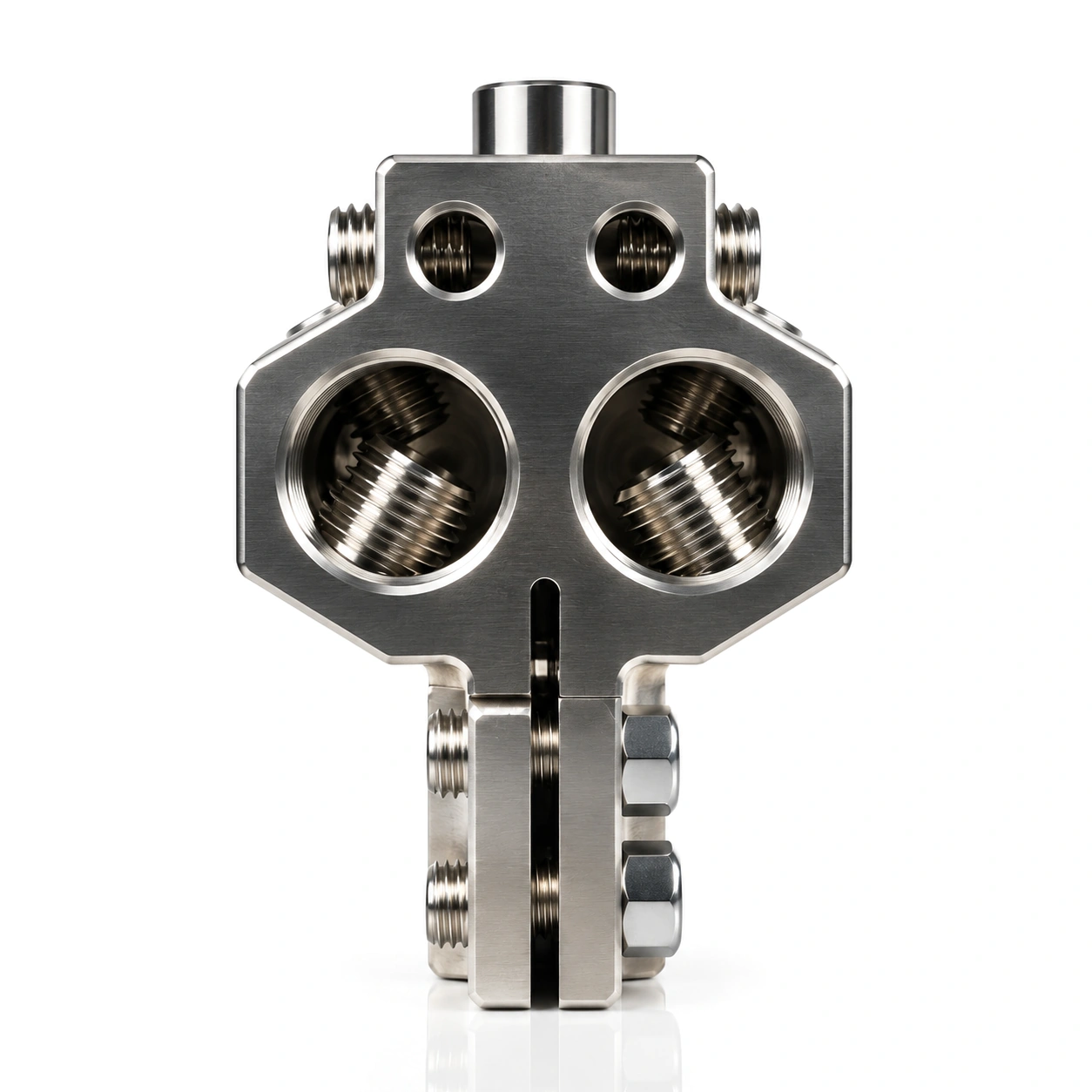
TOC-1/N – version with an extra stud for the neutral or earthing conductor.
Busbar clamps (LV)
When the transformer is connected to the LV switchgear by busbars, clamps with a flat face for the busbar are used instead of cable sockets. Forged MK busbar clamps screw onto the stud and are locked with one screw (MK 1) or two (MK 2, MK 5). They take busbars up to 40 mm wide (MK 1, MK 2) or up to 100 mm (MK 5), on studs from M12 to M30. Energeks supplies MK 1, MK 2 and MK 5 from stock in Poland.
MV bushing clamps
On the high-voltage side the clamp connects the MV conductor to the bushing of the distribution transformer. ZGU clamps (M12 connection thread, 70 mm² conductor) are made of tin-plated brass with stainless steel screws and are fitted with a single wrench. The ZGU-OP version allows an MV surge arrester to be mounted directly on the bushing stud, without additional parts. The design limits torsional forces transferred to the internal parts of the transformer. ZGU and ZGU-OP are available from stock.
Clamp covers
An insulating cover fitted over the clamp protects against accidental contact and short circuits caused by birds and rodents. The TAURON Dystrybucja standard requires LV clamp covers made of a self-extinguishing, flexible material. The OZNN cover is made of flexible, self-extinguishing rubber in three sizes – M12, M20 and M30 – and fits TOC-1, TOC-2 and MK 1 clamps.
Comparison at a glance
| Type | Side | Purpose | Thread / range | Example |
|---|---|---|---|---|
| horizontal cable clamp | LV | 2 main + 2 auxiliary conductors per phase | M12 / M20 / M30, 250–1000 A | TOC-1/U, TOC-2/U |
| neutral clamp with earthing | LV, neutral | cables + earthing conductor, N/PE or earthing strip | M12 / M20 / M30 | TOC-1/N, TOC-2/N |
| busbar clamp | LV | busbars up to 40 mm or up to 100 mm | M12–M30 | MK 1, MK 2, MK 5 |
| MV bushing clamp | MV | 70 mm² MV conductor, optional surge arrester | M12 | ZGU, ZGU-OP |
| cover | LV | protects the clamp against contact and animals | – | OZNN (M12 / M20 / M30) |
How to choose
- cables to the LV switchgear → TOC-1 or TOC-2 cable clamp (thread and current as described in how to choose a transformer clamp),
- busbars → MK busbar clamp matching the busbar width,
- neutral → /N version,
- MV side with a surge arrester on the bushing → ZGU-OP,
- substation exposed to birds and rodents → covers on all LV clamps.
All types in one place: Energeks transformer clamps.
TOC-1 – horizontalM12 / M20 / M30, 250–1000 A, 2 × 300 mm²TOC-2 – compactsame connection capacity, smaller footprint
The decision on selecting a medium‑voltage (MV) transformer is usually made at an early stage of the project – when the investor knows the current power demand but rarely has certainty about what the installation will look like in five or ten years. Yet it is the MV transformer, as the heart of the transformer station, that largely determines whether the future expansion of a plant, PV farm, energy storage system or production line will be a simple engineering task or a costly rebuild of the entire power infrastructure. In this article, we answer the most frequently asked questions about selecting an MV transformer with future installation expansion in mind.
What is an MV transformer and what role does it play in an installation?
An MV transformer is a device that transforms voltage from medium level (most often 6, 10, 15 or 20 kV) to low voltage (0.4 kV) for use by consumers in a plant, or conversely – in the case of energy‑generating installations such as photovoltaic farms or energy storage systems (BESS) – steps up the voltage from low to medium level before feeding energy into the distribution grid. The MV transformer is therefore the boundary point between the distribution system operator's (DSO) grid and the consumer's or generator's internal installation.
From the perspective of expansion planning, the MV transformer acts as a bottleneck, it determines the maximum power that the installation can draw or feed into the grid at any given time.
As long as the demand is within the transformer's rated power, expansion mainly involves adding new loads or sources.
When demand exceeds the available power, the transformer must be replaced, an additional station built, or other usually costly modifications made to the power supply system.
How to select the MV transformer power with future expansion in mind?
The selection of MV transformer power should take into account not only the current load but also a realistic, justifiable scenario for the installation's development over the next 10–15 years – the typical service life of this type of device before its first major overhaul or replacement.
In practice, engineers use several approaches:
Analysis of investment plans – if the investor plans to expand the production hall, add a production line, EV charging stations or a PV installation within a few years, the transformer power should immediately account for these scenarios, even if implementation is staged.
Power margin factor – a margin of 20–40% above the current peak load is commonly adopted, although in facilities with dynamic growth (e.g., data centres, industrial plants in expansion), this margin can be higher.
Load character analysis – installations with a large share of non‑linear loads (inverters, variable frequency drives, EV chargers) generate additional harmonic loads, which should be considered at the power selection stage rather than only during modernisation.
Station modularity – transformer stations are increasingly designed so that the foundation, enclosure and MV switchgear bay allow for the future installation of a second transformer operating in parallel, without building a new station from scratch.
Excessive oversizing of the transformer, however, has its drawbacks, which are discussed in the next section.
Is it worth oversizing the MV transformer as a reserve?
This is one of the questions investors ask most often, and the answer is not straightforward. Oversizing an MV transformer – i.e., selecting a power significantly higher than the current demand – has both advantages and significant disadvantages.
Advantages of oversizing:
ability to connect new loads or sources without replacing the transformer,
lower total cost over many years compared to a double investment (buying a smaller transformer and then replacing it),
lower risk of installation downtime during future expansion, as work is limited to connecting new circuits rather than replacing the main device.
Disadvantages of oversizing:
a transformer operating continuously at low load (below 30–40% of rated power) has poorer energy efficiency – no‑load losses (core losses) burden the installation's energy balance regardless of power consumption,
higher investment cost frozen for years until expansion actually takes place,
larger dimensions and weight of the device, which may require a larger station, a stronger foundation and more expensive transport,
in RES installations – possible restrictions or different connection conditions from the DSO if the declared power significantly exceeds the actual demand at start‑up.
The recommended compromise is usually the previously mentioned 20–40% margin and, where possible, designing the station to allow a second transformer to be installed in the future, rather than a one‑time, significant oversizing of the first unit.
What are the costs of underestimating transformer power?
The opposite situation – selecting an MV transformer exactly for current needs, with no margin – also carries risk that only becomes apparent at the expansion stage.
The most common consequences of underestimation include:
the need to replace the transformer along with the associated infrastructure (MV cables, protection devices, sometimes also the MV switchgear if its rated parameters prove insufficient),
installation downtime during replacement, which in production plants means direct financial losses,
extended connection procedure – increasing the connection capacity with the DSO means a new application, new connection conditions, and often also modernisation of the grid infrastructure on the operator's side, which can take many months,
loss of value of the original investment – a transformer that has not yet reached the end of its service life must be dismantled and sold or scrapped, which rarely allows a significant portion of the costs to be recovered,
additional design and administrative costs – a new technical design, renewed consultations with a fire protection expert, updating the as‑built documentation.
In practice, the cost of replacing an MV transformer along with the associated work can be several times higher than the difference in purchase price between a unit selected "on the edge" and one with a reasonable power margin.
How much does it cost to replace an MV transformer with a larger one?
The cost of replacing an MV transformer depends on many variables, so it is difficult to give a universal figure, but it is worth knowing the cost structure to consciously compare it with the cost of appropriate oversizing at the start of the investment.
The total replacement cost typically includes:
the price of the transformer itself (depending on power, type – oil or dry, manufacturer and additional parameters such as connection group or noise level),
the cost of dismantling the old unit and disposing of or reselling the insulating oil (in oil‑immersed transformers),
possible modernisation of the MV and LV switchgear bays if the current parameters of the new unit require it,
the cost of transport and crane – MV transformers weigh from several hundred kilograms to over a dozen tonnes,
design costs, DSO approvals and, in many cases, a fee for increasing the connection capacity,
the cost of production downtime or a break in energy generation during the work.
For this reason, a TCO (Total Cost of Ownership) analysis at the transformer station design stage should consider not only the purchase price but also the probability and cost of any future replacement.
Which MV transformer parameters matter when planning expansion?
Beyond rated power, when planning installation expansion, several additional MV transformer parameters should be considered:
Short‑circuit voltage (uk) – affects voltage drops at high loads and protection selection; with planned expansion, it is worth checking whether the typical uk value will not limit the future connection of additional loads sensitive to voltage fluctuations.
Connection group – important especially for installations with distributed generation (PV, BESS), where incorrect selection can lead to synchronisation problems or protection selectivity after new sources are added.
Tap range (tap changer) – the ability to adjust the ratio within a certain range makes it easier to match the LV voltage as the load profile changes during expansion.
Insulation class and cooling type (ONAN, ONAF, AN, AF) – oil‑immersed transformers with forced cooling (ONAF) can temporarily operate at a power higher than the ONAN rating, which is sometimes used as a "buffer" during the implementation of the target expansion.
Dimensions and weight – if the transformer station is to accommodate a larger unit in the future, adequate space, foundation strength and door and transport route dimensions should be planned at the design stage.
How does the expansion of a photovoltaic installation or energy storage system affect MV transformer selection?
In RES installations and BESS systems, the expansion topic has a slightly different character than in classical industrial plants, because the MV transformer power determines not only the ability to draw energy but primarily the ability to feed it into the grid.
Key issues in this context:
Connection conditions issued by the DSO – the MV transformer's rated power should be consistent with the connection capacity specified in the conditions, while being flexible enough to allow future generation capacity increases without the need to apply for entirely new connection conditions from scratch.
Staged expansion of a PV farm – installations are increasingly being designed with future addition of further panel sections or inverters in mind; an MV transformer selected with adequate reserve avoids replacing the main connection point at each subsequent stage.
Integration of BESS with an existing PV installation – adding energy storage to an already operating PV farm increases the total power that must be transmitted through the MV transformer, especially in the mode of simultaneous storage discharge and panel production.
IRiESD requirements – the Distribution Grid Operation and Maintenance Instructions impose specific technical parameters on sources connected to the MV grid, including voltage and reactive power regulation requirements, which should also be considered when selecting a transformer with future expansion in mind.
What are the differences between oil‑immersed and dry‑type transformers in the context of expansion?
The choice between an oil‑immersed and a dry‑type (cast‑resin) transformer matters not only for current operation but also for the flexibility of future installation expansion.
Oil‑immersed transformers generally offer a better power‑to‑size ratio and lower unit cost at higher powers, making them a popular choice in large‑scale industrial and power installations. However, they require a dedicated oil compartment, a fire protection system and an oil containment basin, which limits flexibility if the station size needs to be increased in the future.
Dry‑type transformers are more often chosen in facilities where fire safety and the ability to install inside buildings close to loads (e.g., production halls, office buildings, data centres) are important. Their disadvantages can be a higher unit cost at high powers and usually slightly greater sensitivity to environmental conditions (humidity, dust), which should be considered at the selection stage when planned expansion is in more difficult industrial conditions.
From a future expansion perspective, good practice is to choose a transformer type consistent with the facility's long‑term development strategy – if expansion towards indoor installations is planned, a dry‑type transformer can facilitate later project stages.
How to plan an MV/LV transformer station for future expansion?
Planning a transformer station with expansion in mind goes beyond the transformer itself and includes the entire associated infrastructure:
Space reserve in the MV switchgear – designing an additional switchgear bay at the station construction stage significantly facilitates later connection of a second transformer or a new outgoing circuit.
Proper selection of supply cables – the cross‑section of MV and LV cables should be selected with the target, not just the initial, installation power in mind, because replacing cable routes can be as costly as replacing the transformer itself.
Foundation and station structure – providing in the building design the possibility of supporting a larger unit or adding another container module.
Protection and control system – protections selected with some setting margin are easier to adapt to increased power than to replace from scratch.
Transport and service access – planning access roads and manoeuvring space for the dimensions of the target, not just the first, transformer.
What formalities must be completed when expanding an installation requiring greater transformer power?
Expansion of an installation involving an increase in MV transformer power usually requires going through several formal stages:
Applying for new or updated connection conditions from the relevant DSO if the planned power exceeds the value specified in the existing connection agreement.
Updating the technical design of the transformer station, including protection selection, selectivity analysis and – if necessary – a short‑circuit analysis for the new parameters.
Fire protection approvals from a fire protection expert, particularly important for oil‑immersed transformers of increased power.
Technical inspections and measurements carried out by authorised entities before the modernised station is put into operation.
Updating the distribution service agreement and, for generation installations, amending the connection agreement with the DSO.
Early planning of these steps – ideally in parallel with the expansion design stage, not after its physical start – avoids delays resulting from the long processing times of applications by grid operators.
How to approach MV transformer selection with future expansion in mind?
Selecting an MV transformer is a decision that in practice goes far beyond the current power balance of the installation. Consciously considering an expansion scenario – whether in the form of additional production lines, a fleet of electric vehicles, PV farm expansion or energy storage integration – avoids a situation where an investment made a few years earlier becomes a barrier to further development.
Important principles worth applying when planning:
select transformer power with a reasonable margin (usually 20–40%), based on real investment plans rather than solely on current demand,
design the transformer station in a modular way, with the possibility of adding another switchgear bay or a second transformer,
analyse not only the purchase price but the full life‑cycle cost (TCO), including the risk and cost of any future replacement,
account for load characteristics – the share of non‑linear loads, planned distributed generation or integration with energy storage,
start the formal procedures with the grid operator early enough, as these most often determine the actual expansion schedule.
A properly planned MV transformer is not merely a device meeting current technical requirements – it is an investment in the flexibility of the entire installation for years to come.
If you have made it this far – respect, because that was a solid chunk of knowledge about a piece of equipment that usually stands quietly in the corner and simply does its job.
At Energeks, we like such topics and we like to talk about them, so if you are planning an installation expansion and are puzzling over MV transformer selection, we will be happy to help calculate and select it with a sensible reserve for the future – without oversizing for every possible eventuality and without underestimations that only hurt two years later.
The full range of MV transformers can be found here,
and if you need a unit ready to go, take a look at our shop with transformers available off‑the‑shelf – sometimes a transformer in stock is better than an ideal one in six months.
We also invite you to follow us on LinkedIn Energeks – no spam, just concrete content from the MV and LV world.
See you on the next project!
Sources:
WAGO Poland, Connection point to the grid – discussion of technical conditions, the role of IRiESD and requirements for MV installations when connecting consumers and generation units (PV, energy storage)
International Electrotechnical Commission (IEC), IEC 60076-7:2018 — Power transformers, Part 7: Loading guide for mineral‑oil‑immersed power transformers
Technical Connection Rules explained via vde.com
The most common mistakes when installing a transformer concern the foundation, ventilation, service access, earthing, cable routes, protection systems, fire protection, oil retention and environmental conditions. Most of them can be eliminated at the design stage, before the multi‑tonne device arrives on site and politely refuses to cooperate with the prepared space.
A transformer can operate for decades. It cannot, however, move the foundation, widen the doors or persuade cables to suddenly bend according to the designer's wishes.
At Energeks, we have sold hundreds of transformers.
Our devices go, among other things, to projects supporting the infrastructure of Poland's largest distribution system operators, industrial plants and distributed generation installations.
We know that the most expensive corrections often begin with quite innocent statements:
"The room should be sufficient."
"The ventilation will somehow manage."
"The bushing is only slightly offset."
"Service will fit in somehow."
The problem is that centimetres can later turn into hours of downtime, and underestimated temperature, humidity or device weight can shorten the life of an installation designed for many years of operation.
In this article, we will walk through transformer installation from the ground up, literally.
We will start with the foundation and transport conditions, then check ventilation, temperature, humidity, noise and service access.
We will look at earthing, cable routes, bending radii and protection systems.
Finally, we will organise fire protection, oil retention, documentation and acceptance.
This article is for designers, investors, contractors, site managers and maintenance teams. After reading, you will more easily recognise decisions that look good on the drawing but require additional checking before installation.
Because a good transformer installation does not start with the crane.
It starts with a design that remembers that paper will accept anything, but the transformer already has its own dimensions, weight and opinion on ventilation.
Reading time: 11 min
1. Mistake one: treating the transformer space like ordinary free floor area
On the plan, everything looks tidy.
The transformer rectangle fits in the room. There is a door. There are walls. The clearances look "roughly right". And here begins the first classic.
A transformer does not need only the footprint of its own enclosure. It needs working space, ventilation space, service space, space for cable bending radii, space for safe access and space for the future.
It is a bit like fitting a large wardrobe into a flat. On the plan, the wardrobe fits perfectly. The problem begins when you need to open the doors, pull out a drawer, walk past it with a vacuum cleaner and still not bang your hip on the edge every morning. In power engineering, that "hip" is service, measurements, thermography, cleaning, terminal inspection, access to the nameplate and the ability to replace a component without dismantling half the station.
Manufacturers' documentation often contains specific requirements regarding distances from ventilation openings, walls or other obstacles. Eaton indicates that the required clearances may vary depending on the transformer construction and should be read from the markings and manufacturer's instructions, and in many ventilated devices, clearances at ventilation openings must be maintained.
An innocent design mistake is when someone leaves space "for the dimensions" but does not leave space "for the device's life". Then it turns out that the thermal imaging camera cannot see the critical point, the doors do not open fully, the cables enter at the wrong angle, and the terminals can only be reached with the expression of someone who has just lost a bet with geometry.
The best design does not only solve the question:
will the transformer fit?
It explains how to plan the installation so that the transformer can be safely placed, connected, commissioned, inspected, serviced and, in the future, also replaced…
And since even the best unit does not work forever, it is worth knowing when it pays to refurbish a transformer and when it is more sensible to replace it with a new one. We have devoted a separate article to this topic, which may interest you, dear reader:
Refurbish or replace? Your transformer's last chance!
2. Mistake two: ventilation calculated by intuition, not by thermal losses
A transformer works quietly, but it constantly gives off heat.
No‑load and load losses do not magically disappear into the air. They turn into temperature, and temperature is one of the most patient enemies of insulation.
The most innocent mistake sounds like: "the room is large, so it will be fine."
Not necessarily.
Ventilation in medium‑voltage stations serves primarily to remove heat generated by transformers and other equipment, and to support drying after periods of moisture. At the same time, excessive ventilation can also be a problem, because it can increase the risk of condensation, especially during sudden temperature changes.
MV station ventilation should be maintained at the minimum required level, and ventilation openings should support natural convection, with inlet and outlet arranged so that heat can actually leave the transformer space.
This is important, because many people think of ventilation as a grille in the wall. And the transformer thinks of ventilation as a thermal balance.
If the design does not take into account the transformer's losses, ambient conditions, solar exposure of the enclosure, switchgear operation, possible overload states, local temperature and air flow, the ventilation grille becomes a technical decoration. It looks nice, but does not necessarily do the job.
With dry‑type transformers, the problem is particularly insidious, because the absence of oil can give a false sense of simplicity. Meanwhile, dry transformers also require appropriate cooling conditions, air cleanliness and maintenance of the required clearances. If the openings are obstructed, the air flow path is accidental, and dust accumulates in the room, the device begins to operate in an environment that the designer did not plan, but which designed itself. Only worse.
Good ventilation is not a "bigger hole in the wall". Good ventilation is a conversation between physics, the manufacturer's documentation and the real conditions of the facility.
3. Mistake three: ignoring humidity, condensation and the station's microclimate
Humidity is not a small problem.
It is a problem that puts on an invisible suit and works quietly.
In the design, we often see walls, a roof, doors, grilles, a foundation and the equipment layout. We less often see the microclimate.
That is, what happens in the morning when the temperature changes rapidly.
What happens after heavy rainfall.
What happens in winter when the device is temporarily switched off.
What happens near the sea, industrial plants, fields, roads or areas with high dust levels.
Equipment manufacturers point out that air flow should not cause rapid temperature changes leading to the dew point being reached. In practice, this means that "more air" does not always mean "better".
Sometimes it means "more condensation on components that really do not like condensation" – the designer provides ventilation but does not account for moisture behaviour. The station must breathe, but it must not draw problems inside. Ventilation openings, louvres, baffles, the way switchgear is positioned relative to the transformer, anti‑condensation heating and dust protection are not aesthetic details. They are elements of maintaining the working environment.
For outdoor installations, exposure to sun, wind and precipitation also matters. An enclosure heated in summer acts like a metal thermos, only in a less amusing version. In winter, sudden temperature changes can create conditions for condensation, especially when equipment does not operate with a continuous load.
A well‑designed transformer installation does not fight the weather heroically. It anticipates it. That is a calmer and cheaper strategy.
4. Mistake four: a foundation that is "sufficient" but not for the real weight and operation
The foundation under a transformer is not a podium.
It is an element of the technical system.
It must carry the weight of the device.
It must maintain level.
It must work with the transport and unloading route.
It must enable drainage, earthing, possible liquid retention, cable routing and access to mounting points.
It must also not crack when theory ends and the crane, jack, rollers, trolley and real pressure begin.
An innocent mistake looks like this: the design assumes a load‑bearing capacity, but does not consider the installation process. Or the substrate is designed for a static state, but transient loads during internal transport are not checked. Or the foundation is strong but has incorrect slopes. Or assembly tolerances are not foreseen, and the transformer ends up positioned so that everything works, but every cable connection requires a small prayer to geometry.
For oil‑immersed transformers, there is also the issue of the oil containment basin, tightness, drainage and control of possible leaks. For dry‑type transformers, the stability of the substrate, the absence of excessive vibration transmission and the cleanliness of the surroundings are important. In both cases, the foundation is the first declaration of the project's quality.
Good practice is to design the foundation not only for "the transformer will stand here", but for the entire scenario: delivery, unloading, movement, positioning, connection, commissioning, inspections, service and replacement.
In power engineering, very often the project that wins is not the one that looks most elegant on the drawing. It is the one that gives the installation team the most common sense on site.
5. Mistake five: cable routes designed without respect for bending radii
Power cables are not pasta.
They cannot be "laid somehow" without consequences.
One of the most underestimated mistakes is the incorrect positioning of bushings, cable trenches and cable entry points to the transformer. On the drawing, a shift of 20 cm looks innocent.
In reality, it can mean too small a bending radius, stress on cable terminations, difficult installation, a greater risk of connection errors and poor access for inspection.
The transformer manufacturer specifies the permissible cable entry points, the requirements for space inside the enclosure and the method of making connections. Schneider Electric, in its instructions for dry‑type transformers, indicates, among other things, to use the designated entry areas of the enclosure, to use flexible routing where possible, and to use a calibrated torque wrench for electrical connections.
This is not bureaucracy. This is the mechanics of electrical contact.
A connection tightened too much can damage the component. One tightened too little can heat up. A poorly routed cable can work mechanically where it should be calm. A lack of space for laying the conductors can make the installer fight with the material instead of performing precise work.
An innocent design mistake: "we will put the bushing here because it fits nicely against the wall."
A better question is: "will the cable have its natural path, without stress, without struggle and with access for inspection?"
A well‑designed cable route looks a bit like good choreography. Nothing jerks. Nothing strains. Every movement makes sense.
Power cables are not pasta. ;) If their layout starts to resemble an Italian dinner, it is time to go back to the cable route design. CC: ENERGEKS 2026
6. Mistake six: earthing treated as a formality
Earthing is one of those topics where it is not worth being creative in the wrong sense.
Poorly designed earthing and equipotential bonding can cause problems with safety, protection operation, overvoltages, electromagnetic interference and the reliability of the entire installation. Yet in many projects, the topic is treated as the last item on the list: "earth in accordance with the standard."
Only the transformer does not read such mental shortcuts. It works in a specific network system, with a specific short‑circuit impedance, a specific neutral point, specific switchgear, specific fault conditions and specific shock protection.
IEC 61936‑1:2021 concerns the design and execution of power installations above 1 kV AC and indicates requirements to ensure safety and proper operation of the installation according to its intended purpose. This is a good example of systems thinking: the transformer is not a lonely island, but an element of an installation that should behave predictably even under fault conditions.
An innocent mistake is that the design shows an earthing point but does not show the full logic of the connections. It does not analyse the flow of fault currents. It does not take into account compatibility with surge protection. It does not anticipate the quality of equipotential bonding between the transformer enclosure, switchgear, structures, trenches and the earthing busbar.
Good earthing is not a line on a diagram. It is the behaviour of the installation at the worst possible moment.
7. Mistake seven: fire protection added after the location is chosen
For oil‑immersed transformers, the topic of fire and environmental protection must enter the design early.
Not when the building is already standing, the distances are fixed, and the investor asks whether "this can somehow be solved".
Transformer oil performs an insulating and cooling function, but in classic mineral solutions it can be a combustible material.
Oil‑immersed transformers are an important element of electrical infrastructure, and the oil used in such devices can pose a fire risk, therefore they require well‑thought‑out protection.
An innocent mistake sounds like: "we will put the transformer here because it is closest to the switchgear."
Closest does not always mean best.
The transformer location should take into account distances from buildings, partitions, escape routes, other equipment, material stores, auxiliary installations and critical infrastructure. For oil‑immersed transformers, oil retention and the ability to contain contaminants in the event of a leak are added.
IEEE Std 980 is a guide for the limitation and control of oil spills in substations, and its purpose includes designing solutions that help contain oil and limit environmental effects.
This is particularly important for photovoltaic farms, energy storage systems, industrial plants and stations where one transformer is not just a device but a node of the entire process. A fire or leak then does not mean only the repair of one component. It can mean downtime, environmental procedures, production loss, delays and difficult conversations with the insurer.
A good transformer location is not the choice of the shortest cable route. It is the choice of the safest working architecture.
8. Mistake eight: noise and vibrations left "for later"
A transformer hums. That is normal.
The problem begins when the design assumes that "normal" means "unimportant".
Noise and vibrations can travel through the building structure, cable trenches, rigid connections and sound‑reflecting surfaces. As a result, a transformer that itself meets the requirements can, after installation, become a source of nuisance because the surroundings act like a resonance box.
The transformer location affects the perceived sound level, and installation in a corner, a narrow corridor or near smooth surfaces can cause sound reflection and amplification. Measures to limit vibration transmission are also recommended, for example appropriate insulating pads, flexible cable routing and secure fixing of enclosure panels.
An innocent mistake: "we will put it in the corner, it will be less intrusive."
Sometimes it is precisely in the corner that it is more intrusive.
If the transformer is located near offices, control rooms, dwellings, property boundaries or people's workplaces, the acoustics topic should appear before installation. And it is not about dramatising. It is about respect for user comfort and avoiding costly corrections that later resemble treating a toothache by changing the chair.
Noise is designed with space. Vibrations are designed with detail. And operational peace is designed earlier, not after the first complaint.
9. Mistake nine: protection devices selected separately, without coordination with the entire installation
The transformer is patient, but it is not alone.
It works with the MV switchgear, the LV switchgear, protection devices, surge arresters, the metering system, automation, loads and the load character.
A design mistake looks innocent when each element "by itself" is correct. The protection is selected. The instrument transformers are selected. The cables are selected. The switchgear is selected. Only then it turns out that together they do not play like an orchestra, but like five people tuning instruments in a lift.
Protection coordination should take into account short‑circuit currents, transformer inrush current, selectivity, permissible overloads, the nature of the loads, the presence of inverters, energy storage systems, reactive power compensation, automation systems and the grid operator's requirements. In modern installations with photovoltaics, electric vehicle chargers and energy storage systems, the load is no longer a simple story of motors and lighting. It is a dynamic ecosystem.
This is the essence: transformer installation does not end with the transformer.
If the protection devices are designed without a conversation with the entire installation, they can act too nervously, too late or in the wrong place. And then even a very good transformer is drawn into problems it did not create.
10. Mistake ten: no acceptance and commissioning scenario at the design stage
Technical acceptance should not be a finale full of surprises.
It should be a confirmation of what the design foresaw from the beginning.
An innocent mistake: the documentation assumes installation but does not assume proper commissioning. There is no clear list of measurements. There is no provision for access to inspection points. The sequence of activities is not planned. It is not clear who is responsible for checking settings, who for tests, who for as‑built documentation, who for compliance with the DTR, and who for the decision to energise.
Eaton, in its material on best practices for dry‑type transformers, indicates that new transformers should be inspected on receipt for transport damage, and before energisation, among other things, auxiliary devices, tap selection, ratio connections, and the tightening and clearances of electrical connections should be verified.
This sounds simple. And that is precisely why it is sometimes omitted.
Transformer commissioning is not a ribbon‑cutting. It is the moment when the design, delivery, installation, measurements, protection and operation meet at one point. If everyone worked in separate silos before, commissioning will show it.
In a good design, at the documentation stage, it is already known what measurements will be needed, what conditions must be met, what protocols will be produced and which elements must be checked before voltage is applied. Thanks to this, commissioning is a calm process, not a technical escape room with a clock in the background.
11. Mistake eleven: no thought for future expansion
The cheapest time to foresee expansion is before construction.
After that, every additional metre, every bushing, every space reserve and every change to the cable route starts to cost more, because it conflicts with operating infrastructure.
In transformer projects, this mistake appears often. Today one transformer is enough. Today a given power is enough. Today there is no energy storage system. Today there are no chargers. Today the photovoltaic farm has a specific layout. Today the plant operates on its current load profile.
But the power industry is changing faster than before. Companies are electrifying processes. Electric vehicle charging stations are being added. Requirements for power quality are increasing. Energy storage systems, inverters, compensation, automation, monitoring and new operating models are appearing.
An innocent design mistake is that the installation is designed perfectly for today, but without a margin for tomorrow.
It is not always about oversizing the transformer. Sometimes it is about space reserve, an additional bushing, a sensibly planned station layout, the ability to add apparatus, a cable route without traps and an architecture that does not close the door on the investor.
A good design does not predict the future. It leaves reasonable space for it.
How to design a transformer installation so you do not pay twice
The best strategy is simple, though it requires discipline: design the transformer as part of the system, not as a device to be placed.
First, data must be collected.
Power, transformer type, losses, weight, dimensions, manufacturer's requirements, environmental conditions, service access, short‑circuit parameters, network configuration, load profile, operator requirements, expansion scenario and site constraints.
Then geometry must be checked.
Not only the footprint, but also access, door opening, cable routes, bending radii, trenches, bushings, grilles, service zones, crane or transport equipment access, and the possibility of replacing the device in the future.
Then heat must be calculated.
The transformer dissipates losses to the surroundings, so ventilation must be matched to the real conditions. It must be neither symbolic nor excessive. It should operate stably, without creating condensation problems.
The next step is safety.
Earthing, equipotential bonding, shock protection, protection devices, fire protection, oil retention, escape routes and access for emergency services cannot be an add‑on at the end.
Finally, documentation.
Manufacturer's instructions, protocols, measurements, settings, diagrams and as‑built documentation should be prepared so that operation does not have to guess what the designer meant.
A good transformer installation design has something very elegant about it: it does not shout.
It just works.
A good design lets the transformer work calmly
Transformer installation is not a stage that begins on the day of delivery.
The most innocent installation mistakes have a common feature: at the beginning they save a few minutes, and later they can take a few weeks. That is why it is worth, early enough, comparing the design with the manufacturer's documentation, the technical requirements, the site conditions and the planned method of operation.
The transformer really does not expect luxuries.
It needs a stable base, an adequate amount of air, good connections, well‑thought‑out protection and a little respect for physics. In return, it can reliably perform its work for many years.
Thank you for staying with us to the end.
Hundreds of transformers sold and participation in projects powering Poland's energy infrastructure confirm that good solutions start with proper selection and technical partnership.
Explore Energeks transformers, check the units available in stock, and join Energeks on LinkedIn, where we share technical knowledge, projects and what is currently happening in the power industry!
References:
Schneider Electric, Electrical Installation Guide (Schneider Electric)
Eaton, Best practices for the installation and inspection of dry type distribution and power transformers . (Eaton)
Transformers in stock
Shipped from our warehouse in Poland within 2–3 working days, 5-year warranty. Full range 25–2500 kVA in the shop (prices in PLN).

Sometimes an entire investment is stopped by the lack of a single piece of paper.
The EU Declaration of Conformity, the Operation and Maintenance Manual, the factory test report and the acceptance documentation are not add-ons to the transformer but part of the entire delivery. In this article, we show which documents should be checked before commissioning the device, who is responsible for their completeness, and how to avoid a situation where a ready transformer station is stopped not by a technical failure, but by a missing signature, serial number or proper test report.
Let us imagine a simple situation.
The transformer is already standing on its foundation. The cables have been prepared, the protections set, the assembly team is finishing the last measurements, and the energisation date is approaching faster than Monday after a quiet weekend. Everything looks good – until during acceptance someone asks:
– We will need the Declaration of Conformity, the factory test report and the current installation manual.
Silence falls.
Someone starts searching through emails. Someone else calls the supplier. After a moment, it turns out that the documentation "was probably in the inbox", "should be with the site manager" or "the manufacturer will definitely send it".
And it is at that moment that the multi-tonne transformer ceases to be the biggest problem on site. The bigger problem becomes the ring binder that no one can find.
Does this sound trivial? Unfortunately, only until the acceptance of the station is delayed due to incomplete documentation – a production line, a photovoltaic farm, an energy storage system or an entire facility. A transformer's technical documentation is not an extra thrown into the delivery out of the manufacturer's courtesy. It is part of the product – just like the nameplate, bushings, tap changer, temperature sensors or cooling system.
The most important rule is simple: a transformer without complete documentation may be a functional device, but for the investor it remains an unrecognised technical, contractual and financial risk.
This article is intended primarily for investors, designers, general contractors, transformer station integrators, maintenance managers and those responsible for accepting power equipment.
After reading it, you will know:
• what the EU Declaration of Conformity actually means in practice and what the CE mark really proves,
• what a good transformer Operation and Maintenance Manual (DTR) should contain,
• the difference between routine tests, type tests and special tests,
• where the manufacturer's responsibility ends and the designer's, contractor's and user's responsibility begins,
• how to check the documentation before signing the acceptance protocol.
Reading time: approximately 11 minutes
Technical documentation does not supply power to the plant. Until its absence shuts down the entire investment.
In power engineering projects, attention naturally focuses on the device parameters. We analyse the rated power, the MV and LV voltages, the level of no-load and load losses, the short-circuit voltage, the connection group, the cooling method, the noise level, the insulation class and the environmental conditions.
This is a correct approach. The problem begins when we treat the documentation as elegant packaging for the actual technology.
Yet the documents are needed at every stage of the transformer's life.
The designer uses them to prepare the foundation, ventilation, electrical connections and protections.
The contractor needs them during transport, unloading and installation.
The person performing measurements checks the reference parameters.
The maintenance staff base their inspection schedule on them.
The service team compares the results of periodic tests with the initial values.
The insurer or expert may analyse the documentation after a failure.
A well-prepared set of documents therefore creates something like a technical biography of the device. It shows what the transformer was like when it left the factory, what condition it arrived in, how it was installed and what happened to it over the years.
Without this history, diagnosing a problem is like visiting a doctor without test results, medication information and a previous diagnosis. Of course, you can start from scratch – it is just usually more expensive, slower and much more stressful.
The CE mark is not a quality medal or a magic sticker
One of the most commonly misunderstood elements of documentation is the CE marking.
CE does not mean that the device received a quality award, passed one universal European test or was "approved by the central CE authority". The marking indicates that the manufacturer declares the product's conformity with the applicable EU regulations and has carried out the appropriate conformity assessment procedure.
This is an important difference.
The manufacturer cannot simply stick on the CE symbol because it looks nice next to the serial number. They must determine which legal acts apply to the product, prepare the technical documentation, carry out the required assessment and issue a Declaration of Conformity. The CE mark relates to the product's conformity at the time it is placed on the market in the European Union.
For power transformers, one of the key acts is Commission Regulation (EU) No 548/2014 on ecodesign requirements for small, medium and large power transformers. It was amended by Regulation (EU) 2019/1783.
The regulations specify, among other things, requirements for efficiency and maximum energy losses, and the second-stage requirements, known as Tier 2, have been in force since 1 July 2021.
This does not mean, however, that the same list of directives found in the first declaration template from the internet should automatically be copied to every transformer.
Which regulations may apply to a transformer?
The scope of regulations depends on the construction, rated voltages, equipment and the way the device is placed on the market.
The Low Voltage Directive 2014/35/EU applies to electrical equipment designed for operation at voltages from 50 to 1000 V AC and from 75 to 1500 V DC. The main medium-voltage side of an MV/LV transformer is therefore outside the LVD voltage range, but the directive may be relevant for certain low-voltage circuits and auxiliary equipment.
The same applies to electromagnetic compatibility. A classic transformer is a largely passive device, but electronic temperature indicators, ventilation controllers, communication modules, monitoring systems or switch drives may require assessment for EMC.
The RoHS directives or the Machinery Directive should also not be included in the declaration "just in case". Their application requires an analysis of the product's scope, equipment and intended use.
A good declaration is not a document with the longest list of legal acts.
It is a document with a correct list.
It is a bit like seasoning a soup. More does not always mean better, and emptying the entire spice drawer rarely proves the chef's professionalism.
The EU Declaration of Conformity: what should it really contain?
The EU Declaration of Conformity should answer three very simple questions: who is responsible for the transformer, which exact device the document concerns, and on what basis the manufacturer confirms its conformity with the requirements.
This sounds trivial, but during acceptance, this is precisely where it is easiest to stumble.
The nameplate shows one model, the test report shows a slightly different one, and the Declaration of Conformity vaguely describes "transformers of the X series".
Each document individually looks professional.
Only when placed side by side do they start to resemble a family photo where no one is quite sure who the person in the last row is.
Therefore, the declaration should clearly indicate the manufacturer and their address, and if an authorised representative is involved, also their details.
It must also allow unambiguous identification of the product, for example by type, model, batch number, series or serial number.
It should contain a statement that it is issued under the sole responsibility of the manufacturer, indicate the relevant directives and regulations, and cite the applied standards or technical specifications. Finally, the place and date of issue, the details of the authorised person and their signature are needed.
The serial number deserves special attention here.
In many projects, it is expected to be visible not only on the nameplate but also in the declaration, the product test report, the warranty card and the transport documents.
This immediately confirms that all the papers refer to exactly the unit standing on the foundation, not to its cousin from the same series produced three weeks earlier.
This does not mean, however, that a declaration without a serial number is always automatically invalid. The key is whether the product can be unambiguously identified.
Depending on the production method, this can also be achieved by type, series, batch or another consistent identifier.
From the investor's point of view, however, it is best not to leave room for legal puzzles.
The same number on the nameplate, declaration, test report, warranty and delivery documents means fewer questions, faster acceptance and significantly less risk that someone during commissioning will ask:
"But are these documents definitely for this transformer?"
Five documents, one number and zero guessing. In power engineering, that is luxury.
Factory tests, type test reports, routine tests… one piece of paper, many terms
Let us imagine that a transformer arrives on site.
It looks impressive: a fresh paint coating, a legible nameplate, protected bushings, signed delivery documents. The project manager looks at the device with satisfaction, because this time everything has arrived on time.
An innocent question, however, is asked:
– And where is the test report for this unit?
The driver shrugs. The supplier searches through emails. The manufacturer sends a report after a moment, but the serial number does not match. The power is similar, the voltages are almost the same, and the production date differs by only a few weeks. Almost a success.
Unfortunately, in power engineering, "almost the same transformer" works like "almost the same key to the apartment". It may look right, but the door still remains locked.
The EU Declaration of Conformity confirms that the manufacturer takes responsibility for the product's conformity with the applicable requirements. It is not, however, proof that this exact transformer standing before us achieved the parameters on its nameplate.
For that, a report from tests on the specific unit is needed, most often referred to as the Routine Test Report. It may also form part of the FAT documentation – Factory Acceptance Test.
The declaration therefore says: "this type of device has been designed to meet the requirements". The test report adds: "and we actually checked this particular unit".
This is a small linguistic difference, but a very large technical one.
The basic reference point for power transformers is the IEC 60076 series of standards. Its first part specifies the general requirements for single-phase and three-phase transformers. The mere information that the device was made "in accordance with IEC 60076" does not yet say, however, which specific tests were carried out, whether they applied to every unit, and whether the investor will receive the results for their unit.
This is why it is worth distinguishing three groups of tests.
1. Routine tests – checking a specific unit
Routine tests are performed on every manufactured unit to the extent required by the applicable standard and order specification. Their purpose is to confirm that the specific transformer has been correctly manufactured and achieves the declared parameters.
The report may include, among other things, winding resistance measurement, ratio and phase displacement checks, no‑load and load loss measurement, no‑load current, short‑circuit voltage and the relevant dielectric tests.
For the investor, it is particularly important that the report contains identification of the unit – ideally the serial number matching the nameplate. Without this, we receive test results for some transformer. Perhaps a very good one. Just not necessarily ours.
2. Type tests – can this design do what it promises?
Type tests confirm specific properties of the design or an entire family of devices. They do not have to be performed separately for every transformer produced.
They may concern, for example, temperature rise, noise level or other characteristics that would be time‑consuming, costly or require a special test bay to test every time.
One could say that routine tests check a specific unit, while type tests ask whether the design as a whole passed a more important exam.
It is a bit like with a car. Every unit should pass a final inspection, but not every newly produced vehicle is crashed into a wall again as part of a crash test. That would be an extremely thorough approach, though rather unfavourable for the delivery schedule.
3. Special tests – when the standard package is not enough
Special tests are performed when required by the contract conditions, the operator's standard, the nature of the installation or particular operating conditions.
They may include, for example, extended short‑circuit withstand tests, frequency response measurements, additional environmental tests, specialist noise measurements or in‑depth construction diagnostics.
Such requirements appear especially in projects where the transformer will operate in an unusual environment, with a high share of harmonics, with power electronic converters, or in an installation with exceptionally high requirements for supply continuity.
An energy storage system, a photovoltaic farm, a data centre and a small production plant may need transformers of the same power, but that does not mean they need an identical scope of testing.
A complete test package – two words, five different interpretations
Problems often begin already in the tender specification.
The investor writes: "Complete transformer testing package required."
The manufacturer understands this as standard routine tests.
The designer has in mind routine tests and current type test reports.
The operator expects additional tests according to their standard.
The laboratory, meanwhile, asks whether "complete" also includes special tests.
Everyone uses the same term, but each orders something different.
This is an extremely efficient way of producing later disputes.
That is why it is not enough to rely on a general requirement that the transformer should have a "full package" or "complete testing" in the procurement documentation.
You should clearly specify:
• which tests are to be performed for each unit,
• which type test reports the manufacturer should present,
• whether special tests are required,
• according to which standard and its parts the tests should be carried out,
• whether the investor will participate in the FAT,
• in what form and language the results should be delivered,
• which serial number the report should be linked to.
This way, the transformer arrives not only with a declaration that everything should be fine, but also with specific results showing that it really is fine.
The transformer “DTR”(..wth(eck?)), manual or instruction – what is the difference?
Nothing.
In Polish projects, a requirement often appears: "the transformer must be delivered with a DTR."
A foreign manufacturer replies that they do not have any "DTR", but can send an Installation, Operation and Maintenance Manual, Operating Instructions or the German Betriebsanleitung.
And the paper ping‑pong begins.
The investor waits for the DTR, the manufacturer sends the manual again, and someone in the middle tries to establish whether another document should be ordered.
Most often, it is not necessary, because DTR is a somewhat older, established name in Poland for the documentation describing the method of transport, assembly, commissioning, operation and maintenance of the device.
Modern regulations and technical documents more often use terms such as "instruction manual", "user manual" or "operating instructions".
Polish regulations concerning power equipment also use the term "operating instructions" and do not require a document necessarily titled "DTR".
What counts is therefore not the name on the cover, but the content.
The manufacturer's manual should allow unambiguous identification of the transformer and give its most important parameters. It should also explain how to transport, lift, store, position, connect and prepare the device for first energisation.
Basic information on operating conditions, earthing, cooling, tightening torques, pre‑commissioning checks and subsequent inspections is also needed.
It does not have to be a 400‑page saga about the life of transformer oil and its descendants.
It should be a document from which the designer, installer and user can learn what to do to avoid damaging the device and to operate it safely.
If a foreign manual contains this information, it is in practice the equivalent of the traditionally understood manufacturer's DTR. There is no point in requiring a second document just so that three familiar letters appear on the cover.
You must, however, distinguish the manufacturer's manual from the operating instructions for the entire station or installation, prepared by the user for a specific facility.
Such a document may take into account the local grid layout, work organisation, protections, switching procedures and emergency response rules.
Then it is indeed no longer just a translated transformer manual.
Simply put: the transformer DTR, manual and Betriebsanleitung can be one and the same document. A separate operating instructions document is needed only when it is to describe not only the device but also its operation in a specific installation.
The name is secondary.
The transformer will not be offended that its instructions are called a "manual".
The person receiving it, however, may rightly be frustrated if under an elegant cover they do not find the information needed for installation and commissioning.
Manufacturer, importer, designer, contractor and user – each holds a different piece of the puzzle
When the transformer is working correctly, the boundaries of responsibility are rarely the subject of exciting conversations. The situation changes after a failure, an acceptance delay or a warranty dispute.
Then, suddenly, everyone starts reading specifications, protocols and emails from two years ago very carefully.
Manufacturer
The manufacturer is responsible for designing and manufacturing the device in accordance with the applicable requirements.
Their duties include carrying out the appropriate conformity assessment procedure, preparing the technical documentation, performing the required tests, issuing the declaration and providing instructions enabling safe use.
Their responsibility may include, among other things, material defects, design errors, non‑conformity of parameters with the order, incorrectly made windings, tank leaks or incorrect information in the documentation.
If the manual gives the wrong connection diagram or incorrect tightening torque values, the problem does not cease to be the manufacturer's problem just because it is on paper instead of in steel.
Importer and distributor
An importer introducing a product from outside the European Union should not limit their role to organising transport and issuing an invoice.
They must verify whether the manufacturer carried out the required conformity assessment, whether the device has the proper marking and whether the required documents are available.
This does not automatically mean that the importer in every situation "becomes the manufacturer" in the full legal sense.
They may, however, be treated as the manufacturer if they place the product on the market under their own name or trademark, or modify it in a way that may affect conformity.
A distributor should also act with due diligence.
If they see that the documentation is incomplete, the markings are inconsistent, and the device numbers do not match the test report, they should not pretend that the transformer has a mild paper hiccup.
The obligations of manufacturers, importers and distributors, and the principles of product traceability, are described in the EU "Blue Guide" on the implementation of product rules.
Designer
The designer is responsible for selecting the device for the grid, the load and the environmental conditions. They should take into account, among other things, voltage levels, short‑circuit currents, protections, ventilation, fire resistance, floor loading, service access and the operator's requirements.
A transformer may be perfectly manufactured and still operate incorrectly if it is placed in a compartment that is too small, poorly ventilated, or selected without considering the harmonics generated by inverters, rectifiers and converters.
Good equipment does not automatically fix a bad design.
Contractor and installer
The contractor is responsible for how the device was transported to the site, unloaded, positioned, connected, earthed and prepared for commissioning.
Common problems include damage during unloading, incorrect support, stress on bushings from rigid busbar connections, omission of protective conductors, incorrect connection of sensors or lack of functional protection tests.
The contractor should also hand over to the investor the as‑built documentation: measurement protocols, test results, diagrams after changes and confirmation that the protections have been checked.
Without this, acceptance is like buying a house without knowing where the cables, pipes and valves run. Theoretically, you can live in it. Practically, the first failure turns into a treasure hunt.
Investor and user
After acceptance of the device, responsibility for its correct operation passes largely to the user.
They should ensure adequately qualified personnel, maintain operating documentation, carry out inspections, monitor operating conditions and respond to abnormal temperatures, noise, leaks, contamination or protection operation.
The manual should not lie in a cupboard for the next 23 years in its factory‑fresh condition, still smelling of the print shop. It should be a document that is used, supplemented with inspection results and accessible to those responsible for the device.
What about Poland’s technical inspection authority, the DSO and the insurer?
These three parties are often mentioned in the same breath, although they perform completely different jobs. Put simply: one supervises selected categories of technical equipment, another decides whether an installation meets the requirements for connection to the distribution network, and the third becomes particularly interested when something has already gone wrong.
Poland’s Office of Technical Inspection
The Office of Technical Inspection, known in Poland as Urząd Dozoru Technicznego or UDT, is a state institution responsible for supervising technical equipment that may pose a risk to people, property or the environment.
A standard power transformer does not automatically become equipment requiring UDT registration simply because it is installed inside a substation. However, other devices used at the facility — such as lifting equipment or certain pressure devices — may fall under technical inspection rules.
The practical rule is simple: check the actual equipment installed at the site rather than assuming that the entire transformer station is either “subject to UDT” or completely outside its scope.
Distribution System Operator
In Poland, the abbreviation OSD means operator systemu dystrybucyjnego. In English, the correct term is Distribution System Operator — DSO. Polish DSOs include companies such as PGE Dystrybucja, TAURON Dystrybucja, Enea Operator, Energa-Operator and Stoen Operator.
The DSO may define technical parameters, protection requirements, tests and documents needed before a transformer installation can be connected to the distribution network. These requirements are not identical in every project. They depend on the operator, the connection conditions, the ownership structure and the design of the installation.
A missing test report or a transformer that does not meet the relevant DSO standard may delay acceptance. This is why the required documentation should be agreed with the designer, contractor and operator before the transformer is ordered — not when it is already standing in the substation and everyone is searching through old email attachments.
Insurer
The insurer has yet another role. It does not approve the connection and does not perform technical inspection of the transformer. After a failure, however, it may examine the policy terms, the cause of the damage, the maintenance history and the records showing how the equipment was operated.
Incomplete documentation or missing inspection records do not automatically mean that compensation will be refused. Much depends on the wording of the policy, the circumstances of the event and whether any negligence contributed to the loss. Regular inspection and maintenance nevertheless make it much easier to demonstrate that the transformer was operated responsibly. Insurers themselves emphasise the importance of systematic transformer maintenance as part of industrial risk management.
In practical terms, the difference is straightforward: UDT deals with technical inspection obligations, the DSO deals with network connection requirements, and the insurer deals with the financial consequences of a loss.
They may all ask for documents, but definitely not for the same reason.
Two transformers, two failures and completely different outcomes
Let us consider two hypothetical plants.
In the first, an oil‑immersed transformer has been operating for six years. Since the day of delivery, a history of test results, temperatures, inspections and minor repairs has been kept. During a periodic oil analysis, an alarming change appears. The service compares it with previous results, extends the diagnostics and detects a developing problem before a major failure occurs.
The transformer is de‑energised on a planned date. The plant arranges backup power. The repair is costly, but controlled.
In the second plant, a similar transformer has also been operating for six years. The documentation is in several places, some protocols were lost after a change of service company, and the last oil analysis was "probably done".
A temperature alarm appears, but no one knows whether the sensor previously indicated similar values. There is no trend, no reference values and no complete load history. Every decision requires additional tests, and the plant does not know whether it can safely continue production.
In both cases, the device may have the same power, manufacturer and year of production. The difference is made by information.
In power engineering, historical data is often cheaper than steel, copper and oil. The problem is that its value is usually appreciated only when it is already missing.
What to check before accepting a transformer?
Before signing the acceptance protocol, you must ensure that the documents actually refer to the device standing before you.
The type, model, power, voltages, connection group, short‑circuit voltage, tap range and above all the serial number should match the nameplate, the design, the EU Declaration of Conformity, the test report and the warranty card.
The package should also contain the current dimension drawing, the connection diagram and the manufacturer's manual describing transport, installation, commissioning and basic operating principles. If the order included additional type tests or special tests, their reports must also be delivered.
At the commissioning stage, measurement protocols, confirmation of correct tap setting and the results of protection, alarm and signalling tests should be collected.
It is also worth recording the initial values, which will later serve as a reference point during inspections.
If any of these elements is missing before acceptance, it is better to clarify the matter immediately.
After the protocol is signed, lost documents and unfinished arrangements have a remarkable talent for turning into "the investor's scope".
Documentation should be selected together with the transformer, not after delivery
Most problems arise when the transformer is ordered as a device, and documentation is only discussed during acceptance.
Yet its scope should be included already in the request for quotation or specification. It is worth specifying the required language, file format, number of paper copies, scope of testing, operator's standard, drawing approval procedure and the document delivery deadline.
In projects carried out for industry, renewables, BESS and critical infrastructure, a good solution is to prepare a document register. Each item receives a number, status, version, acceptance date and information on who is responsible for its approval.
Does this sound corporate? Perhaps.
But it still sounds better than: "No one knows where the final drawing is, but I think we installed according to version three."
A good transformer arrives with a full history from day one
A transformer without documentation is a bit like a car without a registration certificate, manual and service history. It may look excellent. It may even work. But at the first inspection, failure or attempt to sell it, the show begins – and no one bought a ticket.
The EU Declaration of Conformity confirms the manufacturer's responsibility for the product's conformity with the applicable requirements. The test report shows the parameters of the specific unit. The DTR explains how to transport, install, commission and maintain the device. The as‑built documentation, in turn, proves that the transformer has been correctly integrated into the installation.
Only together do they form a complete system of technical and organisational safety.
At Energeks, we look at transformer delivery more broadly than just through the lens of rated power. We help select a solution for the grid conditions, environment, load character, investor's requirements and project standards.
Our offer includes MarkoEco2 oil‑immersed transformers as well as TeoEco2 cast‑resin transformers intended, among other things, for industry, photovoltaic installations, energy storage systems, containerised stations and critical infrastructure facilities.
Selected units are available off‑the‑shelf, which helps reduce waiting time without compromising the full documentation package and technical support. We invite you to contact the Energeks team – together we will deliver every project.
Because a transformer should change voltage levels – not the stress level of the project team ;)
sources:
European Commission, The Blue Guide on the implementation of EU product rules 2022
EUR-Lex, Commission Regulation (EU) No 548/2014, amended by Commission Regulation (EU) 2019/1783
International Electrotechnical Commission, IEC 60076-1:2011 – Power transformers, Part 1: General
This article is technical and informational in nature and does not replace legal analysis, contract terms, manufacturer documentation or the requirements of the relevant distribution system operator.
Transformers in stock
Shipped from our warehouse in Poland within 2–3 working days, 5-year warranty. Full range 25–2500 kVA in the shop (prices in PLN).
An oil-immersed transformer can stand in one place for decades and transfer energy almost continuously to an industrial plant, a housing estate, a photovoltaic farm, an energy storage system or an electric vehicle charging station.
It has no pistons, shafts or gearboxes that spectacularly rotate during operation.
From the outside, what is most often visible is the steel tank, bushings, radiators, a nameplate and a few control elements.
One might get the impression that not much is happening inside either.
In reality, the transformer is constantly working in a changing magnetic field, carrying large currents and fighting the heat generated in the core and windings.
Every additional ampere, high ambient temperature, and every hour of operation under high load increase the amount of thermal energy that must be effectively removed.
This is precisely why an oil-immersed transformer needs oil.
It is not used to lubricate moving parts, because there are practically none.
Transformer oil performs much more important tasks. It insulates parts under high voltage, absorbs heat from the windings and core, and then transports it to the tank and radiators.
⚡ A transformer does not age solely because the years pass. Its actual durability depends to a very large extent on the temperature at which those years were worked.
This article has been prepared for designers, contractors, investors and those responsible for selecting a transformer for an industrial plant, a renewable energy installation, an energy storage system, a commercial building or critical infrastructure.
We will explain how a transformer transfers energy, where losses come from, how oil can simultaneously cool and insulate, and what distinguishes ONAN and ONAF cooling systems.
We will also show why overloading a transformer by 20% can generate significantly more than 20% additional heat.
Estimated reading time: 9 minutes.
A transformer does not produce energy. It changes its parameters.
Energy cannot be created from nothing or destroyed irreversibly.
It can, however, be transformed, transmitted, stored and dissipated in various forms.
A power plant therefore does not "produce" energy in the literal sense of the word.
It converts the chemical energy of fuel, solar radiation, wind, water or nuclear reactions into electrical energy.
A transformer performs the next stage of this energy relay.
It does not create new kilowatt-hours, but transfers energy from one circuit to another and changes its parameters so that it can be safely transmitted, distributed and used.
The basic task of a transformer is to change the voltage value of alternating current.
In a typical distribution network, it can step down the medium voltage, for example 15 kV or 20 kV, to the level of 400 V used by machines, building installations, switchgear and other low-voltage consumers.
In other applications, the transformer works in the opposite direction and steps up the voltage. This happens, among other things, in power plants, photovoltaic and wind farms, where the electricity must be transferred to the grid at a level that allows it to be efficiently transported over long distances.
A transformer can be compared to a gearbox in a car. The gearbox does not increase the engine's power, but changes the relationship between rotational speed and torque. A transformer similarly changes the proportions of voltage and current, matching the energy to the conditions prevailing in a given part of the installation.
When the voltage is stepped down, a higher current can flow on the secondary side. When the voltage is stepped up, the current decreases accordingly. In an ideal transformer, the input and output power would be the same. However, a real device always causes some losses, because part of the transmitted energy is dissipated as heat.
A loss of one percent may sound harmless, but for a transformer transmitting 1 MW of power, it corresponds to about 10 kW of heat. That is as if several electric heaters were working inside the steel tank around the clock.
The heat must be removed from the windings and core, and then transferred to the surroundings. Without effective cooling, the temperature of the hottest elements of the transformer would rise quickly, accelerating insulation ageing and shortening the expected service life of the device.
What happens between the windings?
Inside a classic transformer there are the primary winding, the secondary winding and a common magnetic core. The primary winding is connected to the power source, while the secondary winding transfers energy to the rest of the installation.
Both windings are close to each other but are not directly electrically connected. Energy does not flow between them through an ordinary conductor.
Its carrier is the changing magnetic field.
When alternating voltage is applied to the primary winding, current begins to flow through it. A changing magnetic field is created around the winding, which is concentrated and guided by the core. This field also covers the secondary winding and induces a voltage in it.
This phenomenon is called electromagnetic induction.
The most important word here is "changing". A constant magnetic field would not allow continuous induction of voltage in the second winding. That is why a classic transformer works with alternating current.
In the European power grid, the frequency is 50 Hz. The magnetic field in the core therefore constantly changes its value and direction. The core is remagnetised dozens of times every second.
The value of the voltage on the secondary side depends primarily on the turns ratio of the two windings. If the medium-voltage winding has more turns than the low-voltage winding, the transformer steps down the voltage.
For example, changing the voltage from 15,000 V to 400 V corresponds to a voltage ratio of approximately 37.5 to 1. This does not mean, however, that the entire transformer design can be reduced to simple division. The designer must also consider voltage drops, short-circuit voltage, tap regulation, current density, magnetic flux, operating temperature and insulation requirements.
Why is the core not made from a single piece of steel?
At first glance, a solid steel block might seem a simpler and more durable solution. In a transformer, however, it would cause very large losses.
The changing magnetic field induces currents not only in the secondary winding. Currents can also appear inside the core material. They are called eddy currents.
They can be imagined as small electrical vortices circulating in the steel. They do no useful work. Instead, they heat the core and increase energy consumption.
To limit this phenomenon, the transformer core is made of thin, mutually insulated electrical steel laminations. Each layer interrupts the path along which large eddy currents could circulate. As a result, the amount of heat generated is significantly reduced.
This is not, however, the only source of core losses. The magnetic material must be constantly remagnetised. Its structure does not react to the change of field completely without resistance. This phenomenon is called magnetic hysteresis.
For this reason, a transformer draws a certain amount of energy even when no significant consumer is connected on the secondary side.
What are no-load and load losses in a transformer?
The losses occurring in a transformer can be divided into two main groups:
no-load losses and load losses.
No-load losses occur when the transformer is energised.
It does not matter much whether the production plant is running at full capacity or whether all machines have been switched off. As long as the primary winding is energised, the core is remagnetised and losses occur in it.
This can be compared to a car left with the engine running. The vehicle is stationary, but it still consumes fuel.
In the case of a transformer, this means that energy is drawn around the clock, also at night, on weekends and during production stoppages. Therefore, no-load losses are particularly important in facilities where the transformer operates at low load for most of the time.
Even a few hundred watts drawn continuously throughout the year translates into thousands of kilowatt-hours of energy. For larger units, these values can be even higher.
Load losses, on the other hand, occur primarily in the windings and increase with the current flowing through them.
They result from the resistance of the conductor, regardless of whether the winding is made of copper or aluminium.
In the industry, they are often referred to as copper losses, even when the winding is aluminium. The name refers to the type of phenomenon, not always to the actual conductor material.
Why does an additional 20% current mean about 44% more losses?
Load losses increase approximately in proportion to the square of the current. This is one of the most important relationships to understand when selecting and operating a transformer.
If the current increases by 20%, the losses do not increase by 20%. The value 1.2 must be squared, which gives 1.44. This means about 44% more current-dependent losses.
With a current increase of 30%, the result is already 1.69, i.e., about 69% more losses.
In practice, this means that a seemingly small overload can cause a much faster rise in winding temperature. Therefore, a transformer should not be selected "on the edge", considering only the sum of the rated powers of the loads.
The load profile, duration of peaks, ambient temperature, cooling method and the possibility of future system expansion should also be checked.
You might also be interested in this topic:
Inside an oil-filled transformer
Why does a transformer need oil?
Transformer oil performs two tasks that at first glance seem completely different.
It must be a good electrical insulator and at the same time effectively transport heat.
In a transformer, there are high voltages and relatively small distances between elements at different potentials. Air also has insulating properties, but oil allows high electrical strength to be achieved in a compact construction.
The liquid fills the spaces between the windings, core, bushings, solid insulation and structural components. It limits the risk of electrical flashover and partial discharges.
At the same time, the oil reaches very close to the surface of the windings – exactly where a significant part of the heat is generated during loading.
It can be described as the transformer's circulatory system.
It absorbs heat from the interior, transports it towards the tank and radiators, releases it to the surroundings, and then returns to the windings for another portion of thermal energy.
Without this circulation, the local temperature of the windings would rise, and the paper insulation and other insulating materials would age much faster.
Oil works well only when it is clean and dry
Properly prepared transformer oil has very good dielectric properties. The problem begins when water, contaminants, solid particles or ageing products appear in it.
Moisture can lower the oil's breakdown voltage and accelerate the degradation of cellulose insulation. High temperature additionally accelerates undesirable chemical reactions.
Inside the transformer, the oil works together with the solid insulation, most often made of paper and pressboard. Cellulosic materials can absorb water. Under the influence of temperature changes, moisture migrates between the paper and the oil.
Therefore, an oil sample is more than just a fragment of liquid taken from the tank. It can be a source of information about the condition of the entire insulation system.
During diagnostics, among other things, the water content, breakdown voltage, acidity, dielectric dissipation factor and gases dissolved in the oil are examined. In some cases, furan compounds are also analysed, which can provide information about the degree of ageing of the cellulose insulation.
Particularly useful is the analysis of dissolved gases, abbreviated as DGA. During local overheating, partial discharges or arcing, characteristic gases can form.
A single result rarely gives a complete answer. What tells the most is the observation of changes over time. If the concentration of certain gases is systematically increasing, it may indicate a developing fault, even if the transformer is apparently still operating correctly.
How does the oil circulate if the transformer has no pump?
In many distribution transformers, the oil circulation is completely natural.
The oil near the windings and core absorbs heat. As its temperature rises, the density of the liquid decreases slightly. The warmer oil therefore begins to rise upwards.
Its place is taken by cooler and denser oil.
In this way, natural circulation is created. The phenomenon is similar to the movement of water heated in a pot. The water at the bottom heats up, rises, and the cooler part of the liquid sinks.
In a transformer, the flow is directed by appropriately placed oil ducts. The heated oil reaches the upper part of the tank, the corrugated walls or the radiators. There it gives off heat to the metal, which transfers it to the surrounding air.
After cooling, the oil sinks and flows again towards the windings.
The whole process can take place without pumps, provided that the transformer construction, cooling surface and ambient conditions ensure adequate heat exchange performance.
The infographic explains the natural circulation of oil in an oil-immersed transformer without the use of a pump. It shows how heated oil rises around the windings and core, releases heat through the radiators, cools down and sinks, creating a continuous cooling cycle. CC:ENERGEKS 2026
A radiator is no help if it has no access to air
Radiators increase the surface area through which heat can pass from the oil to the air. The larger the heat exchange surface, the more effectively the transformer can cool itself.
Even the best-designed radiator will not work properly, however, if it is deprived of free air flow.
This is one of the problems that appear after the transformer has already been installed.
The device may be positioned too close to a wall. The station room may have too small ventilation openings. Air flow may be restricted by cable routes, additional switchgear or materials stored near the transformer.
In such a situation, the transformer starts to cool itself with air that it has previously heated.
This can be compared to a computer with its ventilation holes taped shut. All the cooling components are still in place, but the hot air cannot be effectively removed.
The temperature inside the station gradually rises, and the difference between the oil temperature and the ambient temperature ceases to be sufficient to dissipate the required amount of heat.
How does ONAN cooling work?
ONAN is one of the most common cooling systems for oil-immersed transformers. The abbreviation comes from the English term Oil Natural Air Natural.
The first word indicates that the insulating and cooling medium is oil. The term "Natural" means that the oil moves inside the transformer due to the natural density difference, without pumps.
The second "Natural" refers to the air flow around the tank and radiators. The air also moves naturally, without fans.
Such a system is simple, quiet and reliable. The absence of fans means fewer elements requiring power, control and maintenance. There are also no motors, bearings or ventilation system protections that could fail.
The limitation is cooling performance. The transformer can only release as much heat as the naturally flowing air can absorb.
Therefore, the same transformer will operate differently in an open space and differently in a tight station with limited ventilation. The ambient temperature also matters. On a hot day, the heat dissipation capability is lower than in winter.
ONAF does not increase the transformer's power. It increases cooling capability.
ONAF stands for Oil Natural Air Forced.
The oil inside the transformer still circulates naturally. What changes is the way air flows through the radiators. It is forced by fans.
The fans increase the amount of air flowing over the cooling surfaces, allowing the transformer to release heat to the surroundings more quickly.
They do not, however, change the transformer's ratio, do not increase the winding cross-section and do not create additional electrical energy. They only allow more heat to be removed, which is generated at higher load.
For this reason, some transformers have two power ratings given. The lower one refers to operation in the ONAN system, and the higher one to operation after the fans are switched on in the ONAF system.
This can be compared to a computer processor. An additional fan does not change the number of cores and does not rebuild the electronics. It does, however, allow high performance to be maintained for longer without exceeding the permissible temperature.
The ONAF system requires auxiliary power, temperature sensors, control automation and regular fan checks. If a transformer constantly uses the power available only with forced cooling switched on, a fan failure can quickly become a problem for the entire installation.
You might also appreciate one of the best articles on our blog:
How a transformer is made: 10 stages of oil-immersed transformer production
The hottest point can be deep inside the winding
Oil temperature is an important parameter, but it does not always show the full picture.
The highest temperature can occur locally inside the winding. This place is called the hot spot.
It is the hot-spot temperature that is crucial for insulation durability. The oil in the upper part of the tank may still have an acceptable temperature, while in one fragment of the winding the insulation is already significantly hotter.
The temperature distribution is influenced by the winding construction, the arrangement of oil ducts, the load, ambient temperature, the presence of harmonics and the condition of the cooling system.
Two transformers can have a similar oil temperature but a different hottest spot temperature. Therefore, a professional load assessment should not be limited to reading one indicator.
Can an oil-immersed transformer be overloaded?
Short-term overload does not necessarily mean immediate failure.
A transformer has a large thermal inertia. The core, windings, tank and oil do not heat up in an instant. If the device was previously operating at a low load, it may have some thermal reserve.
This does not mean, however, that every transformer can be safely overloaded by any value.
The ambient temperature, the initial temperature of the oil and windings, the duration of the overload, the previous operating profile, the device construction, the cooling method and the insulation condition all matter.
A transformer that has operated at 30% load for several hours will behave differently. A unit loaded at 95% all day, enclosed in a hot station during a summer afternoon, will behave differently.
During overload, the losses in the windings rise quickly. First, local fragments of the conductor and insulation heat up. Later, the temperature of the oil, tank and other elements rises.
The most insidious consequence is not always an immediate trip. The transformer may still work, but the elevated temperature accelerates the ageing of the cellulose insulation.
This can be compared to regularly driving a car at very high revs.
The engine does not have to break down on the same day, but its components wear out faster.
Inverters and chargers can change operating conditions
In modern installations, rated power does not tell the whole story.
Energy storage systems, photovoltaic farms, inverters, UPS systems, data centres, variable speed drives and electric vehicle charging stations can generate current harmonics.
Harmonics increase additional losses in the windings and metal structural components. They can also cause greater heating of neutral conductors and change the actual temperature distribution in the transformer.
Therefore, the statement "the loads draw 900 kW, so a 1000 kVA transformer will suffice" may be too much of a simplification.
The power factor, load character, harmonic level, simultaneity, load peaks and the planned development of the installation must be checked.
A transformer selected solely on the basis of power may formally meet the requirements and yet operate under unfavourable thermal conditions.
Oil-immersed or dry-type transformer?
An oil-immersed and a dry-type transformer perform the same basic function.
They use electromagnetic induction to change the voltage value.
They differ primarily in the way the insulation and cooling are implemented.
In an oil-immersed transformer, the core and windings are in an insulating liquid.
The oil increases the electrical strength of the system and dissipates heat directly from the interior of the device.
In a dry-type transformer, the windings are protected by a solid material, often resin, and cooling is mainly by air.
Oil-immersed transformers are often chosen for outdoor operation, at higher powers, and where high efficiency and effective heat dissipation are important.
For their power, they can also have a relatively compact construction.
Dry-type transformers are readily used in buildings, public facilities, shopping centres, hospitals and industrial plants, especially where limiting the amount of insulating liquid is important.
It cannot be said, however, that one technology is always safe and the other always problematic.
An oil-immersed transformer requires proper oil retention, fire protection, an appropriate installation location and fluid condition monitoring.
A dry-type transformer needs effective ventilation, protection against dust and moisture, and suitable thermal conditions.
The choice should result from an analysis of the entire installation, not from a single parameter or a sales slogan.
More on this age-old dilemma can be found in our article:
What is the difference between an oil-immersed and a dry-type, cast-resin transformer?
The transformer works correctly, and yet the station overheats
Let us imagine a plant where the transformer was correctly selected in terms of power. After a few years, production is expanded, but the load still does not exceed the device's rated value.
New cable routes, additional switchgear and structural elements appear in the station room, however. Part of the ventilation openings are restricted, and materials begin to be stored near the radiators.
In winter, the system operates without major problems. In summer, however, the temperature in the station begins to rise.
The transformer is formally not overloaded. Nevertheless, it has an increasing problem with heat dissipation, because the temperature of the cooling air is higher and the flow around the radiators has been restricted.
In such a case, the problem may not be the device's power being too low. The source of the trouble may be the station ventilation.
Replacing the transformer with a larger model without improving the air flow does not solve the cause. The larger device will also have to release heat somewhere.
Therefore, before making a decision, it is worth analysing the actual load profile, the temperature inside the station, the condition of the radiators, the operation of the fans, the freedom of air flow and the presence of harmonics.
kVA power is the beginning of the conversation, not the ready answer
Rated power is one of the most important parameters of a transformer, but it cannot be the only selection criterion.
You need to know how long the device will operate close to maximum load, whether short-term peaks occur, what the ambient temperature is, and whether the transformer will be placed inside a building, in a containerised station or outdoors.
It is also important whether the installation includes inverters, chargers, UPS systems and other non-linear loads. The planned expansion, ventilation conditions, permissible noise level and the cost of energy lost over many years of operation should be taken into account.
A transformer may have sufficient power, but at the same time the wrong connection group, short-circuit voltage, loss level, dimensions, terminal arrangement or equipment.
That is why correct transformer selection begins with understanding the installation, not with picking one value from a catalogue.
A good transformer should simply work calmly
An oil-immersed transformer can supply factories, housing estates, photovoltaic farms and energy storage systems almost continuously for decades. Although it remains motionless from the outside, inside it the magnetic field, windings and oil – which simultaneously insulates and dissipates heat – are constantly at work.
The best transformer operation is not spectacular.
Conscious transformer selection begins not with browsing a catalogue, but with understanding how the device will operate in a specific installation.
If you have reached this point, you already know that behind the seemingly simple power value also lie losses, temperature, cooling method, installation conditions and the actual load profile.
It is this approach that allows you to avoid random decisions and select a transformer that will operate stably not only on the day of commissioning but also after years of operation.
If you are preparing a new investment, modernising a transformer station or want to verify a previously selected solution, we invite you to contact our team. We will help translate the project's technical requirements into specific device parameters and select a solution appropriate for the operating conditions.
See our full range of oil-immersed and dry-type transformers.
Also check the transformers currently available off-the-shelf – without waiting for the standard production lead time.
And if you are interested in practical materials on transformers, power engineering and installation design, also follow us on LinkedIn. We regularly publish technical knowledge, application examples and tips useful when preparing investments.
sources:
Guide for transformer maintenance – 2025 Edition
Transformers in stock
Shipped from our warehouse in Poland within 2–3 working days, 5-year warranty. Full range 25–2500 kVA in the shop (prices in PLN).
The project is ready.
The documentation is approved.
The foundation is poured. The container is almost ready for transport.
The transformer? Standard. 1250 kVA. What could go wrong?
On the day of delivery, it turns out that the transformer does not fit in the compartment.
Or it fits – on the drawing – but after installing the bushings, cables, covers and radiators, the doors cannot be closed.
Or they can be closed, but there is no way to remove it later without dismantling half the station.
And then the industry sculpture begins.
Modifying the container structure. Moving the switchgear. New busbar connections. Another transport. A call to the investor. A call to the manufacturer. A call to the person who "sent the data sheet, after all".
Costs rise, the schedule starts to resemble a fantasy story, and the transformer – a device that was supposed to simply stand and hum – suddenly becomes the main character of the investment.
And it would have been enough to ask a few proper questions earlier.
Anyone who has ever designed a prefabricated transformer substation (PSS) knows this rule: a transformer is selected not only for the installation's power. It is selected for the entire station – its structure, ventilation, protection, grid conditions and future mode of operation.
At Energeks, we work with MV/LV transformers intended, among other things, for containerised stations, industrial installations, photovoltaic farms and energy storage systems.
We know, therefore, that two transformers of the same kVA rating can have a similar nameplate but completely different dimensions, losses, termination layout, weight, noise level and operational requirements.
This guide should be read by PSS station designers, general contractors, PV and BESS system integrators, electrical engineers and industrial investors.
After reading, you will know:
how to correctly select the transformer power,
when to choose an oil‑immersed transformer and when a dry‑type one,
which dimensions to check before approving the container,
how to calculate the impact of losses on compartment ventilation,
why short‑circuit voltage affects the entire LV switchgear,
what to agree with the transformer manufacturer and the station manufacturer,
and how to avoid mistakes that most often emerge only during assembly.
Reading time: about 10 minutes.
A transformer for a containerised station is not an ordinary "off‑the‑shelf" transformer
Technically, a transformer standing in a containerised station can be a construction very similar to a standard distribution transformer.
From a design perspective, however, the situation is completely different.
A transformer operating freely outdoors has air around it, space for servicing and relatively good heat dissipation conditions. In a containerised station, it is enclosed in a metal or concrete compartment, often between the MV switchgear and the LV switchgear. Its closest neighbours also produce heat, and in summer, the station enclosure can be additionally heated by the sun.
The transformer does not know that the project looks very elegant in the CAD programme. It reacts to temperature, currents, the magnetic field and the actual amount of air flowing between the radiators.
Prefabricated transformer substations for voltages above 1 kV and up to 52 kV are covered by IEC 62271-202:2022. The standard specifies, among other things, operating conditions, rated parameters, structural requirements and test methods for complete stations. The latest edition also includes an assessment of the influence of solar radiation on the internal temperature of the enclosure and clarifies heating tests.
This is an important distinction:
compliance of the transformer itself with the IEC/EN 60076 series does not automatically mean that the entire station with that transformer will operate correctly.
The transformer and the enclosure must be treated as one thermal, electrical and mechanical system.
Paper will accept anything. The container has a slightly smaller sense of humour.
Power selection: the nameplate is only the beginning
The most common selection method looks like this:
The load is about 900 kW, so let's take a 1000 kVA transformer.
Sometimes this will be the correct decision.
Sometimes it will be a beautifully packaged problem.
Transformer power is specified in kilovolt‑amperes, i.e., kVA or MVA.
Loads, however, are very often described by active power in kilowatts. To move from one value to the other, the power factor must be taken into account:
S = P / cosφ
For a load of 900 kW and cosφ = 0.9, we get:
S = 900 / 0.9 = 1000 kVA
Theoretically, a 1000 kVA transformer fits perfectly.
The problem is that a perfectly matched transformer is sometimes perfect only in a spreadsheet.
Don't ask only: "how many kilowatts?"
Before selecting the power, you need to determine:
the maximum simultaneous power,
the load profile over the day and year,
the power factor,
the share of motors and their starting currents,
the presence of harmonics,
the possibility of plant expansion,
the ambient temperature,
the direction of energy flow,
expected overloads,
the method of reactive power compensation.
A plant may have a total installed power of 1400 kW but never draw more than 750 kW. It may also have loads of 800 kW that, for a few minutes during startup, behave as if they were trying to start a small steelworks.
That is why what counts is not only the sum of power but also the simultaneity factor and the load character.
…or maybe oversize it straight away?
Adding a reasonable margin is usually good practice. Buying a transformer twice as large "just in case" – not necessarily.
An oversized transformer:
costs more,
is larger and heavier,
may require a larger station,
generates no‑load losses whenever it is energised,
may increase the available short‑circuit current on the LV side,
may operate for most of the time far from the optimum load point.
No‑load losses occur whenever the transformer is energised, even if the loads are drawing almost nothing. Load losses, on the other hand, increase approximately with the square of the current.
So a transformer bought "with a large margin" may quietly heat the air and the investor's balance sheet for 20 years.
The current ecodesign requirements for transformers placed on the EU market result from Regulation 548/2014, amended by Regulation 2019/1783.
Tier 2 requirements have been in force since July 2021 and limit permissible losses or require a specific efficiency level.
Example: a 1250 kVA transformer
The rated current on the 400 V side is:
I = 1,250,000 / (√3 × 400) ≈ 1804 A
This single result affects:
the cross‑section and number of LV cables,
the busbar construction,
the rated current of the switchgear,
the protection apparatus,
the method of connecting the transformer,
the connection temperature,
the space needed for the terminations.
If the LV side voltage is 800 V, the current drops to about 902 A. The transformer power remains the same, but the connection geometry and switchgear requirements change radically.
Therefore, the information "1250 kVA" without specifying the voltages is about as complete as ordering a car with the description "large, preferably red".
Industrial load, photovoltaics and BESS – the same power, different work
A standard distribution transformer in an industrial plant most often supplies loads.
A transformer on a photovoltaic farm operates mainly with energy flowing from the inverters to the grid. In an energy storage system, the flow direction regularly changes: charging, discharging, reactive power regulation, partial load and fast load cycles.
This is not a cosmetic difference.
For PV and BESS installations, at least the following must be provided to the transformer manufacturer:
the power and number of inverters or PCS units,
the voltage on the inverter side,
the maximum active power,
the reactive power range,
the required cosφ,
the charging and discharging profile,
the expected harmonic content,
the possibility of long‑term operation at full power,
the frequency of load changes,
the MV grid voltage,
the distribution system operator's requirements.
The IEC 60076 series covers not only general transformer parameters but also issues related to harmonics, transport, DC currents, condition monitoring and the functional method of specifying the device.
The conclusion is simple:
a transformer for BESS or a PV farm should not be ordered solely on the basis of inverter power.
An inverter is not a resistive heater. It generates a specific current spectrum, can operate with reactive power and can cause additional losses in the windings and structural components of the transformer.
Oil‑immersed or dry‑type transformer for a containerised station?
This is one of the most frequently asked questions.
And as usual in power engineering, the most professional answer is:
it depends.
Oil‑immersed transformer
An oil‑immersed transformer, most often hermetically sealed with ONAN cooling, is a common choice for containerised transformer stations.
Its advantages include:
good cooling properties,
compact dimensions for a given power,
high resistance to periodic overloads,
proven construction,
usually favourable price‑to‑power ratio,
good suitability for outdoor station operation.
However, it requires consideration of:
the type and quantity of insulating liquid,
leak protection,
a containment basin or sealed retention compartment,
fire protection,
access to valves, indicators and protections,
the possibility of safe replacement of the unit.
An oil‑immersed transformer can be a very safe solution, but the principle of "let's put it in and the oil will somehow manage" does not apply.
Cast‑resin dry‑type transformer
A dry‑type transformer does not have a tank with insulating liquid. It is often chosen where fire safety requirements, limiting the risk of leakage or location close to people and infrastructure are important.
IEC 60076-11 covers dry‑type transformers, and its scope includes, among other things, environmental, climatic and fire classes, the influence of altitude above sea level, and the operation of the transformer in an enclosure.
Advantages of a dry‑type transformer:
no mineral oil,
no risk of insulating liquid leakage,
possibility of installation close to loads,
limited oil management requirements,
a good solution for buildings, public facilities and selected industrial installations.
But there is a catch the size of a radiator.
A dry‑type transformer is strongly dependent on proper airflow. The air must flow freely from below, pass through the windings and leave the compartment from the top. Manufacturers' installation instructions emphasise the need to ensure ventilation and maintain the air temperature within the transformer's design limits.
In a small, sun‑exposed container, a dry‑type transformer without properly calculated ventilation can quickly remind you that the word "dry" does not mean "insensitive to temperature".
What about esters?
Ester fluids may be considered where different environmental or fire properties than those of standard mineral oil are required.
They should not, however, be treated as a simple one‑to‑one replacement. The type of fluid affects, among other things, the insulation system design, cooling, seals, thermal parameters and the price of the device.
The choice should be agreed with the transformer manufacturer at the specification stage, not added in pen the day before ordering.
The infographic compares an oil‑immersed transformer, a cast‑resin dry‑type transformer and ester‑based solutions for a containerised transformer station, indicating differences in cooling, safety, ventilation, dimensions and operational requirements.
CC: ENERGEKS 2026
Dimensions: the power is right, but physics refused to cooperate
One of the most expensive mistakes when designing a prefabricated transformer station is approving its construction based on "typical transformer dimensions".
The problem is that a typical 1000 kVA transformer does not actually exist.
What exists is a specific transformer from a specific manufacturer, with a specific core, losses, radiator arrangement, equipment, cooling method, short‑circuit voltage, bushings and wheel or skid spacing. Two devices with the same power, ratio and connection group can differ in length, width or height by a dozen or so centimetres. Sometimes by several dozen.
On paper, it will still be a 1000 kVA transformer.
In the container, one will fit without any problem, while the other will make the designer start moving walls in the 3D model in the hope that steel will also prove flexible in reality.
Therefore, the length, width and height of the body are only the beginning.
You need to know the maximum outline of the device together with radiators, bushings, terminals and accessories. Also important are the height needed to remove covers, the position of the MV and LV terminals, the wheel spacing, the direction of movement, the total weight, the centre of gravity and the location of the lifting points.
Add to this the space for cable bending radii, insulation clearances and service access.
The transformer may fit in the compartment as a solid block, but after connecting the cables, it may suddenly turn out that the MV cable would have to bend at an angle previously known only from advanced yoga.
Insulation and external air clearance requirements are not an aesthetic suggestion. IEC 60076-3 describes the insulation requirements and recommended clearances between live parts, as well as between live parts and earth. Therefore, missing ten centimetres cannot be recovered by pushing the MV bushing close to a metal wall just because it looks neat in the design programme.
There is one more thing that is easy to forget: the transformer must not only stand in the station. It must first be delivered there.
Therefore, the entire path of the device, from the vehicle to the working position, must be traced. Will it fit through the door? Is the threshold not too high? Will the floor support its weight during rolling? Will there be room for rollers, a winch and manoeuvring? After the other equipment is set up, will the crane still have access to the compartment?
And what will happen in fifteen or twenty years when the transformer needs to be removed?
The station should be designed not only for the day of installation but also for the day of the first major replacement. Sometimes this means a removable wall, sometimes a removable roof, and sometimes a properly planned transport route. What matters is that the solution is created in the design, not during a failure.
A transformer that fits in the compartment with a margin of twenty millimetres does not fit perfectly.
It is simply very politely warning that someone is about to have a problem.
Transformer compartment ventilation: heat does not disappear from good intentions
Every watt of transformer losses ultimately turns into heat. It does not disappear in the documentation, it does not dissipate in the schedule, and it cannot be convinced that no space was provided for it in the design.
If the total transformer losses are, for example, 12 kW, inside the station we have a heat source equivalent to several powerful electric heaters working continuously. Add to this the losses of the LV switchgear, busbar connections and cables, and in summer also solar radiation heating the station enclosure.
As a result, the transformer may still have an electrical margin, but thermally it may already be on the edge of reason.
Ambient temperature and load profile affect the operating temperature and insulation ageing. This means that a device operating for years in a compartment that is too hot may formally not be overloaded, but its insulation will age faster than assumed.
Therefore, ventilation cannot be an add‑on written at the end of the project. It must result from the actual transformer losses and the station's operating conditions.
With natural ventilation, the principle is simple: cool air should flow in low, heat up as it passes through the compartment and leave as high as possible. A simple principle, however, does not mean a simple design.
Air, like a person after eight hours on a construction site, chooses the easiest path. If the grilles are poorly placed, it may flow straight from the inlet to the outlet, bypassing the transformer. On the drawing, everything then looks correct; air indeed circulates, but not necessarily where it is needed.
You also need to look at the active area of the openings, not only at their external dimensions. A grille with an area of one square metre does not automatically provide one square metre of free flow. Louvres, insect screens, filters and silencers can reduce the actual cross‑section so effectively that a large opening starts to act like the energy equivalent of breathing through a straw.
Flow resistance, the height difference between inlet and outlet, protection against water, wind and the expected temperature difference all matter. The more restrictive elements there are, the larger the opening may be needed.
If natural ventilation is insufficient, forced ventilation must be used. Then, the choice of fan alone does not end the matter.
The required performance, switch‑on temperature, control method and behaviour of the system after a power failure must be determined. It must also be decided what happens if the fan fails. Will an alarm appear? Will a second fan take over? Is the transformer temperature being sent to the station automation or the supervisory system?
A fan should not be the only thing separating the transformer from overheating if no one knows whether it is still spinning.
Well‑designed ventilation is not spectacular. It does not make noise around itself, it does not require phone calls, and usually no one thinks about it.
In other words, it works exactly as it should.
Short‑circuit voltage uk%: a small percentage, big consequences
Short‑circuit voltage is one of those parameters that look innocent until you start calculating short‑circuit currents and selecting the LV switchgear.
For a 1250 kVA transformer with a secondary voltage of 400 V, the rated current is about 1804 A. If the short‑circuit voltage is 6%, the approximate short‑circuit current at the transformer terminals can be estimated using the formula:
Ik ≈ In × 100 / uk
Substituting gives approximately:
Ik ≈ 1804 A × 100 / 6 ≈ 30 kA
This calculation is simplified because it does not take into account the full impedance of the supply grid, cables, busbars and connections. It does, however, show the scale of the problem.
If the short‑circuit voltage is lower, the short‑circuit current will increase. The switchgear, busbars and apparatus will have to withstand greater thermal and dynamic loads. If uk% is higher, the short‑circuit current will decrease, but voltage drops under load will increase, which may, for example, make it more difficult to start large motors.
This one parameter therefore simultaneously affects the selection of the switchgear, circuit breakers, protections, selectivity, voltage drops and the possibility of parallel operation of transformers.
You should not copy the short‑circuit voltage from an old design just because the old design worked.
The fact that the previous installation has not yet caught fire is not a calculation method.
Connection group: a few letters that can stop the whole system
Designations such as Dyn5 or Dyn11 may look like a code written by someone who really did not want to use full sentences. In reality, they convey important information about the winding connection method, the neutral point termination and the phase shift between the MV and LV sides.
The connection group affects the neutral earthing method, the operation of earth‑fault protections, the zero‑sequence current flow and the transformer's compatibility with the existing installation. It is also important when working with inverters, generators and other transformers.
Particular care must be taken with parallel operation. Two transformers with the same power and the same voltages cannot necessarily work together.
They must have compatible connection groups, ratios and phase sequences. The tap positions, short‑circuit voltage values and impedance characteristics are also important. If these parameters differ, circulating currents may appear between the transformers, and the load will not be shared as assumed.
Transformers do not learn to cooperate on an integration trip.
They must understand each other from the nameplate.
Ratio and taps: the grid does not always have as many kilovolts as it promised
The notation 15/0.4 kV looks specific, but it still does not say everything.
You need to know the actual grid voltage conditions, the required insulation level, the highest voltage for equipment Um, the tap range, the number of steps and the value of each step. Also important is at which tap position the nominal ratio is given and what voltage is expected on the LV side during normal load.
In typical distribution transformers, the most common solution is an off‑circuit tap changer. This means that changing the ratio requires the transformer to be de‑energised and disconnected.
It is therefore not a regulator that will automatically correct the voltage in every situation.
If the MV voltage rises during periods of high photovoltaic generation, a poorly chosen ratio can lead to excessively high LV voltage. In a weak grid and under heavy load, the problem can be the opposite – the voltage starts to drop.
Taps allow the ratio to be adjusted to grid conditions, but they will not fix a poorly designed system.
They are not a magic knob labelled "it will be fine".
MV and LV terminations: cables also need space
The transformer does not end with the tank and radiators. It must still be connected to the MV and LV switchgear, and the way these connections are made can completely change the compartment layout.
On the MV side, various solutions can be used, including porcelain or plug‑in bushings, with top or side terminations. On the LV side, flat terminals, cables or busbar connections may appear. Each of these solutions requires a different amount of space and different installation access.
Particularly on the LV side, a few centimetres make a huge difference. For a 1250 kVA transformer, the rated current on the 400 V side exceeds 1800 A. For larger units, we are already talking about several thousand amperes.
In such a system, shifting the terminals can force a complete redesign of the busbar bridge.
Therefore, before approving the station structure, you need to know the MV and LV connection side, phase sequence, terminal height and spacing, and the type of terminations. The number of cables per phase, their bending radii, mounting method and the space required for making connections must also be considered.
Busbar connections additionally require consideration of electrodynamic forces, thermal expansion and vibration compensation.
Heavy cables cannot hang on the transformer bushings like a shopping bag on a door handle. They must have their own support and mechanical strain relief to prevent forces from being transferred to the terminals.
It is also worth leaving enough space for a person to use a torque wrench without dismantling half the station and their own wrist.
How to match the clamps to the transformer rating and cable size is covered in how to choose a transformer clamp, and how to install them so they do not overheat in why transformer clamps overheat.
Earthing: "we'll connect it somehow" is not a diagram
The earthing of the transformer and the entire station must be clearly planned.
You need to determine the earthing method for the LV neutral point, the connection of the transformer tank or structure to the main earthing busbar, the earthing of cable screens, and the execution of equipotential bonding. If the transformer construction requires a separate core earthing termination, it must also be included in the design.
This is not an assembly detail.
The earthing method affects the operation of protections, the values of earth‑fault currents and the behaviour of the entire system under fault conditions. Particular attention must be paid to installations with inverters, EMC filters, non‑linear loads, UPS units and backup sources.
It must also be determined whether the LV neutral point will be brought out and what its current rating should be. In installations with a large number of non‑linear loads, significant third‑harmonic currents and their multiples can appear in the neutral conductor.
In such a situation, the neutral is not an add‑on to the three phases.
And it certainly is not "that fourth busbar we will add later".
Noise and vibrations: the transformer is not loud until it stands next to a bedroom
Every transformer makes a sound. It arises primarily from phenomena occurring in the core and electromagnetic forces acting on the windings.
In an open space, it may be barely noticeable. Once the device is enclosed in a container, the situation can, however, change.
The station enclosure may attenuate some of the sound, but it may also reflect waves, amplify certain frequencies and act like a resonance box. Vibrations can pass through the floor to the foundation and then to adjacent structural elements.
Therefore, for locations near houses, offices, hospitals or other noise‑sensitive facilities, it is not enough to state that the transformer "is quiet".
You need to know the guaranteed sound power level, assess the foundation design, the method of supporting the device, and the influence of fans and louvres. It is also worth analysing the connections between the transformer and the switchgear.
Anti‑vibration pads will do little good if the transformer is connected to the station structure by a rigid busbar bridge that will transmit vibrations further like a professional courier.
Noise should therefore be analysed as a characteristic of the entire station, not only of the transformer. The device itself may meet the requirements, but the container, foundation and ventilation will decide what a person standing on the other side of the fence ultimately hears.
Also read:
How not to burn a million? Principles of building a transformer station for heavy industry
What to provide when enquiring about a transformer for a containerised station
A good request for quotation does not need to have 40 pages, five attachments and an eagle stamp.
It should, however, contain enough information that the transformer manufacturer does not have to guess whether the device is to supply a production hall, a PV farm, an energy storage system or perhaps a small power plant hidden under the name "office building".
The more key data you provide at the beginning, the fewer phone calls, clarifications and magic phrases like "it depends" there will be.
And most importantly – the greater the chance that the offer you receive will be for a transformer you actually need, not for one that happened to be easiest to quote.
⚡ First, the electrical side, because the transformer does live on voltage
To start with, you need to state how much power you need. The value in kVA or MVA is the foundation of the entire enquiry. Without it, the conversation resembles a visit to a restaurant and asking: "how much does the food cost?"
Power alone is not enough, however. The MV and LV voltages, frequency and expected connection group are needed. These parameters determine which grid the transformer will work with and whether, after connection, everything will play according to the design or whether experimental installation jazz will be created.
The short‑circuit voltage should also be provided. This small percentage has a very large impact on short‑circuit currents, protection selection, voltage drops and cooperation with the switchgear. uk% should not be copied from the last project just because "it was also 6% there and it worked".
Another issue is the tap range and the number of available steps. The grid does not always behave exactly as on the single‑line diagram, so it is good to know whether the transformer should allow ratio correction and in what range.
Add to this the insulation level, required no‑load and load loss values, and noise expectations. The last parameter often appears only when the transformer starts working five metres from an office, a house or a gatehouse, and someone discovers that the "gentle hum" has its own acoustic life.
⚡ Next, tell us what this transformer will actually be doing
Two transformers with the same power can have completely different working lives.
One quietly supplies lighting, ventilation and a few production lines for most of the year. Another handles heavy motors, inverters, welders or the PCS of an energy storage system that constantly changes the direction of power flow. They may look similar on the nameplate, but their daily life is completely different.
Therefore, the type of load and the maximum active power must be described. It is worth providing the power factor cosφ or the reactive power range, especially when inverters, compensation or power electronics are present in the installation.
The operating profile is very important. A transformer handles continuous 24‑hour load differently, short peaks differently, and regular overloads differently again. It is therefore good to indicate whether it operates for 24 hours, only on one shift, seasonally, or perhaps in summer it gets more work precisely when the temperature in the container starts to resemble the inside of an oven.
If motors are present in the system, the starting currents should be given. If there are inverters, rectifiers, UPS units or chargers, harmonics should be mentioned. You do not need to immediately send a doctoral thesis on power quality, but information about the load character can prevent the selection of a transformer for conditions it will never actually see.
It is also worth specifying the direction of energy flow. In a classic plant, energy flows from the grid to the loads. In PV and BESS installations, the situation can reverse, sometimes several times a day. If parallel operation with a second transformer, generator or other source is planned, this should also be stated straight away. The transformer does not like integration surprises.
⚡ The container stands in the real world, not in a neutral CAD environment
Environmental conditions are often treated as an add‑on to the specification. This is a mistake, because the transformer does not work in a catalogue; it works in a specific location.
It must be stated whether the device will be installed indoors or outdoors. In the case of a containerised station, "outdoors" does not yet mean that the transformer has comfortable access to fresh air. It can still be enclosed in a metal compartment that collects sun like a solar frying pan for several hours a day.
The minimum and maximum ambient temperatures, altitude above sea level, humidity and dust level should be provided. Altitude matters for cooling and insulation, humidity for the risk of condensation, and dust for ventilation and cleanliness of insulating surfaces.
If corrosive substances, salt atmosphere, chemicals or aggressive industrial dusts are present in the surroundings, the manufacturer must know about it. A station at a chemical plant, wastewater treatment plant, cement works and a quiet logistics centre do not operate in the same conditions, even if all the projects have equally aesthetic covers.
It is worth specifying the requirements regarding condensation and the station's exposure to solar radiation. A container placed in the shade between buildings and a container standing alone on an open plot in full sun are two different microclimates. The transformer will notice the difference faster than the user.
⚡ Then comes the mechanics – the moment when centimetres regain power
A transformer can have ideal electrical parameters and still be unsuitable for a specific station because it is too wide, too tall, too heavy or has terminations on the wrong side.
Therefore, the maximum permissible dimensions and weight of the device should be provided in the enquiry. And it is not only about the dimensions of the tank or windings themselves. The radiators, bushings, accessories, boxes, valves, brackets and everything that in the real world protrudes beyond the elegant rectangle from the drawing must be taken into account.
The direction of the MV and LV terminations should also be clearly specified. This helps to avoid a situation where the switchgear is waiting on the left, the transformer has terminals on the right, and someone is trying to create a connection arrangement between them that resembles an art installation.
The type of connections must be matched to the method of connection to the switchgear. Different solutions are used for cables, different for busbar bridges, and different again for plug‑in bushings. It is worth providing the requirements regarding phase sequence, terminal spacing and connection height.
If the transformer has wheels or skids, their spacing and direction of movement should be specified. This is important for the guides, the station floor and the method of introducing the device into the compartment.
Transport also needs to be described. Will the transformer be slid through the door, lowered through the roof, introduced on rollers, or will the entire station be assembled around it? The door dimensions, floor load‑bearing capacity, crane access and manoeuvring space are not logistical details. They are part of the design.
At this stage, it is also worth specifying the additional equipment: temperature indicators, sensors, protections, alarm contacts, monitoring, valves, relays, fans, enclosures, bushings or other elements required by the investor and the station automation.
⚡ Finally, documentation – everything that everyone suddenly needs "for yesterday"
A good enquiry should specify what documentation you expect and when it is to be delivered.
The basis is the dimension drawing. It allows the station manufacturer to check whether the transformer really fits in the compartment, whether it has adequate space for connections and whether it can be safely installed.
A data sheet and a loss summary will also be needed. Losses are important not only for assessing efficiency but also for ventilation calculations and the thermal balance of the compartment.
Depending on the project stage and the investor's requirements, test reports, a nameplate template, transport, installation and commissioning instructions, and the relevant declarations of conformity may also be required.
It is also worth asking for a full equipment list. Nothing improves the atmosphere on site like discovering that an element considered by one side to be an "obvious standard" was treated by the other as a paid option that no one ordered.
It is also very good to establish a documentation approval schedule. First the data sheet and drawing for approval, then production, then the final documentation. This order seems logical, but in the industry, there are still projects where the drawing for approval reaches the client when the transformer is already slowly drying after painting.
⚡ One good enquiry saves ten nervous phone calls
You do not need to know all the parameters from day one. If some data is still being agreed, simply note it in the enquiry. What matters is that the manufacturer knows which values are approved, which are indicative and which may still change.
The worst enquiry reads:
"Please quote a standard 1000 kVA transformer for a container."
The best does not have to be long, but should clearly describe the device, operating conditions, mechanical limitations and the expected scope of documentation.
Because the transformer manufacturer can advise, optimise and propose the right solution. They should not, however, be forced to telepathically reconstruct the project based on one number and an attachment named "final_v7_ultimate_corrected.pdf".
How to select an MV transformer for a containerised transformer station? The shortest answer
Do not start with the question: how much does the transformer cost?
First, check where it will operate, what it will supply, how it will be loaded, and whether it will actually fit in the station – together with connections, ventilation and service space.
A good transformer must fit the project electrically, mechanically and thermally. Ideally, so that after commissioning, no one has to save the investment with phone calls, modifications and industry survival.
We thank the designers, contractors, integrators and investors who invite us to talk early enough. That is when we can jointly select a solution that will operate calmly and reliably for years.
⚡ At Energeks, we help select oil‑immersed and dry‑type transformers for prefabricated transformer stations, industrial plants, photovoltaic installations and energy storage systems. We analyse not only the rated power but also the grid conditions, connection system, short‑circuit voltage, losses, dimensions, cooling and the actual operating profile.
We do not look for the largest transformer or the cheapest solution at all costs. We look for a configuration that, after commissioning, will simply do its job – calmly, efficiently and without nervous phone calls.
Explore the Energeks transformer range
Are you working on a project where delivery time is critical?
Check the transformers available off‑the‑shelf from our warehouse
And if you want to follow our projects, technical guides and industry stories without corporate frosting – join Energeks on LinkedIn.
Let's talk about your project as partners. Before the transformer goes into the container, not when it turns out that the container has its own opinion on the matter.
references:
International Electrotechnical Commission, IEC 62271-202:2022 — AC prefabricated substations for rated voltages above 1 kV and up to 52 kV.
International Electrotechnical Commission, IEC 60076 series — Power transformers.
European Commission, Power Transformers — Ecodesign requirements and Tier 2 efficiency provisions.
Transformers in stock
Shipped from our warehouse in Poland within 2–3 working days, 5-year warranty. Full range 25–2500 kVA in the shop (prices in PLN).
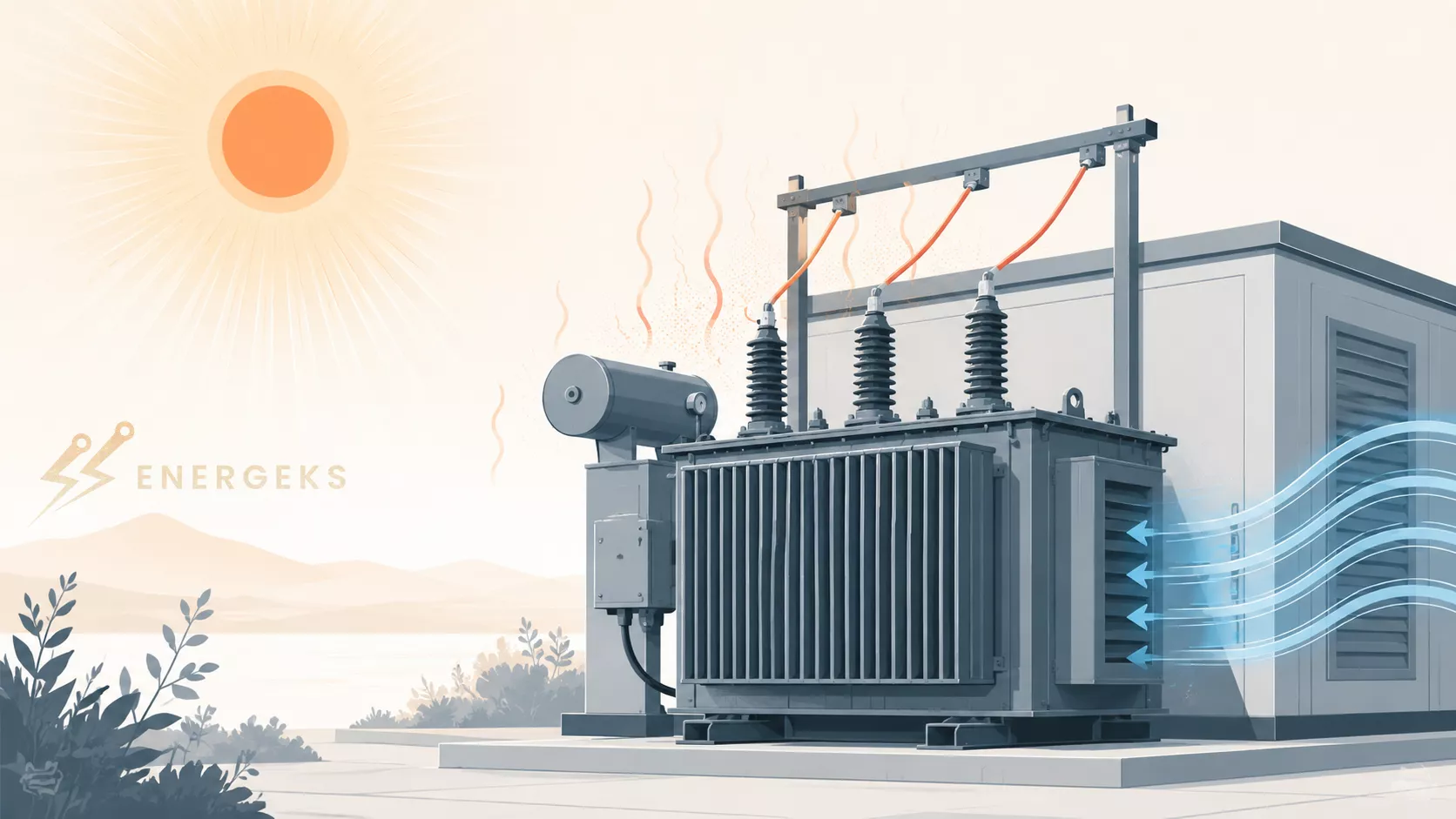
Heatwaves are returning. Transformers remember every one of them.
When the air temperature exceeds 35°C, most electrical devices simply work harder. Air conditioners draw more current. Refrigerators don't rest. Industry runs at full capacity because deadlines chase deadlines.
And the transformer stands in the corner of the switchgear station, in a container or in a building basement, and does its job. Without a word of complaint. Up to a point.
That point has a name: critical winding temperature.
When you exceed it, the transformer does not always shut down elegantly with an error message. Sometimes it just accelerates its ageing. Quietly. Invisibly. Day after day, throughout the hot summer.
This text is about what really happens to a transformer during a heatwave, why standard parameters can be misleading, and what exactly is worth checking before high temperature does it for you.
Reading time: about 9 minutes.
First, some physics without which the rest makes no sense
When a spectacular explosion of a power station appears in the media — like recent well‑known footage from the Enstedværket site near Aabenraa, a facility linked to Energinet infrastructure — it is easy to focus on the effect itself: the flash, the bang, the smoke, the scale of destruction.
Photo via LinkedIn on profile of Emil Mahler Larsen
But in power engineering, such images are only the finale.
The end of a process.
Before a failure, before protection trips, before an electric arc, fire or mechanical damage to equipment, physics always happens first. Sometimes over seconds. Sometimes over months. Sometimes over years.
And that is precisely why the conversation about transformer overheating in heatwaves is not seasonal scaremongering. It is a conversation about what happens inside the device long before the problem becomes spectacular.
A transformer produces heat. Not by accident, but by the very nature of its work.
Core losses. Copper or aluminium winding losses. Eddy currents. Leakage fluxes. All of this turns into heat that must go somewhere.
In oil‑immersed transformers, this heat is taken up by the oil, which circulates naturally or with pumps and releases energy to the surroundings through radiators or tank fins.
In dry‑type transformers — and we will focus on these here, because they stand in buildings, indoor substations, data centres and industrial halls — this heat is released to the air.
And here the problem begins.
Air in summer is warm.
Warm air absorbs heat less effectively than cold air.
A transformer that calmly operates with a winding temperature of 80°C in winter can reach 95–100°C in summer at the same load. Or more.
Every additional 10°C above the rated value translates into roughly twice as fast insulation ageing. This is not an opinion — it is the well‑researched Arrhenius law, used in electrical engineering for decades.
Insulation that should last 30 years, with regular exceedance of the permissible temperature, can end its life in half that time.
Reason 1: Ambient temperature higher than the design assumed
Most dry‑type transformers are designed for a maximum ambient temperature of 40°C. This is a standard value, often visible in the technical documentation.
What does this mean in practice?
That the manufacturer designed the cooling so that at 40°C in the room, the transformer does not exceed the permissible winding temperature.
When the ambient temperature exceeds 40°C — which in Poland's climate during the summers of 2024 and 2025 happened increasingly often — the transformer begins to operate outside its rated thermal capabilities.
There is no fault in that. It is simply physics.
If you have a dry‑type transformer and you do not know what the actual temperature is in its room on a hot day, you are in the situation of a driver who does not know the engine oil temperature on a climb up to the Tatra Mountains. The engine may get you there. But it may not come back intact.
What is worth doing: check what the actual ambient temperature is at the transformer on the hottest days. Not in the office. Not outside the building. At the transformer, at 3:00 PM, when the sun has been heating the walls and roof for several hours.
Reason 2: Room ventilation that cannot keep up
A dry‑type transformer cannot dissipate heat into a vacuum. It dissipates it into the air in the room. That air must go somewhere — and must be replaced by cooler air.
If the room ventilation is too weak, the air temperature at the transformer rises. The transformer dissipates heat into increasingly warmer air, which means it itself becomes increasingly warmer.
This is a vicious circle and can lead to overheating even at a load well below rated power.
Summer heat does one specific thing here: it heats the air outside the building, which is the source of cooling. If the ventilation intakes draw air from the south, and the sun heats the south wall of the building — the intake air temperature can be 5–10°C higher than the air temperature in the shade.
And that is before the air even reaches the transformer.
What is worth doing: assess whether the ventilation openings are well placed and whether the grilles are not blocked by dust, dirt‑clogged protective meshes or accidental storage of items. Check whether the airflow actually passes through the room, rather than circulating in a closed loop.
Reason 3: Load increases together with temperature
This is the paradox of summer that hurts double.
When it gets hot, the demand for electricity rises. Air conditioning. Ventilation. Cooling systems. Food industry at full speed. Refrigerators, freezers, server room cooling systems — everything wants its share of power.
This means that transformers are more loaded in summer than in winter.
And at the same time they have a worse ability to dissipate heat.
Higher load → more losses in windings → more heat to dissipate. Higher ambient temperature → worse cooling conditions → slower heat dissipation.
These two effects act at the same time and in the same direction.
A transformer in July therefore works under a double unfavourable condition. It produces more heat and dissipates it more slowly.
What is worth doing: check historical load data for the transformer from previous years during the summer months. If the load has increased in recent years (because more air conditioning, new equipment or facility expansion has been added), the thermal margin may have shrunk.
Reason 4: Temperature sensors that do not alarm in time
A modern dry‑type transformer should be equipped with winding temperature sensors. These can be PT100 or PTC sensors, which work with a thermal relay. The relay sends an alarm signal at the first threshold and disconnects the transformer at the second — critical — threshold.
Sounds good.
But in practice, three problems appear.
First: the sensor measures temperature at a specific point on the winding. If it is poorly placed or outdated, it may not reflect the actual temperature at the hottest point of the coil.
Second: some transformers, especially older or cheaper installations, have alarm settings set too high. The alarm appears when the insulation has already been operating in excessive heat conditions for weeks.
Third: the alarm signal goes to the building's BMS system or to a local panel. If no one is actively monitoring this in summer, the alarm may burn unnoticed for several hours.
What is worth doing: check when the sensor system was last calibrated and tested. Check the alarm settings in the documentation and compare them with the temperature for class F insulation (155°C) or class B (130°C). Ensure that the alarm reaches someone who responds — not just logged in a file.
Reason 5: Overload during the summer peak
Transformers have the ability for short‑term overload — even up to 120–150% of rated power for a specified time. This is a design option, useful for temporary demand peaks.
Only this capability is calculated on the assumption that the transformer operated for some time at low load before the overload and is relatively cold.
In summer, the transformer can be warm around the clock. Cool nights, which in winter gave it time to rebuild its thermal margin, may not provide sufficient cooling in summer.
When such a transformer enters a peak load state — say, during a hot afternoon when air conditioning is pulling full power — it starts from a higher base temperature. The margin to critical temperature is smaller. An overload that would be fine in winter can be risky in summer.
What is worth doing: if the transformer is often used close to its rated power limits, review the overload curves in the technical documentation and check how they change with ambient temperature. Manufacturers provide this data. It is worth reading before August, not after.
Reason 6: Dust and dirt in summer block cooling ducts
Dry‑type transformers dissipate heat through air ducts in the windings and between structural elements. These ducts must be clear.
In summer, when windows and doors are open more often, fans work more intensively, and nearby construction and renovation work generates more dust — the amount of dust in the air increases.
Dust settles on the windings and in the ducts. If the winding is of the open‑wound or VPI type, dust can gradually restrict airflow. The thicker the dust layer, the worse the cooling.
In cast‑resin transformers, the problem is smaller — the epoxy resin creates a closed shield around the windings. But here too, dust on the external surfaces blocks heat exchange.
Additionally, dust saturated with moisture can pose a risk to insulation — especially if it contains metallic particles or chemical substances from production.
What is worth doing: check the cleanliness of the transformer and its surroundings. If previous inspections showed excessive contamination, it may be worth planning cleaning before the summer peak, not after.
Reason 7: The transformer simply has years on it
Transformer insulation ages. This is not an opinion — it is a technical and economic fact worth taking into account.
With each year of operation, with each heatwave, with each overload and each heating and cooling cycle, the insulation loses its properties. It becomes brittle. Loses flexibility. Its dielectric strength decreases.
A transformer that is 15–20 years old and for half its life has operated in difficult thermal conditions may have insulation in a condition corresponding to a much older device.
No one sees this with the naked eye. The insulation may look good and at the same time be on the verge of breakdown.
Heat is not a problem in itself. Heat is a test.
If the insulation is in good condition, the test will pass without complications. If it is tired — heat may be the moment that finalises what began several years earlier.
What is worth doing: if the transformer is over 15 years old and has not undergone diagnostics in the last few seasons, it is worth considering insulation measurements. Insulation resistance measurement, absorption coefficient, and in the case of oil‑immersed transformers — oil analysis — are tools that give a real picture of the device's technical condition.
What to specifically do when a heatwave arrives
Below is a practical list of actions that make sense before and during high temperatures. There is nothing exotic here — only things that really affect the safety of transformer operation.
Before the summer season:
Check the temperature in the transformer room from the previous summer, if you have such data. Compare it with the ambient temperature assumed in the documentation.
Assess ventilation: are the grilles clear, is the airflow correct, is the intake air not coming from places excessively heated by the sun?
Check the temperature sensor settings and test whether the alarm signal actually reaches the responsible person.
Assess historical load — is the transformer being increasingly loaded year on year?
If the transformer is over 15 years old, consider a diagnostic inspection before the season.
During a heatwave:
Monitor the temperature in the transformer room regularly — not just once a week.
If the transformer has forced cooling (AF fans), check whether the fans are working correctly and whether their operation is triggered at the right time.
If you have the ability to temporarily distribute the load or reduce non‑productive loads during the temperature peak, consider it.
Do not ignore a temperature alarm, even if it has always turned out to be false before. In summer, every alarm needs checking.
Dry‑type vs oil‑immersed transformer — does this change the situation?
Yes, but not as many think.
An oil‑immersed transformer has oil that carries heat away from the windings to the tank walls and radiators. This allows for higher thermal capacity and slower winding temperature rise during short‑term peaks.
But the oil also has its own critical temperature. At too high ambient temperature and too weak cooling — for example with blocked tank fins or a damaged cooling pump — an oil‑immersed transformer will also overheat.
A dry‑type transformer reacts faster to ambient temperature changes because it does not have the thermal buffer of oil. On the other hand, there is no risk of oil leakage, no risk of oil fire, and it is generally less complex to operate.
In both cases, the principle is the same: high ambient temperature reduces the transformer's ability to dissipate heat. And in both cases, ignoring this for several seasons leaves a mark on the insulation.
A few words about what is not worth doing
It is not worth relying solely on the fact that "it has always worked."
Transformers are unfailingly patient devices. They can operate in poor conditions for months and years without giving clear signals. And then the failure happens suddenly — often during the first major overload or an especially long heatwave.
It is also not worth assuming that since the transformer has a temperature sensor, the problem will solve itself. A sensor can warn — but it cannot improve ventilation, reduce load or repair insulation that is already tired.
And it is not worth comparing a transformer to a device where "if it breaks, we will buy a new one." MV transformers are investments for decades. Premature failure is not only the cost of buying a new device — it is downtime, installation cost, risk of burnouts in the installation, potential production loss and a lot of nerves at the station.
Heat is not an enemy of the transformer if you help it
A heatwave is a test of the power infrastructure.
Most transformers that are in good technical condition and operate in well‑designed conditions will get through the summer without problems. These are devices built for long‑term operation.
But those that are a dozen or so years old, operate in poorly ventilated rooms, are increasingly loaded and have not been regularly checked — have much less margin in summer.
The good news is simple: most of these problems can be checked, assessed and improved. Ventilation. Load. Cleanliness. Sensors. Insulation condition.
This is not complicated diagnostics. It is taking care of a device that serves the entire installation and has no replacement during a failure.
If you do not know what condition your transformer is in and how it will react to the next heatwave — this is a good time to find out.
Want to check your transformer before the season?
At Energeks, we help select transformers for real operating conditions and assess whether an existing device has the right margin for summer peaks.
If you are planning a transformer replacement, station modernisation or want to check whether the current unit has the right power reserve, see:
—> our range of dry‑type and oil‑immersed transformers
—> transformers available off‑the‑shelf in our warehouse
—> further technical analyses on the Energeks LinkedIn profile
In a well‑designed transformer station, summer should not be a lottery.
It should be just another working season.
sources:
Energinet — Ensted–Kiskelund / Enstedværket przy Aabenraa
IEC 60076-7:2018 — Loading guide for mineral-oil-immersed power transformers
Transformers in stock
Shipped from our warehouse in Poland within 2–3 working days, 5-year warranty. Full range 25–2500 kVA in the shop (prices in PLN).
From this article you will learn how the transport of a power transformer is planned, what in practice dimensions of about 9.2 m length, 3.4 m width, 4.0 m height and a weight of about 165 tonnes without oil mean, how unloading looks, and why post‑delivery inspection protects the entire investment.
Power transformer transport is not a delivery. It is a technical operation.
There are loads that arrive on a pallet.
There are those that a courier leaves at the gate.
And there are those at which the gate itself starts asking existential questions.
A power transformer with a length of about 9.2 m, width of about 3.4 m, height of about 4.0 m and a transport weight without oil of about 165 tonnes does not travel like ordinary equipment. It does not "drive". It is led along the route like a technical operation on a living organism of infrastructure.
A powerful tractor and good intentions are not enough.
You need a route that really has a margin.
You need a trailer matched to the pressures.
You need an unloading plan that is not made over coffee five minutes before the manoeuvre.
You need people who know that 165 tonnes do not like sudden ideas.
At Energeks, we take this topic seriously, because a power transformer is not an ordinary delivery item.
It is the future heart of a power supply system.
Before it starts working, it must safely pass through transport, unloading, post‑delivery inspection, positioning and preparation for commissioning.
And that is what this text is about.
About logistics that looks spectacular but in practice is precision.
About unloading where patience weighs more than steel.
About post‑delivery inspection that tells you more than the best assurances.
And about why good power transformer transport is not an add‑on to the investment, but one of its first quality tests.
Reading time: about 9 minutes.
Dimensions, weight and centre of gravity: the transformer has its own physics
In power transformer transport, the numbers are not decoration in the documentation.
They are the instruction manual for the survival of the whole operation.
9.2 m length is not just information that the load is long. It is a forecast of how the whole combination will behave on curves, roundabouts, intersections, plant gates and the last metres to the foundation.
3.4 m width means that the comfort of a normal traffic lane ends. Logistics begins where the driver, pilot, traffic management and travel plan must act as one organism. At this width, even an ordinary road sign can suddenly become a technical problem.
4.0 m height forces you to look not only ahead but also upward. Bridges, overhead wires, gates, canopies, process pipelines and structures on the plant site cease to be scenery. They become a checklist.
And 165 tonnes of transport weight without oil?
That is no longer a number.
That is a character.
The weight of a transformer determines axle loads, trailer selection, lashing method, suspension behaviour, ground preparation, unloading options, support points and whether the foundation is really ready to meet a device of this class.
That is precisely why a transformer is not a load that simply needs to be transported.
It is an object that needs to be understood.
The most important thing is the centre of gravity. It does not look spectacular. It does not have its own nameplate with fanfares. Yet it decides how the transformer will behave during lifting, braking, turning, tilting, moving and positioning.
If the centre of gravity is treated superficially, you can have excellent equipment and still create a situation that no sensible person wants to see up close.
It is a bit like carrying a huge wardrobe with a hidden safe on one side. From the outside you see a rectangle. In your hands you feel the truth.
A transformer also has its truth. And you need to know it before the first move.
That is why transport drawings, marking of the centre of gravity, lifting points, lashing points, support points and manufacturer's instructions are so important. This is not paperwork. It is the nerve map of the whole operation.
The route: the shortest road is rarely the best
In power transformer transport, the shortest route does not win.
The route that does not pretend to be ready wins.
On paper, everything may look innocent. The road exists. The bridge exists. The gate exists. The curve exists. But a combination with a 165 tonne transformer does not ask whether something exists. It asks whether it can safely pass that way.
You need to check turning radii, bridge load‑bearing capacities, culverts, shoulders, height restrictions, overhanging wires, roundabouts, intersections, road surface, entrance to the site, and the last metres to the unloading point.
And those last metres can be the most malicious.
The transformer may travel hundreds of kilometres, passing bridges, gates and roundabouts, and then stop a few dozen metres from its destination because the ground is not ready, the turning radius is too tight, or the unloading equipment has no room to work.
That is why not only the public road is analysed. The plant site, site roads, manoeuvring areas, access to the foundation and the working area of the crane or sliding system are also analysed.
In heavy logistics, the map is the beginning. Reality always needs to be examined more closely.
Loading and unloading: here it is not strength that wins, but sequence
From the outside, transformer unloading may look simple.
A crane arrives. We attach. We lift. We move. Done.
A beautiful fairy tale.
In the real world, 165 tonnes do not respond to optimism. They respond to geometry, centre of gravity, working radius, ground load‑bearing capacity, lifting points, sling angles, sequence of movements and quality of communication between people.
It is not about having a big crane.
The crane must be selected for the specific operation. For the specific weight. For the specific radius. For the specific height. For the specific position of the transformer and the specific working space.
Rated capacity looks good in a table, but during unloading the real configuration counts. The larger the working radius, the more the available capacity drops. The more difficult the ground, the more important the outriggers become. The less space around, the more every decision begins to resemble a game of chess with gravity.
And gravity does not lose through inattention.
That is why before unloading you need to know where the transport combination will stand, where the lifting equipment will stand, where the supports will be, how the load will pass, who gives the commands, what the safety zones are, and what we do if conditions cease to be ideal.
The moment the transformer is in the air is the worst moment for creativity.
Good unloading looks almost boring. And that is a compliment.
No shouting. No guessing. No sudden corrections. No people running in different directions. Everyone knows where they stand. Everyone knows when to speak. Everyone knows who makes the decision. Everyone knows when to stop the operation.
With large masses, speed is not evidence of professionalism.
Control is.
Post‑delivery inspection: the transformer also leaves traces of its journey
When the transformer is finally in place, many people think that the hardest part is behind them.
That is exactly when one of the most important stages begins.
Post‑delivery inspection.
It sounds modest. Almost official. In practice, it is a moment of truth.
A transformer may look good and still require thorough verification. It may also arrive with minor transport traces that are harmless, but they need to be assessed correctly. The mere presence of the device on site does not yet mean that everything is ready.
It means that you can start checking.
Post‑delivery inspection includes visual inspection of the tank, paint coatings, nozzles, valves, seals, lashing points, transport securing, separately delivered accessories and completeness of documentation. If the transformer was transported without oil, you also need to check the protection conditions of the active part, for example dry air or nitrogen pressure and tightness.
One of the key elements is the shock recorder.
A small device with great significance. Its task is to record events that could have stressed the transformer during transport, transhipment, parking or unloading. We are talking about shocks, vibrations, accelerations and sometimes also tilts. In more modern systems, there is also time stamping, GPS location and temperature.
The shock recorder acts like the transformer's black box.
It is not interested in who said that everything went gently. It records what really happened.
This does not mean that every recorded event is a disaster. But every significant event requires assessment. You need to combine the recorder data with the external condition of the device, transport documentation, information from the crew and the manufacturer's recommendations.
It is not about looking for sensation.
It is about a technical decision.
Because a power transformer has inside it a core, windings, connections, insulation, a tap changer and a whole precise internal architecture. Not everything that matters is visible to the naked eye.
That is why post‑delivery acceptance should not be based on faith.
It should be based on data.
Foundation and positioning: 165 tonnes must have a place to sit calmly
The transformer has arrived.
It has been unloaded.
Now it needs to be positioned.
It sounds like the finale of the whole story.
In practice, this is the moment when many earlier decisions come to light. Not in theory. In the real contact of 165 tonnes with a prepared place.
The foundation for a power transformer is not a piece of concrete. It is part of the system.
It must carry static and dynamic loads. It must maintain geometry. It must work with support points, rails, rollers or a sliding system. It must enable operation, service, possible replacement and safe management of transformer oil if we are talking about an oil‑filled unit.
A transformer does not load the world generally.
It loads it specifically.
Through specific points, in a specific place, at a specific time. Therefore, the general load‑bearing capacity of the foundation is not enough. Local load under specific support points also matters.
Then there is levelling.
It is not cosmetic. It is not about the device looking nice in a photo. Incorrect positioning can affect load distribution, accessory assembly, access to valves, cooling performance, cable routing, earthing and future maintenance.
A power transformer should not fight with its own stand.
It is supposed to work on it.
That is why the positioning site must be ready earlier. Not almost ready. Ready. With an accepted foundation, checked level, prepared working space, provided service access, solved oil drainage and completed earthing.
With 165 tonnes, the word "almost" starts to become very expensive.
How much does power transformer transport cost?
This is one of those questions to which the honest answer is: it depends on how much reality likes to complicate logistics.
The cost of power transformer transport is not calculated like ordinary freight per kilometre. Here you do not pay only for the journey from point A to point B. The pricing includes the weight of the device, its transport dimensions, the route, the number of axles in the combination, escort, permits, analysis of bridges and viaducts, possible removal of road infrastructure, trailer selection, preparation for loading, unloading, crane or sliding system, and sometimes also additional securing, technical stops and the work of several teams simultaneously.
Therefore, transport of a power transformer weighing several dozen tonnes will be a completely different operation than moving a unit weighing about 165 tonnes without oil. In the first case, we are talking about demanding logistics. In the second, about an operation where every metre of the route, every turning radius and every support point begins to have financial significance.
The greatest impact on cost usually comes from:
transformer weight
transport length, width and height
distance of transport
number of countries and formalities along the way
need for escort
difficulty of the last metres of access
selection of crane or unloading system
ground and foundation preparation
working time of technical teams
post‑delivery inspection requirements
In practice, the cheapest transformer transport is rarely the best news. If the quote looks too light for the weight of the device, it is worth asking what is missing. Does it include unloading? Does it cover route analysis? Does it include escort? Is a shock recorder foreseen? Has anyone checked the last section to the foundation? Is the lifting equipment selected for real conditions, not for an optimistic scenario?
Because with a power transformer, transport cost is not just a line item in the budget. It is part of the protection of the whole investment.
A well‑planned transport may seem more expensive at the beginning, but it often saves money where it really hurts: in delays, damage, additional cranes, foundation corrections, assembly downtime and nervous decisions made already on site.
In short: power transformer transport costs as much as the calm delivery of a very expensive, very heavy and very necessary device without improvisation along the way.
And that is one of the things that sensible people do not try to do accounting magic on.
A large transformer does not need luck. It needs a process
Power transformer transport looks spectacular, but its real value lies not in photos from the road.
It lies in preparation.
In a route that has been checked. In equipment selected for the real weight and dimensions. In people who understand centre of gravity, lifting points, pressures, tilt and movement sequence. In post‑delivery inspection that relies not on impression but on data. In a foundation that is ready to receive the device without nervously writing the plan at the last minute.
A power transformer is not ordinary cargo. It is the future heart of a power supply system. Before it starts working, it must safely pass through transport, unloading, acceptance, positioning and preparation for commissioning.
And that is why good logistics is not an add‑on to the investment.
It is its first quality test.
If you are planning a project involving transformers, transformer stations, switchgear or solutions for power infrastructure, it is worth checking the full Energeks offer and seeing how broadly you can approach power supply from a technical, design and delivery perspective.
Depending on the working conditions, installation location and system requirements, a good starting point may be the choice between an oil‑immersed transformer and a dry‑type transformer. Each of these solutions has its specific applications, its advantages and its requirements, so the decision should result from real working conditions, not a random choice from a catalogue.
And if the project does not like to wait, it is also worth checking which transformers are available off the shelf.
Because sometimes the best news in power engineering is not a big promise, but concrete equipment availability when the schedule really needs it.
More technical inspiration, projects and power engineering specifics can also be found on the Energeks LinkedIn page.
references:
CIGRE Technical Brochure 673, Guide on transformer transportation
Mammoet, Transformer transport services
Hitachi Energy, Install and Commission
Transformers in stock
Shipped from our warehouse in Poland within 2–3 working days, 5-year warranty. Full range 25–2500 kVA in the shop (prices in PLN).