News

A transformer clamp is a small part that carries the full LV current – on a 630 kVA transformer that is over 900 A per phase. If it is the wrong size, it overheats, works loose and can eventually damage the bushing. Choosing one comes down to four questions: what current flows on the LV side, what thread the bushing stud has, how many conductors you connect, and whether the clamp sits on a phase or on the neutral.
1. Work out the LV current
The rated current on the low-voltage side follows from the transformer's rated power:
I = S / (√3 × U)
S is the rated power in VA (kVA × 1000) and U the rated LV voltage – usually 400 V or 420 V for distribution transformers. Example for 400 kVA at 420 V: 400,000 / (1.732 × 420) ≈ 550 A.
2. Check the thread of the LV bushing stud
The clamp screws directly onto the bushing stud, so its internal thread must match the stud. LV bushings of oil-immersed transformers are made to EN 50386, and the stud diameter grows with the bushing current. On distribution transformers up to 630 kVA you will mostly find three sizes:
| Transformer rating | LV current at 400 V | LV current at 420 V | Stud thread | Clamp rating |
|---|---|---|---|---|
| 63 kVA | 91 A | 87 A | M12 | 250 A |
| 100 kVA | 144 A | 138 A | M12 | 250 A |
| 160 kVA | 231 A | 220 A | M12 | 250 A |
| 250 kVA | 361 A | 344 A | M20 | 630 A |
| 400 kVA | 577 A | 550 A | M20 | 630 A |
| 630 kVA | 909 A | 866 A | M30 | 1000 A |
The table shows the typical case, but manufacturers do not always follow it – so we always check the thread on the stud itself or in the transformer documentation (datasheet, dimension drawing). Above 630 kVA the current exceeds 1000 A and larger studs or busbar connections are used – that calls for an individual selection.
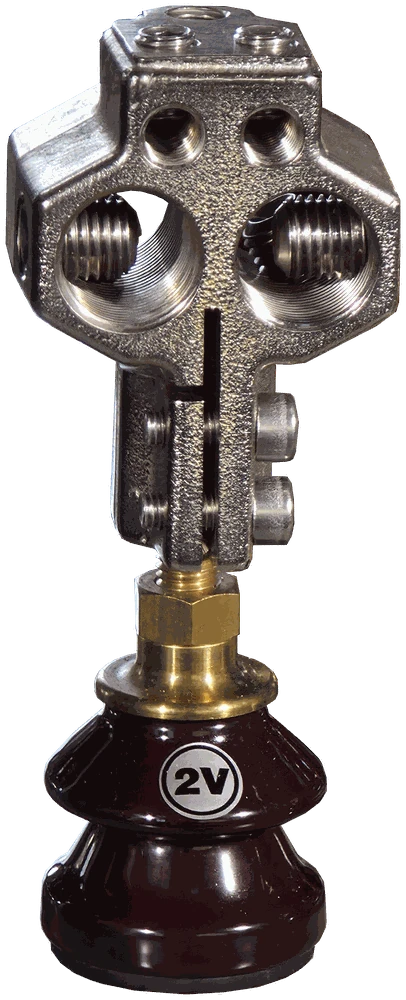
TOC-1 clamp screwed onto the LV bushing stud of a MarkoEco2 transformer.
3. Count the conductors per phase
Horizontal clamps take two main and two auxiliary conductors per phase. For TOC clamps that means:
- main conductors: 2 × 95–240 mm² (RE, RM, SM conductors) or 2 × 300 mm² RMC – aluminium or copper,
- auxiliary conductors: 2 × 2.5–50 mm² – e.g. for metering, the substation's auxiliary supply or an LV surge arrester.
Conductor codes: RE – solid round, RM – stranded round, SM – stranded sector-shaped. The conductors go straight into the sockets and are clamped by screws, with no crimped cable lugs. Grid operators see it the same way – the Polish DSO TAURON Dystrybucja, in its standard for MV/LV transformers, specifies LV clamps for direct conductor connection without crimped lugs, in a cable or a busbar version.
Cable size and number are the designer's call – based on current-carrying capacity, installation method, voltage drop and short-circuit conditions. The clamp has to physically accept them. If you need more than two main cables per phase, or the transformer is connected to the LV switchgear by busbars, choose a busbar clamp. See our overview of types of transformer clamps.
4. Phase or neutral – /U and /N versions
One transformer needs a set of four clamps: three for the phases and one for the neutral. In the TOC series, /U is the phase clamp and /N has an extra stud (two on TOC-2/N) for the neutral or earthing conductor or an earthing strip. Some operators require that a 25 × 4 mm earthing strip can be connected to the neutral clamp – Energa-Operator's requirements for MV/LV transformers are one example. TOC clamps in the /N version allow this.
TOC-1 or TOC-2?
Both clamps share the same thread, current rating and connection capacity – they differ in shape and in how much room they take on the tank cover.
| TOC-1 | TOC-2 | |
|---|---|---|
| Design | body with offset foot, two locking screws under the head | compact head, slotted stem, locking screws on the side |
| When to choose | thick cables, easy access to the sockets | LV bushings close together, little room on the cover |
| Catalogue no. | DP 5100–5300, DP 5100N–5300N | DP 6100–6300, DP 6100N–6300N |
Product pages: TOC-1 transformer clamp and TOC-2 transformer clamp.
Selection in practice – three examples
- 160 kVA, two 120 mm² cables per phase: M12 stud, approx. 231 A → 3 × DP 5100 + 1 × DP 5100N (TOC-1).
- 400 kVA in a container substation, little space between bushings: M20, approx. 577 A → 3 × DP 6200 + 1 × DP 6200N (TOC-2). How to select the transformer itself for such a station is covered in how to select an MV transformer for a container substation.
- 630 kVA, two cables per phase as per design: M30, approx. 909 A → 3 × DP 5300 + 1 × DP 5300N (TOC-1).
What to include in your enquiry
- transformer rating and type, or the LV stud thread,
- number and size of cables per phase, plus auxiliary conductors,
- version: TOC-1 or TOC-2 (if unsure – we will advise),
- whether you need OZNN insulating covers,
- number of sets and delivery date.
The full range is in our transformer clamps category. We ship clamps from stock in Poland – separately or fitted to a MarkoEco2 transformer before dispatch. How to install a clamp so that it does not overheat is explained in why transformer clamps overheat.
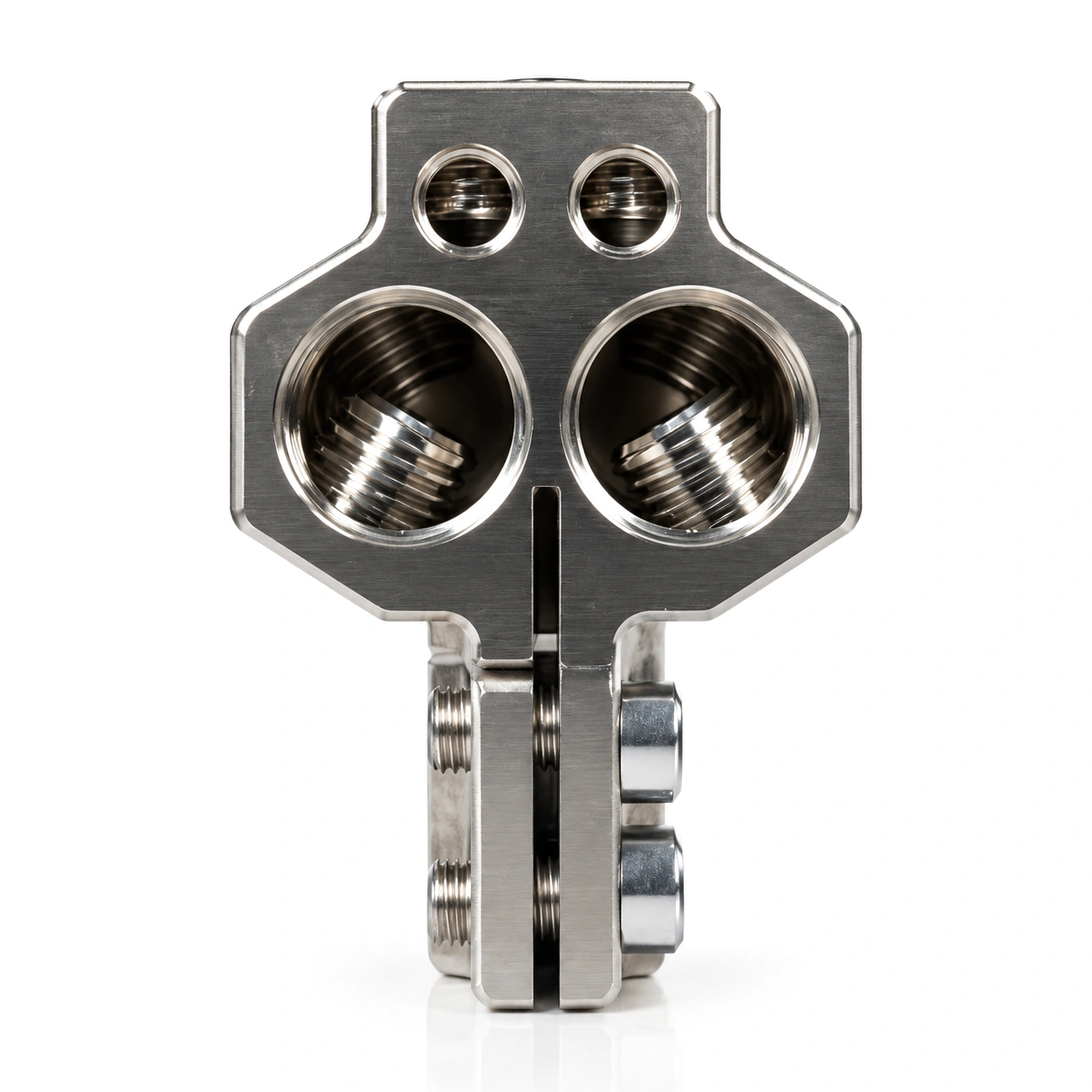 TOC-1 – horizontalM12 / M20 / M30, 250–1000 A, 2 × 300 mm²
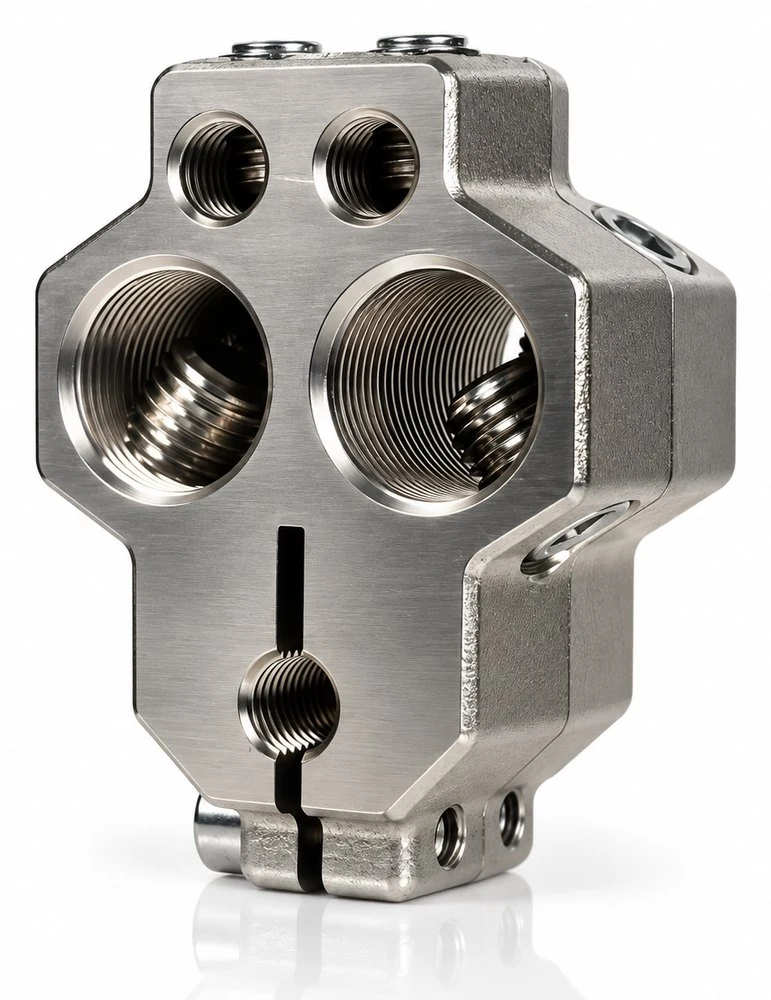 TOC-2 – compactsame connection capacity, smaller footprint
The connection between a cable and the LV bushing stud carries hundreds of amps. A small rise in contact resistance is enough to release tens of watts of heat at a single point – and that heat goes straight into the stud, the bushing insulator and its seal. Below: where hot clamps come from, how to avoid them during installation and how to catch them before they cause a failure.
How much heat a bad contact produces
The power lost in a joint is P = I² × R. On a 630 kVA transformer the LV phase current is about 900 A. At that current every extra 0.1 mΩ of contact resistance means about 81 W of continuous heating in a single clamp. A hot contact oxidises faster, its resistance keeps rising and the process feeds itself.
The most common causes of clamp overheating
Too little clamping force
Clamping screws tightened “by feel” or never checked after commissioning. Conductors – aluminium ones in particular – settle under pressure and the clamping force drops over time.
Too much clamping force
Crushed strands, stripped threads, a cracked body. Tighten the screws with a torque wrench, gradually and alternately – not with brute force and not with an extension on the wrench.
Dirty or oxidised contact
Oxide on an aluminium conductor, a dirty stud, paint residue. Clean the conducting surfaces immediately before installation. TOC clamps accept aluminium and copper conductors – the tin-plated body limits corrosion at the contact with aluminium, but the conductor still has to be cleaned.
Poorly prepared conductor
Stripped too short (insulation under the screw) or too long (bare conductor sticking out of the socket), a cross-section outside the socket range, or a conductor shape the clamp is not designed for.
Cables hanging on the clamp
Heavy LV cables that are not supported bend and twist the stud. This increases the risk of a loose joint, bushing damage and oil leaking past the seal.
Higher load than the clamps were selected for
After an installation is extended, the current is often higher than the one the connections were chosen for – and it is not only the clamp that heats up. More on running a transformer near its limit in our article on transformer ageing.
Installing a transformer clamp step by step
- Inspect the bushing: cracks in the porcelain, oil traces, the condition of the stud thread.
- Clean the stud and the clamp sockets of dirt and paint residue.
- Screw the clamp onto the stud, align the sockets with the cable route and lock it with the fixing screws (TOC-1 – two screws on the foot, TOC-2 – screws on the side of the slotted stem).
- Prepare the conductors: strip them to the depth of the socket, clean aluminium conductors of oxide with a wire brush and – if the cable manufacturer recommends it – apply contact paste.
- Insert the conductors fully and tighten the clamping screws with a torque wrench – gradually and alternately.
- Support and fix the cables so that they do not load the clamp or the stud.
- Fit the insulating cover over the clamp.
- After commissioning, once the load has stabilised, carry out a thermographic check and re-check the clamping force in line with the substation's operating instructions.
A set of TOC-1 clamps on the LV bushings – sockets aligned with the cable route.
Thermographic inspection – how to read the result
Thermography finds a bad contact without switching the transformer off. For the result to mean something:
- measure under load – the closer to the substation's typical load, the clearer the difference,
- compare the same point on all three phases; the difference between phases at similar current tells you more than the temperature alone,
- watch out for shiny surfaces: tin-plated brass has low emissivity and the camera under-reads its temperature – take readings from the cable insulation right next to the clamp or from a matt marker.
A useful reference are the criteria of the US standard ANSI/NETA (table 100.18), used by many inspection companies:
| ΔT between similar components | ΔT above ambient | Recommended action |
|---|---|---|
| 1–3 °C | 1–10 °C | possible deficiency – investigate |
| 4–15 °C | 11–20 °C | probable deficiency – repair as time permits |
| – | 21–40 °C | monitor until corrective action is taken |
| > 15 °C | > 40 °C | major discrepancy – repair immediately |
If the grid operator or the plant has its own operating instructions with different thresholds, those apply.
LV connection inspection checklist
- discolouration, deposits or melted insulation next to the clamp,
- oil traces under the LV bushings,
- condition of the clamp covers, traces of birds and rodents,
- cable fixing and support,
- comparative thermogram of the three phases and the neutral,
- screw tightness check – only when de-energised and earthed, as per instructions.
Regular inspection costs a fraction of a repair – see what a professional transformer overhaul looks like. If a clamp needs replacing, start with choosing the transformer clamp for the rating – ready-made sets are in our transformer clamps category.
TOC-1 – horizontalM12 / M20 / M30, 250–1000 A, 2 × 300 mm²TOC-2 – compactsame connection capacity, smaller footprint
A “transformer clamp” is in practice several different products. On the LV side they connect cables or busbars to the bushing studs; on the MV side they connect conductors to the high-voltage bushings, sometimes together with a surge arrester. Below is an overview of the types you will find in MV/LV substations and tips on when to use which.
Where a transformer clamp works
The clamp screws onto the threaded stud of the bushing insulator and is locked with one or more screws. On the other side it has sockets for the cable conductors or a flat face for a busbar. Grid operators' standards – for example that of the Polish DSO TAURON Dystrybucja for MV/LV transformers – provide two LV variants: clamps for conductors or cables and clamps for a busbar connection, in both cases without crimped lugs, in a set of three phase clamps and one neutral clamp.
Horizontal cable clamps (LV)
The most common type in substations with transformers up to 630 kVA. They take the cables out horizontally from the stud and accept two main and two auxiliary conductors per phase – aluminium or copper. At Energeks this is the TOC series: M12, M20 or M30 thread, 250, 630 or 1000 A, main conductors 2 × 95–240 mm² (RE, RM, SM) or 2 × 300 mm² RMC, auxiliary 2 × 2.5–50 mm².
TOC-1 – with an offset foot
Two locking screws on the foot under the head, sockets higher above the cover. Convenient with thick cables – it is our standard for MarkoEco2 transformers. TOC-1 clamp page.
TOC-2 – compact
Sockets in a single compact head, a slotted stem and locking screws on the side. It takes less room on the cover, so it works well where the LV bushings are close together. TOC-2 clamp page.
Neutral clamps with earthing
The fourth clamp in the set sits on the neutral bushing. Besides the cable sockets it has a stud (or two) for the earthing conductor, N/PE or an earthing strip. In the TOC series these are the /N versions: DP 5100N–5300N (TOC-1) and DP 6100N–6300N (TOC-2). Some operators require that a 25 × 4 mm earthing strip can be connected to the neutral clamp (e.g. Energa-Operator) – the /N versions of the TOC series allow this.
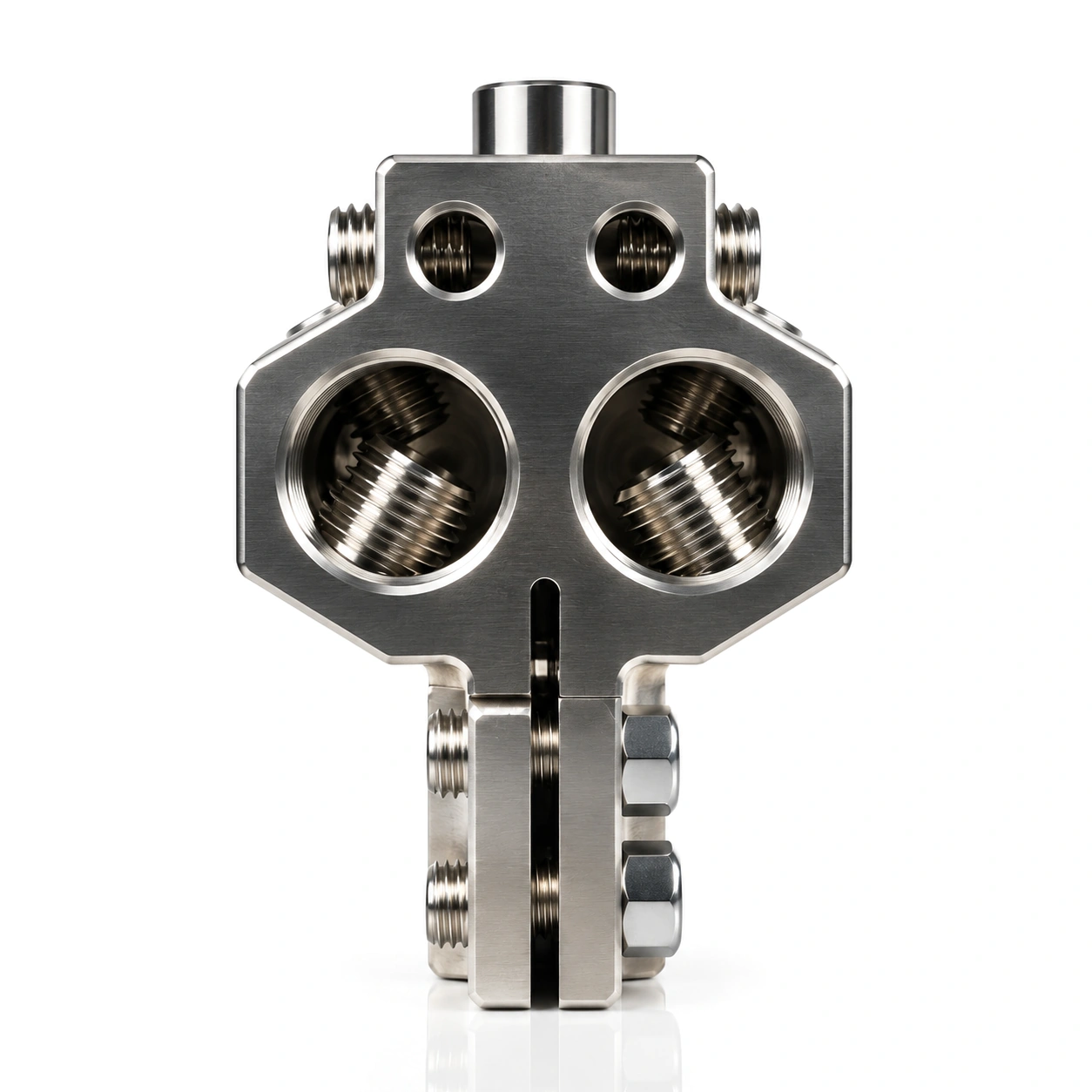
TOC-1/N – version with an extra stud for the neutral or earthing conductor.
Busbar clamps (LV)
When the transformer is connected to the LV switchgear by busbars, clamps with a flat face for the busbar are used instead of cable sockets. Forged MK busbar clamps screw onto the stud and are locked with one screw (MK 1) or two (MK 2, MK 5). They take busbars up to 40 mm wide (MK 1, MK 2) or up to 100 mm (MK 5), on studs from M12 to M30. Energeks supplies MK 1, MK 2 and MK 5 from stock in Poland.
MV bushing clamps
On the high-voltage side the clamp connects the MV conductor to the bushing of the distribution transformer. ZGU clamps (M12 connection thread, 70 mm² conductor) are made of tin-plated brass with stainless steel screws and are fitted with a single wrench. The ZGU-OP version allows an MV surge arrester to be mounted directly on the bushing stud, without additional parts. The design limits torsional forces transferred to the internal parts of the transformer. ZGU and ZGU-OP are available from stock.
Clamp covers
An insulating cover fitted over the clamp protects against accidental contact and short circuits caused by birds and rodents. The TAURON Dystrybucja standard requires LV clamp covers made of a self-extinguishing, flexible material. The OZNN cover is made of flexible, self-extinguishing rubber in three sizes – M12, M20 and M30 – and fits TOC-1, TOC-2 and MK 1 clamps.
Comparison at a glance
| Type | Side | Purpose | Thread / range | Example |
|---|---|---|---|---|
| horizontal cable clamp | LV | 2 main + 2 auxiliary conductors per phase | M12 / M20 / M30, 250–1000 A | TOC-1/U, TOC-2/U |
| neutral clamp with earthing | LV, neutral | cables + earthing conductor, N/PE or earthing strip | M12 / M20 / M30 | TOC-1/N, TOC-2/N |
| busbar clamp | LV | busbars up to 40 mm or up to 100 mm | M12–M30 | MK 1, MK 2, MK 5 |
| MV bushing clamp | MV | 70 mm² MV conductor, optional surge arrester | M12 | ZGU, ZGU-OP |
| cover | LV | protects the clamp against contact and animals | – | OZNN (M12 / M20 / M30) |
How to choose
- cables to the LV switchgear → TOC-1 or TOC-2 cable clamp (thread and current as described in how to choose a transformer clamp),
- busbars → MK busbar clamp matching the busbar width,
- neutral → /N version,
- MV side with a surge arrester on the bushing → ZGU-OP,
- substation exposed to birds and rodents → covers on all LV clamps.
All types in one place: Energeks transformer clamps.
TOC-1 – horizontalM12 / M20 / M30, 250–1000 A, 2 × 300 mm²TOC-2 – compactsame connection capacity, smaller footprint
The decision on selecting a medium‑voltage (MV) transformer is usually made at an early stage of the project – when the investor knows the current power demand but rarely has certainty about what the installation will look like in five or ten years. Yet it is the MV transformer, as the heart of the transformer station, that largely determines whether the future expansion of a plant, PV farm, energy storage system or production line will be a simple engineering task or a costly rebuild of the entire power infrastructure. In this article, we answer the most frequently asked questions about selecting an MV transformer with future installation expansion in mind.
What is an MV transformer and what role does it play in an installation?
An MV transformer is a device that transforms voltage from medium level (most often 6, 10, 15 or 20 kV) to low voltage (0.4 kV) for use by consumers in a plant, or conversely – in the case of energy‑generating installations such as photovoltaic farms or energy storage systems (BESS) – steps up the voltage from low to medium level before feeding energy into the distribution grid. The MV transformer is therefore the boundary point between the distribution system operator's (DSO) grid and the consumer's or generator's internal installation.
From the perspective of expansion planning, the MV transformer acts as a bottleneck, it determines the maximum power that the installation can draw or feed into the grid at any given time.
As long as the demand is within the transformer's rated power, expansion mainly involves adding new loads or sources.
When demand exceeds the available power, the transformer must be replaced, an additional station built, or other usually costly modifications made to the power supply system.
How to select the MV transformer power with future expansion in mind?
The selection of MV transformer power should take into account not only the current load but also a realistic, justifiable scenario for the installation's development over the next 10–15 years – the typical service life of this type of device before its first major overhaul or replacement.
In practice, engineers use several approaches:
Analysis of investment plans – if the investor plans to expand the production hall, add a production line, EV charging stations or a PV installation within a few years, the transformer power should immediately account for these scenarios, even if implementation is staged.
Power margin factor – a margin of 20–40% above the current peak load is commonly adopted, although in facilities with dynamic growth (e.g., data centres, industrial plants in expansion), this margin can be higher.
Load character analysis – installations with a large share of non‑linear loads (inverters, variable frequency drives, EV chargers) generate additional harmonic loads, which should be considered at the power selection stage rather than only during modernisation.
Station modularity – transformer stations are increasingly designed so that the foundation, enclosure and MV switchgear bay allow for the future installation of a second transformer operating in parallel, without building a new station from scratch.
Excessive oversizing of the transformer, however, has its drawbacks, which are discussed in the next section.
Is it worth oversizing the MV transformer as a reserve?
This is one of the questions investors ask most often, and the answer is not straightforward. Oversizing an MV transformer – i.e., selecting a power significantly higher than the current demand – has both advantages and significant disadvantages.
Advantages of oversizing:
ability to connect new loads or sources without replacing the transformer,
lower total cost over many years compared to a double investment (buying a smaller transformer and then replacing it),
lower risk of installation downtime during future expansion, as work is limited to connecting new circuits rather than replacing the main device.
Disadvantages of oversizing:
a transformer operating continuously at low load (below 30–40% of rated power) has poorer energy efficiency – no‑load losses (core losses) burden the installation's energy balance regardless of power consumption,
higher investment cost frozen for years until expansion actually takes place,
larger dimensions and weight of the device, which may require a larger station, a stronger foundation and more expensive transport,
in RES installations – possible restrictions or different connection conditions from the DSO if the declared power significantly exceeds the actual demand at start‑up.
The recommended compromise is usually the previously mentioned 20–40% margin and, where possible, designing the station to allow a second transformer to be installed in the future, rather than a one‑time, significant oversizing of the first unit.
What are the costs of underestimating transformer power?
The opposite situation – selecting an MV transformer exactly for current needs, with no margin – also carries risk that only becomes apparent at the expansion stage.
The most common consequences of underestimation include:
the need to replace the transformer along with the associated infrastructure (MV cables, protection devices, sometimes also the MV switchgear if its rated parameters prove insufficient),
installation downtime during replacement, which in production plants means direct financial losses,
extended connection procedure – increasing the connection capacity with the DSO means a new application, new connection conditions, and often also modernisation of the grid infrastructure on the operator's side, which can take many months,
loss of value of the original investment – a transformer that has not yet reached the end of its service life must be dismantled and sold or scrapped, which rarely allows a significant portion of the costs to be recovered,
additional design and administrative costs – a new technical design, renewed consultations with a fire protection expert, updating the as‑built documentation.
In practice, the cost of replacing an MV transformer along with the associated work can be several times higher than the difference in purchase price between a unit selected "on the edge" and one with a reasonable power margin.
How much does it cost to replace an MV transformer with a larger one?
The cost of replacing an MV transformer depends on many variables, so it is difficult to give a universal figure, but it is worth knowing the cost structure to consciously compare it with the cost of appropriate oversizing at the start of the investment.
The total replacement cost typically includes:
the price of the transformer itself (depending on power, type – oil or dry, manufacturer and additional parameters such as connection group or noise level),
the cost of dismantling the old unit and disposing of or reselling the insulating oil (in oil‑immersed transformers),
possible modernisation of the MV and LV switchgear bays if the current parameters of the new unit require it,
the cost of transport and crane – MV transformers weigh from several hundred kilograms to over a dozen tonnes,
design costs, DSO approvals and, in many cases, a fee for increasing the connection capacity,
the cost of production downtime or a break in energy generation during the work.
For this reason, a TCO (Total Cost of Ownership) analysis at the transformer station design stage should consider not only the purchase price but also the probability and cost of any future replacement.
Which MV transformer parameters matter when planning expansion?
Beyond rated power, when planning installation expansion, several additional MV transformer parameters should be considered:
Short‑circuit voltage (uk) – affects voltage drops at high loads and protection selection; with planned expansion, it is worth checking whether the typical uk value will not limit the future connection of additional loads sensitive to voltage fluctuations.
Connection group – important especially for installations with distributed generation (PV, BESS), where incorrect selection can lead to synchronisation problems or protection selectivity after new sources are added.
Tap range (tap changer) – the ability to adjust the ratio within a certain range makes it easier to match the LV voltage as the load profile changes during expansion.
Insulation class and cooling type (ONAN, ONAF, AN, AF) – oil‑immersed transformers with forced cooling (ONAF) can temporarily operate at a power higher than the ONAN rating, which is sometimes used as a "buffer" during the implementation of the target expansion.
Dimensions and weight – if the transformer station is to accommodate a larger unit in the future, adequate space, foundation strength and door and transport route dimensions should be planned at the design stage.
How does the expansion of a photovoltaic installation or energy storage system affect MV transformer selection?
In RES installations and BESS systems, the expansion topic has a slightly different character than in classical industrial plants, because the MV transformer power determines not only the ability to draw energy but primarily the ability to feed it into the grid.
Key issues in this context:
Connection conditions issued by the DSO – the MV transformer's rated power should be consistent with the connection capacity specified in the conditions, while being flexible enough to allow future generation capacity increases without the need to apply for entirely new connection conditions from scratch.
Staged expansion of a PV farm – installations are increasingly being designed with future addition of further panel sections or inverters in mind; an MV transformer selected with adequate reserve avoids replacing the main connection point at each subsequent stage.
Integration of BESS with an existing PV installation – adding energy storage to an already operating PV farm increases the total power that must be transmitted through the MV transformer, especially in the mode of simultaneous storage discharge and panel production.
IRiESD requirements – the Distribution Grid Operation and Maintenance Instructions impose specific technical parameters on sources connected to the MV grid, including voltage and reactive power regulation requirements, which should also be considered when selecting a transformer with future expansion in mind.
What are the differences between oil‑immersed and dry‑type transformers in the context of expansion?
The choice between an oil‑immersed and a dry‑type (cast‑resin) transformer matters not only for current operation but also for the flexibility of future installation expansion.
Oil‑immersed transformers generally offer a better power‑to‑size ratio and lower unit cost at higher powers, making them a popular choice in large‑scale industrial and power installations. However, they require a dedicated oil compartment, a fire protection system and an oil containment basin, which limits flexibility if the station size needs to be increased in the future.
Dry‑type transformers are more often chosen in facilities where fire safety and the ability to install inside buildings close to loads (e.g., production halls, office buildings, data centres) are important. Their disadvantages can be a higher unit cost at high powers and usually slightly greater sensitivity to environmental conditions (humidity, dust), which should be considered at the selection stage when planned expansion is in more difficult industrial conditions.
From a future expansion perspective, good practice is to choose a transformer type consistent with the facility's long‑term development strategy – if expansion towards indoor installations is planned, a dry‑type transformer can facilitate later project stages.
How to plan an MV/LV transformer station for future expansion?
Planning a transformer station with expansion in mind goes beyond the transformer itself and includes the entire associated infrastructure:
Space reserve in the MV switchgear – designing an additional switchgear bay at the station construction stage significantly facilitates later connection of a second transformer or a new outgoing circuit.
Proper selection of supply cables – the cross‑section of MV and LV cables should be selected with the target, not just the initial, installation power in mind, because replacing cable routes can be as costly as replacing the transformer itself.
Foundation and station structure – providing in the building design the possibility of supporting a larger unit or adding another container module.
Protection and control system – protections selected with some setting margin are easier to adapt to increased power than to replace from scratch.
Transport and service access – planning access roads and manoeuvring space for the dimensions of the target, not just the first, transformer.
What formalities must be completed when expanding an installation requiring greater transformer power?
Expansion of an installation involving an increase in MV transformer power usually requires going through several formal stages:
Applying for new or updated connection conditions from the relevant DSO if the planned power exceeds the value specified in the existing connection agreement.
Updating the technical design of the transformer station, including protection selection, selectivity analysis and – if necessary – a short‑circuit analysis for the new parameters.
Fire protection approvals from a fire protection expert, particularly important for oil‑immersed transformers of increased power.
Technical inspections and measurements carried out by authorised entities before the modernised station is put into operation.
Updating the distribution service agreement and, for generation installations, amending the connection agreement with the DSO.
Early planning of these steps – ideally in parallel with the expansion design stage, not after its physical start – avoids delays resulting from the long processing times of applications by grid operators.
How to approach MV transformer selection with future expansion in mind?
Selecting an MV transformer is a decision that in practice goes far beyond the current power balance of the installation. Consciously considering an expansion scenario – whether in the form of additional production lines, a fleet of electric vehicles, PV farm expansion or energy storage integration – avoids a situation where an investment made a few years earlier becomes a barrier to further development.
Important principles worth applying when planning:
select transformer power with a reasonable margin (usually 20–40%), based on real investment plans rather than solely on current demand,
design the transformer station in a modular way, with the possibility of adding another switchgear bay or a second transformer,
analyse not only the purchase price but the full life‑cycle cost (TCO), including the risk and cost of any future replacement,
account for load characteristics – the share of non‑linear loads, planned distributed generation or integration with energy storage,
start the formal procedures with the grid operator early enough, as these most often determine the actual expansion schedule.
A properly planned MV transformer is not merely a device meeting current technical requirements – it is an investment in the flexibility of the entire installation for years to come.
If you have made it this far – respect, because that was a solid chunk of knowledge about a piece of equipment that usually stands quietly in the corner and simply does its job.
At Energeks, we like such topics and we like to talk about them, so if you are planning an installation expansion and are puzzling over MV transformer selection, we will be happy to help calculate and select it with a sensible reserve for the future – without oversizing for every possible eventuality and without underestimations that only hurt two years later.
The full range of MV transformers can be found here,
and if you need a unit ready to go, take a look at our shop with transformers available off‑the‑shelf – sometimes a transformer in stock is better than an ideal one in six months.
We also invite you to follow us on LinkedIn Energeks – no spam, just concrete content from the MV and LV world.
See you on the next project!
Sources:
WAGO Poland, Connection point to the grid – discussion of technical conditions, the role of IRiESD and requirements for MV installations when connecting consumers and generation units (PV, energy storage)
International Electrotechnical Commission (IEC), IEC 60076-7:2018 — Power transformers, Part 7: Loading guide for mineral‑oil‑immersed power transformers
Technical Connection Rules explained via vde.com
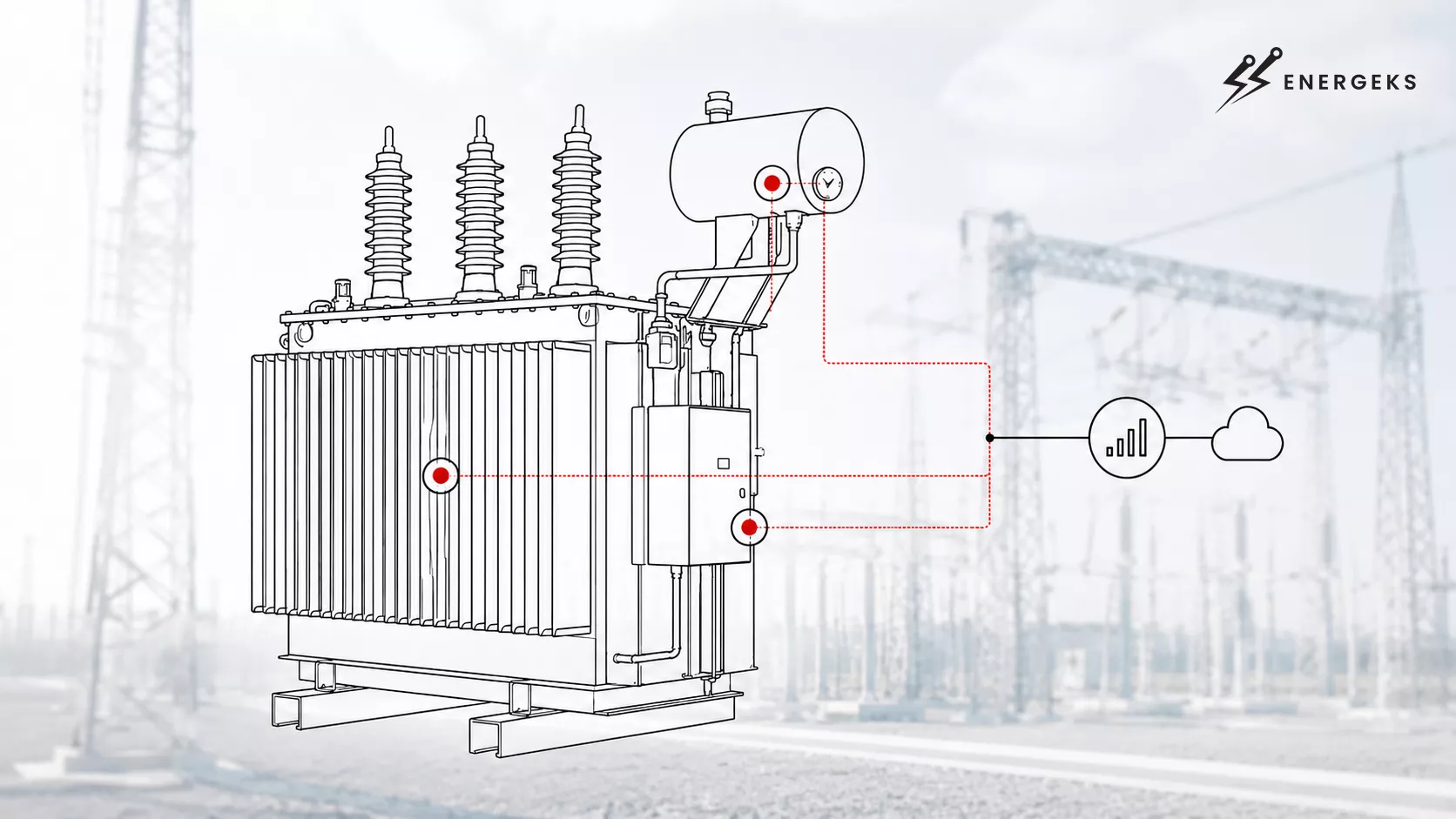
Online transformer monitoring is a solution particularly useful in industrial plants, power substations, photovoltaic farms, data centres and anywhere a transformer failure could stop a critical process. This article shows why to monitor a transformer online, which parameters matter most, and how to approach the topic for an entire fleet of devices. Special attention is given to temperature, moisture and load, because these three areas reveal a great deal about the actual operating conditions of a transformer.
Your transformer can operate for years without drawing particular attention to itself.
It stands in the substation, supplies a plant, a photovoltaic farm, a logistics centre or a bank of chargers.
It emits a characteristic, steady sound, its enclosure remains closed, and the operator checks on it during inspections and maintenance rounds.
Everything seems to be in order.
Inside, however, processes are constantly taking place that are invisible to the naked eye. Insulation ages under the influence of temperature. Load changes depending on the time of day and the nature of the installation's operation. Moisture can migrate between the oil and the cellulose insulation. The cooling system can gradually lose efficiency. A single deviation often does not yet indicate a serious problem, but a repeating trend should already interest those responsible for maintaining the device.
Transformer failure rarely comes out of nowhere. It usually sends warning signals beforehand. They just need to be collected, compared and properly interpreted.
That is what online transformer monitoring is about.
Energeks supplies medium‑voltage transformers – from the perspective of a manufacturer and supplier of energy solutions, we know that handing over a device for operation closes one stage of work.
After that, daily reality begins: variable loads, high ambient temperatures, operation in confined spaces, overloads, and decisions often made under time pressure.
Online transformer monitoring allows continuous tracking of temperature, load, moisture, oil level and other operating parameters. By analysing data in real time, it is possible to detect overloads, overheating, cooling problems and signs of insulation ageing earlier, reducing the risk of failure and unplanned downtime. In this article, we take a closer look at this topic.
Reading time: about 15 minutes.
What does online transformer monitoring mean?
Online transformer monitoring means continuously observing the device during its normal operation. The transformer does not need to be switched off, opened or visited by a technician every time we want to check what is happening with it. Sensors collect data, the system transmits it to the appropriate software, and the operator receives a picture of the device's operation along with history, trends and alarms.
It sounds simple, but in practice it is about much more than displaying a few numbers on a screen.
A transformer operates under changing conditions. In the morning, the load may be low; at midday, the plant starts up additional production lines; in the evening, power consumption drops again. In the case of a photovoltaic farm, the situation depends on insolation. In a logistics centre, the warehouse work rhythm matters, and for electric vehicle charging infrastructure, the load can increase sharply within a few minutes.
At the same time, oil temperature, ambient temperature, current flowing through the windings and the load on the cooling system change. If moisture, dirty radiators, unbalanced phase loading or deteriorating insulation condition are added to this, a single reading ceases to be sufficient. A history of the device's operation is needed.
And that history is what online monitoring creates.
Oil temperature shows how the transformer handles heat
Oil temperature is one of the most important parameters observed in oil‑immersed transformers. The oil insulates the live parts and removes the heat generated during core and winding operation. In short: the transformer produces heat, and the oil helps to carry it out of the device.
If the transformer operates under higher load, losses increase and oil temperature begins to rise. The phenomenon itself is completely normal. Concern arises when the temperature rises too quickly, persists for a long time, or reaches higher values than previously at similar operating conditions.
Let us imagine a transformer that operated for several months at a 70% load and maintained an oil temperature of around 55–60°C. If, after some time, at the same load, the temperature starts to reach 68–70°C, the system gives the maintenance team a very clear signal. The cause could be a dirty radiator, restricted oil flow, a fan problem, higher ambient temperature or changed installation conditions.
Without a history, such a reading is just a number. With a history, it becomes diagnostic information.
The duration of elevated temperature is also important. A fifteen‑minute load peak and eight hours of operation at high temperature have completely different implications for the insulation. Monitoring records both events and allows the actual operating profile to be reconstructed.
Winding temperature and the hottest point
Oil temperature says a lot about the conditions inside the tank, but it does not always show the hottest point in the transformer. Local areas of higher temperature, known as the hottest point, can occur in the windings.
The temperature of the hottest point is of great importance for assessing insulation ageing. Insulation materials do not age uniformly throughout the device. The most thermally stressed sections operate under more difficult conditions than areas where the temperature remains lower.
Depending on the transformer construction, the winding temperature or hottest point can be measured directly or determined based on oil temperature, load current and the device's thermal model. In both cases, the system needs data from several areas for the interpretation to make sense.
If the oil temperature looks correct but the model indicates an unusually high hottest‑point temperature, the team can check the load distribution, cooling condition and operating conditions. Such information is particularly valuable for devices operating close to their rated power limit.
The transformer does not have to trip immediately due to elevated temperature. However, the insulation can age faster, and subsequent overloads will gradually reduce the safety margin. Monitoring allows this process to be observed, rather than learning about it only after a failure.
Ambient temperature gives readings the right context
Ambient temperature may seem like a secondary parameter. In reality, without it, it is difficult to properly assess the cooling system's performance.
A transformer operating at an ambient temperature of 12°C has completely different heat dissipation conditions than a device located in a hot hall or container where the temperature exceeds 35°C. The same oil temperature can mean normal operation in one case and thermal overload in another.
High ambient temperature reduces cooling capacity. If the transformer is additionally located in a room with limited ventilation, heat can accumulate around the tank. Under such conditions, the device will heat up faster and return to its steady temperature more slowly.
Combining ambient temperature with oil temperature and load allows an assessment of whether the transformer's response is adequate to the conditions. The system can also capture seasonal changes. In summer, temperatures will be higher, in winter lower, but the device should behave according to a predictable pattern.
Current and voltage show the actual electrical conditions
Current monitoring allows checking how much energy is actually flowing through the transformer. The design documentation shows the rated power and expected operating conditions. Only operational measurements show what daily operation looks like.
Current can change very quickly. In a production plant, it increases when machines and production lines start up. In an installation with many inverters, it depends on energy production and load operation. In electric vehicle charging infrastructure, several simultaneous charging sessions can cause a short but intense peak.
The system records such events and allows determining whether they occur sporadically or repeat every day.
Voltage provides further information. Its fluctuations, asymmetry or unusual values may indicate problems in the grid, incorrect load configuration or conditions affecting the transformer load. When analysing voltage, power quality, harmonics and short‑term disturbances can also be considered.
Not every installation requires such an extensive power quality analysis. In the case of a plant with many drives, rectifiers, inverters and converters, however, such a measurement range can provide very important information about the transformer load.
Active and reactive power help understand the load character
Current alone tells you how much energy is flowing through the device. Active and reactive power help understand how that energy is being used.
Active power is responsible for the actual work of the loads: driving motors, powering machines, lighting, heating or charging batteries. Reactive power is associated, among other things, with the operation of inductive and capacitive devices. It does not perform useful work in the same way as active power, but it affects the current flowing in the installation and the transformer load.
In a plant, it may turn out that active power remains at a moderate level, but reactive power is high. The transformer must then conduct a higher current, which translates into losses and heating.
Monitoring allows these relationships to be observed over time. It can be checked whether specific devices or processes cause an increase in reactive power, whether the problem appears at a particular time, and whether compensation measures bring the expected effect.
Power factor shows how efficiently the infrastructure is being used
The power factor, denoted as cos φ, describes the relationship between active power and apparent power. The lower its value, the greater the share of reactive power in the total electrical load.
A high power factor means more favourable utilisation of the transformer's available capacity. A low power factor can cause current to increase, losses to rise and the available load margin to be reduced.
For a fleet operator, cos φ data can be useful when comparing locations. One plant may draw a similar active power to another, yet load its transformer more heavily due to a higher share of reactive power.
This type of information helps in making decisions regarding reactive power compensation, load distribution and future installation expansion planning.
Load imbalance between phases
In an ideal world, each phase would be loaded evenly. In real installations, however, loads are distributed differently, some operate cyclically, and some start up independently.
If one phase is significantly more loaded than the others, uneven heating and worsening operating conditions can occur. Long‑term asymmetry also affects voltage quality and can be a signal of a problem on the load side.
Monitoring each phase allows you to see whether the imbalance is temporary or permanent. In the first case, it may result from a normal work cycle. In the second, it is worth checking the load distribution, installation configuration and devices connected to individual phases.
This is particularly important in large plants where load changes with the operation of many independent loads.
Oil level and system tightness
In an oil‑immersed transformer, the oil level is directly related to insulation safety and cooling. A drop in level may result from a leak in the tank, pipes, bushings, radiators or the conservator system.
A small change does not always mean an immediate threat. If the level gradually drops over several weeks, the system can help determine the rate of loss. If the drop is sudden, the alarm should prompt a rapid inspection.
The influence of temperature is also important. Oil changes volume with temperature, so its level can naturally differ depending on operating conditions. Monitoring allows the oil level to be correlated with temperature and distinguishes normal volume change from a potential leak.
For transformers equipped with a conservator, level indicators and the breathing system play an additional role. Data from these elements can complement the picture and help assess whether the device is behaving correctly.
Moisture in oil and insulation
Moisture has a significant impact on the condition of a transformer's insulation system. It can accelerate paper ageing, reduce the dielectric strength of the oil and affect the device's behaviour under higher load.
Sources of moisture can include leaks, the breathing system, seals, transport conditions, storage and servicing. Water can also migrate between the oil and the cellulosic materials inside the transformer.
Interpreting the measurement requires taking temperature into account. Moisture is not distributed in the insulation in a completely static way. When temperature and load change, the equilibrium conditions between oil and paper also change.
Therefore, moisture monitoring is most valuable when data is analysed together with oil temperature, hottest‑point temperature and load. Then it is possible to observe whether the moisture level is stable, increasing, reacting to overloads or showing seasonal changes.
Gases dissolved in the oil
Gases dissolved in the oil are produced by processes occurring inside the transformer. Their presence does not always mean a serious fault, but specific gases and their rate of increase can indicate overheating, partial discharges, cellulose degradation or arcing.
DGA analysis can be performed in a laboratory based on oil samples. For transformers of high power or high criticality, an online analyser can be used to continuously monitor selected gases.
Such a system does not replace the laboratory or the engineer's experience. It does, however, provide information between successive tests. If the concentration of a particular gas starts to rise faster than before, the operator can plan additional testing, load reduction or device inspection.
In transformer diagnostics, the rate of change is of great importance. A single result can be difficult to interpret. A series of results showing a clear trend tells much more.
Fan and pump condition
The cooling system may have a very good design and adequate capacity, but its effectiveness depends on the actual operation of fans, pumps, thermostats, controllers and the power supply system.
Monitoring can show when fans were started, how long they have been running and whether the temperature changes as expected. If the fans run for a long time and the oil temperature continues to rise, the causes should be sought more broadly. There may be a problem with airflow, a dirty radiator, an oil pump or a sensor.
For a fleet of transformers, comparing cooling operation can be very interesting. If one transformer, at a similar load, starts its fans significantly more often than the others, the system shows a difference worth investigating.
Vibration and unusual noise
A transformer emits a characteristic sound related, among other things, to core operation, magnetostriction and load current. A change in noise or the appearance of unusual vibrations may indicate mechanical problems, loose elements, a change in core operation or abnormalities in the windings.
Noise alone is difficult to assess solely on the basis of subjective human perception. One operator may say the transformer "is humming a bit louder", another may consider everything normal. Vibration sensors and frequency analysis allow the current signal to be compared with previous measurements.
Not every change in sound means damage. What counts is repeatability, the direction of the change and consistency with other parameters.
Partial discharges
Partial discharges are local electrical phenomena occurring where the insulation is not working correctly. They may be associated with voids, contamination, damage to the insulating material or local overstressing of the electric field.
Their detection requires appropriately selected sensors and advanced interpretation. Partial discharge monitoring is used primarily for devices of high value, great importance to the system or with an increased risk of failure.
Early detection of such phenomena allows more detailed diagnostics and planning of actions. For a transformer supplying a critical industrial process, this can determine whether a shutdown takes place during scheduled downtime or in the middle of normal production.
Protection alarms and event history
Monitoring should also record alarms and protection operations. The information that an alarm is active is important, but the history is even more valuable.
It is possible to check whether the alarm appears for the first time or has been recurring for several months. It can be correlated with temperature, load and cooling status. It can be seen whether, after a specific event, the parameters returned to their previous level.
Thanks to this, every event is recorded and can be used in subsequent analyses. The device's memory does not depend on whether someone happened to be on site and wrote down the result in a notebook.
The scope of monitoring should match the actual risk
Not every transformer needs an extensive system with gas analysis, vibration and partial discharge monitoring.
A small distribution transformer working in an easily accessible hall may require monitoring of temperature, load and basic alarms. For a larger unit supplying a production line, oil level, cooling status and trend analysis should be added. A transformer operating in a hospital, data centre, steelworks or large power substation may require a much wider diagnostic scope.
The device's power, age, operating history, load character, reserve availability, delivery time for a new transformer, environmental conditions and the cost of downtime should all be considered.
For a fleet, a tiered model is particularly useful. The most important devices receive extensive monitoring, while the others are observed using a basic set of parameters. All data, however, goes to a common system, allowing comparison of individual units and quick identification of devices behaving differently from the rest.
Online monitoring makes sense when the data leads to action. The operator should know what an alarm means, who analyses it and what steps to take. Then the sensors, communication and software form a practical maintenance tool, rather than another tab in a system that no one looks at.
Why are transformer protections not enough?
Protections are essential.
They protect the transformer and the installation in situations where continued operation could lead to serious damage. They respond to specific fault conditions: short circuits, overloads, excessive temperature, oil level drop or other dangerous phenomena.
Their action is of an interventionist nature.
Monitoring provides a broader picture.
It records operating conditions before, during and after an alarm. It shows not only that the temperature exceeded a certain level, but also whether similar events have occurred over recent weeks. It can be checked at what load the problem appears, how quickly the temperature rises and whether the cooling system responds correctly.
A transformer can operate for a long time under conditions that do not immediately trigger a protection. Regular overloads, insufficient cooling or elevated moisture can gradually degrade the insulation. The device still supplies the loads, but its safety margin becomes smaller and smaller.
These are precisely the processes that are particularly important from the point of view of online monitoring. They allow a response to a change in the device's behaviour before the situation reaches a level requiring emergency shutdown.
How does temperature affect transformer operation?
Temperature is one of the easiest parameters to measure and one of the most useful diagnostic indicators.
In an oil‑immersed transformer, the oil insulates the windings and removes heat from them. Energy lost in the core and windings is converted into heat, which must be transferred to the surroundings. At higher load, losses increase and temperature rises with them.
The temperature rise itself during higher load is a natural phenomenon. What matters is how the device responds to changing conditions.
Suppose the transformer on Monday operated at 70% load and the oil temperature stabilised at 58°C. A week later, at a similar load, the temperature rose to 66°C. This does not yet mean a failure, but it is information that requires checking. The cause could be higher ambient temperature, a dirty radiator, restricted oil flow, a fan problem or changed installation conditions.
Monitoring allows the following to be correlated:
load,
oil temperature,
ambient temperature,
duration of elevated temperature,
cooling system status,
history of previous measurements.
Such a data set gives a much more complete picture than a single reading taken during a technician's visit.
High temperature accelerates insulation ageing. Every transformer has specified operating conditions, but long‑term operation at elevated temperature can shorten its actual life. Therefore, the system should also record the duration of load and temperature. A short‑term load peak and many hours of operation at high temperature have different implications for the device.
Is winding temperature monitoring more important than oil temperature?
Both measurements are needed because they show different elements of the same process.
Oil temperature indicates the thermal conditions in the tank. Winding temperature or the calculated hottest‑point temperature allows better assessment of the insulation load and local heating.
In many transformers, the hottest‑point temperature is not measured directly. It is determined based on oil temperature, load current, device characteristics and a thermal model. In more advanced systems, additional sensors or solutions for more accurate winding condition assessment can be used.
The hottest point is particularly important because the local temperature can be higher than the value read elsewhere in the tank. It is in the hottest fragments that insulation ages faster.
If the monitoring system knows the oil temperature, load and ambient conditions, it can assess whether the current operation is within the expected thermal profile. A deviation from this profile may indicate a change in cooling efficiency, a mechanical problem or an unusual load distribution.
How does load affect the transformer?
A transformer operates under conditions that can change very dynamically.
In a production plant, load increases when machines are started. In an automated warehouse, it depends on the intensity of transport system operation. In a facility with car chargers, power consumption can change depending on the number of vehicles charging simultaneously. On a photovoltaic farm, load and energy flow depend on inverter production and grid configuration.
Design assumptions about average power consumption may look reasonable on paper, but actual operation can bring a completely different profile.
Load monitoring shows:
when peaks occur,
how long they last,
how often they repeat,
whether the load is balanced between phases,
how the transformer responds thermally,
whether seasonal overloads appear.
For example, a transformer may have an average load of 65%, yet operate at 105% for two hours every day. The daily average looks safe, but the recurring peaks affect temperature and insulation ageing.
An additional issue is phase asymmetry. Uneven loading can lead to local temperature rises and worsen operating conditions. Monitoring each phase allows you to see that the problem concerns a specific part of the installation, not the entire transformer.
Why is moisture in a transformer so important?
Moisture affects the oil, paper insulation and the overall strength of the insulation system.
It can enter the transformer through leaks, the breathing system, damaged seals, incorrectly performed service work or improper transport and storage conditions. Water can also be generated or migrate within the insulating materials during operation.
Cellulosic insulation absorbs moisture. Its presence can accelerate paper degradation, reduce the dielectric strength of the oil and increase the risk of adverse phenomena during overload. At high temperature and with the right moisture concentration, the risk of gas bubble formation in the oil can also arise.
Moisture does not behave in a completely static way in a transformer. Its distribution depends on temperature, load, oil type and insulation condition. Water can migrate between oil and paper. The result of a sample taken at one moment does not always reflect the full state of the entire insulation system.
Therefore, moisture monitoring should be analysed together with temperature and load. Only then can it be seen whether a particular change is a permanent trend, a reaction to a change in operating conditions or the result of a measurement error.
CIGRE indicates that when interpreting moisture, factors such as oil temperature, hottest‑point temperature, load, cooling mode and breathing system type should be considered. This approach allows better assessment of insulation ageing and overload risk.
You may also be interested in this topic:
Water vapour condensation in a transformer tank. The silent killer in winter.
How are dissolved gases in the oil analysed?
Gases can accumulate in transformer oil as a result of processes occurring inside the device. Their type, concentration and rate of increase provide information about potential problems.
DGA analysis includes, among others, hydrogen, methane, ethane, ethylene, acetylene, carbon monoxide and carbon dioxide. Individual gases can be associated with oil overheating, cellulose degradation, partial discharges or arcing.
Traditional laboratory analysis involves periodic oil sampling. This is an important diagnostic method and remains the basis of many transformer maintenance procedures. Online monitoring allows changes between laboratory tests to be observed.
For a large transformer operating in a critical installation, continuous gas analysis can be particularly important. A rapid increase in a specific component can trigger additional inspection, sampling, load reduction or planned shutdown preparation.
DGA requires expert interpretation. It is not enough to look at one number and decide to replace the device immediately. The history, rate of change, gas ratios, laboratory results, temperature, load and other symptoms are analysed.
Gas laws in DGA: 5 physical rules that warn you before a transformer failure occurs
How does a transformer monitoring system work?
A monitoring system consists of several cooperating layers.
The first is the sensors. They record temperature, current, voltage, moisture, oil level, gases or vibration.
The second layer is responsible for data collection and transmission. A communication module or industrial gateway can perform preliminary processing of measurements, filter interference, store data locally and transmit it to the supervisory system. Depending on the infrastructure, Ethernet, Modbus TCP, MQTT, cellular network or integration with a SCADA system are used.
The third layer covers analysis. The software compares values with alarm levels, tracks trends and can detect deviations from the typical behaviour of a specific device.
The fourth layer is for presentation and alarm handling. The operator can receive information on a panel, by email, SMS or in an application. For distributed installations, remote access is particularly important.
The greatest value comes from a system that delivers information understandable to the maintenance team. An alarm should indicate the device, the parameter, the time the problem started, the rate of change and the urgency level.
1. Sensors and measurements
The first layer of the system is located directly at the transformer. Sensors record its key operating parameters: oil and winding temperature, current, voltage, load, moisture, oil level, dissolved gases and vibrations. This is where the data reflecting the actual condition of the equipment is generated.
2. Data collection and transmission
The collected measurements are sent to a communication module or industrial gateway. The device can initially filter out interference, store data locally and transmit it via Ethernet, Modbus TCP, MQTT, a cellular network or an existing SCADA system.
3. Analysis and interpretation
In the third layer, the data begins to provide meaningful information. The software compares current readings with alarm thresholds, analyses trends and checks whether the transformer is behaving in the same way as before. The system can detect a gradual rise in temperature, unusual loading or a change in parameters that has not yet exceeded the alarm threshold.
4. Presentation and response
The final layer delivers the information to the operator. Results can be displayed in a dashboard, application or SCADA system, or sent by email, SMS or push notification. An effective alarm identifies the specific unit and parameter, the moment the issue began, the rate of change and the level of urgency. This allows the team to determine whether observation is sufficient, additional diagnostics are required or immediate action must be taken.
Does online monitoring make sense for an entire fleet of transformers?
For a larger number of devices, online monitoring helps organise a huge amount of information.
For a single transformer, regular rounds, oil tests, thermography and inspections can provide sufficient control. For a dozen or several dozen units, the risk increases that the team will miss a change developing between visits.
The fleet may be dispersed across plants, substations, PV farms and charging points. Each transformer may have a different power, age, operating history and process significance. A central system allows information to be gathered in one place.
The operator can check the condition of the entire fleet and then go to a selected location and specific device. It is possible to compare transformers of similar power and construction. It is visible which devices have the most alarms, which operate closest to the load limit and where the temperature rises faster than in comparable units.
Such a system also helps to identify problems common to several devices. If transformers from the same location have similar temperature profiles, the cause may be the ventilation method, ambient temperature or installation conditions. If only one unit behaves differently, its individual technical condition is more likely to be the issue.
Does online monitoring make sense for an entire fleet of transformers?
For a larger number of devices, online monitoring helps organise a huge amount of information.
For a single transformer, regular rounds, oil tests, thermography and inspections can provide sufficient control. For a dozen or several dozen units, the risk increases that the team will miss a change developing between visits.
The fleet may be dispersed across plants, substations, PV farms and charging points. Each transformer may have a different power, age, operating history and process significance. A central system allows information to be gathered in one place.
The operator can check the condition of the entire fleet and then go to a selected location and specific device. It is possible to compare transformers of similar power and construction. It is visible which devices have the most alarms, which operate closest to the load limit and where the temperature rises faster than in comparable units.
Such a system also helps to identify problems common to several devices. If transformers from the same location have similar temperature profiles, the cause may be the ventilation method, ambient temperature or installation conditions. If only one unit behaves differently, its individual technical condition is more likely to be the issue.
How to design monitoring for a transformer fleet?
Fleet monitoring begins with a simple question: which devices really require constant attention, and which can operate calmly under basic supervision?
Because if we connect all possible sensors to every transformer, we will create an impressive amount of data. But what good is it if the operator has to look at hundreds of charts every day, most of which change nothing? The monitoring system is meant to help make decisions, not to give the maintenance team a digital marathon through dashboards.
A well‑designed fleet monitoring system should correspond to the infrastructure management structure. The person responsible for the entire energy asset needs a different view than a technician analysing a specific transformer. One looks at the whole map, the other looks into the details of a specific device.
Three levels of information
At the highest level, the manager should see the entire fleet quickly and clearly. How many transformers are operating correctly? Where have active alarms appeared? Which locations require a response? Does the problem concern one device, or perhaps several transformers operating under similar conditions?
Such a view should not resemble the cockpit of an aircraft preparing for a Mars landing. A clear location map, device status, number of alarms, urgency level and information on which units deviate from their typical behaviour are enough.
If ninety‑nine transformers are operating stably and one has been showing elevated temperature at similar load for several days, the system should bring that information to the foreground. The operator should not have to search for it among hundreds of green indicators. Green is pleasant, but in excess it can effectively hide a small red problem.
The second level concerns a specific substation, plant or location. Here, the mutual operation of several devices matters. Their load, temperatures, cooling system activity and alarm history can be compared. Such a view helps to see whether the load is distributed evenly and whether one transformer is not taking on too much of the work.
For example: three transformers in a plant operate at a similar ambient temperature. Two maintain an oil temperature of 55°C, and the third reaches 68°C at a similar load. This is not yet a ready technical verdict, but it is a very good reason to check the cooling, airflow, radiator dirt, sensor readings and actual operating conditions.
At the third level is the specific transformer. Here, details are needed: temperature, current and load charts, oil level data, moisture, fan operation, oil test results, inspection information, reported faults and a history of actions taken.
A technician should be able to check not only that an alarm occurred, but also when it started, how long it lasted and what was happening with the device at the same time. An alarm without context resembles a message: "something is wrong." The history already allows a specific question: what exactly changed and what could have caused that change?
First criticality, then sensors
Before selecting the scope of monitoring, a criticality analysis of each transformer should be performed. It sounds very formal, but in practice it is about determining how much a given unit can make life difficult for the company if it suddenly stops working.
Does the transformer supply one hall or an entire production line? Will its failure stop a technological process, a server room, a cooling system or charging infrastructure? Is there a backup transformer? How long would it take to deliver a new device? Can it be brought in without rebuilding the foundation and the entire installation?
Location should also be considered. A transformer located at a plant with 24/7 service availability is in a different situation than a device operating at a remote photovoltaic farm, in difficult terrain or in a substation that requires planning and outages to access.
History also matters. If the device previously had problems with temperature, moisture, leaks, the tap changer or the cooling system, it should not be treated the same as a new transformer that has been operating stably for years.
Add to this the cost of downtime. In one place, an hour‑long interruption means a few phone calls and a shift in the work plan. In another, it can mean production stoppage, loss of a batch of material, interruption of energy supplies or the need to start expensive backup power.
Not every transformer needs the same monitoring
After the criticality analysis, transformers can be divided into several groups.
The most important units receive extensive monitoring. For them, observation of oil and hottest‑point temperature, load, oil level, moisture, cooling status and protection alarms can be justified, and with sufficiently high power, also dissolved gases, vibration or partial discharges.
The second group includes devices important to the process but with partial reserve or easier service access. Here, monitoring of temperature, current, voltage, load, basic alarms and cooling operation may be reasonable. If the data shows a worrying trend, diagnostics can be expanded or additional tests planned.
The third group consists of units of lower criticality, operating under predictable conditions and easily accessible to personnel. In such cases, basic parameter monitoring, an alarm register and periodic trend analysis are often sufficient.
This approach helps avoid two extremes. The first involves equipping every transformer with the entire diagnostic catalogue, even though no one subsequently analyses the data obtained. The second reduces monitoring to a single indicator that lights up green for five years until one day it goes out together with the transformer.
Comparison matters, not just the number
For a fleet, the ability to compare devices is particularly valuable. A transformer should not be evaluated solely by a single universal limit. It is worth checking how it behaves relative to its own history and relative to similar units.
If all transformers in a given group respond similarly to a rise in ambient temperature, we are probably dealing with a normal phenomenon. If one of them starts heating up faster than the others, the situation is different.
The same applies to alarms. Two devices may have five alarms per month, but in one case they will be short warnings related to a temporary load peak, and in the other, repeating signals about rising temperature and cooling problems. The number of alarms alone is not enough. Their context, duration and correlation with other parameters are needed.
Monitoring must end with a decision
The best monitoring system is not the one that shows the most data. It is the one that helps decide what to do next.
An alarm should have a defined urgency level. For an informational signal, recording the event and observing the trend is sufficient. A warning may require analysis by the maintenance team or planning an additional measurement. A critical alarm should trigger a clearly defined procedure: load reduction, on‑site inspection, preparation for shutdown or switching to reserve.
Each alarm should indicate the specific device, the parameter, the time the problem started, the rate of change and the conditions under which it occurred. It is good if the system also suggests what actions were taken previously and whether a similar situation has occurred in the past.
Transformer fleet monitoring should therefore work like a well‑organised team. At the top, it shows a picture of the entire infrastructure. Lower down, it allows analysis of a specific substation. At the end, it leads the technician to one device, one trend and one decision.
Does online monitoring replace inspections and oil testing?
Online monitoring should work alongside existing diagnostic methods.
Visual inspection allows assessment of the tank, connections, bushings, radiators, valves and seals. Thermography shows the temperature distribution on the device surface. Oil tests provide information about its properties, water content, dielectric strength and dissolved gases. Electrical measurements allow assessment of selected elements of the insulation system.
A temperature sensor will not replace visual inspection. A monitoring platform will not perform a connection assessment for the technician. Online DGA does not eliminate the need for laboratory tests, especially when a worrying change appears.
The best results come from combining current data with documentation, the device's history and inspection results. Then it is possible to determine whether the current deviation is something new or has been recurring for some time.
How to implement transformer monitoring step by step
First, it must be determined what problem the system is intended to solve. In one plant, the most important factor will be overload control. In another, remote observation of dispersed devices will be a priority. For a large grid transformer, dissolved gases, moisture and hottest‑point temperature may be relevant.
Next, sensors, communication methods and the extent of integration with the existing automation system are selected. At this stage, it is worth checking which signals are already available and which require additional instrumentation.
After commissioning, the system should collect baseline data. A few weeks of normal operation help establish the typical temperature, load and cooling profile. Only on this basis can alarms be properly tuned.
The next element is the response procedure. Each alarm should have an assigned responsible person and a defined course of action. The team should know when observation is sufficient, when an additional test is needed and when the load should be reduced or a shutdown prepared.
A monitoring system without a response procedure remains merely a source of data. Its value appears when the data leads to a specific operational decision.
Is online transformer monitoring cost‑effective?
Cost‑effectiveness depends on the relationship between the implementation cost and the consequences of a failure.
Downtime can mean production stoppage, loss of energy sales opportunities, problems with contract fulfilment, costs of renting a replacement transformer, transport, service work and restarting the installation.
Monitoring is particularly well justified for transformers:
supplying critical processes,
operating under high or variable load,
located in difficult‑to‑access locations,
belonging to a dispersed fleet,
whose replacement involves a long delivery time,
with a history of faults,
lacking a backup unit.
For a smaller transformer of low criticality, basic temperature, current and alarm monitoring may be sufficient. For a large device operating in a key substation, the diagnostic scope will be much wider.
The best basis for a decision is a risk analysis. The price of the system should be compared with the value of the protected process and the possible cost of downtime.
Which parameters to monitor first?
For most installations, a good starting point is temperature, load and cooling system status.
Temperature shows the thermal operating conditions of the transformer. Load explains what these conditions result from. The status of fans, pumps and other cooling elements allows assessment of whether the device is properly dissipating heat.
For oil‑immersed transformers, oil level and moisture monitoring should also be considered. For units of high power or criticality, online DGA, partial discharge measurement and vibration analysis may be justified.
The choice should result from the device's construction, operating method and the consequences of a potential failure. Each additional function makes sense when the data will be used in the maintenance process.
What is worth remembering?
Online transformer monitoring provides the ability to observe the device during actual operation. It shows temperature, load, moisture and other parameters over time, making it possible to identify trends and respond to changes early enough.
For a single transformer, the system helps organise diagnostics and reduce the risk of missing a problem. For an entire fleet, it becomes an energy asset management tool. It facilitates comparing units, setting priorities, planning inspections and making decisions about further operation.
A transformer can operate correctly for many years, but its condition changes with temperature, load, moisture and environmental conditions. The more we know about these changes, the easier it is to plan service, reduce downtime and use the device safely.
Energeks supplies oil‑immersed and cast‑resin transformers, selected for the actual load, operating conditions and installation significance. When choosing a device, requirements regarding cooling, resistance to moisture and dust, fire safety, noise level, available space and the planned monitoring system can be taken into account.
If you are interested in solutions available off‑the‑shelf, explore the range of transformers currently in stock at Energeks.
Also join us on LinkedIn, where we are building a community of power engineering enthusiasts and professionals. Thank you and see you there!
Sources:
CIGRE – Online moisture monitoring of transformers for ageing assessment
IEC – The Establishment and Design of Standard for Condition Monitoring in Power Systems
Hitachi Energy – TXpert Ready CoreSense M10 online DGA analyzer
Transformers in stock
Shipped from our warehouse in Poland within 2–3 working days, 5-year warranty. Full range 25–2500 kVA in the shop (prices in PLN).
A medium‑voltage transformer can hum gently during normal operation. The characteristic sound arises mainly from vibrations of the magnetic core, through which the alternating magnetic flux flows. A steady hum usually does not indicate a fault. Concern should be raised by a sudden change in noise level, metallic buzzing, crackling, knocking, excessive vibration or a simultaneous increase in device temperature. In such cases, voltage, load, power quality, the condition of mountings, ventilation and the transformer's foundation should be checked.
An MV transformer rarely operates in complete silence. Even a modern device, made of high‑quality materials and correctly installed, can emit a characteristic low sound. For some, it will be a barely audible murmur. In another room, with hard walls, a large metal enclosure and inadequate ventilation, the same sound can become the dominant acoustic element of the entire station.
This is where the problem begins. The hum itself does not necessarily indicate a fault, but its character can tell a great deal about the transformer's operating conditions. Sometimes the sound is a natural consequence of core operation. Other times, it signals overloading, incorrect voltage, a loose structural element, enclosure resonance or an improperly designed room.
Why does a medium‑voltage transformer hum? How to recognise a sound typical of normal operation? When is immediate action needed? And can noise be reduced without risking overheating of the device?
In this article, we look at the problem from both a technical and practical perspective. We will start with the source of the sound itself, then move on to the most common causes of excessive noise, diagnostic methods and solutions worth considering already at the transformer station design stage.
Why does an MV transformer hum?
The most typical hum of a transformer comes from its magnetic core. The core performs an extremely important job: it guides the magnetic flux and enables the correct transformation of voltage between the medium‑voltage and low‑voltage sides.
It is made of thin, mutually insulated ferromagnetic laminations. Their task is to limit losses caused by eddy currents. When alternating current flows through the transformer windings, a changing magnetic flux is created in the core. Under the influence of this flux, the core material slightly changes its dimensions.
This phenomenon is called magnetostriction.
The deformations are very small, often invisible to the naked eye, but they repeat many times per second. At the grid frequency of 50 Hz, vibrations are generated that can be perceived as a low, steady sound. In practice, the audible frequency is often associated with the 100 Hz component, because the core reacts to the change in the magnetic field in every half‑cycle of the alternating voltage.
It can be said that the transformer "sings" under the influence of the magnetic field. It is not, however, a random song. Its volume and character depend on many factors: the type of laminations used, the precision of core construction, the way it is assembled, mechanical stresses, voltage level and the construction of the tank or enclosure.
If the core has been correctly designed and the transformer operates under conditions consistent with the documentation, the sound should be stable and predictable. It may be audible, but it usually has no sudden changes or additional alarming noises.
Is transformer humming normal?
Yes – a gentle and steady hum from the transformer is a normal phenomenon.
It is worth clarifying, however, what "normal" means. It does not refer to a specific sound level that would be identical for every unit. A large oil‑immersed transformer, a cast‑resin transformer operating in an enclosure and a small unit installed in a well‑soundproofed room can sound completely different.
The most important thing is whether the sound corresponds to the parameters foreseen for the given device and whether it remains stable over time.
A transformer that has emitted a low, steady tone since the day of commissioning, and whose temperature, load and electrical parameters remain correct, most often gives no cause for concern. The sound may be more audible during increased load, especially if the load current or cooling conditions change.
A transformer that operated quietly for many months and then started to hum noticeably louder should be treated differently. Even more attention is required for sounds that were not present before: metallic buzzing, irregular crackling, rhythmic knocking, friction noises or vibration of enclosure elements.
In such situations, it is worth asking a simple question: does the transformer sound the same as before?
This is one of the most important questions in practical diagnostics. A change in sound does not yet indicate a specific cause, but it is a signal that the device or its surroundings should be checked.
When should transformer noise be a concern?
What matters most is not the mere presence of sound, but its change. A transformer can operate for years, emitting a gentle hum that remains at a similar level. If it suddenly starts to resonate, buzz or vibrate, this should be treated as diagnostic information.
A sound that appears only at a specific load should also be concerning. For example, a transformer operating quietly at night starts to hum intensely after the start‑up of large motors, variable frequency drives or other loads with variable power consumption. Such a symptom may indicate a problem with power quality, harmonics or load conditions.
Concern should also be raised by noise combined with other symptoms. If, along with an increase in volume, the temperature of the windings or oil rises, there is a smell of overheated insulation, alarm fans are operating, or the monitoring system registers abnormalities, further operation without checking the cause may be risky.
Attention should also be paid to where the sound is coming from. If the transformer itself is operating stably but one of the covers, enclosure doors or ventilation grilles is resonating loudly, the source of the problem may be mechanical. A small amount of play can turn a quiet hum into a very irritating metallic buzz.
In the medium‑voltage environment, no sound that appears suddenly should be underestimated. The final assessment always rests with qualified personnel, but a rapid report of a change can help detect a problem before it leads to a more serious failure.
What causes louder transformer humming?
One of the most common causes of louder operation is excessive supply voltage. Every transformer has been designed to operate at specific parameters. If the medium‑voltage voltage is higher than the rated value, the core may operate with a higher magnetic flux.
Under such conditions, the magnetising current increases, no‑load losses rise, and core vibrations can become more pronounced. The transformer then starts to hum more intensely and, at the same time, may operate at a higher temperature.
A similar effect can appear in the case of an incorrect tap‑changer setting. Taps allow the transformer ratio to be adjusted to grid conditions, but their position must correspond to the actual voltage parameters and the device documentation. Changing the tap setting is not an activity that should be performed intuitively. It requires de‑energising the device, securing the work area and applying the correct procedure.
Another cause can be voltage waveform distortion. Modern industrial plants use many power electronic devices. Variable frequency drives, rectifiers, switch‑mode power supplies, UPS systems and photovoltaic installations can affect the power quality in the grid.
Higher harmonics increase losses in the transformer and can cause additional vibrations. The device then starts to react to a voltage waveform that deviates from a perfect sine wave. This is precisely why, in the case of unusual noise, a power quality analysis should be performed, rather than limiting the diagnosis to a simple rated voltage measurement.
Can a loose core cause noise?
Yes. A loose core packet is one of the possible causes of characteristic metallic buzzing.
The transformer core must maintain adequate rigidity. The individual elements are precisely assembled and secured to limit mutual movement and the transmission of vibrations. If the clamping pressure changes over time, fastening elements loosen, or mechanical wear appears, vibrations can intensify.
The sound then often ceases to be a soft, steady hum. A harder, more metallic tone appears, sometimes resembling the buzzing of thin sheet metal. Vibrations may be felt on the enclosure or structural elements, though this is not always the rule.
Core diagnostics require particular care. An MV transformer must not be opened or inspected internally while energised. Disconnection, isolation and earthing of the device in accordance with applicable procedures are necessary. Visual inspection and any adjustment work should be carried out by persons with appropriate qualifications and experience.
It is worth remembering that not every metallic sound comes from the core. A loose cover, grille, bracket, guard or supporting structure element can behave very similarly. Therefore, diagnosis should be carried out methodically, starting with the simplest possible causes.
Can the enclosure amplify the transformer's sound?
The enclosure can act like a resonance box. The transformer emits a certain level of vibration, but the way the sound propagates through the room depends on the construction of the entire station.
A large metal surface, a thin cover or an insufficiently rigid wall can start to vibrate under the influence of the device's operation. As a result, small vibrations are amplified and become much more audible.
Sometimes, a small amount of play in a hinge, an undertightened screw or an element touching the enclosure is enough to produce an irritating resonance. The sound may then be audible mainly in a specific part of the room, for example near one of the walls or close to a cable trench.
A similar effect occurs in empty, hard‑surfaced rooms. Concrete walls, ceilings and floors reflect sound waves instead of absorbing them. The transformer may not be working louder, but the sound is perceived as more intense.
For this reason, the noise level should be assessed together with the measurement conditions. The same transformer sounds different in an open container station, different in a large hall, and different again in a small technical room located near office spaces.
Does the installation location affect transformer noise?
The installation location has a very large impact. The transformer generates vibrations that can propagate both through the air and through the building structure.
If the device is placed on an improperly prepared foundation, vibrations can transfer to the walls, ceiling, cable trenches and adjacent structural elements. People in neighbouring rooms may then hear a low sound or feel slight vibrations, even if the noise level in the transformer compartment itself does not seem particularly high.
Levelling is also important. An uneven surface can cause uneven load distribution and additional stresses in the device structure. For oil‑immersed transformers, attention must be paid to correct tank support. For cast‑resin transformers, structural stability, cable routing and proper enclosure fixing are important.
At the design stage, it is worth planning how to reduce vibration transmission. Appropriate vibration isolation solutions can be used, but they must be matched to the device weight and operating conditions. Randomly placing damping material under the transformer is not a technical solution and can worsen the device's stability.
Why can fans cause noise?
In dry‑type transformers and in installations with forced cooling, part of the noise can come from the fans.
This cause is easiest to recognise by observing when the sound appears. If the transformer operates quietly until the fans start, and then a hum, vibration or rhythmic buzzing appears, the cooling system should be checked.
A fan can be noisy due to a worn bearing, an unbalanced impeller, dirty blades or incorrect mounting. The sound can also be amplified by grilles, ventilation ducts and enclosure elements.
In the case of air ducts, turbulence can be a problem. If the airflow is poorly directed, changes direction at a sharp bend or encounters an obstacle, additional aerodynamic noise is generated. The room can then be noisy even though the transformer itself is operating correctly.
Ventilation grilles should not be covered, nor should airflow be restricted to reduce sound. The transformer needs adequate cooling, and any interference with the ventilation can lead to a rise in winding temperature and protection operation.
How to check exactly where the noise is coming from?
The first step is observation. It is worth determining whether the sound occurs constantly or changes with load. Check whether its level increases after the start‑up of specific machines, fans or reactive power compensation systems.
Locating the source is also helpful. The sound should be assessed at the transformer, at the enclosure, at the doors, at the ventilation grilles and in places where the structure contacts the building. In practice, it often turns out that the loudest point is not directly at the transformer.
For a professional assessment, sound level measurement and spectrum analysis can be used. The spectrum allows checking whether the dominant components are related to core operation, fans, mechanical vibrations or auxiliary devices.
When vibration transmission through the structure is suspected, vibration measurements can be useful. Thermography, in turn, can check whether the noise is accompanied by overheating of connections, terminals, cables or apparatus components.
The decibel measurement alone will not answer all questions. Two devices can have a similar noise level but completely different causes and different operational risks. Therefore, the result should be interpreted together with temperature, load, voltage, power quality and the transformer's operating history.
How to correctly measure transformer noise?
The measurement should be carried out under specified and repeatable conditions. The microphone distance from the device, measurement height, background noise level, ambient temperature and transformer load all matter.
If one measurement was taken at minimum load from a distance of two metres, and another at full load from a distance of one metre, a direct comparison of the results may be misleading.
When accepting a new unit, it is worth recording the conditions under which the measurement was made. Such a result becomes a reference point for future inspections. If, after a year or two, the noise level increases significantly, this will be important information for the maintenance team and the service.
The measurement should also include the acoustic background. In a small room, sound reflects off the walls, and other equipment may be operating nearby. Without considering these factors, the result will not always reflect the transformer's actual emission.
How to reduce transformer noise?
The best method of reducing noise is to eliminate its cause. If the source of the problem is excessive voltage, the grid parameters must be analysed. If a loose cover is to blame, the play should be removed. If a fan is causing the noise, its technical condition and mounting method should be checked.
Vibration isolation can limit the transmission of vibrations to the foundation and building structure. It should, however, be matched to the transformer weight and the loads occurring during transport, installation and operation. Incorrectly selected elements can worsen the device's stability.
In technical rooms, acoustic solutions can be applied to walls and ventilation ducts. Their task is to absorb or limit sound reflections. The materials must, however, comply with fire, environmental and operational requirements.
For transformers operating inside buildings, the required noise level should be specified at the purchase stage. A later attempt to "soundproof" a finished installation can be much more expensive and complicated than choosing a device with parameters matched to the facility.
It must also be remembered that sound‑absorbing material will not solve the problem of an overheating transformer, a loose core or incorrect voltage. Soundproofing can reduce the sound level perceived in the room, but it should not be used to hide technical symptoms.
Is an oil‑immersed transformer quieter than a cast‑resin one?
There is no single answer that would be true for all models.
An oil‑immersed transformer and a cast‑resin transformer have different constructions, different cooling methods and different installation conditions. In an oil‑immersed transformer, the sound can be amplified by the tank. In a cast‑resin unit, the enclosure, the way the windings are fixed and fan operation can play a greater role.
The noise level is determined by the specific design solutions, manufacturing quality and installation conditions. Therefore, when choosing a transformer, the data for the specific model should be analysed, rather than relying on the general belief that one type will always be quieter than the other.
In indoor facilities, other features may also be important. A cast‑resin transformer may be preferred due to its limited fire risk and the possibility of installation close to consumers, while an oil‑immersed transformer may better suit the requirements of large outdoor stations and industrial installations. Each case requires individual selection.
How to prevent noise problems?
Most can be done before the transformer is delivered. The designer and investor should determine where the device will operate, who will be nearby, and what acoustic requirements apply in the facility.
A station for a production plant is designed differently than one for an office building, hospital, shopping centre, hotel or data centre. In each of these places, the transformer has the same basic function, but the consequences of noise will be different.
It is worth checking the declared sound power level, measurement conditions, cooling method and foundation requirements. The location of ventilation ducts and cable routes should also be analysed. Sound can travel far from the device itself.
A well‑executed design also considers service access. If the transformer is enclosed in a way that makes inspection difficult, any subsequent diagnostics will be more time‑consuming. It is then easy to overlook a loose element, a deteriorating fan or a change in temperature.
What to do when the transformer suddenly starts working loudly?
If the transformer suddenly starts humming loudly, the first step should be to note the circumstances. It is worth checking when the sound appeared, at what load it occurs and whether other symptoms are present.
The device should not be opened or its elements touched without proper authorisation. Medium‑voltage devices require appropriate safety procedures. Inspection, measurements and any service work should be carried out by qualified personnel.
Until the cause is clarified, attention should be paid to temperature, protection indications, load and fan operation. If a smell of burning, oil leak, signs of overheating, strong vibrations, crackling or alarms appear, the situation should be treated as urgent.
In some cases, the cause will turn out to be a minor resonance of a cover. In others – a problem with voltage, power quality or the mechanical condition of the core. Without measurements, it is not worth guessing.
Transformer noise and the acoustics of the entire MV station
The transformer does not operate in isolation from the rest of the infrastructure. The station room also contains switchgear, protection apparatus, ventilation, cables, busbars and structural elements.
Each of these components can emit vibrations or amplify sound. In switchgear, the source of noise can include, among other things, electromagnetic vibrations, loose elements, drives, ventilation and resonating panels.
Therefore, the station's acoustics should be treated as a whole. A properly designed structure, rigid frames, correct mountings, appropriate partitions and vibration transmission control can improve both working comfort and equipment durability.
More on how MV switchgear acoustics affect safety, diagnostics and infrastructure durability can be found in the article
"The silence that protects: how MV switchgear acoustics affect safety and durability".
A quiet transformer starts with proper selection
The noise level should be one of the parameters analysed before purchasing a transformer. It is not worth leaving this issue to the very end, when the device is already ordered and the room is ready.
When choosing, voltage, power, connection group, short‑circuit impedance, cooling method, dimensions, weight, installation conditions and the declared noise level should be considered. Actual operating conditions are also important: the number of hours under load, the character of the loads, the presence of harmonics and the possibility of future installation expansion.
The Energeks range includes oil‑immersed and cast‑resin MV transformers intended for use in power engineering, industry, infrastructure and installations requiring reliable power supply. The full range can be seen on the Energeks transformers page.
If the project requires fast delivery, transformers available off‑the‑shelf in the Energeks shop are also worth checking. Before selecting a specific model, all parameters should of course be confirmed against the project documentation and station operating conditions.
A sound not worth ignoring
The humming of an MV transformer is a natural consequence of magnetic core operation. The sound itself does not yet mean a fault. Much more important is its stability, character and relationship with the device's other parameters.
A steady tone that has accompanied the transformer's operation from the start is usually within normal operating conditions. A sudden metallic buzz, an increase in noise level, knocking, crackling, vibrations or noise appearing together with elevated temperature require checking.
Sometimes the problem is in the core. Sometimes in the voltage, power quality, fan, foundation or a loose cover. Therefore, correct diagnostics start with observation and end with measurements performed by appropriately trained personnel.
A well‑chosen transformer, a correctly designed station and regular parameter monitoring allow the noise to be kept at a predictable level. And predictability in power engineering is of enormous value – it means greater safety, easier maintenance and a lower risk of unplanned downtime.
Thank you for reading. If you are planning an investment, station modernisation or transformer replacement, we invite you to contact us to discuss a solution matched to real operating conditions. We are also happy to talk about cooperation and partnership opportunities for energy, industrial and infrastructure projects.
We encourage you to check the Energeks transformer range, and for urgent projects, also the transformers available off‑the‑shelf.
We also warmly invite you to our Energeks LinkedIn page, where we publish information about transformers, projects, solutions for the power industry and practical issues related to the operation of electrical infrastructure.
References:
IEC 60076-10:2016 – Power transformers: determination of sound levels
Why Transformers Hum: Magnetostriction, Electromagnetic Forces and Cooling Sources
Transformers in stock
Shipped from our warehouse in Poland within 2–3 working days, 5-year warranty. Full range 25–2500 kVA in the shop (prices in PLN).
In this article, we explain what partial discharges are, why they occur, what symptoms they can cause, and how they are measured. We will also show why the value in picocoulombs alone is not enough to assess risk.
The light works.
The fridge cools.
The kettle boils water.
Nothing sparks, nothing smokes, no one runs for a fire extinguisher.
You could assume everything is fine.
Now imagine that in one socket, a very small, almost imperceptible sparking appears. Not every time. Sometimes under a higher load.
Sometimes when it is humid in the flat. Sometimes only for a fraction of a second.
Would you still assume there is no problem?
Probably not.
In a transformer, partial discharges—known as PD—can play a similar role. They are small, short-lived and often invisible during a standard inspection.
They do not immediately cause a spectacular breakdown or an instant trip of the device.
Instead, they gradually weaken the insulation.
A bit like a leak in a roof. One drop will not destroy the building. But if it drips every day for many months, the structure starts to soak. Moisture appears, mould, material damage and an increasingly large repair bill.
With partial discharges it is similar. A single pulse does not necessarily mean disaster. Repeated pulses, however, can indicate that a small, invisible degradation mechanism is at work inside the transformer.
And that is precisely why PD is worth detecting while the transformer is still running.
This material is intended for those responsible for maintaining transformers, transformer stations, switchgear and industrial installations. It will also be useful for designers, investors and anyone who wants to better understand what is happening in the insulation of high‑ and medium‑voltage equipment.
After reading, it will be easier to answer the questions:
Is every PD a failure?
Which symptoms should raise concern?
What is the difference between offline measurement and online monitoring?
Why does oil analysis not replace PD measurement?
How to distinguish a real discharge from interference?
What to do when results start to deteriorate?
Reading time: about 9 minutes.
Partial discharge – a small spark with great potential
A transformer works thanks to the controlled flow of energy between the windings. The insulation separates elements at different potentials and ensures that current flows where it should.
Under ideal conditions, the electric field is evenly distributed. The insulation retains its properties and the device operates without unwanted phenomena.
Reality is less elegant.
In the insulating material, there may be small gas voids. Delaminations, micro‑cracks, contamination or areas of incorrect geometry can appear. Sometimes the problem arises from ageing, moisture, mechanical stress or unfavourable operating conditions.
At such a point, the electric field strength can become locally too high. A brief discharge then occurs.
It does not cover the entire path between the electrodes. That is why we call it a partial discharge.
It is a bit like a spark jumping in a worn‑out charger. It is not yet a complete short circuit, but the material is already getting a signal that its best years may be slowly passing.
In a transformer, a single discharge lasts very briefly. The problem is the repetition frequency and the location where the phenomenon occurs. If the pulses appear in a critical area of the insulation, they can gradually destroy the material and create paths along which subsequent discharges can spread more easily.
Where in a transformer can discharges appear?
Partial discharges do not need a large hole or visible damage.
Sometimes a microscopic space is enough, where the local electrical conditions differ from those in the rest of the insulation.
One typical location is gas voids in the solid insulation.
Gas has a lower electrical strength than well‑made paper, resin or oil insulation. In a small void, a discharge can therefore occur, even though the entire insulation structure still appears to work correctly.
This can be compared to a pavement.
Most of its surface is stable, but under one fragment a small space has collapsed. A pedestrian may not notice it. A car will also drive over it without a problem. However, every subsequent load will deepen the damage.
The problem can also appear at sharp edges, incorrectly made connections and places where the electric field concentrates more than it should.
In high‑voltage system design, geometry is of great importance.
A sharp conducting element can act like the tip of a pin under pressure. The force is not distributed evenly. It concentrates on a very small surface.
In an electric field, this means a local increase in stress.
Discharges can also be associated with delaminations.
If a gap forms between insulation elements, the way the field is distributed changes. The material no longer works as a uniform barrier.
Over time, a place may develop where PD activity repeats with every voltage cycle.
Moisture also has a lot to say here. Under the influence of moisture, paper insulation loses some of its properties, and ageing processes can accelerate.
In oil‑immersed transformers, moisture moves between the oil and the solid insulation depending on temperature and operating conditions.
That is why a transformer does not always behave the same way under all conditions.
The same system can show different activity at low temperature, different at high load, and different again after a long period of operation in a humid environment.
Why does PD remain unnoticed for a long time?
Partial discharges have one particularly awkward feature: they can develop without spectacular symptoms.
The transformer can still transfer energy correctly.
Voltages can remain within permissible limits. Temperature can look normal. Protection devices do not have to react.
It is a bit like a car that loses air from a tyre very slowly.
For a few days, the driver notices nothing. The car drives. The steering works. The radio plays. Only after some time does information appear that something is wrong.
In the case of a transformer, the first signal may be a change in oil analysis results, an increase in the number of pulses recorded by the monitoring system, or the appearance of an unusual pattern in the phase‑resolved measurement.
Sometimes a characteristic sound, local vibrations or changes in the parameters of auxiliary devices can be observed. These are not, however, symptoms that always occur. The absence of audible noise does not mean the absence of PD.
A human hears part of the frequency spectrum. Measuring equipment can record phenomena lasting nanoseconds. It is a bit like trying to assess the operation of a server by listening to whether the computer makes the right sound. If nothing is heard, it does not yet mean that everything is working perfectly.
Therefore, the most valuable thing is not single observations, but data collected over time.
If the measurement result remains stable, the situation may be less worrying than for a device where activity is gradually increasing. The trend shows the direction. A single number shows only the moment.
DGA analysis, or what can be learned from the oil
In oil‑immersed transformers, an important diagnostic tool is the analysis of gases dissolved in the oil, known as DGA.
During some processes occurring inside the transformer, gases are produced. Their type and proportions can provide information about possible overheating, electric arcs, insulation ageing or discharge activity.
In this case, the oil can be treated as the device's chronicle.
It does not describe every event with minute‑by‑minute accuracy, but it retains traces of processes that took place inside the tank.
DGA is very useful, but it should not be treated as a direct substitute for PD measurement.
Oil analysis can suggest that an electrical phenomenon is occurring in the transformer.
It will not, however, always show its exact location. It will also not tell everything about the pulse frequency, their phase distribution, or whether the source is at the bushing, winding, connection or another part of the insulation.
The best results come from combining data. If DGA indicates electrical activity and PD measurement shows a repetitive pulse pattern, the diagnosis becomes more reliable. If additionally an acoustic or UHF method indicates a specific area, further actions can be planned more precisely.
One test is a clue. Several consistent tests begin to form a story.
How are partial discharges measured?
The basis of classic measurements is the electrical method described in IEC 60270. The current standard IEC 60270:2025 covers charge‑based measurement of partial discharges at AC voltages up to 500 Hz and at DC voltage. It describes, among other things, measuring quantities, test circuits, calibration and methods of distinguishing discharges from external interference.
One of the most commonly used parameters is the so‑called apparent charge, expressed in picocoulombs, i.e. pC.
Caution is needed here. Apparent charge is not a simple measurement of the energy of the entire process. It is a value determined on the basis of the response of a specific measuring system to a discharge impulse.
It can be compared to measuring noise in a building. A microphone placed against the wall will record a different value than a microphone placed directly at the sound source. If the room acoustics are also changed, the results will also differ.
PD measurement works similarly. The result is influenced by the transformer construction, the distance from the source, the connection method of the apparatus, shielding, system impedance and the level of interference.
The PRPD pattern is also important, i.e. the distribution of pulses relative to the voltage phase. It allows analysis of in which parts of the voltage cycle discharges appear.
Such an image can help recognise the type of phenomenon. Internal, surface, corona discharges and external interference often form different patterns.
The PRPD pattern should not, however, be treated as an automatic device that pronounces a verdict at a single glance. Interpretation requires comparison with other parameters and knowledge of the specific device.
Offline and online measurement – inspection test and live monitoring
Offline measurement is performed after the transformer is de‑energised. The device is isolated from the grid and the test conditions can be controlled.
This is like a car inspection in a workshop. The mechanic can lift the vehicle, check components from underneath, connect equipment and perform a test under conditions where many variables remain under control.
In the case of offline measurement, the voltage can be gradually increased, the PD inception voltage determined, the intensity of discharges observed and the voltage at which activity ceases checked.
Such a test provides valuable information, especially after transformer production, after repair or before the device is put into service.
It does, however, have a limitation. The transformer is not then operating in its everyday environment. There is no real load, all grid interference can be different, and the temperature and operating conditions differ from those occurring during operation.
Online measurement allows the transformer to be observed during normal operation. Sensors can record high‑frequency pulses, signals in earthing conductors or electromagnetic waves.
This is like observing a car during everyday driving. You can see how it behaves under acceleration, under load, in traffic and on a long journey. The workshop test is important, but daily operation sometimes reveals things that are not visible on the test bench.
Online monitoring allows changes in activity to be recorded during load increases, switching operations, temperature changes and system disturbances.
Its challenge is measurement noise. Switchgear, inverters, instrument transformers, automation systems and other equipment operate near the transformer. Each can generate signals resembling PD.
Therefore, an online system should analyse not only the amplitude but also the time of the impulse, its repeatability, its phase dependence, the differences between sensors and the direction of changes.
UHF, acoustic measurements and HFCT
Classic electrical measurement tells you that there is a certain activity in the system. In many cases, however, we need to know exactly where the source is located.
One method helpful in locating is UHF. Discharges generate high‑frequency electromagnetic impulses. Appropriate sensors can record these impulses at different points on the transformer.
If the signal reaches the sensors at different times, it is possible to estimate the position of the source. It is a bit like determining the location of a firework based on the difference between the moment the flash was seen and the moment the bang arrived. In a transformer, everything happens much faster, but the principle of comparing time remains similar.
Another method is acoustic measurement. A partial discharge can generate a mechanical wave propagating through the oil and the transformer structure. Sensors placed on the tank record signals, and their comparison helps indicate the area of activity.
Here one can use the example of tapping on a wall. If someone taps from one side of the building, the sound will be stronger near the source and weaker further away. A transformer is, of course, a much more complex object than a wall in a flat, because signals reflect off structural elements and can be attenuated along the way.
HFCT sensors mounted on earthing conductors are also used. They record high‑frequency pulses associated with discharge activity.
CIGRE indicates that conventional and unconventional methods can complement each other.
One method can detect a signal, another can confirm its character, and a third can help determine the location.
Does a high PD value always mean a serious threat?
This is one of the most frequently asked questions and at the same time one of those that is difficult to answer in a single sentence.
Partial discharges are assessed in context. The level in picocoulombs is important, but it does not tell everything.
The transformer construction, type of insulation, rated voltage, location of the discharges and the behaviour of the signal with voltage changes all matter.
Imagine body temperature. A result of 38 degrees can mean one thing in an adult after exertion, another in a child, and yet another in combination with other symptoms. The number alone is important, but without context it remains incomplete.
It is similar with PD.
A transformer with a moderate, stable level of activity may require observation and additional tests. A transformer with a lower level that clearly deteriorates over several months may pose a greater diagnostic challenge.
Concern should be raised by situations where activity increases, a new phase pattern appears, the signal location changes, or PD results are consistent with unfavourable changes in oil analysis.
It is also worth remembering that not every pulse is a real internal discharge. The signal source can be external interference, incorrect earthing, a loose element, the operation of nearby equipment or a measurement configuration error.
Therefore, result interpretation should resemble the work of a good detective. One trace is interesting. Several traces leading to the same place begin to form evidence.
How does PD destroy insulation?
A partial discharge is short, but it can be aggressive.
Repeated impulses cause local thermal, chemical and mechanical effects. Micro‑damage, decomposition products and areas of lower strength appear in the insulation.
The process can resemble a crack in a car windscreen. At first it is small and does not interfere with driving. But if the car regularly drives on uneven roads, the crack can lengthen and branch.
In insulation, a similar role is played by voltage cycles, temperature, vibrations and electromagnetic stresses.
At some point, paths appear along which subsequent discharges can spread more easily. The damage can cover an increasingly large area until eventually a breakdown occurs.
In oil‑immersed transformers, discharges can cause oil decomposition and gas generation. In paper insulation, an ageing process can develop that affects its mechanical and electrical strength.
The most important thing is that a failure often does not begin on the day the protection operates. The protection may be the last chapter of a story that began many months earlier with small, ignored impulses.
What to do after PD activity is detected?
The first step is to confirm the result. The measurement should be repeated or supplemented with another method, especially if the noise level was high.
Then the result should be compared with previous measurements. If the device's history is not available, the first measurement can be treated as a reference point for future tests.
The next stage is to determine the character and location of the activity. Depending on the situation, UHF measurement, acoustic method, HFCT, additional DGA analysis or a specialist offline test can be used.
Only then can operational decisions be made.
Sometimes increasing the measurement frequency will be sufficient. In other cases, it may be necessary to reduce the load, plan an inspection, check bushings, analyse the earthing system or prepare for a repair.
If the source is in a critical area of the insulation and shows increasing activity, further operation of the transformer requires particularly careful assessment.
It is not worth waiting for smoke, a smell of burning or a spectacular flash. Then diagnostics turn into a failure analysis, and the possibilities for planning are much smaller.
Diagnostics and practice
Partial discharges remind us that the condition of a transformer is worth assessing before a problem becomes a failure. A single pulse does not always mean an immediate need to de‑energise the device. It always, however, deserves attention, especially when its level increases, the signal character changes, or the result is confirmed by oil analysis and other diagnostic tests.
The right decision requires context, measurement history and knowledge of the specific device. The PD level, its trend, its phase dependence, its location and the influence of operating conditions all matter.
A transformer can still operate and at the same time send warning signals.
Just like a car can drive despite slowly leaking air from a tyre.
Just like a roof can look good even though it is starting to let water through in one place.
Professional diagnostics allow for an earlier response and for planning further actions with greater calm.
This is where the value of a good partnership begins.
If you are planning a new transformer station, modernising existing infrastructure or an investment involving photovoltaics, energy storage or electromobility, it is worth starting the conversation with technical parameters and the real needs of the project.
Check the available medium‑voltage transformers
Equipment availability can shorten the path from investment decision to installation commissioning.
See what transformers we have available off‑the‑shelf.
A good transformer should not be a random item in an order.
It should fit the entire system, its load, its mode of operation and its planned development.
Because in power engineering, the most valuable alarm is the one that appears early enough to plan a response calmly.
And the best cooperation starts even earlier, with the proper selection of the device.
Sources:
IEC 60270:2025, High voltage test techniques, Charge based measurement of partial discharges
CIGRE, Guidelines for partial discharge detection using conventional and unconventional methods
Transformers in stock
Shipped from our warehouse in Poland within 2–3 working days, 5-year warranty. Full range 25–2500 kVA in the shop (prices in PLN).
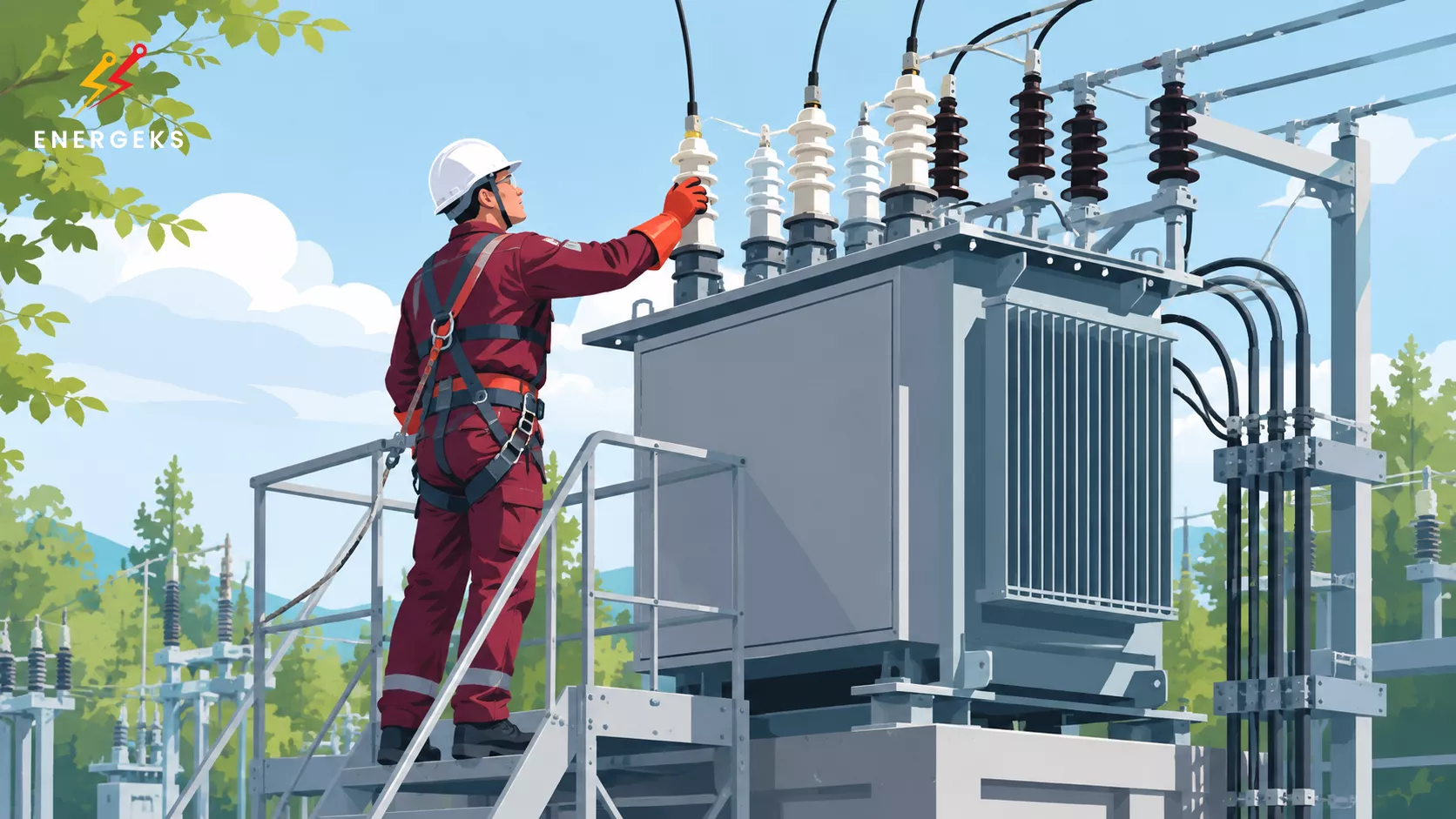
The most common mistakes when installing a transformer concern the foundation, ventilation, service access, earthing, cable routes, protection systems, fire protection, oil retention and environmental conditions. Most of them can be eliminated at the design stage, before the multi‑tonne device arrives on site and politely refuses to cooperate with the prepared space.
A transformer can operate for decades. It cannot, however, move the foundation, widen the doors or persuade cables to suddenly bend according to the designer's wishes.
At Energeks, we have sold hundreds of transformers.
Our devices go, among other things, to projects supporting the infrastructure of Poland's largest distribution system operators, industrial plants and distributed generation installations.
We know that the most expensive corrections often begin with quite innocent statements:
"The room should be sufficient."
"The ventilation will somehow manage."
"The bushing is only slightly offset."
"Service will fit in somehow."
The problem is that centimetres can later turn into hours of downtime, and underestimated temperature, humidity or device weight can shorten the life of an installation designed for many years of operation.
In this article, we will walk through transformer installation from the ground up, literally.
We will start with the foundation and transport conditions, then check ventilation, temperature, humidity, noise and service access.
We will look at earthing, cable routes, bending radii and protection systems.
Finally, we will organise fire protection, oil retention, documentation and acceptance.
This article is for designers, investors, contractors, site managers and maintenance teams. After reading, you will more easily recognise decisions that look good on the drawing but require additional checking before installation.
Because a good transformer installation does not start with the crane.
It starts with a design that remembers that paper will accept anything, but the transformer already has its own dimensions, weight and opinion on ventilation.
Reading time: 11 min
1. Mistake one: treating the transformer space like ordinary free floor area
On the plan, everything looks tidy.
The transformer rectangle fits in the room. There is a door. There are walls. The clearances look "roughly right". And here begins the first classic.
A transformer does not need only the footprint of its own enclosure. It needs working space, ventilation space, service space, space for cable bending radii, space for safe access and space for the future.
It is a bit like fitting a large wardrobe into a flat. On the plan, the wardrobe fits perfectly. The problem begins when you need to open the doors, pull out a drawer, walk past it with a vacuum cleaner and still not bang your hip on the edge every morning. In power engineering, that "hip" is service, measurements, thermography, cleaning, terminal inspection, access to the nameplate and the ability to replace a component without dismantling half the station.
Manufacturers' documentation often contains specific requirements regarding distances from ventilation openings, walls or other obstacles. Eaton indicates that the required clearances may vary depending on the transformer construction and should be read from the markings and manufacturer's instructions, and in many ventilated devices, clearances at ventilation openings must be maintained.
An innocent design mistake is when someone leaves space "for the dimensions" but does not leave space "for the device's life". Then it turns out that the thermal imaging camera cannot see the critical point, the doors do not open fully, the cables enter at the wrong angle, and the terminals can only be reached with the expression of someone who has just lost a bet with geometry.
The best design does not only solve the question:
will the transformer fit?
It explains how to plan the installation so that the transformer can be safely placed, connected, commissioned, inspected, serviced and, in the future, also replaced…
And since even the best unit does not work forever, it is worth knowing when it pays to refurbish a transformer and when it is more sensible to replace it with a new one. We have devoted a separate article to this topic, which may interest you, dear reader:
Refurbish or replace? Your transformer's last chance!
2. Mistake two: ventilation calculated by intuition, not by thermal losses
A transformer works quietly, but it constantly gives off heat.
No‑load and load losses do not magically disappear into the air. They turn into temperature, and temperature is one of the most patient enemies of insulation.
The most innocent mistake sounds like: "the room is large, so it will be fine."
Not necessarily.
Ventilation in medium‑voltage stations serves primarily to remove heat generated by transformers and other equipment, and to support drying after periods of moisture. At the same time, excessive ventilation can also be a problem, because it can increase the risk of condensation, especially during sudden temperature changes.
MV station ventilation should be maintained at the minimum required level, and ventilation openings should support natural convection, with inlet and outlet arranged so that heat can actually leave the transformer space.
This is important, because many people think of ventilation as a grille in the wall. And the transformer thinks of ventilation as a thermal balance.
If the design does not take into account the transformer's losses, ambient conditions, solar exposure of the enclosure, switchgear operation, possible overload states, local temperature and air flow, the ventilation grille becomes a technical decoration. It looks nice, but does not necessarily do the job.
With dry‑type transformers, the problem is particularly insidious, because the absence of oil can give a false sense of simplicity. Meanwhile, dry transformers also require appropriate cooling conditions, air cleanliness and maintenance of the required clearances. If the openings are obstructed, the air flow path is accidental, and dust accumulates in the room, the device begins to operate in an environment that the designer did not plan, but which designed itself. Only worse.
Good ventilation is not a "bigger hole in the wall". Good ventilation is a conversation between physics, the manufacturer's documentation and the real conditions of the facility.
3. Mistake three: ignoring humidity, condensation and the station's microclimate
Humidity is not a small problem.
It is a problem that puts on an invisible suit and works quietly.
In the design, we often see walls, a roof, doors, grilles, a foundation and the equipment layout. We less often see the microclimate.
That is, what happens in the morning when the temperature changes rapidly.
What happens after heavy rainfall.
What happens in winter when the device is temporarily switched off.
What happens near the sea, industrial plants, fields, roads or areas with high dust levels.
Equipment manufacturers point out that air flow should not cause rapid temperature changes leading to the dew point being reached. In practice, this means that "more air" does not always mean "better".
Sometimes it means "more condensation on components that really do not like condensation" – the designer provides ventilation but does not account for moisture behaviour. The station must breathe, but it must not draw problems inside. Ventilation openings, louvres, baffles, the way switchgear is positioned relative to the transformer, anti‑condensation heating and dust protection are not aesthetic details. They are elements of maintaining the working environment.
For outdoor installations, exposure to sun, wind and precipitation also matters. An enclosure heated in summer acts like a metal thermos, only in a less amusing version. In winter, sudden temperature changes can create conditions for condensation, especially when equipment does not operate with a continuous load.
A well‑designed transformer installation does not fight the weather heroically. It anticipates it. That is a calmer and cheaper strategy.
4. Mistake four: a foundation that is "sufficient" but not for the real weight and operation
The foundation under a transformer is not a podium.
It is an element of the technical system.
It must carry the weight of the device.
It must maintain level.
It must work with the transport and unloading route.
It must enable drainage, earthing, possible liquid retention, cable routing and access to mounting points.
It must also not crack when theory ends and the crane, jack, rollers, trolley and real pressure begin.
An innocent mistake looks like this: the design assumes a load‑bearing capacity, but does not consider the installation process. Or the substrate is designed for a static state, but transient loads during internal transport are not checked. Or the foundation is strong but has incorrect slopes. Or assembly tolerances are not foreseen, and the transformer ends up positioned so that everything works, but every cable connection requires a small prayer to geometry.
For oil‑immersed transformers, there is also the issue of the oil containment basin, tightness, drainage and control of possible leaks. For dry‑type transformers, the stability of the substrate, the absence of excessive vibration transmission and the cleanliness of the surroundings are important. In both cases, the foundation is the first declaration of the project's quality.
Good practice is to design the foundation not only for "the transformer will stand here", but for the entire scenario: delivery, unloading, movement, positioning, connection, commissioning, inspections, service and replacement.
In power engineering, very often the project that wins is not the one that looks most elegant on the drawing. It is the one that gives the installation team the most common sense on site.
5. Mistake five: cable routes designed without respect for bending radii
Power cables are not pasta.
They cannot be "laid somehow" without consequences.
One of the most underestimated mistakes is the incorrect positioning of bushings, cable trenches and cable entry points to the transformer. On the drawing, a shift of 20 cm looks innocent.
In reality, it can mean too small a bending radius, stress on cable terminations, difficult installation, a greater risk of connection errors and poor access for inspection.
The transformer manufacturer specifies the permissible cable entry points, the requirements for space inside the enclosure and the method of making connections. Schneider Electric, in its instructions for dry‑type transformers, indicates, among other things, to use the designated entry areas of the enclosure, to use flexible routing where possible, and to use a calibrated torque wrench for electrical connections.
This is not bureaucracy. This is the mechanics of electrical contact.
A connection tightened too much can damage the component. One tightened too little can heat up. A poorly routed cable can work mechanically where it should be calm. A lack of space for laying the conductors can make the installer fight with the material instead of performing precise work.
An innocent design mistake: "we will put the bushing here because it fits nicely against the wall."
A better question is: "will the cable have its natural path, without stress, without struggle and with access for inspection?"
A well‑designed cable route looks a bit like good choreography. Nothing jerks. Nothing strains. Every movement makes sense.
Power cables are not pasta. ;) If their layout starts to resemble an Italian dinner, it is time to go back to the cable route design. CC: ENERGEKS 2026
6. Mistake six: earthing treated as a formality
Earthing is one of those topics where it is not worth being creative in the wrong sense.
Poorly designed earthing and equipotential bonding can cause problems with safety, protection operation, overvoltages, electromagnetic interference and the reliability of the entire installation. Yet in many projects, the topic is treated as the last item on the list: "earth in accordance with the standard."
Only the transformer does not read such mental shortcuts. It works in a specific network system, with a specific short‑circuit impedance, a specific neutral point, specific switchgear, specific fault conditions and specific shock protection.
IEC 61936‑1:2021 concerns the design and execution of power installations above 1 kV AC and indicates requirements to ensure safety and proper operation of the installation according to its intended purpose. This is a good example of systems thinking: the transformer is not a lonely island, but an element of an installation that should behave predictably even under fault conditions.
An innocent mistake is that the design shows an earthing point but does not show the full logic of the connections. It does not analyse the flow of fault currents. It does not take into account compatibility with surge protection. It does not anticipate the quality of equipotential bonding between the transformer enclosure, switchgear, structures, trenches and the earthing busbar.
Good earthing is not a line on a diagram. It is the behaviour of the installation at the worst possible moment.
7. Mistake seven: fire protection added after the location is chosen
For oil‑immersed transformers, the topic of fire and environmental protection must enter the design early.
Not when the building is already standing, the distances are fixed, and the investor asks whether "this can somehow be solved".
Transformer oil performs an insulating and cooling function, but in classic mineral solutions it can be a combustible material.
Oil‑immersed transformers are an important element of electrical infrastructure, and the oil used in such devices can pose a fire risk, therefore they require well‑thought‑out protection.
An innocent mistake sounds like: "we will put the transformer here because it is closest to the switchgear."
Closest does not always mean best.
The transformer location should take into account distances from buildings, partitions, escape routes, other equipment, material stores, auxiliary installations and critical infrastructure. For oil‑immersed transformers, oil retention and the ability to contain contaminants in the event of a leak are added.
IEEE Std 980 is a guide for the limitation and control of oil spills in substations, and its purpose includes designing solutions that help contain oil and limit environmental effects.
This is particularly important for photovoltaic farms, energy storage systems, industrial plants and stations where one transformer is not just a device but a node of the entire process. A fire or leak then does not mean only the repair of one component. It can mean downtime, environmental procedures, production loss, delays and difficult conversations with the insurer.
A good transformer location is not the choice of the shortest cable route. It is the choice of the safest working architecture.
8. Mistake eight: noise and vibrations left "for later"
A transformer hums. That is normal.
The problem begins when the design assumes that "normal" means "unimportant".
Noise and vibrations can travel through the building structure, cable trenches, rigid connections and sound‑reflecting surfaces. As a result, a transformer that itself meets the requirements can, after installation, become a source of nuisance because the surroundings act like a resonance box.
The transformer location affects the perceived sound level, and installation in a corner, a narrow corridor or near smooth surfaces can cause sound reflection and amplification. Measures to limit vibration transmission are also recommended, for example appropriate insulating pads, flexible cable routing and secure fixing of enclosure panels.
An innocent mistake: "we will put it in the corner, it will be less intrusive."
Sometimes it is precisely in the corner that it is more intrusive.
If the transformer is located near offices, control rooms, dwellings, property boundaries or people's workplaces, the acoustics topic should appear before installation. And it is not about dramatising. It is about respect for user comfort and avoiding costly corrections that later resemble treating a toothache by changing the chair.
Noise is designed with space. Vibrations are designed with detail. And operational peace is designed earlier, not after the first complaint.
9. Mistake nine: protection devices selected separately, without coordination with the entire installation
The transformer is patient, but it is not alone.
It works with the MV switchgear, the LV switchgear, protection devices, surge arresters, the metering system, automation, loads and the load character.
A design mistake looks innocent when each element "by itself" is correct. The protection is selected. The instrument transformers are selected. The cables are selected. The switchgear is selected. Only then it turns out that together they do not play like an orchestra, but like five people tuning instruments in a lift.
Protection coordination should take into account short‑circuit currents, transformer inrush current, selectivity, permissible overloads, the nature of the loads, the presence of inverters, energy storage systems, reactive power compensation, automation systems and the grid operator's requirements. In modern installations with photovoltaics, electric vehicle chargers and energy storage systems, the load is no longer a simple story of motors and lighting. It is a dynamic ecosystem.
This is the essence: transformer installation does not end with the transformer.
If the protection devices are designed without a conversation with the entire installation, they can act too nervously, too late or in the wrong place. And then even a very good transformer is drawn into problems it did not create.
10. Mistake ten: no acceptance and commissioning scenario at the design stage
Technical acceptance should not be a finale full of surprises.
It should be a confirmation of what the design foresaw from the beginning.
An innocent mistake: the documentation assumes installation but does not assume proper commissioning. There is no clear list of measurements. There is no provision for access to inspection points. The sequence of activities is not planned. It is not clear who is responsible for checking settings, who for tests, who for as‑built documentation, who for compliance with the DTR, and who for the decision to energise.
Eaton, in its material on best practices for dry‑type transformers, indicates that new transformers should be inspected on receipt for transport damage, and before energisation, among other things, auxiliary devices, tap selection, ratio connections, and the tightening and clearances of electrical connections should be verified.
This sounds simple. And that is precisely why it is sometimes omitted.
Transformer commissioning is not a ribbon‑cutting. It is the moment when the design, delivery, installation, measurements, protection and operation meet at one point. If everyone worked in separate silos before, commissioning will show it.
In a good design, at the documentation stage, it is already known what measurements will be needed, what conditions must be met, what protocols will be produced and which elements must be checked before voltage is applied. Thanks to this, commissioning is a calm process, not a technical escape room with a clock in the background.
11. Mistake eleven: no thought for future expansion
The cheapest time to foresee expansion is before construction.
After that, every additional metre, every bushing, every space reserve and every change to the cable route starts to cost more, because it conflicts with operating infrastructure.
In transformer projects, this mistake appears often. Today one transformer is enough. Today a given power is enough. Today there is no energy storage system. Today there are no chargers. Today the photovoltaic farm has a specific layout. Today the plant operates on its current load profile.
But the power industry is changing faster than before. Companies are electrifying processes. Electric vehicle charging stations are being added. Requirements for power quality are increasing. Energy storage systems, inverters, compensation, automation, monitoring and new operating models are appearing.
An innocent design mistake is that the installation is designed perfectly for today, but without a margin for tomorrow.
It is not always about oversizing the transformer. Sometimes it is about space reserve, an additional bushing, a sensibly planned station layout, the ability to add apparatus, a cable route without traps and an architecture that does not close the door on the investor.
A good design does not predict the future. It leaves reasonable space for it.
How to design a transformer installation so you do not pay twice
The best strategy is simple, though it requires discipline: design the transformer as part of the system, not as a device to be placed.
First, data must be collected.
Power, transformer type, losses, weight, dimensions, manufacturer's requirements, environmental conditions, service access, short‑circuit parameters, network configuration, load profile, operator requirements, expansion scenario and site constraints.
Then geometry must be checked.
Not only the footprint, but also access, door opening, cable routes, bending radii, trenches, bushings, grilles, service zones, crane or transport equipment access, and the possibility of replacing the device in the future.
Then heat must be calculated.
The transformer dissipates losses to the surroundings, so ventilation must be matched to the real conditions. It must be neither symbolic nor excessive. It should operate stably, without creating condensation problems.
The next step is safety.
Earthing, equipotential bonding, shock protection, protection devices, fire protection, oil retention, escape routes and access for emergency services cannot be an add‑on at the end.
Finally, documentation.
Manufacturer's instructions, protocols, measurements, settings, diagrams and as‑built documentation should be prepared so that operation does not have to guess what the designer meant.
A good transformer installation design has something very elegant about it: it does not shout.
It just works.
A good design lets the transformer work calmly
Transformer installation is not a stage that begins on the day of delivery.
The most innocent installation mistakes have a common feature: at the beginning they save a few minutes, and later they can take a few weeks. That is why it is worth, early enough, comparing the design with the manufacturer's documentation, the technical requirements, the site conditions and the planned method of operation.
The transformer really does not expect luxuries.
It needs a stable base, an adequate amount of air, good connections, well‑thought‑out protection and a little respect for physics. In return, it can reliably perform its work for many years.
Thank you for staying with us to the end.
Hundreds of transformers sold and participation in projects powering Poland's energy infrastructure confirm that good solutions start with proper selection and technical partnership.
Explore Energeks transformers, check the units available in stock, and join Energeks on LinkedIn, where we share technical knowledge, projects and what is currently happening in the power industry!
References:
Schneider Electric, Electrical Installation Guide (Schneider Electric)
Eaton, Best practices for the installation and inspection of dry type distribution and power transformers . (Eaton)
Transformers in stock
Shipped from our warehouse in Poland within 2–3 working days, 5-year warranty. Full range 25–2500 kVA in the shop (prices in PLN).
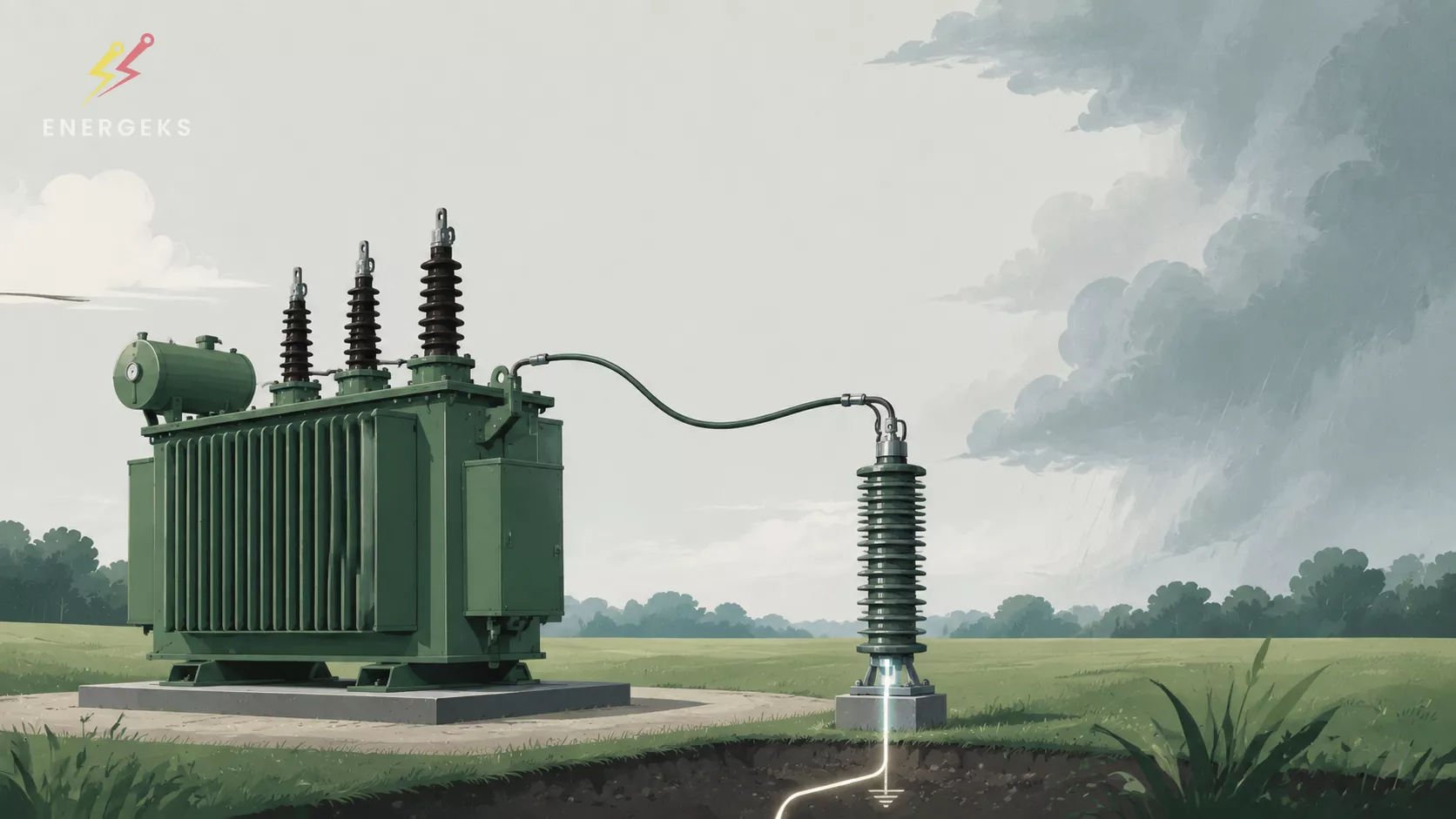
Heat melts people. Thunderstorms test transformers.
And it does it in microseconds.
The heatwave season has its own physics. The air stands still, asphalt softens, and we all slowly change our state of matter. A person starts treating shade like premium real estate, and every fridge opening sounds like a strategic decision.
And then the storm comes.
For a moment, it brings relief. The temperature drops, the wind picks up, the air regains its meaning. Except that for the power grid, that same storm is not a pleasant break from the heat. It is a test whose outcome can be decided in less time than a blink of an eye. Much less.
0.000001 seconds. That is how long one microsecond lasts.
It is on this scale that the front of a lightning surge develops. Does the transformer have a chance to survive it? Yes, provided that the right decisions were made before the first flash appeared in the sky.
The overvoltage reaching the transformer develops in microseconds. The operator will not have time to react. The controller will not call a meeting. The transformer also does not have a moment to "prepare" its insulation. The outcome is decided by solutions chosen earlier: insulation coordination, the type and parameters of the surge arrester, its location, the length of the connections, and the quality of the entire surge current discharge path.
This is why lightning protection for a transformer is a good topic right now. Not because a thunderstorm is spectacular, but because it reminds us of a simple rule in power engineering: the most important protections do their work when no one has time left to make a decision.
What really threatens the transformer during a thunderstorm?
A lightning strike does not have to hit the transformer directly to cause a dangerous overvoltage. A surge can enter the system through several paths.
A direct strike on an overhead line introduces a very high current with a steep change over time. A strike near the line can induce voltage in the conductors. Another possibility is a strike to a structure, a lightning protection system or the ground, which causes a sudden change in the potential of the earthing system. A surge wave can also arrive from another part of the grid, travelling along conductors and cables.
The transformer therefore sees not so much the flash itself, but the voltage wave appearing at its terminals.
If the value and steepness of this wave exceed the insulation's ability to withstand the electrical stress, a flashover on the bushing, breakdown of the main insulation or damage to the turn‑to‑turn insulation can occur. Not every event ends with an immediate short circuit. Sometimes the impulse leaves behind a weakening, local damage or the beginning of a degradation process that will manifest itself later.
This is precisely why the absence of a failure immediately after a storm is not automatically proof that the protection system worked perfectly. Insulation can remember electrical stress, even though it does not keep an event log.
Why do we talk about microseconds?
In high‑voltage engineering, the resistance of equipment to atmospheric overvoltages is assessed, among other things, using a standardised voltage impulse. The designation 1.2/50 µs describes a waveform whose nominal rise time is 1.2 microseconds and whose time to fall to half the value is 50 microseconds.
This is a test model, not a photographic portrait of every lightning strike. It does, however, allow the insulation strength of equipment to be compared and consistent principles of insulation coordination to be established.
One microsecond is one millionth of a second. In 1.2 microseconds, an electromagnetic wave can travel hundreds of metres, depending on the propagation medium. From a human perspective, nothing has happened yet. From the transformer's perspective, the voltage has already reached a level that can determine the fate of its insulation.
The steepness of the impulse is as important as its peak value. For fast‑changing currents, every fragment of conductor has inductance. The voltage on such a connection can be described by the relationship:
UL = L × (di / dt)
The faster the current rises and the greater the inductance of the connection, the greater the additional voltage drop. This voltage can add to the residual voltage of the arrester and appear at the terminals of the protected device.
The example is illustrative. If the connection has an inductance of about 1 µH and the surge current changes at a rate of 10 kA/µs, the connection itself can contribute about 10 kV. This does not mean that every metre of conductor always "costs" exactly 10 kV. It does, however, show the scale of the phenomenon and explains why, in surge protection, a short path is an electrical parameter, not an installer's aesthetic preference.
Does a lightning rod protect the transformer?
Yes, but not by itself and not against every scenario.
The external lightning protection system is designed to intercept a direct strike on the protected structure, conduct the current along a designated path and disperse it into the ground. It thus limits the risk of physical damage to the structure and the danger to people. The scope of this protection is described by the IEC 62305 series.
A surge arrester works on a different part of the problem. Its task is to limit the overvoltage on the device and direct the surge current to the earthing system. In medium‑voltage networks, it protects, among other things, transformers, bushings and switchgear against atmospheric and switching overvoltages.
Insulation coordination connects both worlds with the transformer itself. It consists of selecting the insulation strength, the protection level of the arresters and the system configuration so that the stress reaching the device remains below its assumed withstand level, with an appropriate margin.
So you can build a correct lightning protection system for the building and still leave the transformer with insufficient protection against a wave arriving via a conductor. You can also choose a good arrester and weaken its effectiveness with excessively long connections. Protection works as a system. The logo on one component does not replace the physics of the entire surge path.
How do arresters work, i.e., metal‑oxide surge arresters?
In modern AC networks, gapless metal‑oxide surge arresters with metal‑oxide resistors are widely used. Their requirements are specified in IEC 60099‑4 for systems with the highest voltage for equipment above 1 kV.
In everyday language, they are often called lightning arresters. In industry jargon, the more precise term is surge arrester, because the device does not catch lightning like a baseball glove. It limits the voltage and creates a controlled path for the surge current. A small linguistic difference, perhaps, but behind it lies the entire principle of operation.
The heart of the arrester is a non‑linear block, most often based on zinc oxide. Under normal conditions, the arrester has a very high resistance and only conducts a small leakage current. When the voltage rises sharply, its characteristic changes dramatically. The arrester begins to conduct the surge current, directing it to earth and limiting the voltage on the protected device.
After the overvoltage subsides, it returns to a high‑resistance state. It does not "swallow" the entire lightning strike and does not make the voltage disappear. It limits it to a specific level, called the residual voltage or protection level, and absorbs and dissipates part of the energy.
The whole process involves the appearance of the overvoltage, the rapid increase in the arrester's conductivity, the discharge of the surge current and the device's return to a high‑resistance state. For it to actually protect the transformer, the residual voltage, together with additional drops on the connections, must remain safely below the impulse withstand voltage of the insulation.
ZnO, spark gap or a special solution?
Different constructions can be found on the market and in older installations. Not all of them should be lumped together in the same drawer.
The modern standard for transformer protection is gapless arresters with ZnO blocks. They react thanks to the strongly non‑linear characteristic of the material and can withstand successive surges within their declared capability.
Older spark‑gap constructions, often with silicon carbide resistors, are still operating in some facilities. When modernising, ZnO is usually considered, but a "one‑to‑one" replacement without checking the network parameters and insulation coordination is not a good shortcut.
There are also special solutions, for example arresters with an external spark gap used on lines, and constructions for GIS. Their application is determined by the function, the insulation system and the overvoltage analysis, not by a catalogue power ranking.
The most effective therefore does not mean the most impressive in the catalogue. It means properly selected for the voltage, the network earthing method, the expected energy, the transformer's LI level and the environmental conditions.
Insulation coordination: the most important conversation between the transformer and the arrester
IEC 60076‑3 specifies the insulation requirements, dielectric tests and minimum test levels for transformers. The IEC 60071 series sets out the principles of insulation coordination for equipment and installations above 1 kV.
In design practice, at least two levels must be compared:
the rated lightning impulse withstand voltage of the transformer, often abbreviated as LI
the protection level provided by the arrester under specific current and impulse shape conditions
A margin should remain between them, taking into account uncertainties, the installation configuration, the distance from the transformer, the inductance of the conductors, wave phenomena and actual operating conditions.
It is not enough to check whether the number on the arrester data sheet is lower than the number on the transformer documentation. The voltage seen by the insulation can be higher than the residual voltage itself. Inductive drops and the effect of distance from the device must be added.
The shortest version of this rule is: the arrester does not protect the transformer's catalogue. It protects a specific transformer in a specific installation.
How to select a surge arrester for a transformer?
Selection begins with the system data, not with one voltage printed on the housing.
✅ Continuous operating voltage
The Uc value, i.e., the permissible continuous operating voltage, must correspond to the highest voltage that can occur on the arrester for a long time. The neutral earthing method and the voltage rise of healthy phases during an earth fault are important.
Too low a Uc can expose the arrester to overload during a temporary overvoltage. Too high a Uc usually means a higher protection level, which can reduce the margin for the transformer insulation.
✅ Rated voltage and temporary overvoltage withstand
The Ur and TOV parameters must be assessed together with the duration of the possible overvoltage. The arrester must survive a real fault scenario or other disturbance in the given network, not just the nominal operating point.
✅ Protection level
The residual voltage must be compared with the transformer's impulse withstand level. The influence of connections and location must also be taken into account. A low value in the table is useful only when the installation allows it to be exploited.
✅ Energy and charge capability
The exposure depends on the network configuration. Different requirements may apply to a station supplied by a long overhead line in an area of high lightning activity than to a device operating in a cable system. Switching overvoltages, the repeatability of surges and the nature of the protected facility also matter.
✅ Environmental and mechanical conditions
Altitude above sea level, pollution, UV radiation, temperature, humidity and mechanical loads influence the choice of design. The selection of a silicone or porcelain housing should result from the project conditions.
✅ Behaviour in the event of failure
The short‑circuit class, the method of safe venting or disconnection, and the risk to people and adjacent equipment must be considered. Protection of the transformer must not create a new problem at the moment when the arrester itself reaches the end of its service capability.
Why is the installation location just as important as the selection?
The best arrester placed too far from the transformer can provide weaker protection than a properly selected device mounted at the protected terminal.
Three principles decide:
the smallest possible distance between the arrester and the transformer bushing
short, straight connections on the phase and earthing side
avoiding loops, sharp changes of direction and unnecessary conductor sections
During surge current flow, the impedance of the entire path matters, not just the earthing resistance measured at power frequency or by a method suitable for static conditions. A fast impulse "sees" the inductance of the conductors, the geometry of the system and the mutual position of the connections.
Therefore, a larger conductor cross‑section does not automatically fix the problem of excessive length. Cross‑section remains important for thermal, mechanical and short‑circuit reasons, but for a very steep impulse, the path geometry can determine the induced voltage.
It is here that theory meets execution detail. An extra metre of conductor may look innocent. For an impulse measured in microseconds, it is a fully‑fledged circuit element.
Earthing: where should the energy actually flow?
A surge arrester does not remove energy from the system. It provides a controlled path for it. If this path has a high impulse impedance or is routed in a way that creates significant potential differences, the voltage on the protected device can still reach a dangerous level.
An effective system requires continuity of connections, correct connection of the transformer tank, the structure, cable screens and the other elements covered by the earthing design. Equipotential bonding is also important. During a discharge, the potential of the local earth electrode can rise sharply. The goal is not to magically keep the entire station at perfect zero potential, but to limit dangerous potential differences and ensure a predictable current path.
The earthing resistance value alone does not tell the whole story. Proper geometry, connections of adequate durability, corrosion control and compliance with the lightning protection design and network requirements are also needed.
Earthing is a bit like an evacuation route. Knowing that it exists is not enough.
It must lead where it should, be clear and work exactly when things get crowded.
Does a cable line eliminate the risk of atmospheric overvoltages?
No. It changes the risk profile but does not cancel it.
A cable is less exposed to a direct strike than an overhead line. A wave can, however, enter at the transition point from an overhead line, be caused by a rise in earth potential, or arrive from another part of the grid. Reflections at the boundaries of different impedances also change the voltage. Therefore, terminations, cable length, screens, earthing and surge limitation points must be analysed. A cable underground does not receive immunity from thunderstorms.
Is it enough to protect the MV side?
An arrester on the MV side protects the transformer against a wave arriving from that grid, but an impulse can transfer between windings. On the LV side, today there are controllers, inverters, measurements, communication and automation. Therefore, protection should be layered: include MV, coordinated SPDs on the LV side, auxiliary and signal circuits, and equipotential bonding. Protection of the transformer and of the electronics are related but not identical tasks.
7 mistakes in transformer lightning protection
A poorly selected arrester is a bit like a solid door installed next to the entrance.
It looks professional, but lightning has no obligation to use it.
❌ The first mistake is selection based solely on the rated network voltage.
Omitting the neutral earthing, the earth‑fault clearing time and TOV can give an incorrect Uc value. Too low a value exposes the device to overload, while too high a value can worsen the protection level.
❌ The second is installation far from the bushing.
In a surge, there is no such thing as "just a piece of conductor". Every section contributes inductance.
❌ The third is running long, looped connections to the earthing system.
A neatly routed conductor does not always mean a good surge path.
❌ The fourth is treating earthing resistance as the only measure of protection quality.
The measurement result is important, but it does not replace the assessment of continuity, geometry and impedance for fast transients.
❌ The fifth is the lack of coordination with the transformer insulation level.
The arrester cannot be selected in isolation from the LI, bushings, cables and switchgear.
❌ The sixth is neglecting the low‑voltage side and auxiliary circuits. A surge usually does not read the scope of delivery.
❌ The seventh is assuming that the arrester is permanent.
Multiple surges, moisture, damage and deteriorating connections can change its condition.
This does not mean replacement after every storm, but regular inspection instead of a wishful "it still looks fine".
Lightning vs. the budget: why protection simply pays off
The price of the arrester and correct installation is easy to see in the cost estimate. The price of a transformer failure has many more items, and some of them only appear when the device stops working.
The bill may include diagnostics, transport of heavy equipment, service work, equipment rental, repair or replacement of the transformer, emergency actions and loss of supply continuity. In a production plant, the cost of a stopped process is added. In an infrastructure facility, service availability matters. On a photovoltaic farm, every hour of downtime can mean energy that cannot be produced later.
Depending on the transformer power and the effects of the downtime, the total cost of an event can quickly reach tens or hundreds of thousands of PLN, and for large units much more. It is not worth promising, however, that any arrester will solve this problem. Savings only appear when the device is part of a properly coordinated system.
The investment therefore includes not only the purchase of the device. It includes selection, proper positioning, short connections, effective earthing, protection of subsequent levels and later inspection. This is less spectacular than a slow‑motion lightning video. It does, however, look much better in the installation availability report.
How to check protection after station commissioning?
Surge protection requires inspections adapted to the type of equipment, the manufacturer's recommendations and the importance of the facility.
During an inspection, it is worth considering:
the condition of the arrester housing, contamination, signs of discharge and mechanical damage
the quality of the terminals, phase and earthing connections
the continuity of equipotential bonding and the condition of the earthing
the readings of operation counters, if fitted
the trend of leakage current or its resistive component in installations equipped with monitoring
compliance of the station configuration with the design after modifications
A surge counter informs about events, but does not diagnose the arrester. Leakage current monitoring also requires interpretation. The greatest value comes from trends and comparison with the manufacturer's criteria. After a severe storm or protection operation, a targeted inspection based on the device condition and exposure history is advisable.
Good protection does not fight the storm. It manages its effects.
We cannot stop lightning discharges, and we are unlikely to persuade July to lower its temperature out of respect for infrastructure. We can, however, decide how the surge energy will pass through the station and what voltage the transformer insulation will see.
Effective protection is created when the transformer, arrester, connections, earthing and other protection levels are treated as one system. The arrester must have parameters appropriate for the network. It should be located close to the protected terminal. The current path must be short and consciously designed. The protection level should maintain an appropriate margin relative to the insulation strength.
That is a lot of dependencies for an event that lasts a few dozen microseconds.
That is precisely why it is worth resolving them calmly at the design stage, before the first summer storm appears over the station. If you are selecting a transformer, a transformer station or a surge protection system, let us compare the device parameters and the network configuration as a whole. Good questions asked today can do very concrete work during the next flash.
Energy deserves a good path
We cannot stop a storm. We cannot ask a lightning discharge to wait for the end of an inspection, and we are unlikely to persuade August to lower its temperature out of respect for infrastructure. We can, however, decide what happens at the moment the surge wave reaches the station.
We can give it a short, predictable path to earth. We can match the protection level to the actual insulation strength. We can look at the transformer, arrester, bushings, conductors, cables and earthing as one system, not seven separate items in an order.
And that is good news. In power engineering, we do not have influence over everything, but we have enormous influence over the quality of design decisions.
Thank you for taking the time to enter the world of microseconds with us. We know that surge protection does not sound as spectacular as lightning itself. In practice, it is precisely this protection that allows the transformer to continue doing its job after the flash: without drama, without downtime and without costly improvisation.
If you are selecting a transformer for a new station, modernising an existing system or want to verify parameters before submitting an enquiry, take a look at the oil‑immersed and cast‑resin transformers in the Energeks range. It is worth starting the conversation not only with the power in kVA, but also with the voltages, the LI level, the network operating mode, the environmental conditions and the entire protection concept.
Do you have a project where the arrester, cable and transformer must finally start talking to each other? Contact the Energeks team. We will look at the data, organise the technical questions and seek a solution matched to the real installation.
And if you like power engineering told concretely, with technique, experience and a touch of humour, follow Energeks on LinkedIn. There we share knowledge about transformers, stations, renewables and everything that makes energy go exactly where it is needed.
Thank you for your trust, your questions and every technical conversation. They help create better projects.
A thunderstorm may have the last flash.
But it does not have to have the last word.
Sources:
IEC 60071-1:2019, Insulation co-ordination, definitions, principles and rules
IEC 60099-4:2014, Metal-oxide surge arresters without gaps for AC systems
IEC 60076-3:2013 with Amendment 1:2018, Power transformers, insulation levels and dielectric tests
IEC 62305-1:2024, Protection against lightning, general principles
Hubbell Power Systems, The Importance of Lead Length for Arrester Applications
Transformers in stock
Shipped from our warehouse in Poland within 2–3 working days, 5-year warranty. Full range 25–2500 kVA in the shop (prices in PLN).