6 May
2026
Energeks
Copper and aluminium in transformer windings have different properties, but the quality of the device is determined by the entire design. Check 4 facts about losses, durability, dimensions and operation.
On the table lie two offers.
In one, someone declares: copper, so premium.
In the other: aluminium, so economical.
Both sound confident.
Both try to win your attention with a single word.
And this is where the problem begins.
Because in transformers, a single word very rarely tells the truth about the whole device.
We are writing about this because these doubts often return in conversations with investors, designers and contractors. Each time we see the same mechanism:
The winding material is often sold as an ideology, although in practice what counts is the whole transformer design: its losses, cooling, short‑circuit strength, termination method and manufacturing quality.
The applicable efficiency requirements in the EU and the USA do not force a choice by definition of copper or aluminium. They demand a technical result. That is a fundamental difference.
The question "copper or aluminium" is often poorly framed.
A better question is: which transformer design gives me real technical, operational and economic benefit for my application?
This text is for people who do not want to buy a slogan.
After reading, you will be able to distinguish material properties from manufacturer marketing, understand when copper really makes sense, when aluminium is a sensible choice, and what questions to ask so that silence falls on the other side of the table, followed by the most valuable sentence: yes, that is exactly the point.
Concrete content awaits you inside.
First, we will dismantle the most common myths.
Then we will go through the physics of materials, the impact on efficiency and dimensions, behaviour during short circuits, connection and service issues, and how to read an offer.
Finally, we will give you a practical decision filter.
Reading time: ~ 8 minutes
Do not jump too quickly.
First, name the game.
In the dispute over windings, the game usually looks like this: copper is presented as the choice of sensible, durable and professional people, while aluminium is presented as a cheaper substitute.
Or the opposite: aluminium is shown as modern, light and good enough, while copper is shown as a costly relic.
Both narratives are convenient for sales because they simplify reality to a single symbol.
Technology does not work that way.
Manufacturers and standards evaluate a transformer by the result of the whole design.
What counts are no‑load and load losses, temperature rise, insulation, impedance, mechanical strength, heat dissipation method, behaviour under overloads, and connection quality.
European ecodesign regulations for transformers focus on minimum efficiency levels.
Similarly in the United States, the DOE (Department of Energy) tightens energy efficiency requirements for transformers but does not impose one single correct winding material.
This is an important moment. Because when a salesperson starts with the material rather than with loss parameters, temperature, insulation class and operating conditions, it is very possible they are trying to close the conversation before you ask uncomfortable questions. In negotiations, this is a classic shortcut. In transformers as well.
There is no point pretending the differences do not exist.
Copper has very high conductivity and serves as the reference point for the IACS scale – the international standard of conductivity.
For annealed copper, the standard is 100% IACS.
At the same time, its density is high, about 8.89 g/cm³ according to the definition used for the IACS standard.
Aluminium conducts less well on a volumetric basis, but has a much lower density.
The Aluminium Association also points out something that copper marketing does not like to repeat: aluminium gives about twice the conductivity per unit mass compared to copper.
That is why for decades it has been the preferred material in many transmission and distribution applications.
And this is where the simple story ends and real design begins.
If aluminium has higher resistivity, the designer compensates with a larger conductor cross‑section.
In other words, you do not compare a naked piece of metal to a naked piece of metal, but two complete winding designs.
Therefore, the sentence "copper has lower losses" is too crude to decide anything sensibly.
Copper may have lower losses at the same cross‑section, but a transformer is not a competition for the same cross‑section.
It is a competition for the result of the whole construction.
Eaton explicitly emphasises that the common belief that a transformer with copper windings is by definition more efficient, more reliable or stronger under short‑circuit conditions is a simplification and a false assumption.
It is a bit like comparing two cars only by the material of their pistons, without asking about the engine, cooling, gearbox and aerodynamics.
Sounds impressive. Says little.
In recent years, efficiency requirements have become tougher.
The EU has Regulation 2019/1783 amending the earlier ecodesign requirements for transformers, and the European Commission explicitly indicates that these regulations have pushed the market towards models with higher efficiency and lower life‑cycle costs.
In the USA, the DOE adopted new standards for distribution transformers, published in 2024, with compliance mandatory from April 23, 2029.
What does this mean in practice?
That the market is increasingly less tolerant of transformers based on slogans alone. The manufacturer must deliver the parameters.
If an aluminium design meets the loss and temperature requirements, it meets them really, not pretend. If a copper design does not close them or does so at the cost of unjustified price increases, the mere presence of copper does not save the offer.
And here we come to the point where the marketing narrative often breaks.
Copper is not an automatic guarantee of better overall transformer efficiency.
Aluminium is not an automatic guarantee of worse efficiency.
Efficiency is the result of the electromagnetic and thermal design, core selection, winding geometry, cooling method and loss control.
When someone tries to close the conversation with a single word, it is worth calmly replying:
"I understand – are you saying that the material itself is more important than the declared load losses, no‑load losses and temperature rise?"
Very often after such a question the conversation suddenly becomes more substantive.
Not to fall into the opposite extreme, one must honestly say: copper has real advantages.
Thanks to its higher volumetric conductivity, it allows the required resistance to be achieved with a smaller cross‑section than aluminium. In many designs, this translates into more compact windings and easier fitting of the design into a limited space.
Copper also has high mechanical strength and good thermal conductivity, which in practice is an advantage in constructions where compactness, high power density, high mechanical rigidity or specific short‑circuit conditions matter.
Industry sources highlight these features, and even a report comparing busbar systems indicates that the obvious advantages of aluminium are lower initial cost and weight, while copper offers more compact solutions and greater mechanical robustness.
This does not mean that every copper design beats every aluminium design.
It only means that under certain design conditions, copper gives the designer greater comfort. If the transformer has to fit into a tight enclosure, operate in more difficult thermal conditions, or the investor prioritises minimising dimensions, copper often becomes a strong candidate.
Here the truth is inconvenient for both sides of the marketing dispute.
The copper advocate cannot say: always better.
The aluminium advocate cannot say: there is never any difference.
A difference can exist. You just have to know how to locate it.
The most damaging myth is: aluminium is just cost cutting.
No.
Aluminium is a full‑fledged engineering material, widely used in power engineering.
If aluminium is given the right cross‑section, well‑designed connections, proper winding geometry and is backed by a sensible manufacturing regime, it can create a transformer with very good performance.
And here it is worth pausing for a moment.
The problem is not aluminium itself.
The problem can be a poor design based on aluminium, or the way such a design is later sold. Because if someone wants to buy aluminium at the price of aluminium, yet expects the compactness of copper, its design margins and the psychological comfort of the word "premium", they stop talking to physics and start talking to their own imagination.
And physics remains calm. It is not interested in labels. It is interested in cross‑sections, losses, operating temperature, impedance, termination method and test results.
That is where marketing ends and the truth about transformer quality begins.
This is where the conversation becomes really practical.
Because even the best material can be spoiled by a poor connection.
For years, aluminium has had a reputation as a tricky material at terminals.
Part of this reputation grows from the history of old, poorly executed applications, but part comes from the real need for proper approach to connections and terminations.
ANSI C119 standards cover tests for aluminium‑aluminium, aluminium‑copper and copper‑copper connectors. NEMA also reminds that for conductors of different metals, appropriate certified connectors and proper installation procedures should be used, and the quality of terminations should comply with the requirements of the hardware and equipment manufacturer.
In other words, the problem is not "aluminium is bad".
The problem is: is the entire connection system designed and executed as it should be?
This is precisely the point where the buyer should stop hunting for a quick "yes" and start looking for a real "no".
Instead of asking "do you have copper?",
it is better to ask: how have you solved the material transitions, what connectors do you use, what are the tightening torque procedures, how do you validate connections, and what operational experience do you have? Then the other party will either engage in the technical details or stay with the slogan.
And you will know who you are talking to.
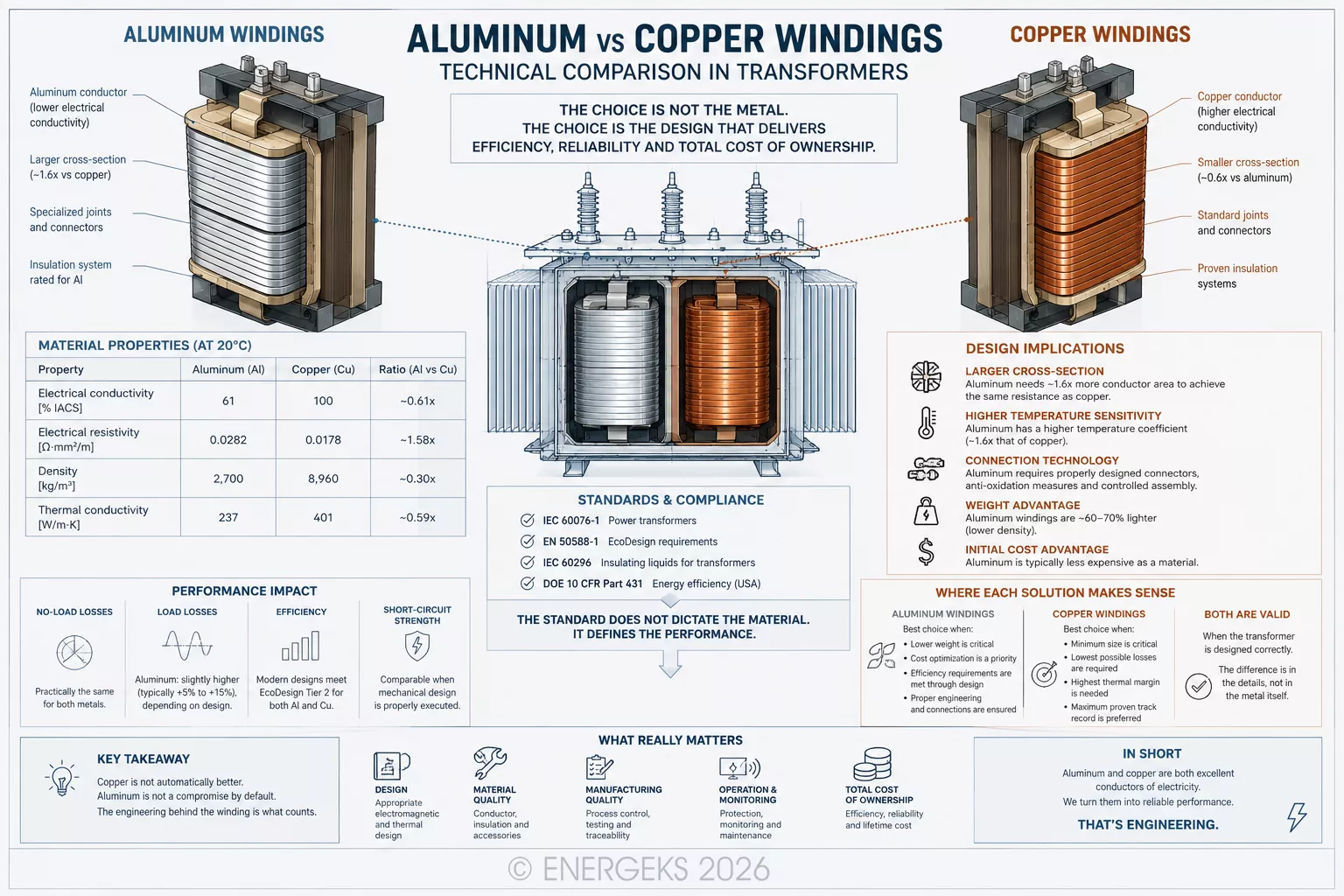
The infographic organises the key issues that return when asking: copper or aluminium in transformer windings? It shows the differences in conductivity, cross‑section, weight, losses and design requirements, making it easier to understand what really determines efficiency, durability and the selection of a transformer for a specific application. This is a synthetic summary for those looking for a practical answer to questions about copper and aluminium windings, no‑load and load losses, operational safety and total life‑cycle cost.
The truth does not lie on one side of the barricade.
Copper indeed has higher volumetric conductivity, usually allows more compact designs to be built, and often gives greater comfort where dimensions, mechanical margin or demanding operating conditions matter.
Aluminium, on the other hand, has for years been a full‑fledged material used in power engineering. With properly designed windings, appropriate connections and a well‑calculated overall design, it does not have to mean either lower efficiency or lower reliability.
Marketing begins when someone tries to turn this technical difference into a worldview war. In one version we hear that only copper is professional. In another, that aluminium is always just as good and there is no point in paying extra. Both narratives are convenient.
Both look good in a catalogue. And both simplify the topic to a level that ceases to be useful for the investor.
A mature decision looks different.
If compact dimensions, a specific mechanical margin, a specific winding architecture or limited installation space are key, copper may be the right choice.
If the priority is a well‑calculated total cost, reasonable weight, adequate efficiency and a proven design with correctly solved connections, aluminium may be a fully rational choice. The problem, therefore, is not which material sounds better.
The problem is whether someone evaluates the transformer through parameters and design, or only through a label.
The best questions usually do not sound spectacular.
They sound calm and precise.
Therefore, instead of starting the conversation with the winding material alone, it is better to ask about the declared no‑load and load losses, insulation class, temperature rise, short‑circuit impedance, dimensions, weight, termination method, connection type and warranty conditions.
It is also worth asking which standards and tests confirm the given solution, and what exactly copper or aluminium gives in this specific unit, not in a general sales presentation.
It is here that the difference between technique and storytelling very quickly becomes apparent. If the other side provides numbers, relationships, documentation and specific answers, the conversation stands on solid ground. If instead prestige, emotion and a mental shortcut appear, you are most likely entering not a world of parameters but a world of marketing.
And perhaps this is where the most honest answer to the whole question of copper and aluminium lies. The truth does not reside in the metal itself. It resides in the design, documentation, manufacturing quality and honesty of the conversation. Copper and aluminium are not heroes of a moral tale. They are tools. Both materials can work very well. Both can also be used badly.
The most expensive mistake appears when someone stops thinking and buys a narrative instead of parameters.
In transformers, as in life, the most confusion is usually caused by answers that are too simple.
At Energeks, we look at the subject of windings more broadly than just through the lens of the slogan "copper" or "aluminium". What matters much more to us is whether the whole transformer has been designed responsibly, coherently and with long‑term stable operation in mind.
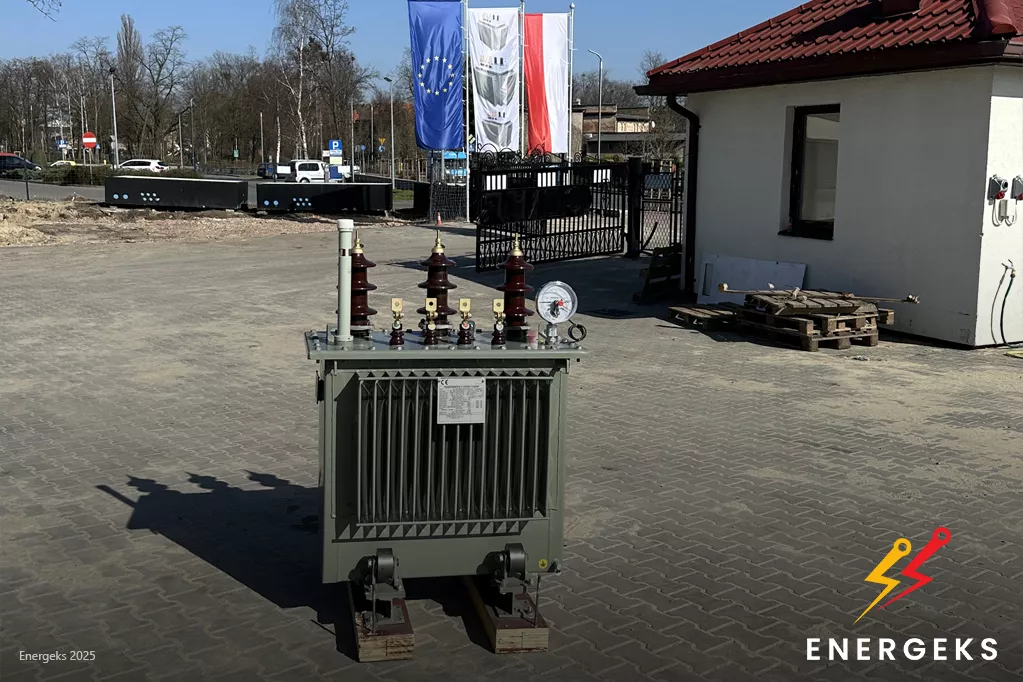
Therefore, for MarkoEco2 oil‑immersed transformers, what counts for us is the whole: hermetic construction, oil compliant with IEC 60296, compliance with EN 50588‑1 and EN 60076‑1, monitoring capabilities and solutions supporting long life and loss reduction.
It is from such decisions that a device is created that is supposed to work calmly, stably and without surprises.
We look similarly at TeoEco2 dry‑type transformers. Here, quality is determined by disciplined engineering: compliance with EcoDesign Tier 2, reduction of no‑load and load losses, F1 fire safety, and readiness for real operating conditions and cooperation with protection systems. This is equipment that is supposed not only to look good in an offer but above all to find its place where certainty matters.
We offer both transformer types in variants with aluminium and copper windings.
Sometimes the best answer is copper, sometimes aluminium, and sometimes simply a well‑chosen design. And that, actually, is quite good news.
In power engineering, the most expensive thing is not the material itself.
The most expensive thing is oversimplification.
That is why it is worth negotiating with an offer the same way you negotiate good cooperation terms.
With an attitude towards real mutual benefit.
You get a transformer that does its job for years.
The manufacturer gains a customer who understands what they are paying for.
And only then does the conversation truly make sense.
Sources:
European Commission, Power Transformers, Ecodesign Requirements
U.S. Department of Energy, Distribution Transformers, 2024 final rule and compliance timeline
Eaton, Copper vs. Aluminum Conductor Information for Distribution Transformers
Shipped from our warehouse in Poland within 2–3 working days, 5-year warranty. Full range 25–2500 kVA in the shop (prices in PLN).
Need a complete MV/LV substation? See ready-made transformer substations in the shop or configure your own in the free station configurator (technical design, data sheet, configuration code; in Polish).
No reviews!