18 Mar
2025
Energeks
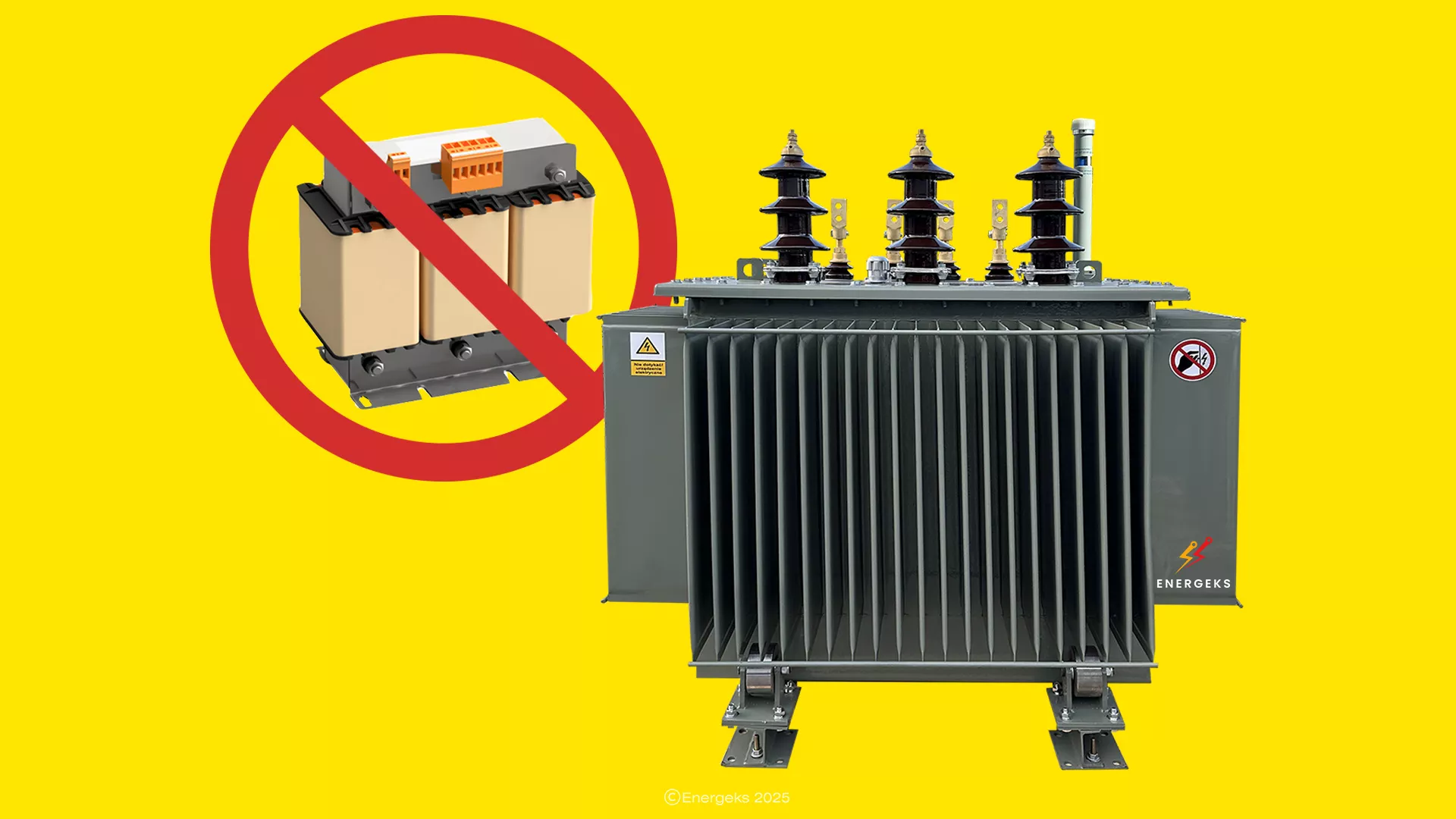
Your installation can operate more stably and cost-effectively, without additional components, unnecessary expenses, or compromises. At Energeks, we provide solutions that change the approach to energy management. Our modern low-loss transformers significantly reduce reactive power consumption, almost to zero, eliminating the need for compensation reactors. Yes, technology truly saves space, money, and energy.
If you want your installation to be more efficient, stop thinking about compensators and read how low-loss transformers solve the problem at its source.
At the end, you will find out whether your current solution still makes sense.
What compensation reactors are and where they are used
What regulations govern reactive power compensation in Poland
Why modern transformers eliminate the need for them
When and where it is most profitable to switch to low-loss technology
Reading time: 8 minutes
Compensation reactors, also known as compensation inductors, are key components of power infrastructure, used in medium voltage (MV) and high voltage (HV) installations. Their primary function is the compensation of inductive reactive power, that is, eliminating excess energy circulating in the network without performing any useful work, while burdening transmission lines and equipment.
To illustrate this: imagine your installation as the circulatory system of a factory. Active power is the blood delivering oxygen to the cells, meaning the real energy driving production processes. Meanwhile, reactive power is excess voltage in the veins. It does not cause harm in small amounts, but in excess, it leads to overloads, increased operating costs, and reduced efficiency of the entire system. A compensation reactor acts like a precise regulating valve – it removes the surplus of this unused energy, ensuring proper "pressure," meaning voltage stability and an appropriate power factor.
From a technical perspective, compensation reactors absorb inductive reactive power, counteracting the phenomenon of phase shift between current and voltage. As a result, they improve the power factor cosφ, which under optimal conditions should be at least 0.93–0.95. This is particularly important in the European Union and the USA, where exceeding specified power factor thresholds results in additional charges imposed by network operators.
Compensation reactors can be:
Built into the transformer – commonly used in modern solutions where the number of devices in the substation is minimized
Installed externally – as separate units in compensation cabinets, allowing greater flexibility in selecting the required compensation power
You will find them wherever reactive power poses a real issue:
In industrial facilities with large induction motors and machines, where significant amounts of inductive energy are generated
On photovoltaic and wind farms, where the variability of energy production requires dynamic compensation
In medium and high voltage transmission and distribution systems, where voltage stability and reduced transmission losses are critical for the reliability of the entire network
In practice, their selection must comply with applicable standards, and their parameters appropriately matched to the characteristics of the power system.
However, as the development of modern low-loss transformers shows, using compensation reactors is not always necessary. Thanks to the reduction of no-load losses and optimized core operation, it is possible to achieve a high power factor without the need for additional compensation devices.
Efficient reactive power management is the foundation of stability and economic performance in power systems, both in the European Union and the United States. Although legal regulations on both sides of the Atlantic share the same objective – reducing transmission losses and optimizing energy quality – their approach to reactive power compensation and requirements for industrial consumers differ in terms of detail and enforcement methods.
In the European Union, detailed regulations regarding reactive power compensation have been introduced to ensure the efficient operation of distribution and transmission networks. For instance, in Poland, the legal basis is the Distribution Network Operation and Maintenance Instruction (IRiESD). According to its provisions, energy consumers are obliged to maintain the power factor within a strictly defined range.
Permissible tgφ values are within the range from 0.4 inductive to 0.4 capacitive, which translates to a power factor cosφ of at least 0.93. Any exceedance of this range results in additional charges for excessive consumption of reactive power, both inductive and capacitive.
To meet these requirements, compensation reactors and capacitor banks are used. In Europe, their parameters must comply with applicable technical standards:
PN-EN 60831 – for low voltage capacitors
PN-EN 61642 and EN 61921 – for medium voltage capacitor banks
It is worth noting that there is an increasing emphasis on eliminating the need for separate compensation systems by implementing modern low-loss transformers. By optimizing their construction and reducing no-load losses, these transformers naturally improve the power factor, removing the need for additional components such as compensation reactors or capacitor banks.
In the United States, regulations regarding reactive power compensation are more varied and depend on the specific network operator and applicable state regulations. Despite the lack of unified federal standards, in practice, most operators require maintaining a minimum Power Factor (PF) in the range of 0.90 to 0.95, which corresponds to cosφ values above 0.90.
Failure to comply with these guidelines results in additional charges, referred to as Power Factor Penalties. These penalties serve as a mechanism encouraging consumers to invest in systems improving the power factor.
The technical basis for regulating energy quality in the USA is the IEEE Standard 519, which defines permissible harmonic levels and energy quality criteria. Additionally, local Public Utility Commissions (PUC) impose specific requirements for individual states and network operators.
Similar to Europe, reactive power compensation in the USA commonly involves the use of capacitor banks and compensation reactors. However, increasingly advanced solutions are being introduced, such as dynamic reactive power compensators (D-STATCOM) and modern low-loss transformers, which reduce losses and support network stability at the level of key infrastructure components.
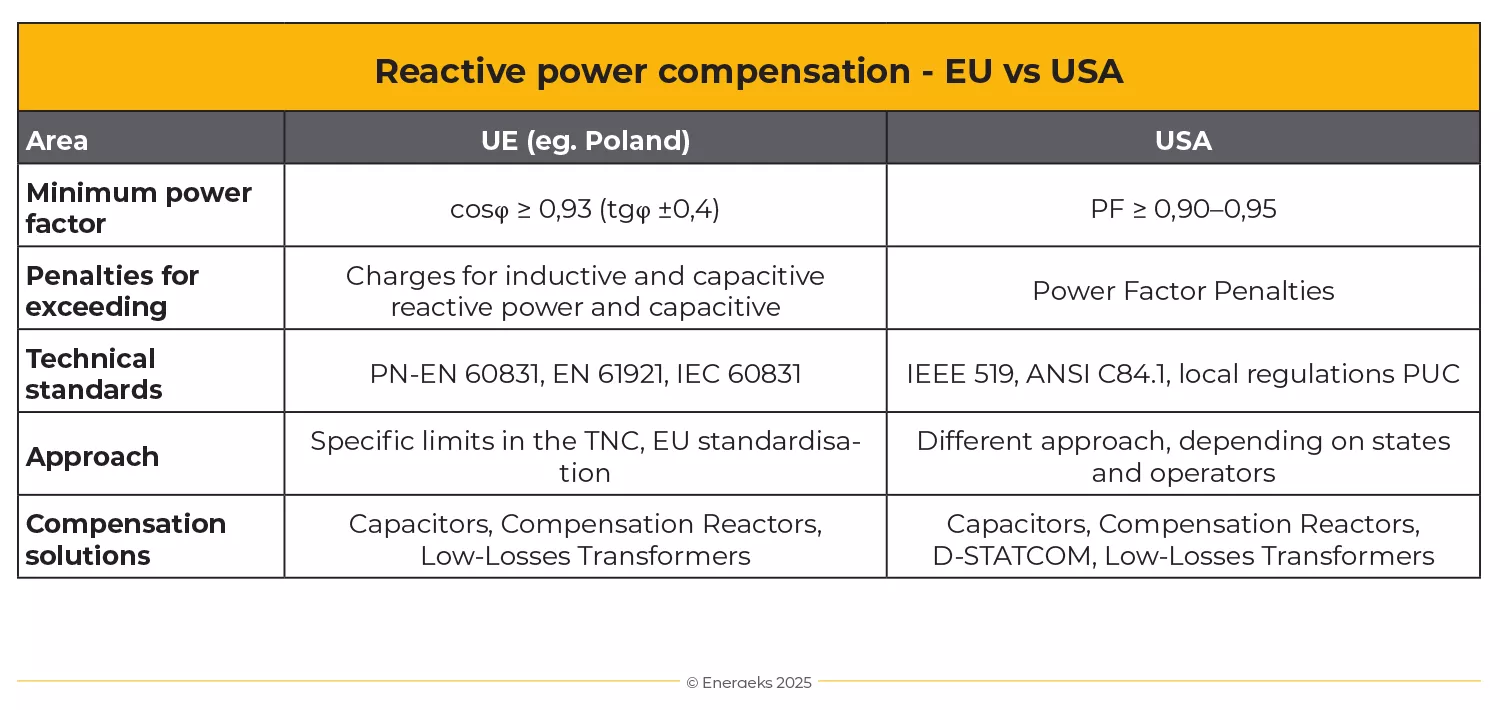
The table below presents a comparison of the approach to reactive power compensation in the European Union and the USA. It shows the minimum power factor requirements, penalties for exceeding them, and the technical solutions used, such as compensation reactors, capacitor banks, and low-loss transformers.
Table 1: Comparison of the EU and USA approach to reactive power compensation
What does this mean in practice?
Regardless of location, every industrial consumer must ensure an optimal power factor to avoid additional charges and improve the energy efficiency of their system. This can be achieved by using classic solutions such as compensation reactors or capacitor banks, but increasingly the best choice proves to be modern low-loss transformers, which naturally reduce reactive power demand at the source of the installation.
The primary reason for using compensation reactors in power systems is the excessive consumption of reactive power, generated mainly by traditional transformers characterized by high no-load losses. Modern low-loss transformers effectively eliminate this problem at its source thanks to the use of innovative material technologies and precise construction processes. In practice, this means not only reduced operational costs but also simplification of the entire power system by eliminating additional compensation devices such as compensation reactors.
A key element influencing the efficiency of modern transformers is the use of advanced magnetic materials. High-quality amorphous sheets and optimized silicon steel grades allow for significant reduction of magnetic losses in the core. Reducing no-load losses directly translates into lower magnetizing current, which largely contributes to the generation of inductive reactive power. As a result, modern transformers consume significantly less energy that would otherwise need to be compensated using compensation reactors or capacitor banks.
In traditional transformers, such losses could reach several percent of the rated power. In the case of low-loss designs, no-load losses are reduced by around 20 to 30 percent compared to older units, which represents a measurable energy and financial saving.
Another significant aspect is the improvement of the power factor at no-load. Older transformer designs exhibited a clear phase shift between current and voltage, resulting in a power factor significantly lower than optimal values. Therefore, in many cases, it was necessary to install additional compensation devices such as compensation reactors or capacitors to improve cosφ.
Modern low-loss transformers feature an optimized phase angle of no-load current, meaning that even at no-load they achieve a power factor cosφ close to unity. The user does not have to worry about additional expenses on compensation systems, as the transformer itself operates with high energy efficiency and minimal reactive power involvement.
Traditional compensation systems, especially those based on static capacitor banks, carry the risk of overcompensation, also known as negative tgφ. This occurs when reactive power compensation exceeds the actual demand of the installation, leading to an increase in network voltage and potential power quality disturbances.
Low-loss transformers naturally eliminate this problem. Thanks to significantly reduced no-load losses and optimized operating characteristics, they do not generate excessive reactive power, and therefore do not require aggressive compensation. The end user can be confident that the installation operates stably, without the risk of uncontrolled voltage increase, without the need for additional compensation reactors, and without the costs associated with an expanded compensation infrastructure.
This is why choosing low-loss transformers is not only a technological decision but also an economic one. Minimizing losses and eliminating the need for compensation reactors translates into lower operating costs, simplified system configuration, and increased reliability of the power installation.Does your installation need compensation reactors?
Not every power installation today has to rely on classic compensation solutions. In many cases, the use of modern low-loss transformers eliminates the need for compensation reactors, with benefits visible from the first months of operation.
Not every power installation today has to rely on classic compensation solutions. In many cases, the use of modern low-loss transformers eliminates the need for compensation reactors, with benefits visible from the first months of operation.
In industrial plants, where large motors and induction machines dominate, reactive power generated by the equipment leads to increased operating costs. By reducing reactive power using low-loss transformers, it is possible to significantly lower charges related to exceeding the power factor, as well as reduce transmission losses within the plant's network. Fewer compensation reactors also mean less space occupied by equipment, simpler maintenance, and greater energy efficiency.
In PV farms, a stable power factor is crucial for the reliability of the entire installation. Modern transformers eliminate the need for extensive compensation systems, allowing for simplified substation design and simultaneously reducing investment expenditures. Fewer components in the system mean not only lower initial costs but also reduced risk of failure during long-term operation.
In energy storage installations, especially those cooperating with renewable sources, system flexibility and reliability are essential. Modern power electronic converters and low-loss transformers enable stable operation without the need for additional compensation reactors. Fewer elements in the system mean simplified system architecture, easier synchronization with the grid, and greater stability of the entire energy storage facility.
The use of low-loss transformers is one of the simplest and most cost-effective ways to improve the energy efficiency of any power installation. According to data from the International Energy Agency (IEA), replacing standard transformers with low-loss units can reduce energy losses by up to 30 percent over the entire operational cycle. In the case of large industrial plants or photovoltaic farms, this translates into tangible savings of tens of thousands of euros annually, depending on the installed capacity.
Lower no-load losses directly result not only in reduced electricity bills but also in extended equipment lifespan. Lower network load and reduced reactive power mean more stable operating conditions for the entire system, which leads to lower risk of failures, fewer unplanned downtimes, and reduced maintenance costs.
Additionally, optimizing the power factor eliminates the need for external compensation devices such as compensation reactors or capacitor banks, resulting in savings at the infrastructure investment level and more available space in the transformer station.
It is worth acting before the distribution network operator begins charging additional fees for exceeding permissible levels of reactive power. Transformer modernization is not only a step toward efficiency but also protection against rising energy costs. Optimize your installation today and gain both operational and financial advantage.
Are low-loss transformers more expensive?
The purchase cost may be higher, but operational savings and the elimination of compensation devices quickly offset this difference.
How can I tell if my transformer requires compensation?
Check the nameplate and documentation – the power factor and no-load current will reveal a lot.
Does replacing a transformer require downtime?
In most cases, modernization can be scheduled with minimal installation downtime.
If you are wondering whether your installation is operating at its full potential, it is worth checking at the source. At Energeks, we help our partners achieve more every day by optimizing energy consumption, simplifying systems, and eliminating unnecessary costs. Thanks to this trust, we have been able to share not only proven solutions but also practical experience for years.
We proudly invite you to browse our current offer of low-loss transformers. With us, you will find both tried-and-tested models available immediately and solutions tailored to individual needs.
Our knowledge base and blog publications are based on real-world implementations and cooperation with industrial plants, photovoltaic farms, and network operators. If you want to consult the modernization of your system or simply exchange experiences – join our community on LinkedIn. There we share not only our offer but also knowledge, case studies, and ideas that can help you make informed decisions.
Energeks is not just about products, it is about people who want to build the future of energy together with you. Contact us and see how we can support your plans!
Shipped from our warehouse in Poland within 2–3 working days, 5-year warranty. Full range 25–2500 kVA in the shop (prices in PLN).
No reviews!