Energy transformation
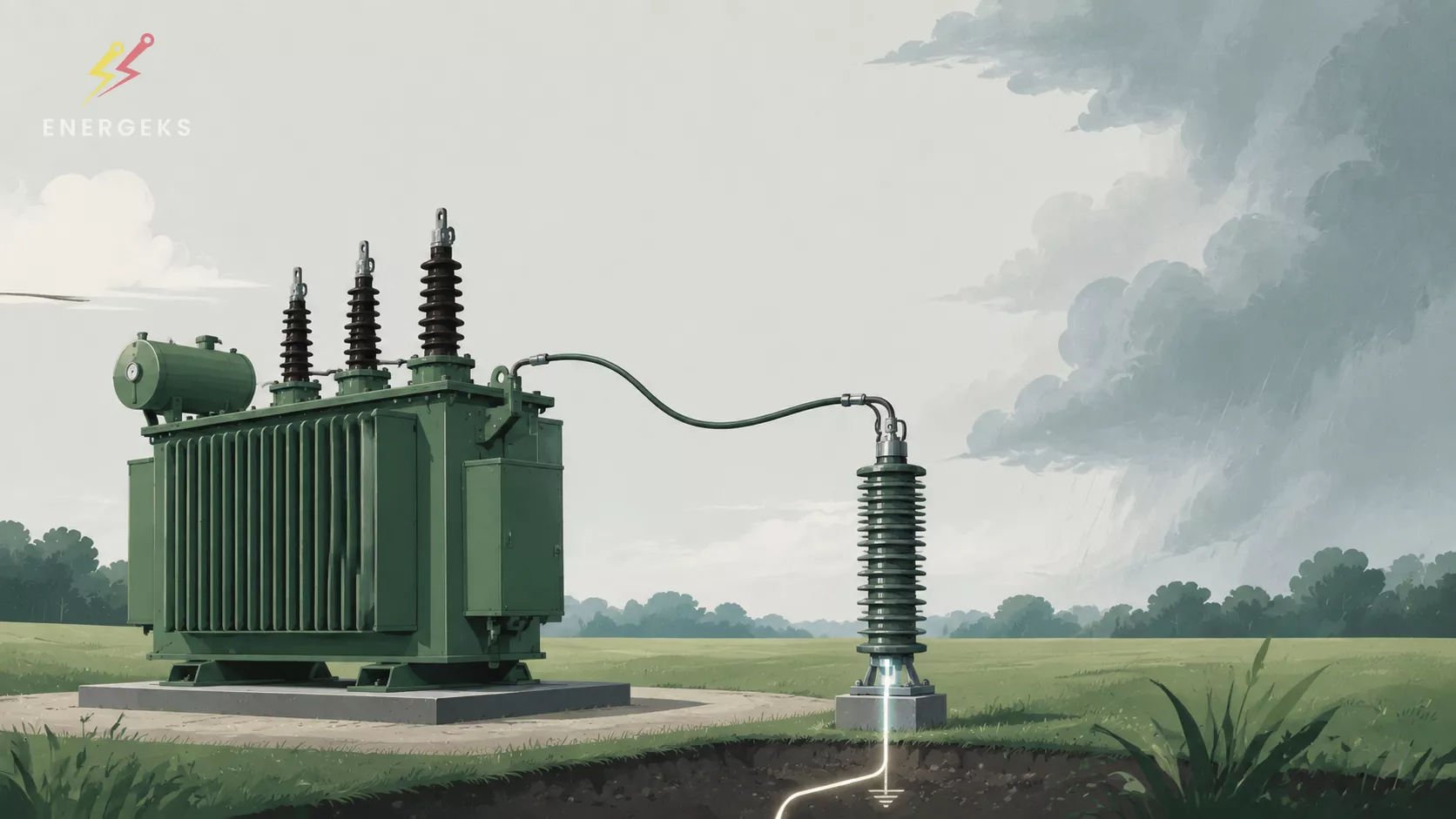
Heat melts people. Thunderstorms test transformers.
And it does it in microseconds.
The heatwave season has its own physics. The air stands still, asphalt softens, and we all slowly change our state of matter. A person starts treating shade like premium real estate, and every fridge opening sounds like a strategic decision.
And then the storm comes.
For a moment, it brings relief. The temperature drops, the wind picks up, the air regains its meaning. Except that for the power grid, that same storm is not a pleasant break from the heat. It is a test whose outcome can be decided in less time than a blink of an eye. Much less.
0.000001 seconds. That is how long one microsecond lasts.
It is on this scale that the front of a lightning surge develops. Does the transformer have a chance to survive it? Yes, provided that the right decisions were made before the first flash appeared in the sky.
The overvoltage reaching the transformer develops in microseconds. The operator will not have time to react. The controller will not call a meeting. The transformer also does not have a moment to "prepare" its insulation. The outcome is decided by solutions chosen earlier: insulation coordination, the type and parameters of the surge arrester, its location, the length of the connections, and the quality of the entire surge current discharge path.
This is why lightning protection for a transformer is a good topic right now. Not because a thunderstorm is spectacular, but because it reminds us of a simple rule in power engineering: the most important protections do their work when no one has time left to make a decision.
What really threatens the transformer during a thunderstorm?
A lightning strike does not have to hit the transformer directly to cause a dangerous overvoltage. A surge can enter the system through several paths.
A direct strike on an overhead line introduces a very high current with a steep change over time. A strike near the line can induce voltage in the conductors. Another possibility is a strike to a structure, a lightning protection system or the ground, which causes a sudden change in the potential of the earthing system. A surge wave can also arrive from another part of the grid, travelling along conductors and cables.
The transformer therefore sees not so much the flash itself, but the voltage wave appearing at its terminals.
If the value and steepness of this wave exceed the insulation's ability to withstand the electrical stress, a flashover on the bushing, breakdown of the main insulation or damage to the turn‑to‑turn insulation can occur. Not every event ends with an immediate short circuit. Sometimes the impulse leaves behind a weakening, local damage or the beginning of a degradation process that will manifest itself later.
This is precisely why the absence of a failure immediately after a storm is not automatically proof that the protection system worked perfectly. Insulation can remember electrical stress, even though it does not keep an event log.
Why do we talk about microseconds?
In high‑voltage engineering, the resistance of equipment to atmospheric overvoltages is assessed, among other things, using a standardised voltage impulse. The designation 1.2/50 µs describes a waveform whose nominal rise time is 1.2 microseconds and whose time to fall to half the value is 50 microseconds.
This is a test model, not a photographic portrait of every lightning strike. It does, however, allow the insulation strength of equipment to be compared and consistent principles of insulation coordination to be established.
One microsecond is one millionth of a second. In 1.2 microseconds, an electromagnetic wave can travel hundreds of metres, depending on the propagation medium. From a human perspective, nothing has happened yet. From the transformer's perspective, the voltage has already reached a level that can determine the fate of its insulation.
The steepness of the impulse is as important as its peak value. For fast‑changing currents, every fragment of conductor has inductance. The voltage on such a connection can be described by the relationship:
UL = L × (di / dt)
The faster the current rises and the greater the inductance of the connection, the greater the additional voltage drop. This voltage can add to the residual voltage of the arrester and appear at the terminals of the protected device.
The example is illustrative. If the connection has an inductance of about 1 µH and the surge current changes at a rate of 10 kA/µs, the connection itself can contribute about 10 kV. This does not mean that every metre of conductor always "costs" exactly 10 kV. It does, however, show the scale of the phenomenon and explains why, in surge protection, a short path is an electrical parameter, not an installer's aesthetic preference.
Does a lightning rod protect the transformer?
Yes, but not by itself and not against every scenario.
The external lightning protection system is designed to intercept a direct strike on the protected structure, conduct the current along a designated path and disperse it into the ground. It thus limits the risk of physical damage to the structure and the danger to people. The scope of this protection is described by the IEC 62305 series.
A surge arrester works on a different part of the problem. Its task is to limit the overvoltage on the device and direct the surge current to the earthing system. In medium‑voltage networks, it protects, among other things, transformers, bushings and switchgear against atmospheric and switching overvoltages.
Insulation coordination connects both worlds with the transformer itself. It consists of selecting the insulation strength, the protection level of the arresters and the system configuration so that the stress reaching the device remains below its assumed withstand level, with an appropriate margin.
So you can build a correct lightning protection system for the building and still leave the transformer with insufficient protection against a wave arriving via a conductor. You can also choose a good arrester and weaken its effectiveness with excessively long connections. Protection works as a system. The logo on one component does not replace the physics of the entire surge path.
How do arresters work, i.e., metal‑oxide surge arresters?
In modern AC networks, gapless metal‑oxide surge arresters with metal‑oxide resistors are widely used. Their requirements are specified in IEC 60099‑4 for systems with the highest voltage for equipment above 1 kV.
In everyday language, they are often called lightning arresters. In industry jargon, the more precise term is surge arrester, because the device does not catch lightning like a baseball glove. It limits the voltage and creates a controlled path for the surge current. A small linguistic difference, perhaps, but behind it lies the entire principle of operation.
The heart of the arrester is a non‑linear block, most often based on zinc oxide. Under normal conditions, the arrester has a very high resistance and only conducts a small leakage current. When the voltage rises sharply, its characteristic changes dramatically. The arrester begins to conduct the surge current, directing it to earth and limiting the voltage on the protected device.
After the overvoltage subsides, it returns to a high‑resistance state. It does not "swallow" the entire lightning strike and does not make the voltage disappear. It limits it to a specific level, called the residual voltage or protection level, and absorbs and dissipates part of the energy.
The whole process involves the appearance of the overvoltage, the rapid increase in the arrester's conductivity, the discharge of the surge current and the device's return to a high‑resistance state. For it to actually protect the transformer, the residual voltage, together with additional drops on the connections, must remain safely below the impulse withstand voltage of the insulation.
ZnO, spark gap or a special solution?
Different constructions can be found on the market and in older installations. Not all of them should be lumped together in the same drawer.
The modern standard for transformer protection is gapless arresters with ZnO blocks. They react thanks to the strongly non‑linear characteristic of the material and can withstand successive surges within their declared capability.
Older spark‑gap constructions, often with silicon carbide resistors, are still operating in some facilities. When modernising, ZnO is usually considered, but a "one‑to‑one" replacement without checking the network parameters and insulation coordination is not a good shortcut.
There are also special solutions, for example arresters with an external spark gap used on lines, and constructions for GIS. Their application is determined by the function, the insulation system and the overvoltage analysis, not by a catalogue power ranking.
The most effective therefore does not mean the most impressive in the catalogue. It means properly selected for the voltage, the network earthing method, the expected energy, the transformer's LI level and the environmental conditions.
Insulation coordination: the most important conversation between the transformer and the arrester
IEC 60076‑3 specifies the insulation requirements, dielectric tests and minimum test levels for transformers. The IEC 60071 series sets out the principles of insulation coordination for equipment and installations above 1 kV.
In design practice, at least two levels must be compared:
the rated lightning impulse withstand voltage of the transformer, often abbreviated as LI
the protection level provided by the arrester under specific current and impulse shape conditions
A margin should remain between them, taking into account uncertainties, the installation configuration, the distance from the transformer, the inductance of the conductors, wave phenomena and actual operating conditions.
It is not enough to check whether the number on the arrester data sheet is lower than the number on the transformer documentation. The voltage seen by the insulation can be higher than the residual voltage itself. Inductive drops and the effect of distance from the device must be added.
The shortest version of this rule is: the arrester does not protect the transformer's catalogue. It protects a specific transformer in a specific installation.
How to select a surge arrester for a transformer?
Selection begins with the system data, not with one voltage printed on the housing.
✅ Continuous operating voltage
The Uc value, i.e., the permissible continuous operating voltage, must correspond to the highest voltage that can occur on the arrester for a long time. The neutral earthing method and the voltage rise of healthy phases during an earth fault are important.
Too low a Uc can expose the arrester to overload during a temporary overvoltage. Too high a Uc usually means a higher protection level, which can reduce the margin for the transformer insulation.
✅ Rated voltage and temporary overvoltage withstand
The Ur and TOV parameters must be assessed together with the duration of the possible overvoltage. The arrester must survive a real fault scenario or other disturbance in the given network, not just the nominal operating point.
✅ Protection level
The residual voltage must be compared with the transformer's impulse withstand level. The influence of connections and location must also be taken into account. A low value in the table is useful only when the installation allows it to be exploited.
✅ Energy and charge capability
The exposure depends on the network configuration. Different requirements may apply to a station supplied by a long overhead line in an area of high lightning activity than to a device operating in a cable system. Switching overvoltages, the repeatability of surges and the nature of the protected facility also matter.
✅ Environmental and mechanical conditions
Altitude above sea level, pollution, UV radiation, temperature, humidity and mechanical loads influence the choice of design. The selection of a silicone or porcelain housing should result from the project conditions.
✅ Behaviour in the event of failure
The short‑circuit class, the method of safe venting or disconnection, and the risk to people and adjacent equipment must be considered. Protection of the transformer must not create a new problem at the moment when the arrester itself reaches the end of its service capability.
Why is the installation location just as important as the selection?
The best arrester placed too far from the transformer can provide weaker protection than a properly selected device mounted at the protected terminal.
Three principles decide:
the smallest possible distance between the arrester and the transformer bushing
short, straight connections on the phase and earthing side
avoiding loops, sharp changes of direction and unnecessary conductor sections
During surge current flow, the impedance of the entire path matters, not just the earthing resistance measured at power frequency or by a method suitable for static conditions. A fast impulse "sees" the inductance of the conductors, the geometry of the system and the mutual position of the connections.
Therefore, a larger conductor cross‑section does not automatically fix the problem of excessive length. Cross‑section remains important for thermal, mechanical and short‑circuit reasons, but for a very steep impulse, the path geometry can determine the induced voltage.
It is here that theory meets execution detail. An extra metre of conductor may look innocent. For an impulse measured in microseconds, it is a fully‑fledged circuit element.
Earthing: where should the energy actually flow?
A surge arrester does not remove energy from the system. It provides a controlled path for it. If this path has a high impulse impedance or is routed in a way that creates significant potential differences, the voltage on the protected device can still reach a dangerous level.
An effective system requires continuity of connections, correct connection of the transformer tank, the structure, cable screens and the other elements covered by the earthing design. Equipotential bonding is also important. During a discharge, the potential of the local earth electrode can rise sharply. The goal is not to magically keep the entire station at perfect zero potential, but to limit dangerous potential differences and ensure a predictable current path.
The earthing resistance value alone does not tell the whole story. Proper geometry, connections of adequate durability, corrosion control and compliance with the lightning protection design and network requirements are also needed.
Earthing is a bit like an evacuation route. Knowing that it exists is not enough.
It must lead where it should, be clear and work exactly when things get crowded.
Does a cable line eliminate the risk of atmospheric overvoltages?
No. It changes the risk profile but does not cancel it.
A cable is less exposed to a direct strike than an overhead line. A wave can, however, enter at the transition point from an overhead line, be caused by a rise in earth potential, or arrive from another part of the grid. Reflections at the boundaries of different impedances also change the voltage. Therefore, terminations, cable length, screens, earthing and surge limitation points must be analysed. A cable underground does not receive immunity from thunderstorms.
Is it enough to protect the MV side?
An arrester on the MV side protects the transformer against a wave arriving from that grid, but an impulse can transfer between windings. On the LV side, today there are controllers, inverters, measurements, communication and automation. Therefore, protection should be layered: include MV, coordinated SPDs on the LV side, auxiliary and signal circuits, and equipotential bonding. Protection of the transformer and of the electronics are related but not identical tasks.
7 mistakes in transformer lightning protection
A poorly selected arrester is a bit like a solid door installed next to the entrance.
It looks professional, but lightning has no obligation to use it.
❌ The first mistake is selection based solely on the rated network voltage.
Omitting the neutral earthing, the earth‑fault clearing time and TOV can give an incorrect Uc value. Too low a value exposes the device to overload, while too high a value can worsen the protection level.
❌ The second is installation far from the bushing.
In a surge, there is no such thing as "just a piece of conductor". Every section contributes inductance.
❌ The third is running long, looped connections to the earthing system.
A neatly routed conductor does not always mean a good surge path.
❌ The fourth is treating earthing resistance as the only measure of protection quality.
The measurement result is important, but it does not replace the assessment of continuity, geometry and impedance for fast transients.
❌ The fifth is the lack of coordination with the transformer insulation level.
The arrester cannot be selected in isolation from the LI, bushings, cables and switchgear.
❌ The sixth is neglecting the low‑voltage side and auxiliary circuits. A surge usually does not read the scope of delivery.
❌ The seventh is assuming that the arrester is permanent.
Multiple surges, moisture, damage and deteriorating connections can change its condition.
This does not mean replacement after every storm, but regular inspection instead of a wishful "it still looks fine".
Lightning vs. the budget: why protection simply pays off
The price of the arrester and correct installation is easy to see in the cost estimate. The price of a transformer failure has many more items, and some of them only appear when the device stops working.
The bill may include diagnostics, transport of heavy equipment, service work, equipment rental, repair or replacement of the transformer, emergency actions and loss of supply continuity. In a production plant, the cost of a stopped process is added. In an infrastructure facility, service availability matters. On a photovoltaic farm, every hour of downtime can mean energy that cannot be produced later.
Depending on the transformer power and the effects of the downtime, the total cost of an event can quickly reach tens or hundreds of thousands of PLN, and for large units much more. It is not worth promising, however, that any arrester will solve this problem. Savings only appear when the device is part of a properly coordinated system.
The investment therefore includes not only the purchase of the device. It includes selection, proper positioning, short connections, effective earthing, protection of subsequent levels and later inspection. This is less spectacular than a slow‑motion lightning video. It does, however, look much better in the installation availability report.
How to check protection after station commissioning?
Surge protection requires inspections adapted to the type of equipment, the manufacturer's recommendations and the importance of the facility.
During an inspection, it is worth considering:
the condition of the arrester housing, contamination, signs of discharge and mechanical damage
the quality of the terminals, phase and earthing connections
the continuity of equipotential bonding and the condition of the earthing
the readings of operation counters, if fitted
the trend of leakage current or its resistive component in installations equipped with monitoring
compliance of the station configuration with the design after modifications
A surge counter informs about events, but does not diagnose the arrester. Leakage current monitoring also requires interpretation. The greatest value comes from trends and comparison with the manufacturer's criteria. After a severe storm or protection operation, a targeted inspection based on the device condition and exposure history is advisable.
Good protection does not fight the storm. It manages its effects.
We cannot stop lightning discharges, and we are unlikely to persuade July to lower its temperature out of respect for infrastructure. We can, however, decide how the surge energy will pass through the station and what voltage the transformer insulation will see.
Effective protection is created when the transformer, arrester, connections, earthing and other protection levels are treated as one system. The arrester must have parameters appropriate for the network. It should be located close to the protected terminal. The current path must be short and consciously designed. The protection level should maintain an appropriate margin relative to the insulation strength.
That is a lot of dependencies for an event that lasts a few dozen microseconds.
That is precisely why it is worth resolving them calmly at the design stage, before the first summer storm appears over the station. If you are selecting a transformer, a transformer station or a surge protection system, let us compare the device parameters and the network configuration as a whole. Good questions asked today can do very concrete work during the next flash.
Energy deserves a good path
We cannot stop a storm. We cannot ask a lightning discharge to wait for the end of an inspection, and we are unlikely to persuade August to lower its temperature out of respect for infrastructure. We can, however, decide what happens at the moment the surge wave reaches the station.
We can give it a short, predictable path to earth. We can match the protection level to the actual insulation strength. We can look at the transformer, arrester, bushings, conductors, cables and earthing as one system, not seven separate items in an order.
And that is good news. In power engineering, we do not have influence over everything, but we have enormous influence over the quality of design decisions.
Thank you for taking the time to enter the world of microseconds with us. We know that surge protection does not sound as spectacular as lightning itself. In practice, it is precisely this protection that allows the transformer to continue doing its job after the flash: without drama, without downtime and without costly improvisation.
If you are selecting a transformer for a new station, modernising an existing system or want to verify parameters before submitting an enquiry, take a look at the oil‑immersed and cast‑resin transformers in the Energeks range. It is worth starting the conversation not only with the power in kVA, but also with the voltages, the LI level, the network operating mode, the environmental conditions and the entire protection concept.
Do you have a project where the arrester, cable and transformer must finally start talking to each other? Contact the Energeks team. We will look at the data, organise the technical questions and seek a solution matched to the real installation.
And if you like power engineering told concretely, with technique, experience and a touch of humour, follow Energeks on LinkedIn. There we share knowledge about transformers, stations, renewables and everything that makes energy go exactly where it is needed.
Thank you for your trust, your questions and every technical conversation. They help create better projects.
A thunderstorm may have the last flash.
But it does not have to have the last word.
Sources:
IEC 60071-1:2019, Insulation co-ordination, definitions, principles and rules
IEC 60099-4:2014, Metal-oxide surge arresters without gaps for AC systems
IEC 60076-3:2013 with Amendment 1:2018, Power transformers, insulation levels and dielectric tests
IEC 62305-1:2024, Protection against lightning, general principles
Hubbell Power Systems, The Importance of Lead Length for Arrester Applications
Transformers in stock
Shipped from our warehouse in Poland within 2–3 working days, 5-year warranty. Full range 25–2500 kVA in the shop (prices in PLN).
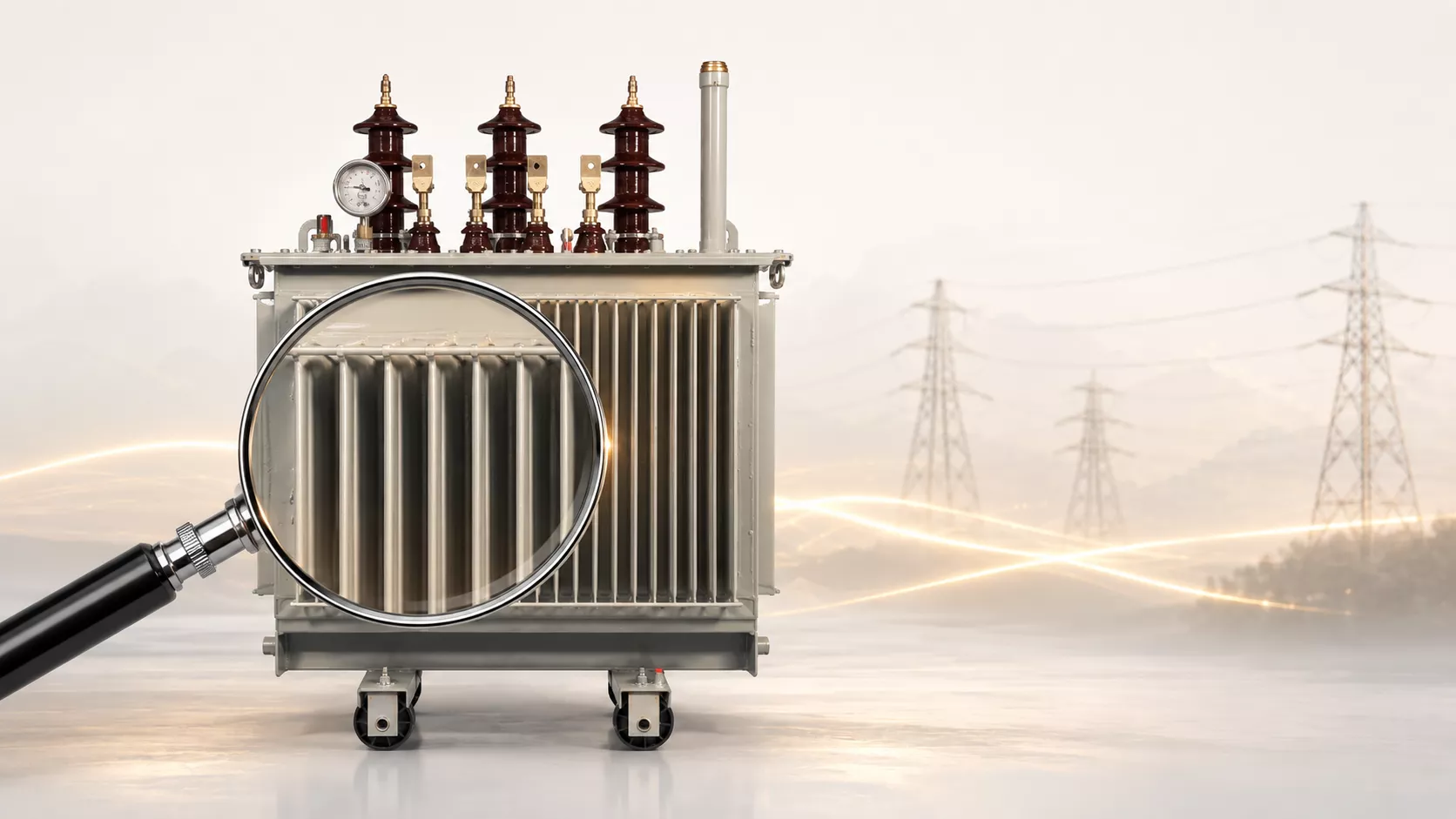
An oil-immersed transformer can stand in one place for decades and transfer energy almost continuously to an industrial plant, a housing estate, a photovoltaic farm, an energy storage system or an electric vehicle charging station.
It has no pistons, shafts or gearboxes that spectacularly rotate during operation.
From the outside, what is most often visible is the steel tank, bushings, radiators, a nameplate and a few control elements.
One might get the impression that not much is happening inside either.
In reality, the transformer is constantly working in a changing magnetic field, carrying large currents and fighting the heat generated in the core and windings.
Every additional ampere, high ambient temperature, and every hour of operation under high load increase the amount of thermal energy that must be effectively removed.
This is precisely why an oil-immersed transformer needs oil.
It is not used to lubricate moving parts, because there are practically none.
Transformer oil performs much more important tasks. It insulates parts under high voltage, absorbs heat from the windings and core, and then transports it to the tank and radiators.
⚡ A transformer does not age solely because the years pass. Its actual durability depends to a very large extent on the temperature at which those years were worked.
This article has been prepared for designers, contractors, investors and those responsible for selecting a transformer for an industrial plant, a renewable energy installation, an energy storage system, a commercial building or critical infrastructure.
We will explain how a transformer transfers energy, where losses come from, how oil can simultaneously cool and insulate, and what distinguishes ONAN and ONAF cooling systems.
We will also show why overloading a transformer by 20% can generate significantly more than 20% additional heat.
Estimated reading time: 9 minutes.
A transformer does not produce energy. It changes its parameters.
Energy cannot be created from nothing or destroyed irreversibly.
It can, however, be transformed, transmitted, stored and dissipated in various forms.
A power plant therefore does not "produce" energy in the literal sense of the word.
It converts the chemical energy of fuel, solar radiation, wind, water or nuclear reactions into electrical energy.
A transformer performs the next stage of this energy relay.
It does not create new kilowatt-hours, but transfers energy from one circuit to another and changes its parameters so that it can be safely transmitted, distributed and used.
The basic task of a transformer is to change the voltage value of alternating current.
In a typical distribution network, it can step down the medium voltage, for example 15 kV or 20 kV, to the level of 400 V used by machines, building installations, switchgear and other low-voltage consumers.
In other applications, the transformer works in the opposite direction and steps up the voltage. This happens, among other things, in power plants, photovoltaic and wind farms, where the electricity must be transferred to the grid at a level that allows it to be efficiently transported over long distances.
A transformer can be compared to a gearbox in a car. The gearbox does not increase the engine's power, but changes the relationship between rotational speed and torque. A transformer similarly changes the proportions of voltage and current, matching the energy to the conditions prevailing in a given part of the installation.
When the voltage is stepped down, a higher current can flow on the secondary side. When the voltage is stepped up, the current decreases accordingly. In an ideal transformer, the input and output power would be the same. However, a real device always causes some losses, because part of the transmitted energy is dissipated as heat.
A loss of one percent may sound harmless, but for a transformer transmitting 1 MW of power, it corresponds to about 10 kW of heat. That is as if several electric heaters were working inside the steel tank around the clock.
The heat must be removed from the windings and core, and then transferred to the surroundings. Without effective cooling, the temperature of the hottest elements of the transformer would rise quickly, accelerating insulation ageing and shortening the expected service life of the device.
What happens between the windings?
Inside a classic transformer there are the primary winding, the secondary winding and a common magnetic core. The primary winding is connected to the power source, while the secondary winding transfers energy to the rest of the installation.
Both windings are close to each other but are not directly electrically connected. Energy does not flow between them through an ordinary conductor.
Its carrier is the changing magnetic field.
When alternating voltage is applied to the primary winding, current begins to flow through it. A changing magnetic field is created around the winding, which is concentrated and guided by the core. This field also covers the secondary winding and induces a voltage in it.
This phenomenon is called electromagnetic induction.
The most important word here is "changing". A constant magnetic field would not allow continuous induction of voltage in the second winding. That is why a classic transformer works with alternating current.
In the European power grid, the frequency is 50 Hz. The magnetic field in the core therefore constantly changes its value and direction. The core is remagnetised dozens of times every second.
The value of the voltage on the secondary side depends primarily on the turns ratio of the two windings. If the medium-voltage winding has more turns than the low-voltage winding, the transformer steps down the voltage.
For example, changing the voltage from 15,000 V to 400 V corresponds to a voltage ratio of approximately 37.5 to 1. This does not mean, however, that the entire transformer design can be reduced to simple division. The designer must also consider voltage drops, short-circuit voltage, tap regulation, current density, magnetic flux, operating temperature and insulation requirements.
Why is the core not made from a single piece of steel?
At first glance, a solid steel block might seem a simpler and more durable solution. In a transformer, however, it would cause very large losses.
The changing magnetic field induces currents not only in the secondary winding. Currents can also appear inside the core material. They are called eddy currents.
They can be imagined as small electrical vortices circulating in the steel. They do no useful work. Instead, they heat the core and increase energy consumption.
To limit this phenomenon, the transformer core is made of thin, mutually insulated electrical steel laminations. Each layer interrupts the path along which large eddy currents could circulate. As a result, the amount of heat generated is significantly reduced.
This is not, however, the only source of core losses. The magnetic material must be constantly remagnetised. Its structure does not react to the change of field completely without resistance. This phenomenon is called magnetic hysteresis.
For this reason, a transformer draws a certain amount of energy even when no significant consumer is connected on the secondary side.
What are no-load and load losses in a transformer?
The losses occurring in a transformer can be divided into two main groups:
no-load losses and load losses.
No-load losses occur when the transformer is energised.
It does not matter much whether the production plant is running at full capacity or whether all machines have been switched off. As long as the primary winding is energised, the core is remagnetised and losses occur in it.
This can be compared to a car left with the engine running. The vehicle is stationary, but it still consumes fuel.
In the case of a transformer, this means that energy is drawn around the clock, also at night, on weekends and during production stoppages. Therefore, no-load losses are particularly important in facilities where the transformer operates at low load for most of the time.
Even a few hundred watts drawn continuously throughout the year translates into thousands of kilowatt-hours of energy. For larger units, these values can be even higher.
Load losses, on the other hand, occur primarily in the windings and increase with the current flowing through them.
They result from the resistance of the conductor, regardless of whether the winding is made of copper or aluminium.
In the industry, they are often referred to as copper losses, even when the winding is aluminium. The name refers to the type of phenomenon, not always to the actual conductor material.
Why does an additional 20% current mean about 44% more losses?
Load losses increase approximately in proportion to the square of the current. This is one of the most important relationships to understand when selecting and operating a transformer.
If the current increases by 20%, the losses do not increase by 20%. The value 1.2 must be squared, which gives 1.44. This means about 44% more current-dependent losses.
With a current increase of 30%, the result is already 1.69, i.e., about 69% more losses.
In practice, this means that a seemingly small overload can cause a much faster rise in winding temperature. Therefore, a transformer should not be selected "on the edge", considering only the sum of the rated powers of the loads.
The load profile, duration of peaks, ambient temperature, cooling method and the possibility of future system expansion should also be checked.
You might also be interested in this topic:
Inside an oil-filled transformer
Why does a transformer need oil?
Transformer oil performs two tasks that at first glance seem completely different.
It must be a good electrical insulator and at the same time effectively transport heat.
In a transformer, there are high voltages and relatively small distances between elements at different potentials. Air also has insulating properties, but oil allows high electrical strength to be achieved in a compact construction.
The liquid fills the spaces between the windings, core, bushings, solid insulation and structural components. It limits the risk of electrical flashover and partial discharges.
At the same time, the oil reaches very close to the surface of the windings – exactly where a significant part of the heat is generated during loading.
It can be described as the transformer's circulatory system.
It absorbs heat from the interior, transports it towards the tank and radiators, releases it to the surroundings, and then returns to the windings for another portion of thermal energy.
Without this circulation, the local temperature of the windings would rise, and the paper insulation and other insulating materials would age much faster.
Oil works well only when it is clean and dry
Properly prepared transformer oil has very good dielectric properties. The problem begins when water, contaminants, solid particles or ageing products appear in it.
Moisture can lower the oil's breakdown voltage and accelerate the degradation of cellulose insulation. High temperature additionally accelerates undesirable chemical reactions.
Inside the transformer, the oil works together with the solid insulation, most often made of paper and pressboard. Cellulosic materials can absorb water. Under the influence of temperature changes, moisture migrates between the paper and the oil.
Therefore, an oil sample is more than just a fragment of liquid taken from the tank. It can be a source of information about the condition of the entire insulation system.
During diagnostics, among other things, the water content, breakdown voltage, acidity, dielectric dissipation factor and gases dissolved in the oil are examined. In some cases, furan compounds are also analysed, which can provide information about the degree of ageing of the cellulose insulation.
Particularly useful is the analysis of dissolved gases, abbreviated as DGA. During local overheating, partial discharges or arcing, characteristic gases can form.
A single result rarely gives a complete answer. What tells the most is the observation of changes over time. If the concentration of certain gases is systematically increasing, it may indicate a developing fault, even if the transformer is apparently still operating correctly.
How does the oil circulate if the transformer has no pump?
In many distribution transformers, the oil circulation is completely natural.
The oil near the windings and core absorbs heat. As its temperature rises, the density of the liquid decreases slightly. The warmer oil therefore begins to rise upwards.
Its place is taken by cooler and denser oil.
In this way, natural circulation is created. The phenomenon is similar to the movement of water heated in a pot. The water at the bottom heats up, rises, and the cooler part of the liquid sinks.
In a transformer, the flow is directed by appropriately placed oil ducts. The heated oil reaches the upper part of the tank, the corrugated walls or the radiators. There it gives off heat to the metal, which transfers it to the surrounding air.
After cooling, the oil sinks and flows again towards the windings.
The whole process can take place without pumps, provided that the transformer construction, cooling surface and ambient conditions ensure adequate heat exchange performance.
The infographic explains the natural circulation of oil in an oil-immersed transformer without the use of a pump. It shows how heated oil rises around the windings and core, releases heat through the radiators, cools down and sinks, creating a continuous cooling cycle. CC:ENERGEKS 2026
A radiator is no help if it has no access to air
Radiators increase the surface area through which heat can pass from the oil to the air. The larger the heat exchange surface, the more effectively the transformer can cool itself.
Even the best-designed radiator will not work properly, however, if it is deprived of free air flow.
This is one of the problems that appear after the transformer has already been installed.
The device may be positioned too close to a wall. The station room may have too small ventilation openings. Air flow may be restricted by cable routes, additional switchgear or materials stored near the transformer.
In such a situation, the transformer starts to cool itself with air that it has previously heated.
This can be compared to a computer with its ventilation holes taped shut. All the cooling components are still in place, but the hot air cannot be effectively removed.
The temperature inside the station gradually rises, and the difference between the oil temperature and the ambient temperature ceases to be sufficient to dissipate the required amount of heat.
How does ONAN cooling work?
ONAN is one of the most common cooling systems for oil-immersed transformers. The abbreviation comes from the English term Oil Natural Air Natural.
The first word indicates that the insulating and cooling medium is oil. The term "Natural" means that the oil moves inside the transformer due to the natural density difference, without pumps.
The second "Natural" refers to the air flow around the tank and radiators. The air also moves naturally, without fans.
Such a system is simple, quiet and reliable. The absence of fans means fewer elements requiring power, control and maintenance. There are also no motors, bearings or ventilation system protections that could fail.
The limitation is cooling performance. The transformer can only release as much heat as the naturally flowing air can absorb.
Therefore, the same transformer will operate differently in an open space and differently in a tight station with limited ventilation. The ambient temperature also matters. On a hot day, the heat dissipation capability is lower than in winter.
ONAF does not increase the transformer's power. It increases cooling capability.
ONAF stands for Oil Natural Air Forced.
The oil inside the transformer still circulates naturally. What changes is the way air flows through the radiators. It is forced by fans.
The fans increase the amount of air flowing over the cooling surfaces, allowing the transformer to release heat to the surroundings more quickly.
They do not, however, change the transformer's ratio, do not increase the winding cross-section and do not create additional electrical energy. They only allow more heat to be removed, which is generated at higher load.
For this reason, some transformers have two power ratings given. The lower one refers to operation in the ONAN system, and the higher one to operation after the fans are switched on in the ONAF system.
This can be compared to a computer processor. An additional fan does not change the number of cores and does not rebuild the electronics. It does, however, allow high performance to be maintained for longer without exceeding the permissible temperature.
The ONAF system requires auxiliary power, temperature sensors, control automation and regular fan checks. If a transformer constantly uses the power available only with forced cooling switched on, a fan failure can quickly become a problem for the entire installation.
You might also appreciate one of the best articles on our blog:
How a transformer is made: 10 stages of oil-immersed transformer production
The hottest point can be deep inside the winding
Oil temperature is an important parameter, but it does not always show the full picture.
The highest temperature can occur locally inside the winding. This place is called the hot spot.
It is the hot-spot temperature that is crucial for insulation durability. The oil in the upper part of the tank may still have an acceptable temperature, while in one fragment of the winding the insulation is already significantly hotter.
The temperature distribution is influenced by the winding construction, the arrangement of oil ducts, the load, ambient temperature, the presence of harmonics and the condition of the cooling system.
Two transformers can have a similar oil temperature but a different hottest spot temperature. Therefore, a professional load assessment should not be limited to reading one indicator.
Can an oil-immersed transformer be overloaded?
Short-term overload does not necessarily mean immediate failure.
A transformer has a large thermal inertia. The core, windings, tank and oil do not heat up in an instant. If the device was previously operating at a low load, it may have some thermal reserve.
This does not mean, however, that every transformer can be safely overloaded by any value.
The ambient temperature, the initial temperature of the oil and windings, the duration of the overload, the previous operating profile, the device construction, the cooling method and the insulation condition all matter.
A transformer that has operated at 30% load for several hours will behave differently. A unit loaded at 95% all day, enclosed in a hot station during a summer afternoon, will behave differently.
During overload, the losses in the windings rise quickly. First, local fragments of the conductor and insulation heat up. Later, the temperature of the oil, tank and other elements rises.
The most insidious consequence is not always an immediate trip. The transformer may still work, but the elevated temperature accelerates the ageing of the cellulose insulation.
This can be compared to regularly driving a car at very high revs.
The engine does not have to break down on the same day, but its components wear out faster.
Inverters and chargers can change operating conditions
In modern installations, rated power does not tell the whole story.
Energy storage systems, photovoltaic farms, inverters, UPS systems, data centres, variable speed drives and electric vehicle charging stations can generate current harmonics.
Harmonics increase additional losses in the windings and metal structural components. They can also cause greater heating of neutral conductors and change the actual temperature distribution in the transformer.
Therefore, the statement "the loads draw 900 kW, so a 1000 kVA transformer will suffice" may be too much of a simplification.
The power factor, load character, harmonic level, simultaneity, load peaks and the planned development of the installation must be checked.
A transformer selected solely on the basis of power may formally meet the requirements and yet operate under unfavourable thermal conditions.
Oil-immersed or dry-type transformer?
An oil-immersed and a dry-type transformer perform the same basic function.
They use electromagnetic induction to change the voltage value.
They differ primarily in the way the insulation and cooling are implemented.
In an oil-immersed transformer, the core and windings are in an insulating liquid.
The oil increases the electrical strength of the system and dissipates heat directly from the interior of the device.
In a dry-type transformer, the windings are protected by a solid material, often resin, and cooling is mainly by air.
Oil-immersed transformers are often chosen for outdoor operation, at higher powers, and where high efficiency and effective heat dissipation are important.
For their power, they can also have a relatively compact construction.
Dry-type transformers are readily used in buildings, public facilities, shopping centres, hospitals and industrial plants, especially where limiting the amount of insulating liquid is important.
It cannot be said, however, that one technology is always safe and the other always problematic.
An oil-immersed transformer requires proper oil retention, fire protection, an appropriate installation location and fluid condition monitoring.
A dry-type transformer needs effective ventilation, protection against dust and moisture, and suitable thermal conditions.
The choice should result from an analysis of the entire installation, not from a single parameter or a sales slogan.
More on this age-old dilemma can be found in our article:
What is the difference between an oil-immersed and a dry-type, cast-resin transformer?
The transformer works correctly, and yet the station overheats
Let us imagine a plant where the transformer was correctly selected in terms of power. After a few years, production is expanded, but the load still does not exceed the device's rated value.
New cable routes, additional switchgear and structural elements appear in the station room, however. Part of the ventilation openings are restricted, and materials begin to be stored near the radiators.
In winter, the system operates without major problems. In summer, however, the temperature in the station begins to rise.
The transformer is formally not overloaded. Nevertheless, it has an increasing problem with heat dissipation, because the temperature of the cooling air is higher and the flow around the radiators has been restricted.
In such a case, the problem may not be the device's power being too low. The source of the trouble may be the station ventilation.
Replacing the transformer with a larger model without improving the air flow does not solve the cause. The larger device will also have to release heat somewhere.
Therefore, before making a decision, it is worth analysing the actual load profile, the temperature inside the station, the condition of the radiators, the operation of the fans, the freedom of air flow and the presence of harmonics.
kVA power is the beginning of the conversation, not the ready answer
Rated power is one of the most important parameters of a transformer, but it cannot be the only selection criterion.
You need to know how long the device will operate close to maximum load, whether short-term peaks occur, what the ambient temperature is, and whether the transformer will be placed inside a building, in a containerised station or outdoors.
It is also important whether the installation includes inverters, chargers, UPS systems and other non-linear loads. The planned expansion, ventilation conditions, permissible noise level and the cost of energy lost over many years of operation should be taken into account.
A transformer may have sufficient power, but at the same time the wrong connection group, short-circuit voltage, loss level, dimensions, terminal arrangement or equipment.
That is why correct transformer selection begins with understanding the installation, not with picking one value from a catalogue.
A good transformer should simply work calmly
An oil-immersed transformer can supply factories, housing estates, photovoltaic farms and energy storage systems almost continuously for decades. Although it remains motionless from the outside, inside it the magnetic field, windings and oil – which simultaneously insulates and dissipates heat – are constantly at work.
The best transformer operation is not spectacular.
Conscious transformer selection begins not with browsing a catalogue, but with understanding how the device will operate in a specific installation.
If you have reached this point, you already know that behind the seemingly simple power value also lie losses, temperature, cooling method, installation conditions and the actual load profile.
It is this approach that allows you to avoid random decisions and select a transformer that will operate stably not only on the day of commissioning but also after years of operation.
If you are preparing a new investment, modernising a transformer station or want to verify a previously selected solution, we invite you to contact our team. We will help translate the project's technical requirements into specific device parameters and select a solution appropriate for the operating conditions.
See our full range of oil-immersed and dry-type transformers.
Also check the transformers currently available off-the-shelf – without waiting for the standard production lead time.
And if you are interested in practical materials on transformers, power engineering and installation design, also follow us on LinkedIn. We regularly publish technical knowledge, application examples and tips useful when preparing investments.
sources:
Guide for transformer maintenance – 2025 Edition
Transformers in stock
Shipped from our warehouse in Poland within 2–3 working days, 5-year warranty. Full range 25–2500 kVA in the shop (prices in PLN).
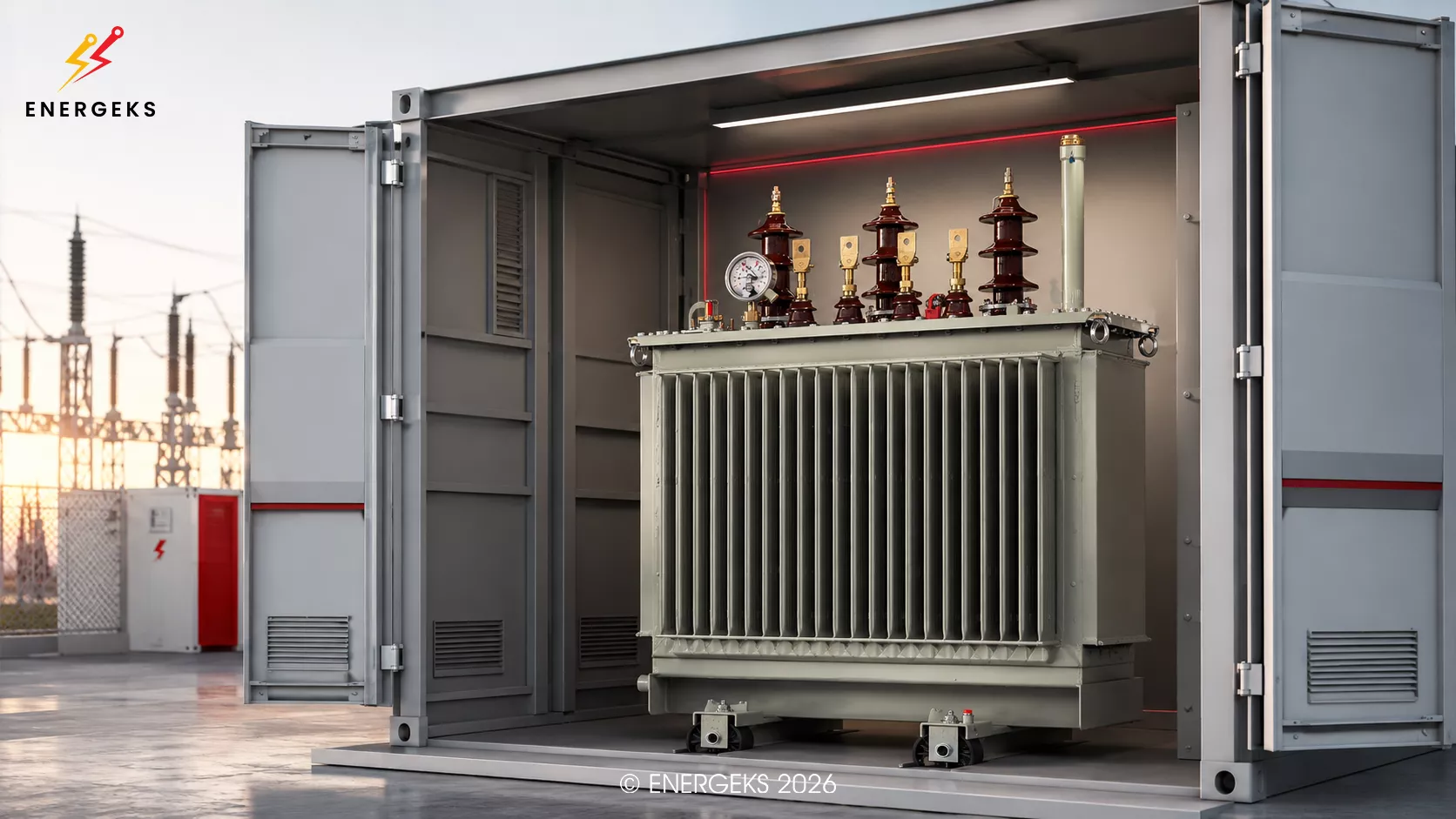
The project is ready.
The documentation is approved.
The foundation is poured. The container is almost ready for transport.
The transformer? Standard. 1250 kVA. What could go wrong?
On the day of delivery, it turns out that the transformer does not fit in the compartment.
Or it fits – on the drawing – but after installing the bushings, cables, covers and radiators, the doors cannot be closed.
Or they can be closed, but there is no way to remove it later without dismantling half the station.
And then the industry sculpture begins.
Modifying the container structure. Moving the switchgear. New busbar connections. Another transport. A call to the investor. A call to the manufacturer. A call to the person who "sent the data sheet, after all".
Costs rise, the schedule starts to resemble a fantasy story, and the transformer – a device that was supposed to simply stand and hum – suddenly becomes the main character of the investment.
And it would have been enough to ask a few proper questions earlier.
Anyone who has ever designed a prefabricated transformer substation (PSS) knows this rule: a transformer is selected not only for the installation's power. It is selected for the entire station – its structure, ventilation, protection, grid conditions and future mode of operation.
At Energeks, we work with MV/LV transformers intended, among other things, for containerised stations, industrial installations, photovoltaic farms and energy storage systems.
We know, therefore, that two transformers of the same kVA rating can have a similar nameplate but completely different dimensions, losses, termination layout, weight, noise level and operational requirements.
This guide should be read by PSS station designers, general contractors, PV and BESS system integrators, electrical engineers and industrial investors.
After reading, you will know:
how to correctly select the transformer power,
when to choose an oil‑immersed transformer and when a dry‑type one,
which dimensions to check before approving the container,
how to calculate the impact of losses on compartment ventilation,
why short‑circuit voltage affects the entire LV switchgear,
what to agree with the transformer manufacturer and the station manufacturer,
and how to avoid mistakes that most often emerge only during assembly.
Reading time: about 10 minutes.
A transformer for a containerised station is not an ordinary "off‑the‑shelf" transformer
Technically, a transformer standing in a containerised station can be a construction very similar to a standard distribution transformer.
From a design perspective, however, the situation is completely different.
A transformer operating freely outdoors has air around it, space for servicing and relatively good heat dissipation conditions. In a containerised station, it is enclosed in a metal or concrete compartment, often between the MV switchgear and the LV switchgear. Its closest neighbours also produce heat, and in summer, the station enclosure can be additionally heated by the sun.
The transformer does not know that the project looks very elegant in the CAD programme. It reacts to temperature, currents, the magnetic field and the actual amount of air flowing between the radiators.
Prefabricated transformer substations for voltages above 1 kV and up to 52 kV are covered by IEC 62271-202:2022. The standard specifies, among other things, operating conditions, rated parameters, structural requirements and test methods for complete stations. The latest edition also includes an assessment of the influence of solar radiation on the internal temperature of the enclosure and clarifies heating tests.
This is an important distinction:
compliance of the transformer itself with the IEC/EN 60076 series does not automatically mean that the entire station with that transformer will operate correctly.
The transformer and the enclosure must be treated as one thermal, electrical and mechanical system.
Paper will accept anything. The container has a slightly smaller sense of humour.
Power selection: the nameplate is only the beginning
The most common selection method looks like this:
The load is about 900 kW, so let's take a 1000 kVA transformer.
Sometimes this will be the correct decision.
Sometimes it will be a beautifully packaged problem.
Transformer power is specified in kilovolt‑amperes, i.e., kVA or MVA.
Loads, however, are very often described by active power in kilowatts. To move from one value to the other, the power factor must be taken into account:
S = P / cosφ
For a load of 900 kW and cosφ = 0.9, we get:
S = 900 / 0.9 = 1000 kVA
Theoretically, a 1000 kVA transformer fits perfectly.
The problem is that a perfectly matched transformer is sometimes perfect only in a spreadsheet.
Don't ask only: "how many kilowatts?"
Before selecting the power, you need to determine:
the maximum simultaneous power,
the load profile over the day and year,
the power factor,
the share of motors and their starting currents,
the presence of harmonics,
the possibility of plant expansion,
the ambient temperature,
the direction of energy flow,
expected overloads,
the method of reactive power compensation.
A plant may have a total installed power of 1400 kW but never draw more than 750 kW. It may also have loads of 800 kW that, for a few minutes during startup, behave as if they were trying to start a small steelworks.
That is why what counts is not only the sum of power but also the simultaneity factor and the load character.
…or maybe oversize it straight away?
Adding a reasonable margin is usually good practice. Buying a transformer twice as large "just in case" – not necessarily.
An oversized transformer:
costs more,
is larger and heavier,
may require a larger station,
generates no‑load losses whenever it is energised,
may increase the available short‑circuit current on the LV side,
may operate for most of the time far from the optimum load point.
No‑load losses occur whenever the transformer is energised, even if the loads are drawing almost nothing. Load losses, on the other hand, increase approximately with the square of the current.
So a transformer bought "with a large margin" may quietly heat the air and the investor's balance sheet for 20 years.
The current ecodesign requirements for transformers placed on the EU market result from Regulation 548/2014, amended by Regulation 2019/1783.
Tier 2 requirements have been in force since July 2021 and limit permissible losses or require a specific efficiency level.
Example: a 1250 kVA transformer
The rated current on the 400 V side is:
I = 1,250,000 / (√3 × 400) ≈ 1804 A
This single result affects:
the cross‑section and number of LV cables,
the busbar construction,
the rated current of the switchgear,
the protection apparatus,
the method of connecting the transformer,
the connection temperature,
the space needed for the terminations.
If the LV side voltage is 800 V, the current drops to about 902 A. The transformer power remains the same, but the connection geometry and switchgear requirements change radically.
Therefore, the information "1250 kVA" without specifying the voltages is about as complete as ordering a car with the description "large, preferably red".
Industrial load, photovoltaics and BESS – the same power, different work
A standard distribution transformer in an industrial plant most often supplies loads.
A transformer on a photovoltaic farm operates mainly with energy flowing from the inverters to the grid. In an energy storage system, the flow direction regularly changes: charging, discharging, reactive power regulation, partial load and fast load cycles.
This is not a cosmetic difference.
For PV and BESS installations, at least the following must be provided to the transformer manufacturer:
the power and number of inverters or PCS units,
the voltage on the inverter side,
the maximum active power,
the reactive power range,
the required cosφ,
the charging and discharging profile,
the expected harmonic content,
the possibility of long‑term operation at full power,
the frequency of load changes,
the MV grid voltage,
the distribution system operator's requirements.
The IEC 60076 series covers not only general transformer parameters but also issues related to harmonics, transport, DC currents, condition monitoring and the functional method of specifying the device.
The conclusion is simple:
a transformer for BESS or a PV farm should not be ordered solely on the basis of inverter power.
An inverter is not a resistive heater. It generates a specific current spectrum, can operate with reactive power and can cause additional losses in the windings and structural components of the transformer.
Oil‑immersed or dry‑type transformer for a containerised station?
This is one of the most frequently asked questions.
And as usual in power engineering, the most professional answer is:
it depends.
Oil‑immersed transformer
An oil‑immersed transformer, most often hermetically sealed with ONAN cooling, is a common choice for containerised transformer stations.
Its advantages include:
good cooling properties,
compact dimensions for a given power,
high resistance to periodic overloads,
proven construction,
usually favourable price‑to‑power ratio,
good suitability for outdoor station operation.
However, it requires consideration of:
the type and quantity of insulating liquid,
leak protection,
a containment basin or sealed retention compartment,
fire protection,
access to valves, indicators and protections,
the possibility of safe replacement of the unit.
An oil‑immersed transformer can be a very safe solution, but the principle of "let's put it in and the oil will somehow manage" does not apply.
Cast‑resin dry‑type transformer
A dry‑type transformer does not have a tank with insulating liquid. It is often chosen where fire safety requirements, limiting the risk of leakage or location close to people and infrastructure are important.
IEC 60076-11 covers dry‑type transformers, and its scope includes, among other things, environmental, climatic and fire classes, the influence of altitude above sea level, and the operation of the transformer in an enclosure.
Advantages of a dry‑type transformer:
no mineral oil,
no risk of insulating liquid leakage,
possibility of installation close to loads,
limited oil management requirements,
a good solution for buildings, public facilities and selected industrial installations.
But there is a catch the size of a radiator.
A dry‑type transformer is strongly dependent on proper airflow. The air must flow freely from below, pass through the windings and leave the compartment from the top. Manufacturers' installation instructions emphasise the need to ensure ventilation and maintain the air temperature within the transformer's design limits.
In a small, sun‑exposed container, a dry‑type transformer without properly calculated ventilation can quickly remind you that the word "dry" does not mean "insensitive to temperature".
What about esters?
Ester fluids may be considered where different environmental or fire properties than those of standard mineral oil are required.
They should not, however, be treated as a simple one‑to‑one replacement. The type of fluid affects, among other things, the insulation system design, cooling, seals, thermal parameters and the price of the device.
The choice should be agreed with the transformer manufacturer at the specification stage, not added in pen the day before ordering.
The infographic compares an oil‑immersed transformer, a cast‑resin dry‑type transformer and ester‑based solutions for a containerised transformer station, indicating differences in cooling, safety, ventilation, dimensions and operational requirements.
CC: ENERGEKS 2026
Dimensions: the power is right, but physics refused to cooperate
One of the most expensive mistakes when designing a prefabricated transformer station is approving its construction based on "typical transformer dimensions".
The problem is that a typical 1000 kVA transformer does not actually exist.
What exists is a specific transformer from a specific manufacturer, with a specific core, losses, radiator arrangement, equipment, cooling method, short‑circuit voltage, bushings and wheel or skid spacing. Two devices with the same power, ratio and connection group can differ in length, width or height by a dozen or so centimetres. Sometimes by several dozen.
On paper, it will still be a 1000 kVA transformer.
In the container, one will fit without any problem, while the other will make the designer start moving walls in the 3D model in the hope that steel will also prove flexible in reality.
Therefore, the length, width and height of the body are only the beginning.
You need to know the maximum outline of the device together with radiators, bushings, terminals and accessories. Also important are the height needed to remove covers, the position of the MV and LV terminals, the wheel spacing, the direction of movement, the total weight, the centre of gravity and the location of the lifting points.
Add to this the space for cable bending radii, insulation clearances and service access.
The transformer may fit in the compartment as a solid block, but after connecting the cables, it may suddenly turn out that the MV cable would have to bend at an angle previously known only from advanced yoga.
Insulation and external air clearance requirements are not an aesthetic suggestion. IEC 60076-3 describes the insulation requirements and recommended clearances between live parts, as well as between live parts and earth. Therefore, missing ten centimetres cannot be recovered by pushing the MV bushing close to a metal wall just because it looks neat in the design programme.
There is one more thing that is easy to forget: the transformer must not only stand in the station. It must first be delivered there.
Therefore, the entire path of the device, from the vehicle to the working position, must be traced. Will it fit through the door? Is the threshold not too high? Will the floor support its weight during rolling? Will there be room for rollers, a winch and manoeuvring? After the other equipment is set up, will the crane still have access to the compartment?
And what will happen in fifteen or twenty years when the transformer needs to be removed?
The station should be designed not only for the day of installation but also for the day of the first major replacement. Sometimes this means a removable wall, sometimes a removable roof, and sometimes a properly planned transport route. What matters is that the solution is created in the design, not during a failure.
A transformer that fits in the compartment with a margin of twenty millimetres does not fit perfectly.
It is simply very politely warning that someone is about to have a problem.
Transformer compartment ventilation: heat does not disappear from good intentions
Every watt of transformer losses ultimately turns into heat. It does not disappear in the documentation, it does not dissipate in the schedule, and it cannot be convinced that no space was provided for it in the design.
If the total transformer losses are, for example, 12 kW, inside the station we have a heat source equivalent to several powerful electric heaters working continuously. Add to this the losses of the LV switchgear, busbar connections and cables, and in summer also solar radiation heating the station enclosure.
As a result, the transformer may still have an electrical margin, but thermally it may already be on the edge of reason.
Ambient temperature and load profile affect the operating temperature and insulation ageing. This means that a device operating for years in a compartment that is too hot may formally not be overloaded, but its insulation will age faster than assumed.
Therefore, ventilation cannot be an add‑on written at the end of the project. It must result from the actual transformer losses and the station's operating conditions.
With natural ventilation, the principle is simple: cool air should flow in low, heat up as it passes through the compartment and leave as high as possible. A simple principle, however, does not mean a simple design.
Air, like a person after eight hours on a construction site, chooses the easiest path. If the grilles are poorly placed, it may flow straight from the inlet to the outlet, bypassing the transformer. On the drawing, everything then looks correct; air indeed circulates, but not necessarily where it is needed.
You also need to look at the active area of the openings, not only at their external dimensions. A grille with an area of one square metre does not automatically provide one square metre of free flow. Louvres, insect screens, filters and silencers can reduce the actual cross‑section so effectively that a large opening starts to act like the energy equivalent of breathing through a straw.
Flow resistance, the height difference between inlet and outlet, protection against water, wind and the expected temperature difference all matter. The more restrictive elements there are, the larger the opening may be needed.
If natural ventilation is insufficient, forced ventilation must be used. Then, the choice of fan alone does not end the matter.
The required performance, switch‑on temperature, control method and behaviour of the system after a power failure must be determined. It must also be decided what happens if the fan fails. Will an alarm appear? Will a second fan take over? Is the transformer temperature being sent to the station automation or the supervisory system?
A fan should not be the only thing separating the transformer from overheating if no one knows whether it is still spinning.
Well‑designed ventilation is not spectacular. It does not make noise around itself, it does not require phone calls, and usually no one thinks about it.
In other words, it works exactly as it should.
Short‑circuit voltage uk%: a small percentage, big consequences
Short‑circuit voltage is one of those parameters that look innocent until you start calculating short‑circuit currents and selecting the LV switchgear.
For a 1250 kVA transformer with a secondary voltage of 400 V, the rated current is about 1804 A. If the short‑circuit voltage is 6%, the approximate short‑circuit current at the transformer terminals can be estimated using the formula:
Ik ≈ In × 100 / uk
Substituting gives approximately:
Ik ≈ 1804 A × 100 / 6 ≈ 30 kA
This calculation is simplified because it does not take into account the full impedance of the supply grid, cables, busbars and connections. It does, however, show the scale of the problem.
If the short‑circuit voltage is lower, the short‑circuit current will increase. The switchgear, busbars and apparatus will have to withstand greater thermal and dynamic loads. If uk% is higher, the short‑circuit current will decrease, but voltage drops under load will increase, which may, for example, make it more difficult to start large motors.
This one parameter therefore simultaneously affects the selection of the switchgear, circuit breakers, protections, selectivity, voltage drops and the possibility of parallel operation of transformers.
You should not copy the short‑circuit voltage from an old design just because the old design worked.
The fact that the previous installation has not yet caught fire is not a calculation method.
Connection group: a few letters that can stop the whole system
Designations such as Dyn5 or Dyn11 may look like a code written by someone who really did not want to use full sentences. In reality, they convey important information about the winding connection method, the neutral point termination and the phase shift between the MV and LV sides.
The connection group affects the neutral earthing method, the operation of earth‑fault protections, the zero‑sequence current flow and the transformer's compatibility with the existing installation. It is also important when working with inverters, generators and other transformers.
Particular care must be taken with parallel operation. Two transformers with the same power and the same voltages cannot necessarily work together.
They must have compatible connection groups, ratios and phase sequences. The tap positions, short‑circuit voltage values and impedance characteristics are also important. If these parameters differ, circulating currents may appear between the transformers, and the load will not be shared as assumed.
Transformers do not learn to cooperate on an integration trip.
They must understand each other from the nameplate.
Ratio and taps: the grid does not always have as many kilovolts as it promised
The notation 15/0.4 kV looks specific, but it still does not say everything.
You need to know the actual grid voltage conditions, the required insulation level, the highest voltage for equipment Um, the tap range, the number of steps and the value of each step. Also important is at which tap position the nominal ratio is given and what voltage is expected on the LV side during normal load.
In typical distribution transformers, the most common solution is an off‑circuit tap changer. This means that changing the ratio requires the transformer to be de‑energised and disconnected.
It is therefore not a regulator that will automatically correct the voltage in every situation.
If the MV voltage rises during periods of high photovoltaic generation, a poorly chosen ratio can lead to excessively high LV voltage. In a weak grid and under heavy load, the problem can be the opposite – the voltage starts to drop.
Taps allow the ratio to be adjusted to grid conditions, but they will not fix a poorly designed system.
They are not a magic knob labelled "it will be fine".
MV and LV terminations: cables also need space
The transformer does not end with the tank and radiators. It must still be connected to the MV and LV switchgear, and the way these connections are made can completely change the compartment layout.
On the MV side, various solutions can be used, including porcelain or plug‑in bushings, with top or side terminations. On the LV side, flat terminals, cables or busbar connections may appear. Each of these solutions requires a different amount of space and different installation access.
Particularly on the LV side, a few centimetres make a huge difference. For a 1250 kVA transformer, the rated current on the 400 V side exceeds 1800 A. For larger units, we are already talking about several thousand amperes.
In such a system, shifting the terminals can force a complete redesign of the busbar bridge.
Therefore, before approving the station structure, you need to know the MV and LV connection side, phase sequence, terminal height and spacing, and the type of terminations. The number of cables per phase, their bending radii, mounting method and the space required for making connections must also be considered.
Busbar connections additionally require consideration of electrodynamic forces, thermal expansion and vibration compensation.
Heavy cables cannot hang on the transformer bushings like a shopping bag on a door handle. They must have their own support and mechanical strain relief to prevent forces from being transferred to the terminals.
It is also worth leaving enough space for a person to use a torque wrench without dismantling half the station and their own wrist.
How to match the clamps to the transformer rating and cable size is covered in how to choose a transformer clamp, and how to install them so they do not overheat in why transformer clamps overheat.
Earthing: "we'll connect it somehow" is not a diagram
The earthing of the transformer and the entire station must be clearly planned.
You need to determine the earthing method for the LV neutral point, the connection of the transformer tank or structure to the main earthing busbar, the earthing of cable screens, and the execution of equipotential bonding. If the transformer construction requires a separate core earthing termination, it must also be included in the design.
This is not an assembly detail.
The earthing method affects the operation of protections, the values of earth‑fault currents and the behaviour of the entire system under fault conditions. Particular attention must be paid to installations with inverters, EMC filters, non‑linear loads, UPS units and backup sources.
It must also be determined whether the LV neutral point will be brought out and what its current rating should be. In installations with a large number of non‑linear loads, significant third‑harmonic currents and their multiples can appear in the neutral conductor.
In such a situation, the neutral is not an add‑on to the three phases.
And it certainly is not "that fourth busbar we will add later".
Noise and vibrations: the transformer is not loud until it stands next to a bedroom
Every transformer makes a sound. It arises primarily from phenomena occurring in the core and electromagnetic forces acting on the windings.
In an open space, it may be barely noticeable. Once the device is enclosed in a container, the situation can, however, change.
The station enclosure may attenuate some of the sound, but it may also reflect waves, amplify certain frequencies and act like a resonance box. Vibrations can pass through the floor to the foundation and then to adjacent structural elements.
Therefore, for locations near houses, offices, hospitals or other noise‑sensitive facilities, it is not enough to state that the transformer "is quiet".
You need to know the guaranteed sound power level, assess the foundation design, the method of supporting the device, and the influence of fans and louvres. It is also worth analysing the connections between the transformer and the switchgear.
Anti‑vibration pads will do little good if the transformer is connected to the station structure by a rigid busbar bridge that will transmit vibrations further like a professional courier.
Noise should therefore be analysed as a characteristic of the entire station, not only of the transformer. The device itself may meet the requirements, but the container, foundation and ventilation will decide what a person standing on the other side of the fence ultimately hears.
Also read:
How not to burn a million? Principles of building a transformer station for heavy industry
What to provide when enquiring about a transformer for a containerised station
A good request for quotation does not need to have 40 pages, five attachments and an eagle stamp.
It should, however, contain enough information that the transformer manufacturer does not have to guess whether the device is to supply a production hall, a PV farm, an energy storage system or perhaps a small power plant hidden under the name "office building".
The more key data you provide at the beginning, the fewer phone calls, clarifications and magic phrases like "it depends" there will be.
And most importantly – the greater the chance that the offer you receive will be for a transformer you actually need, not for one that happened to be easiest to quote.
⚡ First, the electrical side, because the transformer does live on voltage
To start with, you need to state how much power you need. The value in kVA or MVA is the foundation of the entire enquiry. Without it, the conversation resembles a visit to a restaurant and asking: "how much does the food cost?"
Power alone is not enough, however. The MV and LV voltages, frequency and expected connection group are needed. These parameters determine which grid the transformer will work with and whether, after connection, everything will play according to the design or whether experimental installation jazz will be created.
The short‑circuit voltage should also be provided. This small percentage has a very large impact on short‑circuit currents, protection selection, voltage drops and cooperation with the switchgear. uk% should not be copied from the last project just because "it was also 6% there and it worked".
Another issue is the tap range and the number of available steps. The grid does not always behave exactly as on the single‑line diagram, so it is good to know whether the transformer should allow ratio correction and in what range.
Add to this the insulation level, required no‑load and load loss values, and noise expectations. The last parameter often appears only when the transformer starts working five metres from an office, a house or a gatehouse, and someone discovers that the "gentle hum" has its own acoustic life.
⚡ Next, tell us what this transformer will actually be doing
Two transformers with the same power can have completely different working lives.
One quietly supplies lighting, ventilation and a few production lines for most of the year. Another handles heavy motors, inverters, welders or the PCS of an energy storage system that constantly changes the direction of power flow. They may look similar on the nameplate, but their daily life is completely different.
Therefore, the type of load and the maximum active power must be described. It is worth providing the power factor cosφ or the reactive power range, especially when inverters, compensation or power electronics are present in the installation.
The operating profile is very important. A transformer handles continuous 24‑hour load differently, short peaks differently, and regular overloads differently again. It is therefore good to indicate whether it operates for 24 hours, only on one shift, seasonally, or perhaps in summer it gets more work precisely when the temperature in the container starts to resemble the inside of an oven.
If motors are present in the system, the starting currents should be given. If there are inverters, rectifiers, UPS units or chargers, harmonics should be mentioned. You do not need to immediately send a doctoral thesis on power quality, but information about the load character can prevent the selection of a transformer for conditions it will never actually see.
It is also worth specifying the direction of energy flow. In a classic plant, energy flows from the grid to the loads. In PV and BESS installations, the situation can reverse, sometimes several times a day. If parallel operation with a second transformer, generator or other source is planned, this should also be stated straight away. The transformer does not like integration surprises.
⚡ The container stands in the real world, not in a neutral CAD environment
Environmental conditions are often treated as an add‑on to the specification. This is a mistake, because the transformer does not work in a catalogue; it works in a specific location.
It must be stated whether the device will be installed indoors or outdoors. In the case of a containerised station, "outdoors" does not yet mean that the transformer has comfortable access to fresh air. It can still be enclosed in a metal compartment that collects sun like a solar frying pan for several hours a day.
The minimum and maximum ambient temperatures, altitude above sea level, humidity and dust level should be provided. Altitude matters for cooling and insulation, humidity for the risk of condensation, and dust for ventilation and cleanliness of insulating surfaces.
If corrosive substances, salt atmosphere, chemicals or aggressive industrial dusts are present in the surroundings, the manufacturer must know about it. A station at a chemical plant, wastewater treatment plant, cement works and a quiet logistics centre do not operate in the same conditions, even if all the projects have equally aesthetic covers.
It is worth specifying the requirements regarding condensation and the station's exposure to solar radiation. A container placed in the shade between buildings and a container standing alone on an open plot in full sun are two different microclimates. The transformer will notice the difference faster than the user.
⚡ Then comes the mechanics – the moment when centimetres regain power
A transformer can have ideal electrical parameters and still be unsuitable for a specific station because it is too wide, too tall, too heavy or has terminations on the wrong side.
Therefore, the maximum permissible dimensions and weight of the device should be provided in the enquiry. And it is not only about the dimensions of the tank or windings themselves. The radiators, bushings, accessories, boxes, valves, brackets and everything that in the real world protrudes beyond the elegant rectangle from the drawing must be taken into account.
The direction of the MV and LV terminations should also be clearly specified. This helps to avoid a situation where the switchgear is waiting on the left, the transformer has terminals on the right, and someone is trying to create a connection arrangement between them that resembles an art installation.
The type of connections must be matched to the method of connection to the switchgear. Different solutions are used for cables, different for busbar bridges, and different again for plug‑in bushings. It is worth providing the requirements regarding phase sequence, terminal spacing and connection height.
If the transformer has wheels or skids, their spacing and direction of movement should be specified. This is important for the guides, the station floor and the method of introducing the device into the compartment.
Transport also needs to be described. Will the transformer be slid through the door, lowered through the roof, introduced on rollers, or will the entire station be assembled around it? The door dimensions, floor load‑bearing capacity, crane access and manoeuvring space are not logistical details. They are part of the design.
At this stage, it is also worth specifying the additional equipment: temperature indicators, sensors, protections, alarm contacts, monitoring, valves, relays, fans, enclosures, bushings or other elements required by the investor and the station automation.
⚡ Finally, documentation – everything that everyone suddenly needs "for yesterday"
A good enquiry should specify what documentation you expect and when it is to be delivered.
The basis is the dimension drawing. It allows the station manufacturer to check whether the transformer really fits in the compartment, whether it has adequate space for connections and whether it can be safely installed.
A data sheet and a loss summary will also be needed. Losses are important not only for assessing efficiency but also for ventilation calculations and the thermal balance of the compartment.
Depending on the project stage and the investor's requirements, test reports, a nameplate template, transport, installation and commissioning instructions, and the relevant declarations of conformity may also be required.
It is also worth asking for a full equipment list. Nothing improves the atmosphere on site like discovering that an element considered by one side to be an "obvious standard" was treated by the other as a paid option that no one ordered.
It is also very good to establish a documentation approval schedule. First the data sheet and drawing for approval, then production, then the final documentation. This order seems logical, but in the industry, there are still projects where the drawing for approval reaches the client when the transformer is already slowly drying after painting.
⚡ One good enquiry saves ten nervous phone calls
You do not need to know all the parameters from day one. If some data is still being agreed, simply note it in the enquiry. What matters is that the manufacturer knows which values are approved, which are indicative and which may still change.
The worst enquiry reads:
"Please quote a standard 1000 kVA transformer for a container."
The best does not have to be long, but should clearly describe the device, operating conditions, mechanical limitations and the expected scope of documentation.
Because the transformer manufacturer can advise, optimise and propose the right solution. They should not, however, be forced to telepathically reconstruct the project based on one number and an attachment named "final_v7_ultimate_corrected.pdf".
How to select an MV transformer for a containerised transformer station? The shortest answer
Do not start with the question: how much does the transformer cost?
First, check where it will operate, what it will supply, how it will be loaded, and whether it will actually fit in the station – together with connections, ventilation and service space.
A good transformer must fit the project electrically, mechanically and thermally. Ideally, so that after commissioning, no one has to save the investment with phone calls, modifications and industry survival.
We thank the designers, contractors, integrators and investors who invite us to talk early enough. That is when we can jointly select a solution that will operate calmly and reliably for years.
⚡ At Energeks, we help select oil‑immersed and dry‑type transformers for prefabricated transformer stations, industrial plants, photovoltaic installations and energy storage systems. We analyse not only the rated power but also the grid conditions, connection system, short‑circuit voltage, losses, dimensions, cooling and the actual operating profile.
We do not look for the largest transformer or the cheapest solution at all costs. We look for a configuration that, after commissioning, will simply do its job – calmly, efficiently and without nervous phone calls.
Explore the Energeks transformer range
Are you working on a project where delivery time is critical?
Check the transformers available off‑the‑shelf from our warehouse
And if you want to follow our projects, technical guides and industry stories without corporate frosting – join Energeks on LinkedIn.
Let's talk about your project as partners. Before the transformer goes into the container, not when it turns out that the container has its own opinion on the matter.
references:
International Electrotechnical Commission, IEC 62271-202:2022 — AC prefabricated substations for rated voltages above 1 kV and up to 52 kV.
International Electrotechnical Commission, IEC 60076 series — Power transformers.
European Commission, Power Transformers — Ecodesign requirements and Tier 2 efficiency provisions.
Transformers in stock
Shipped from our warehouse in Poland within 2–3 working days, 5-year warranty. Full range 25–2500 kVA in the shop (prices in PLN).

There is a moment like that.
The transformer is already on its foundation, the oil is filled, everything looks solid, and someone half-jokingly says, "Well, that's one thing off our plate."
The unit is in place, voltage is present, the network is operational. At first glance, the matter is closed.
Except an oil transformer doesn't know the concept of "off our plate."
It is only just beginning its work.
And it remembers very well how it was installed, the conditions it operates in, how it was treated in the first months of service, and whether anyone even glanced at its documentation after commissioning.
When writing about the installation and maintenance requirements of oil transformers, we are not revisiting theory for theory's sake.
We are revisiting experiences from project implementations, whose origins almost always lie much earlier than it seems. Often in decisions that, at the moment of installation, seemed minor, obvious, or "done this way for years."
This article is for designers, contractors, investors, and maintenance personnel who want to have calmer heating seasons and fewer phone calls that start with the words, "something's up with the transformer."
To start, we'll talk about why installing a transformer is more than just correctly placing it on a foundation.
Next, we'll look at daily operation and what the transformer "tells" us through its behavior long before a failure occurs.
Finally, we'll return to maintenance, understood not as a checklist of tests, but as a way of thinking about a device that is meant to operate stably for decades.
reading time ~10 min
Installation of an oil transformer, or the moment you create your future or problems in installments
Installing an oil transformer is not just a "logistical operation."
It is not just unloading, placing, and signing a handover protocol. It is the moment when this device gets its character. Like a person at the start of their career. You either set them up for success, or later you'll be hauling them to workshops. Except this involves costly, time-consuming hassle.
A transformer pays you back for everything in failures.
A shoddily made foundation is a classic.
Concrete, sure. Rebar, sure. There was a design, sure.
The level was checked once because they were in a hurry. "It's almost level."
And here, the first red light goes on. An oil transformer is patient, but it's not naive. It remembers every millimeter of tilt, every makeshift solution, and every solemn "we'll fix it later." "Later" usually never comes.
At first, everything looks proper. Oil is filled, the tank stands, cooling works.
Except with even a slight tilt, the oil inside starts working differently than the manufacturer intended. Cooling becomes uneven, windings experience conditions no one predicted, and the transformer begins to age faster than it needs to. This isn't visible immediately. It shows up over time. Always over time.
Ventilation is another topic that often loses to reality.
An oil transformer doesn't like standing in a stuffy corner, even if it looks like a chunk of solid iron. A too-tight enclosure of a prefabricated transformer substation, a lack of sensible airflow, poorly chosen clearances. A classic. The first season is quiet. The second one too.
And then questions start about why temperatures don't match the theory.
If anyone wants to see how much operating conditions can change the rules of the game, it's worth revisiting the topic of transformer substations operating in heavy industrial conditions:
Otoczenie, montaż i projekt to jeden organizm, a nie trzy osobne tematy:
How not to burn a million? Principles for building a transformer substation for heavy industry
The environment, installation, and design are one organism, not three separate topics.
Grounding is a separate story
"It's connected, the resistance tested out, the protocol is done."
Everyone has heard that.
Except that grounding doesn't exist for paper. It's there to protect the transformer, the installation, and people. A poorly executed one will take its revenge during the first disturbances, overvoltages, or lightning strikes. And again, not always immediately. Most often, when nobody has time for it.
Installation is not a cost. It is an investment. An investment in whether you'll sleep soundly in five years or be nervously sifting through documentation wondering who signed off on the foundation back then.
Operation of an oil transformer, or: it's talking all the time, you just have to stop pretending not to hear it
An oil transformer in operation is not a "grey box."
It is not a device that either works or it doesn't. It talks non-stop.
Just not via email or alarms, until it absolutely has to. It talks through sound, temperature, smell, and behavior. The problem is that many people consider this background noise.
At first, everything is by the book.
It runs, voltages match, load is normal. And then the most dangerous phrase in power engineering appears: "It works, don't touch it." Hearing that phrase, an oil transformer starts planning its revenge, only spread out over time.
The first signal is often sound.
A soft hum is normal, everyone knows that. But a change in the sound's character is not normal. A deeper tone, a metallic resonance, irregularity. This isn't "the charm of an old network." It is information. Ignored information.
Then come the temperatures. Someone glances at the readings and waves it off.
"Summer, it's warm, higher load." Sure, it happens.
But if the transformer regularly runs warmer than before, it's not a whim of the weather. It's a signal that something in the operating conditions has changed. Cooling, oil, ventilation, surroundings. Something is off.
The smell of oil near the transformer is something many people only notice when it's already really strong.
A pity. Transformer oil can tell you a lot much earlier. A change in smell, color, clarity. These are trivialities only for someone who doesn't want to see them. For the transformer, it's a full-fledged language of communication.
Oil leaks are one of those signals that everyone sees, but many pretend it's "nothing serious." A drop here, slight dampness near a gasket, a trace on the oil sump.
At this moment, the oil transformer isn't screaming. It's just raising its hand and calmly saying that something is no longer sealed. Ignoring such small things is a straight path to accelerated insulation aging, cooling problems, and costs that always appear at the least opportune moment.
That's why if someone wants to understand why oil leaks are not a cosmetic issue but a real warning signal, it's worth checking out the separate article dedicated to this topic:
Oil leaks in transformers – do not ignore these signals
There you can see in black and white that oil doesn't escape without reason, and every leak is information about the state of the transformer, not just the state of a gasket.
Operation is also about loading.
An oil transformer can handle overloads because it was designed for that.
But it handles them short-term. Permanently operating at the power limit is not proof that "we managed with a reserve." It is a very consistent and very predictable way of shortening the device's life.
An oil transformer doesn't spring surprises. It is predictable to a fault.
You just have to want to listen, not assume that if the light is green, the issue doesn't exist.
Maintenance of an oil transformer, or why revisiting the beginning saves the future
Maintenance has terrible PR.
It's associated with paperwork, costs, and an obligation that can always be pushed to later. Preferably to the next quarter. Or the next year.
Meanwhile, for an oil transformer, maintenance is the purest form of ensuring longevity. Without it, even the best-designed device starts showing signs of fatigue sooner.
And here it's worth going back to basics for a moment.
To the moment when the transformer was installed and commissioned. Because very often, what we call an operational problem today is not a new failure or some malicious fault of the equipment. It is a consequence of how the installation was done at the start.
An oil transformer doesn't change the rules mid-game. It simply delivers on what it was given at the beginning.
If something was rushed during installation, if something was done by eye, if the handover was quick because the deadline was looming, then maintenance will show it sooner or later. Temperature changes, unusual sounds, faster oil aging, cooling problems. These aren't new phenomena.
They are the effects of earlier decisions, just stretched over time.
Oil testing is the best example here.
It's not a manufacturer's whim or a standard's invention. It is the simplest and cheapest way to look inside a transformer without taking it apart. Physicochemical parameters, dissolved gas content, oil moisture level say more than many a visual inspection.
And yet, in practice, tests are done irregularly or only "for handover," as if the oil stopped working after the protocol was signed.
Seals, accessories, electrical connections, and grounding also age.
A transformer doesn't stand in a sterile lab. It operates under variable temperature, humidity, vibration, and pollution. Every season adds its share. A lack of regular inspection means small problems have time to grow. And then everyone is surprised that something that seemed cosmetic suddenly becomes an emergency issue.
That's why returning to the installation stage when operational and maintenance questions arise is one of the best things you can do.
Checking whether the foundation truly met the assumptions, whether ventilation works as intended, whether grounding was executed according to the craft, not just according to the protocol. This often explains more than hours of analyzing current parameters.
The specific stages that have a real impact on how the transformer behaves later in daily operation, and why some units work quietly for years while others start acting up much sooner, are described here:
Power transformer installation – a comprehensive checklist
The most important thing is the approach
Maintenance is not a checklist to tick off or an obligation imposed by standards.
It is a way of thinking about a transformer as a device that should operate stably for twenty, thirty years. Every test, every note, and every review shorten the list of surprises.
An oil transformer does not spring surprises.
It is predictable to a fault. If something starts happening, it is very rarely a coincidence. Usually, it's a response to the conditions it has been given. Except the response comes with a delay, at a time when everyone is already convinced the matter was closed long ago.
If you want smooth operation, you need to honestly look at the beginning and regularly check in along the way.
An oil transformer doesn't require flattery or gifts. It requires attention.
And attention pays back with interest, most often when others are busy putting out fires.
Don't stop at the start
An oil transformer is not a matter to "tick off." It is a piece of infrastructure that either works quietly for years or regularly reminds you of itself at the least opportune moments.
Transformer installation, operation, and maintenance are not three separate worlds.
It's one story, written from the day the transformer was placed on its foundation. Every decision at the beginning works in the background later. Either for you or against you. An oil transformer doesn't create drama. It simply adds up the facts.
That's why if you're planning an investment, a modernization, or simply want peace of mind in operation, it's worth looking broader than just the moment of purchase.
At Energeks, we have been working with oil transformers in real grid, industrial, and infrastructure conditions for years. Our offering includes both oil-filled and dry-type (resin-insulated) units, selected for specific operating conditions.
Everything is in the EcoDesign Tier 2 class, with full documentation and certificates:
You can find the current transformer offering here.
Thank you for taking the time to read this text.
If even one thought stayed with you, it means it was worth it. And if you want to stay updated, I invite you to Energeks on LinkedIn.
Transformers in stock
Shipped from our warehouse in Poland within 2–3 working days, 5-year warranty. Full range 25–2500 kVA in the shop (prices in PLN).

2025. The year theory stopped being enough
The year 2025 did not bring a single, great technological breakthrough.
No miracle material appeared. Physics didn't change. No new law of electrical engineering was discovered.
Instead, something much less spectacular but far more painful happened.
Reality started to test assumptions.
Those that had worked "well enough" for years suddenly stopped holding up.
Projects copied from previous years began to fall apart during the execution phase. Budgets that were supposed to balance on paper started to leak in areas previously considered safe. Schedules based on standard solutions had to be corrected mid-game.
And it quickly became apparent that the transformer was no longer just part of the background.
In 2025, the transformer became a topic of conversation on construction sites, in design offices, and at investors' tables. It appeared in questions about energy losses, compliance with Ecodesign Tier 2, real operating costs, dimensions, logistics, and acceptance procedures. Increasingly, not as an isolated problem, but as an element that could decide the success of an entire project.
This was the year theory was invited onto the construction site. And it didn't always come out unscathed.
This text is not a product summary. It is a summary of experiences.
It is an attempt to gather conclusions from a year that very effectively separated convenient assumptions from true ones. It is written with designers, contractors, and investors in mind who don't want to enter 2026 relying on memory or shortcuts. Only with greater peace of mind and better insight.
Because if 2025 taught the energy industry anything, it's that not everything that worked yesterday works just as well tomorrow.
We didn't ask which transformer is the best. We asked which one stopped being a problem.
We are not creating a ranking. We are not selling promises. We are looking at the tensions that emerged in 2025 between regulations, physics, and budgets. We examine where theory diverged from practice and what decisions began to win out in real projects.
This is a story about losses that suddenly started to matter.
About power that stopped being just a number in a table. About documentation that could either save or stall an investment. And about why, in 2026, the question is no longer "what is the most powerful," but "what provides predictability."
Reading time: ~11 minutes
Ecodesign Tier 2 Stopped Being Theory. It Became a Reality Filter
Just a few years ago, Ecodesign Tier 2 was mainly a future concept in the industry.
Something that would "come into effect," "be mandatory," "need to be considered." In 2025, this mindset stopped working.
Tier 2 ceased to be a clause in a directive. It became a very practical filter through which real projects either started to pass or began to fail.
On paper, everything looked simple.
Lower no-load losses, better efficiency, compliance with the regulation. In practice, 2025 showed that not every transformer that "almost meets" the requirements actually meets them in the context of a specific installation. Differences of a few watts in no-load losses, previously ignored, started to matter. Not because everyone suddenly fell in love with efficiency.
But because energy stopped being cheap background noise and became a real cost.
In many projects, Tier 2 exposed old design habits.
Selecting a transformer "by eye," based on previous projects, stopped being safe. Solutions that had passed acceptance for years without major questions began to raise doubts in 2025. Additional queries, clarifications, and corrections appeared. Sometimes at the design stage, sometimes during execution, which always hurts more.
The problem wasn't the regulation itself.
It was that Tier 2 forced a confrontation with the transformer's actual operating profile. No-load losses, previously treated as a "fixed and negligible" cost, began to be analyzed on a yearly scale, not just at the moment of acceptance. In installations where transformers operate at low load most of the time, it suddenly turned out that these very losses determined the economics of the solution.
2025 also showed that not every project is equally ready for Tier 2.
In new installations, it was easier to incorporate the requirements from the start. In modernizations and expansions, the situation was often more complicated. Space constraints, existing infrastructure, and previous design assumptions could clash with the new requirements in a very unpleasant way.
Added to this was the issue of availability.
Last year, the market felt very clearly that a Tier 2-compliant transformer is not always an "off-the-shelf" item. Lead times, logistics, and delivery planning began to have a real impact on investment schedules. Projects that didn't account for this in advance often had to make up for lost time in other areas or postpone deadlines.
Another interesting phenomenon was how the narrative around Tier 2 changed.
The question "do we have to?" disappeared, and the question "how to do it sensibly?" appeared. Conversations increasingly focused not just on meeting the standard, but on the consequences of choosing a specific solution.
How will it affect losses in the long term? What about servicing? And future load changes?
In this sense, Ecodesign Tier 2 did the industry a favor. It didn't simplify life.
But it forced thinking in holistic, not just formal, terms. And it quickly became clear that in 2026, Tier 2 will no longer be a topic for discussion. It will be the starting point.
We wrote about no-load losses in Tier 2 and their translation into specific financial figures here—it's worth familiarizing yourself with this knowledge:
No-load losses in Tier 2 transformers. How to calculate the real cost?
Nameplate Rating Versus Real-World Usage
If one assumption was tested with particular harshness in 2025, it was the belief that a transformer's nameplate rating tells you everything about it.
For years, it was treated as a safe anchor. There's the number. There's the margin. There's peace of mind. The problem is that reality very rarely operates according to the same chart.
In 2025, many projects painfully collided with the fact that a transformer doesn't operate in a vacuum. It operates over time. In daily cycles. With seasonal patterns. In an environment of loads that changed their character faster than most design assumptions.
The classic mistake looked innocent. "Let's take a larger transformer, it will be safer."
Or the opposite. "The load profile looks light, we can reduce the power." On paper, it all added up. In the spreadsheet too. On the construction site and in operation, problems began.
Oversizing in 2025 ceased to be neutral.
A transformer operating most of the time at a very low load generates no-load losses regardless of whether it's delivering power or not. With rising energy costs, this became noticeable not after a year, but after a few months. Investors, who not long ago would have waved it off, began asking questions. Where do these numbers come from? Why don't the bills look as projected?
On the other hand, problems with undersizing emerged.
Especially where the load profile was based on historical data that didn't account for changes on the consumer side. Heat pumps, electric vehicle chargers, inverters, irregular operating cycles. All this meant that momentary overloads, starting currents, and short-term power peaks began occurring more frequently than anticipated.
In 2025, many people truly saw, for the first time, the difference between the nameplate rating and the transformer's actual behavior over time. A transformer can have a power reserve, yet operate under conditions that cause excessive heating.
It can formally meet requirements, yet practically shorten its lifespan. It can "manage," but at the cost of losses and operational stress.
A common source of the problem was a simplified approach to the load profile.
The average power over a day or month says little about what happens at specific moments.
And it is precisely these moments that determine how the transformer behaves. Short but intense loads can do more damage than stable operation at a higher level.
The year 2025 also showed that the conversation about a transformer's power cannot end with the number in its name. Increasingly, questions about the nature of the loads, their variability over time, and plans for installation development came to the fore. Designers began returning to investors more often with questions previously deemed unnecessary.
What will the load look like in two years?
What will change after expansion?
Which scenarios are realistic, and which are only theoretical?
All of this meant that in 2025, selecting a transformer's power rating stopped being a "just-in-case" decision. It became a strategic decision. One that must consider not only what is today, but what is very likely tomorrow.
And that is precisely why, heading into 2026, fewer and fewer people ask which transformer has the highest power rating. More and more ask which one best fits the actual way it will be used.
And that is a change that makes a huge difference.
Energy losses stopped being abstract. They started to cost, truly
For many years, transformer losses were one of those topics everyone was aware of, but few truly calculated. Sure, they appeared in documentation. Sure, they were listed in catalog sheets. But in practice, they were treated as a background cost. Something that "just exists" and doesn't require deeper attention.
The year 2025 ended this comfortable stage.
At the moment when energy prices stopped being a stable reference point and began to fluctuate in reality, transformer no-load losses stepped out of the shadows.
And they did so in a very unpleasant way. It suddenly turned out that differences which previously seemed cosmetic began to be noticeable in the operational budget over the course of a year.
The biggest surprise for many investors wasn't the load losses. Those are intuitively associated with the device's work. The real discovery turned out to be the no-load losses. Constant. Independent of the load. Present always, even when the transformer is mostly just "waiting."
In installations with uneven or seasonal operating profiles, it was precisely these losses that began to play the leading role. A transformer that was formally well-matched spent a large part of the year operating far from its optimal point. And energy was leaking away. Day after day. Without noise. Without alarms. Without visible symptoms, except for one thing that cannot be ignored: the bill.
2025 was also the moment when more and more projects began to be analyzed in terms of Total Cost of Ownership (TCO), not just the purchase price. TCO stopped being a trendy acronym. It became a defensive tool. Investors began asking not what a given transformer would cost at the moment of acceptance, but after five, ten, fifteen years of operation.
This changed the dynamic of conversations.
Cheaper solutions began to lose in the long-term horizon. A difference of a few percent in efficiency, previously considered a detail, in the new calculations could determine the profitability of the entire investment. And interestingly, these conversations increasingly took place not at the tender stage, but after the first year of operation, when the data stopped being theoretical.
It's worth noting that 2025 coincided with a clear increase in energy awareness on the part of regulators and international institutions as well. Reports on energy efficiency increasingly pointed out that losses in transmission and distribution infrastructure are not a marginal problem, but one of the real areas for optimization.
In practice, this meant one thing. The transformer stopped being a one-time cost. It became an element that generates a constant stream of costs or savings. Depending on how it was chosen. And how it really operates.
This also changed the way designers and investors talk to each other. More questions appeared about long-term scenarios. About load changes. About installation flexibility. About whether the solution chosen today won't become a burden in a few years.
Heading into 2026, it's increasingly difficult to ignore the topic of energy losses. Not because someone requires it. But because the numbers have started to speak for themselves.
And with such data, as we know, you can't win with narrative alone.
What the IEA's "Energy Efficiency 2025" Report Really Says and Why It Matters for Transformers
The International Energy Agency's Energy Efficiency 2025 report clearly shows that energy efficiency has ceased to be an add-on to the energy transition. It has become its foundation. Significantly, the IEA is not talking about futuristic technologies here, but about devices already operating in power grids today.
According to the IEA, the pace of global energy efficiency improvement is still too slow to meet climate goals while maintaining the stability of energy systems. The agency points out that the global rate of efficiency improvement should be around 4 percent annually, while in recent years it has realistically hovered closer to 2 percent. This difference translates directly into greater energy losses, higher operational costs, and increased strain on infrastructure.
The report strongly emphasizes the topic of power infrastructure. The IEA stresses that reducing losses in energy transmission and distribution is one of the quickest and most cost-effective ways to improve the efficiency of entire energy systems. It does not require a technological revolution, but the consistent application of proven, more efficient solutions in equipment like transformers.
Particular attention is paid to no-load losses and load losses in devices operating continuously. The IEA indicates that even small differences in the efficiency of individual infrastructure elements, on a systemic and multi-year scale, translate into very tangible economic effects. This refers to savings counted not in percentages, but in real energy costs and reduced demand for its generation.
The report also notes the changing nature of loads in grids. The growing share of renewable sources, energy storage systems, electric vehicles, and the electrification of heating is causing greater variability in energy flows. In such an environment, devices with lower losses and better partial-load efficiency gain importance, as they operate efficiently not only at nominal points but also under loads far from maximum.
The IEA also emphasizes the cost aspect. Investments in energy efficiency are among the fastest-returning actions in the energy sector. Reducing losses in power equipment decreases the demand for primary energy, lowers operational costs, and reduces pressure to expand generation capacity. This is particularly important under the conditions of unstable energy prices that the market has faced in recent years.
In practical terms, the IEA report sends a very clear signal: the efficiency of infrastructure equipment is no longer an image-related or regulatory choice, but a systemic decision. How transformers are designed and selected directly impacts not only the balance of a single installation but the resilience and costs of entire power grids.
For the industry, this means one thing. In the coming years, it will be increasingly difficult to justify choosing solutions with higher losses based solely on a lower purchase price.
Energy Efficiency as Industry's Key Response to Rising Energy Costs | Source: International Energy Agency, Industrial Competitiveness Survey 2025.
An infographic based on a 2025 International Energy Agency survey shows how industrial enterprises are responding to rising energy costs and price volatility. The survey results from 1,000 respondents across 14 countries clearly indicate that energy efficiency is today the most important strategic priority, surpassing on-site renewable energy investments, passing costs to customers, or reducing production.
The second part confirms that energy efficiency actions genuinely increase companies' resilience to energy price fluctuations. Over 80% of respondents rate their impact as critical, strong, or moderate, with only 7% noticing no effect. This data shows that modernizing power infrastructure, reducing losses, and better energy management directly translate into the stability of operational costs and the continuity of plant operations.
The conclusions from the IEA study clearly indicate that in 2025, energy efficiency ceased to be an environmental add-on and became one of the key tools for building industrial competitiveness and resilience to energy crises.
Dimensions, Logistics, and Installation. Seemingly minor details that caused major pain
If anything consistently derailed schedules in 2025, it wasn't spectacular failures. It was the details. Dimensions. Weight. Site accessibility. The sequence of work. Things that seem obvious at the design stage but in the real world can dominate the entire process.
For a long time, a transformer was treated as an element that would "somehow fit in." In practice, 2025 showed this assumption is becoming less and less valid. Especially when talking about prefabricated transformer substations, modernizations of existing facilities, or projects in densely built-up areas.
The first flashpoint turned out to be dimensions.
Differences of a few centimeters in width or height, which don't raise eyebrows in a catalog, on a construction site could mean having to change the entire foundation concept. In 2025, many projects painfully felt that a substation designed for a "standard transformer" is not always compatible with the actual device available at a given time.
The second problem was weight.
Transporting a transformer stopped being a simple logistical operation.
Load-bearing limits of local roads, access to the construction site, the availability of a crane with specific parameters. All of this started to matter earlier than ever. Projects that didn't consider these aspects during the planning stage often had to make up for it frantically at the end.
In 2025, situations increasingly arose where the transformer was ready, but there was no physical possibility to install it safely according to the original schedule. Additional days of downtime. Additional costs. Additional negotiations. And the question that came too late: did it really have to be this way?
The third aspect is servicing and accessibility after commissioning.
More and more people started thinking not only about how to install the transformer, but how to access it in five or ten years.
In 2025, there were more questions about service space, the possibility of safely removing components, and access to inspection points. This isn't a topic that impresses in a sales presentation. But it's a topic that comes back very consistently in operation.
An interesting phenomenon was that in 2025, more and more logistical problems began to be seen as systemic, not accidental.
International reports on infrastructure project implementation clearly show that underestimating logistics and the integration of technical elements is one of the main causes of delays and cost overruns. In a McKinsey report on productivity in infrastructure construction, it was pointed out that a lack of coordination between design and actual installation capabilities is one of the most frequent sources of time and money losses in energy investments.
In the practice of 2025, this meant a change in approach.
Designers began asking more frequently about things previously taken for granted. Contractors began incorporating logistics into the planning process earlier. Investors began to understand that compactness and predictable installation are not a luxury, but a real saving.
Dimensions stopped being a secondary parameter. They became one of the selection criteria.
Not because someone suddenly started liking smaller devices.
But because in 2025, the market saw very clearly what a mismatch costs.
Heading into 2026, it is increasingly difficult to think of a transformer in isolation from the place where it is supposed to work. Physical reality has returned to design conversations.
And it's likely here to stay.
Documentation, repeatability, and peace of mind during acceptance
If there was one thing that could halt a technically ready investment in 2025, it wasn't a lack of power or equipment failure. It was documentation. Or more precisely, its absence, ambiguity, or a disconnect between what was written and what was actually on site.
For years, documents were treated as a formality to be checked off.
Something that "has to be there" but doesn't necessarily require particular attention. In 2025, this way of thinking stopped working. Distribution System Operators (DSOs), inspectors, and investors began looking at paperwork not as an add-on, but as proof of the entire project's coherence.
The most common problem wasn't the complete absence of documents. They existed. But they were inconsistent. Declarations that didn't fully match the actual execution. Technical data sheets current "at the moment of order" but not necessarily at the moment of acceptance. Operation manuals that resembled a generic product description more than real support for the user.
In 2025, questions that were rarely asked before began to appear more frequently.
Does this transformer actually meet the specific requirements of the grid operator?
Do the parameters stated in the documentation match what was delivered?
Did the manufacturer anticipate operating scenarios that are now the norm, not the exception?
Repeatability proved to be a particularly sensitive point. Serial projects implemented in different locations began to painfully feel the differences between successive deliveries. The same transformer model, but with minor changes in execution. Different component placement. Different documentation. For operation, this isn't a detail. It's a source of unnecessary questions, risk, and stress.
Many contractors admitted openly that in 2025, the greatest relief during acceptance procedures was simply when the documentation matched up. Without excuses. Without "it's similar." Without handwritten additions. Consistency between the design, execution, and paperwork began to be treated as a technical value, not an administrative one.
Operational documents also began to carry increasing weight.
Manuals that actually help the user understand how the transformer works, when to react, and what to watch for. In a world where technical staff are increasingly stretched thin, the clarity and readability of documentation ceased to be a luxury. They became a safety element.
This trend is not accidental.
According to reports from international institutions dealing with technical infrastructure safety, one of the main sources of operational problems is communication errors and a lack of unambiguous technical information. Studies on the reliability of critical infrastructure explicitly state that standardizing documentation and procedures significantly reduces the risk of downtime and unplanned interventions.
In the practice of 2025, this meant a shift in emphasis.
Solutions were increasingly chosen that may not have been the most impressive, but were predictable. Ones that wouldn't cause surprises at the next acceptance. Ones that could be easily compared, serviced, and integrated into existing procedures.
Documentation stopped being an add-on. It became part of the infrastructure. And the peace of mind during acceptance that results from it turned out to be one of the most underrated benefits of a well-chosen transformer.
What to Choose After All This for 2026, and Why Peace of Mind Became the New Currency
After a year like 2025, the temptation to ask directly is natural. If so many things went off track, if theory was verified by practice, if details turned out to be decisive, then what transformer should be chosen for 2026.
And here it's worth slowing down for a moment.
Because the biggest takeaway from the last twelve months is not that the market needs something new. The biggest takeaway is that the market needs something predictable. Solutions that don't cause unpleasant surprises. That fit not only in the documentation but also in the substation, the schedule, and the budget. That comply with regulations not at the edge of tolerance, but with a real safety margin.
In this sense, choosing a transformer for 2026 is less and less a choice of the "technically best" option. Increasingly, it is a choice of the most sensible option in the context of the entire system. Energy losses. Load profile. Logistics. Documentation. Acceptance procedures. Operation in 5, 10, 20... years. This is why the conclusions from 2025 naturally lead to solutions like the MarkoEco and Teo Eco Tier 2 lines in the Energeks offering.
Not because they are the most impressive.
Not because "you have to."
But because they respond precisely to the problems this year exposed.
Meeting Ecodesign Tier 2 requirements without interpretive gray areas.
Low no-load losses where the transformer operates most of the time away from its nominal load.
Predictable dimensions and construction compliant with Distribution System Operator requirements.
Documentation that doesn't require explanations during acceptance.
This isn't a story about a single product. This is a story about an approach. About the fact that after 2025, fewer and fewer people want to improvise. More and more want to know that the decision made today won't come back in two years in the form of a problem.
This entire analysis, from the first section to the last, stems from a very simple assumption: listen and respond to the actual needs of the market.
In the end, we want to say one thing. Thank you.
For the conversations on investment sites.
For the tough questions in projects.
For the exchange of observations and knowledge.
For the feedback that sometimes stings but always teaches.
And for the fact that we increasingly think about the energy sector not only in terms of power, but in terms of responsibility and long-term consequences.
A new year in the energy industry is rarely calm. And that's good.
We wish you for 2026 not an absence of challenges, because they drive progress…
but more predictability where it matters. Less firefighting. More decisions that stand the test of time.
If these topics are close to you, we invite you to our community on LinkedIn.
We share market experiences, implementation insights, and conversations that usually don't fit in product brochures, for people who want to see further than the next acceptance procedure.
2026 is coming fast. It's good to enter it with energy that works for you!
Sources:
Cover Photo: Juan Soler Campello/pexels
International Energy Agency (IEA) - Energy Efficiency 2025
McKinsey Global Institute - Reinventing construction through a productivity revolution
Transformers in stock
Shipped from our warehouse in Poland within 2–3 working days, 5-year warranty. Full range 25–2500 kVA in the shop (prices in PLN).
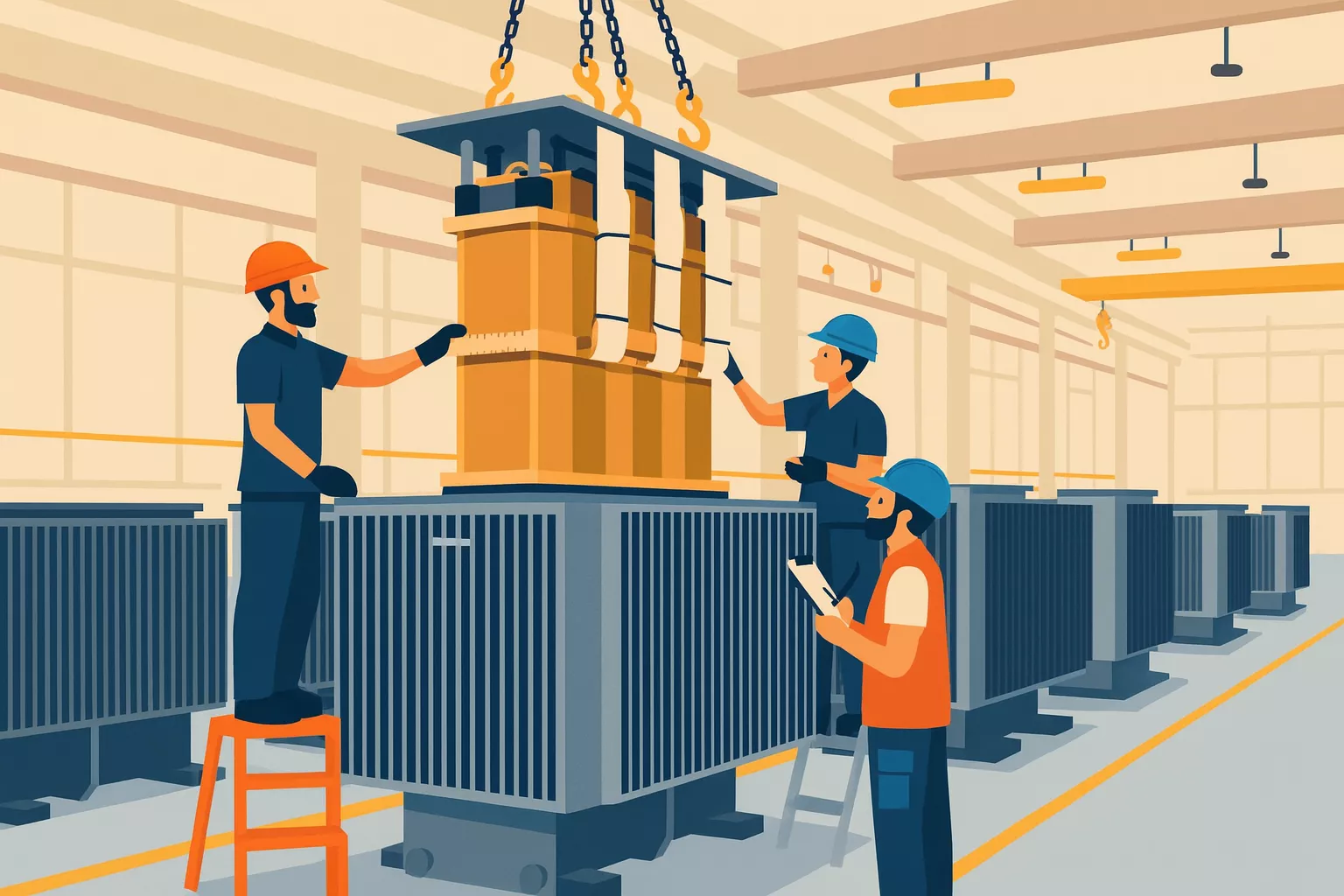
When you stand next to a transformer substation and hear its soft hum, it's hard to believe that within that metal box, the lifeblood of the power network pulses.
And yet, most of us carry within us the same curiosity from childhood: the very same curiosity that made us wonder what was inside a golf ball, a ping-pong ball, or a tennis ball.
Who among us hasn't tried to drill, cut, or pry one open just to see what the "inside of the world" looks like? Let him who has not cast the first fuse ;-)
The transformer operates on this exact same archetypal impulse: the desire to peek where we don't usually look.
Inside a transformer, something fascinating happens. Current transforms as if in an alchemical process, and its heart is cooled by oil of near-laboratory-grade parameters.
What exactly lies beneath the steel cover?
And why does this structure work continuously for decades, despite extreme temperatures, vibrations, and voltages reaching thousands of volts?
At Energeks, we work with medium-voltage transformers every day – from design and testing to field implementations. We know that understanding the inside of a transformer is not just a matter of curiosity, but also of safety, efficiency, and compliance with standards.
This article is for contractors, investors, designers, and technology enthusiasts who want to look inside without the risk of electric shock.
After reading, you will know:
What key components make up an oil transformer.
What role the oil plays and how it works with the magnetic system.
How the construction of a sealed transformer differs from one with a conservator.
Which design flaws most commonly shorten its lifespan.
At the end, a bonus awaits you: a list of 5 operational errors that can destroy even the best-designed transformer.
Reading time: approx. 7 minutes
The magnetic core – the iron heart of the transformer
When you look at an oil transformer from the outside, you see a solid steel box, often enclosed in the concrete housing of a prefabricated substation. But the true life of this device pulses inside – where its iron heart beats: the magnetic core. Without it, a transformer would be like a body without a circulatory system – it would have no way to transfer energy from the primary to the secondary windings.
To understand how this works, we need to briefly revisit basic physics. A transformer doesn't "transmit" current directly between its windings. Instead, it uses the phenomenon of electromagnetic induction. When alternating current flows through the primary winding, it generates a varying magnetic field, which in turn induces voltage in the secondary winding. And all of this happens thanks to the core – the element that guides and concentrates this magnetic flux, like a well-laid highway for the electromagnetic field.
What is a transformer core made of?
Not from "iron," as is commonly said, but from electrical steel laminations – thin, precisely rolled sheets of silicon steel with low magnetic losses.
This is a very special material. Each lamination is coated with insulation to minimize the phenomenon of eddy currents, which could turn the transformer into an unwanted heater.
The thickness of a single lamination is usually 0.23–0.30 mm – about the same as a sheet of technical drawing paper.
The laminations are stacked in layers, like the pages of a book on energy, and clamped into packages.
This is called a laminated core. The thinner the laminations and the higher their quality, the lower the no-load losses – the energy the transformer consumes just to be "on," even without any load.
Two main types of cores are used in oil transformers:
Core-type, where the windings are wound around the vertical limbs of the core.
Shell-type, less common in medium-voltage power systems, where the windings surround the core.
Core-type designs have the advantage of being more compact and dissipating heat better – ideal for use with cooling oil.
What does core assembly look like in practice?
This is where theory ends, and true craftsmanship begins. A transformer core cannot have gaps or air spaces because every such micro-gap is a potential source of losses and noise. Therefore, the laminations are stacked with surgical precision. In large production plants, robots and presses are used for automatic stacking, but in smaller MV transformers, you can still literally see the human hand at work.
The laminations are overlapped in a "step-lap" configuration, which limits losses at the joints and reduces the characteristic hum. That hum you hear when standing by a substation is precisely the micro-vibrations of the laminations under the influence of the alternating magnetic field. For some, it's the sound of a stable, reliable grid; for others – a signal that "the transformer is working as it should."
What is the significance of grain orientation?
This is a term that sounds like it's from a metallurgy course, but it has enormous significance for a transformer's efficiency.
Silicon steel can be either non-oriented or grain-oriented (GO).
The latter has a crystalline structure oriented in one direction, allowing it to conduct magnetic flux more easily.
The result? Lower losses and quieter operation.
A transformer with a grain-oriented lamination core can have no-load losses 30–40% lower compared to older designs.
In practice, this translates to tens of megawatt-hours of saved energy over the entire life of the equipment.
What you see here is the moment when the oil-filled giant stands almost stripped to the bones, showing off its copper muscles without a hint of shame: the copper windings gleam like lacquered alloy rims, the insulation is layered like a perfect haircut from a master barber, and the core serves as the solid backbone of the entire structure. Here, you can see the precision, the craftsmanship, and the obsession with quality that defines this work.
Oil meets iron – how the core cooperates with cooling
The core is fully immersed in transformer oil, which serves a dual function: insulating and cooling. Heat generated by magnetic losses and eddy currents is absorbed by the oil and transferred to the tank walls, where it is dissipated. Modern transformers use forced oil circulation systems, allowing for higher unit power without overheating the core.
Why does all of this matter?
Because the core is not just a metal skeleton – it is the starting point for the transformer's entire efficiency. Its quality determines:
The level of no-load losses (i.e., the cost of energy the network "consumes" without any load).
Noise and vibration levels.
Operating temperature and the durability of the insulation.
And consequently – the transformer's lifespan.
As assembly floor engineers like to say:
"A bad core will eat up the best oil, the best windings, and the best design."
This is why, before a transformer reaches the substation, its core undergoes tests for inductance, losses, and magnetic permeability.
These are the tests that determine whether the iron heart will beat with a steady rhythm for decades to come.
Windings that transform voltage into usable energy
In the world of transformers, windings are like a bodybuilder's muscles.
They don't shine as much as a lacquered enclosure, nor do they buzz as distinctly as the core, but they do the heaviest lifting. They transform voltage, stabilize energy flow, and do it with a precision that begs for a comparison to martial arts masters: minimum movement, maximum effect.
An oil transformer has two main types of windings.
Primary, which receives high voltage like a gatekeeper at a power plant, and secondary, which outputs current in a form digestible for the network.
Copper – or aluminium – forms neatly layered, multiple turns that somewhat resemble a perfectly layered mille-feuille pastry.
Every layer has its insulation. Every turn must be in its place. Every millimeter matters, because we're talking about electric fields capable of generating voltages that can, in a second, turn a simple assembly error into a fire, an oil blockage, or a flashover nobody wants to witness.
The windings in an oil transformer are also the element that most reveals the manufacturer's character.
A single glance at the geometry, cooling layout, and the way the leads are brought out is enough for an experienced engineer to assess whether they are dealing with top-tier craftsmanship or a budget experiment that probably shouldn't get anywhere near an MV switchgear room.
The winding line tells the truth. It's either clean, uniform, and perfectly wound, or it screams that something was rushed.
It's worth remembering that windings operate at temperatures that can exceed one hundred degrees Celsius. Oil cools, but you can't cheat physics.
This is why insulation materials are so crucial – typically oil-impregnated electrical paper, which acts as both a blanket and a barrier.
The better the impregnation and the more uniform the layers, the longer the transformer will work without complaint. Leaving micro-gaps, overheated copper, or using the wrong insulation class – all these shorten a transformer's life like sleepless nights shorten a human's.
This is precisely where all the magic of voltage conversion happens.
A varying magnetic field arises in the core, which induces voltage in the secondary winding. It's like a dialogue you can't hear, but you see the results – in the form of usable energy that reaches homes, pumps, factories, energy storage systems, and all the other infrastructure we take for granted.
Well-designed windings also guarantee stability during short-circuits and overloads. A transformer that is "copper-resistant" will withstand more, because its windings won't collapse, shift, or break in critical moments.
The difference between a robust and a weak transformer often only reveals itself after the first short-circuit – and then there's no more debate about which copper was "the right one."
Finally, it's worth noting that windings have their subtle charm. There is a certain geometric aesthetic, order, and rhythm to them. A transformer with such windings will reward you with years of quiet operation. It's one of those relationships where precision truly matters.
If you want to see how these windings are created step by step, check out our article:
How a transformer is made: 10 stages of oil transformer production
It's a great complement to this part of the post, as it shows the entire process from the first lamination, through winding the copper, to final testing and assembly. It perfectly rounds out the topic.
Insulating oil, the invisible guardian of temperature
If a transformer were a living organism, the insulating oil would be its lifeblood.
A quiet, hardworking substance that doesn't demand attention, doesn't shine, doesn't smell spectacular, but performs a task so vital that without it the entire system would collapse like a house of cards.
This insulating oil stands on the boundary between smooth operation and the kind of catastrophe operators prefer to see only in training scenarios.
Transformer oil serves two main roles.
First, it insulates, pushing voltages apart as effectively as if it stretched an invisible protective net between conductors.
Second, it cools—and it cools literally every element that generates heat.
Copper (or aluminium) and the core have a tendency to heat up their surroundings. The oil absorbs this heat, transports it to the tank walls, and dissipates it to the environment. Without it, the transformer would be like a convection oven, only decidedly less pleasant.
Two main categories of oil dominate the market.
The first is mineral oils, the classic of the power industry. Stable, predictable, cost-effective, with well-researched characteristics.
The second is ester oils. They are increasingly chosen by designers of substations and photovoltaic farms because they are biodegradable and have a higher fire point. In practice, this means an additional safety margin.
For many investors, it also matters that ester oils penetrate the insulating paper better, slowing down its aging.
The operating temperature of a transformer is a complex puzzle.
Every degree increase translates to faster aging of the cellulose insulation. And it's the insulation, not the copper, that determines the longevity of the entire device. Therefore, good oil isn't a fancy extra. It's an investment in decades of stable operation.
Excessive moisture in the oil, contaminants, or chemical degradation can lead to what in the power industry is described succinctly and directly: trouble.
An interesting fact is that transformer oil keeps its own chronicle of the device's life over the years.
Every chemical micro-flaw leaves a trace in it.
This is why DGA testing, or Dissolved Gas Analysis, is like reading a flight recorder.
From the printouts, one can learn whether there is arcing, localized overheating, slow degradation of the insulation, or the beginnings of thermal processes that require attention. An experienced diagnostician can extract more information from this sample than a doctor can from a chest X-ray.
Transformer oil also works as a shock absorber.
It dampens vibrations, protects windings from shifting, and safeguards the system in case of a short-circuit. In sealed transformers, the oil enjoys peace because the entire system is closed. In constructions with a conservator, it "breathes" through a breather system designed to keep moisture at bay.
Why does all this matter?
Because oil quality changes everything. If the oil is clean, dry, and chemically stable, the transformer can work for thirty years without issues. If the oil is neglected, even the best core and the most uniform windings won't save the situation.
At this point, many engineers start treating the oil as a partner, not just a technical medium.
Because when you see how well-impregnated paper, clean oil, and stable temperature translate into quiet operation and low losses, understanding comes naturally. It's this invisible part of the transformer that deserves significantly more attention.
If you're interested in how oil behaves in real operating conditions and how to recognize when something starts to go wrong, it's also worth checking out our article:
Transformer oil leaks – do not ignore these signals
It's a practical guide on the symptoms, diagnosis, and repair of leaks that can determine the fate of an entire transformer.
Tank, conservator, tap-changers, thermometers: the body of the transformer
When we look at an oil transformer as a whole, it's easy to focus on the windings and the core.
That's the heart and muscles, the interior that does the actual work. But all of this interior needs a solid housing.
A body that will protect it, maintain its parameters, and give the transformer a chance to survive three decades even in the most capricious climate.
And here begins the story of the tank, conservator, tap-changers, and thermometers.
Elements that at first glance look like add-ons, but actually determine whether the transformer even has a chance of reaching retirement age.
The tank is the armor that keeps the entire system in check.
Thick steel, often corrugated into radiators, which give the oil a place to dissipate heat. In the field, it looks like an unassuming box, but every designer knows the tank is like a turtle's shell. It withstands overloads, temperature swings, wind gusts, knee-deep snow, and every short-circuit that puts the structure under momentary stress.
Perched atop the tank often sits the conservator, an additional oil reservoir that compensates for volume changes due to temperature. It's like the transformer's technical breath.
When the device heats up, the oil expands and moves into the conservator. When it cools, it returns to the main tank. The presence of a conservator may seem like a detail, but it's a detail that tangibly protects the insulation from moisture. This is precisely why so many specialists seek the answer to the classic question: should one choose a transformer with a conservator or a sealed one?
We've examined both constructions here and encourage you to check out the content:
Transformer with conservator or sealed - when does which make sense?
It's a good reference point if you want to approach an order or substation modernization knowledgeably.
Tap-changers are another key element of the transformer's body.
These small mechanisms allow the voltage to be adjusted to grid conditions. In MV transformers, you most often find off-circuit tap-changers, which are set before the device is energized.
It's a bit like fitting shoes before a long march, because the correct setting determines whether the transformer will start operating smoothly or struggle at voltage limits.
Larger units use OLTCs, or On-Load Tap-Changers.
This is advanced engineering. Mechanics, hydraulics, sparks quenched in oil, and live voltage regulation during operation.
Then we have thermometers, oil level gauges, valves, and relays.
Small components that serve as the transformer's sensory organs. The thermometer shows winding and oil temperature. The oil level gauge signals when something alarming is happening. Valves allow for quick venting or oil draining for testing.
And the Buchholz relay in transformers with a conservator reacts to gas accumulation.
This is a very serious signal. If the Buchholz relay activates, the entire crew knows they must act before a spark turns into a failure.
This entire transformer body is a team that works harmoniously only when every element is perfected.
The quality of the welds.
The tightness of the gaskets.
The mechanical stability of the radiators.
The condition of the anti-corrosion coating.
These are the things you only truly see in the field, especially when faced with November winds, shin-deep snow, and a standard technical inspection where nobody will overlook even a centimeter.
It's right there that the tank and all its accessory family show whether the transformer is a well-thought-out construction or just an attempt to enter the world of power engineering through the back door.
The transformer's body is more than just a metal can.
It is a shield, a shock absorber, a stabilizer, and a guardian that protects the interior. And if it's well-made, the transformer repays it with quiet operation even in places where the weather and loads can be capricious.
Power engineering does not like surprises.
That's why it's so crucial for the devices operating within it to be predictable, tight, and resilient.
When design fails and the transformer pays the price: the most common design pitfalls shortening its lifespan
An oil transformer can be designed like a dream and produced with the best copper on the continent, but if a design error occurs along the way, the device's life begins to shorten from the very day of assembly.
In the industry, it's sometimes said that a transformer ages not from the number of years, but from the number of misguided design decisions someone once considered a saving or a minor compromise.
And compromises in transformers take revenge slowly but surely.
The most common sin is improper winding layout.
If the copper is laid unevenly, if local stresses appear, or if there are spaces that are later difficult to fill with oil, the transformer starts having problems even before factory testing. Poorly cooled spots heat up faster, and overheated insulating paper ages at a rate that cannot be reversed later.
From a durability perspective, it's like putting a new engine into a car with already worn-out bearings. It will run, but not for long.
The second classic design error is poor cooling system geometry.
Radiators that are too small, poorly positioned, or set at an angle that hinders the natural oil circulation. The consequences are simple. Instead of circulating calmly and dissipating heat, the oil forms hot spots.
In these hot spots, everything ages. The oil. The paper. The gaskets.
The transformer seems to work, but it does so under constant thermal stress. And every degree above the norm shortens the insulation's life exponentially. If someone wants to check how much can be lost due to poor cooling geometry, just look at the oil condition test results after a few years of operation. They reveal everything.
The third problem is tank construction.
It might seem that steel is steel. But not all steel has the same quality, not all welds will withstand the same stresses, and not all connections will remain tight during temperature changes.
Even a slight deformation of a radiator under pressure can alter the oil flow, and a microscopic leak in a weld leads to moisture ingress. Moisture in the oil means an increased dielectric loss factor. An increased dielectric loss factor means the transformer starts working harder. And so on, in a vicious cycle, until the first major alarm.
Another mistake is cutting corners on the sealing system.
In many transformers, the gaskets are the first element to age. Poor rubber quality, ill-fitting rings, lack of proper tolerance for thermal movement. The end result is always the same: oil begins to disappear. And a transformer without oil is a transformer with problems not only for insulation but also for thermal management. It starts working like a furnace with a blocked chimney. Sooner or later, a signal will come, followed by questions about why that gasket cost five złoty less.
A separate category of errors involves poorly thought-out tap-changer designs.
Poorly chosen regulation positions, weak internal insulation, a tap-changer compartment that is too small. All this causes the tap-changers not only to wear out faster but also to create points of risk for arcing. And every spark in oil creates gases. And gases mean a Buchholz relay alarm. And every Buchholz alarm means a phone call from the operator and long discussions about why the device didn't quietly complete another operating cycle.
Finally, it's worth mentioning excessive compromises in noise-reduction design. A poorly designed step-lap configuration, insufficient core bracing, play in the core packages. All this increases vibrations, which over time cause micro-cracks in the insulation.
Even if the transformer doesn't exceed noise limits, vibrations are its internal enemy. Over the years, they do the same thing waves do to a concrete breakwater. Slowly, invisibly, but consistently.
Design errors are like flaws in a building's foundation.
You can't see them on the surface, but they affect everything. Every transformer has its history and its purpose. And the one designed without compromises has the greatest chance of living its twenty-five to thirty years not as a maintenance curiosity, but as a stable network element that simply does its job.
5 operational errors that can destroy even the best-designed transformer
Design is one thing, but a transformer's life truly unfolds in the field.
And here begins the real test of the device's character. Even a perfectly designed and manufactured transformer can be run into the ground if operation goes against common sense.
On construction sites, in substations, and at PV farms, we've seen many situations where the fault lay not with the device, but with human habits, shortcuts, and haste.
And a transformer, though resilient, cannot win against time or operational errors. Here are the most common operational transgressions.
1. The first is ignoring moisture.
A transformer dislikes water in any form. Not in the oil, not in the paper, and not the kind that appears through leaks. When oil's moisture content becomes elevated, its dielectric properties drop drastically. The insulating paper begins to age at a rate comparable to driving a car with the handbrake on. And all of this could be avoided with a single annual oil test and heeding the first warning signs.
2. The second error is overheating the insulation by improper transformer loading.
In power engineering, it's often said a transformer can be overloaded, but with care. The problem is many contractors do it recklessly, assuming that if a transformer has a nameplate with a beautiful MVA rating, it can operate at that level twelve months a year. Meanwhile, every manufacturer provides curves for permissible overloads and temperatures. Ignoring them is like setting a treadmill at too steep an incline and pretending nothing is wrong. Something is wrong. Always.
3. The third problem is a lack of regular mechanical inspections.
Gaskets perish. Bushings get dirty. Valves can be forgotten. Even bolts on radiators can loosen if the transformer is in a location where the wind blows from one direction for half the year. Mechanical neglect leads to leaks, leaks lead to moisture, and moisture leads to failure. A spiral that is quick, predictable, and almost always avoidable.
4. The fourth error is disregarding voltage deviations and power quality.
A transformer that operates at elevated voltage for years is like a person who drinks one too many cups of coffee every day. It will manage, but its heart won't be grateful. Core overheating, increased no-load losses, stressed insulation. In distribution networks, connections are often built quickly and under pressure, causing the transformer to bear the brunt of poorly compensated installations. And what happens at the voltage level later becomes visible in DGA results.
5. The fifth error is unsuitable environmental conditions.
Transformers cope poorly with constant salt exposure, industrial pollution, lack of protection from water running off the installation, and vibrations transmitted through the foundation. If a transformer stands on a poorly executed foundation, every short-circuit impulse and every gust of wind is transmitted to the structure. Over the years, this makes a difference. It becomes visible in the condition of the radiators, connections, bushings, and sometimes even the core itself.
Operational errors are often not the result of ill will, but of routine.
The transformer stands there, works, no alarms are flashing, so "it looks fine." Meanwhile, slow processes are occurring inside that only become visible after years. Good operation isn't just about responding to failures. It's the daily care of a device that repays this care with reliability. A transformer with clean oil, healthy insulation, and stable operating conditions can work so predictably that it's almost boring. And in power engineering, boredom is the highest form of compliment.
What remains when we close the transformer's cover
Looking inside an oil transformer is a bit like opening that golf ball from childhood. The only difference is that here, instead of a rubber core, we find precision, thermodynamics, oil chemistry, and an architecture that keeps thousands of volts in check.
A transformer is not a "metal box with copper." It is a living, responsive system where every detail determines years of operation. The core. The windings. The oil. The tank. The tap-changers. The diagnostics. The operation. It all contributes to the story of a device with just one task: to work quietly, stably, and without drama.
If you are working on a project where reliability, safety, compliance with standards, and long service life matter, we are by your side. We select the power rating, cooling, insulation type, oil type, and parameters that truly make a difference in the field.
Explore our offering of Ecodesign Tier 2 transformers, including units available off-the-shelf and full documentation packages.We also invite you to our community on LinkedIn.
Thank you for being here with us. And if you'd like to discuss your project, define parameters, or prepare an acceptance checklist for an MV transformer, just send us a message.
Let's do it the way the best things are done in power engineering: calmly, concretely, and together.
Sources:
https://electrical-engineering-portal.com/
Transformers in stock
Shipped from our warehouse in Poland within 2–3 working days, 5-year warranty. Full range 25–2500 kVA in the shop (prices in PLN).

There is a moment of silence before the first ampere trembles.
On the screen glows a 3D visualization, where the core consists of thousands of thin laminations, and the windings resemble precisely laid ribbons.
This is where the life of an oil transformer begins, long before it reaches a substation and powers a residential district or a production line.
A good story isn't magic; it's engineering told in the right sequence.
That is exactly what we are doing today.
At Energeks, we work with medium-voltage transformers, prefabricated transformer substations, switchgear, and energy storage systems every day.
We combine practical experience with the requirements of standards and the expectations of investors.
This text is the result of numerous conversations with designers, technologists, and assembly teams.
We present the process in a way that helps make better decisions and predict outcomes at the concept stage.
If you design, purchase, order, or will be operating an oil transformer, understanding the production chain of cause and effect will save you time, money, and nerves.
In the end, you will know why a specific requirement in the technical specification translates into particular operations, risks, and performance parameters for decades.
Agenda:
Design and digital visualization
CRGO lamination core and step lap configuration
Windings. Conductor selection and geometry
Insulation system. Kraft paper and DDP
Active part assembly and preparation for testing
Tank. Corrugated or with radiators
Surface treatment and anti-corrosion protection
Drying of the active part and moisture control
Vacuum oil filling and heat cycling
Routine tests and readiness for shipment
Reading time: ~20 minutes - just right for some worthwhile reading during your afternoon coffee and biscuit break!
Design and digital visualization
Every transformer begins with an idea, which looks less like a magical spark and more like... Excel, CAD, and... coffee at three in the morning.
The process of designing an oil transformer is a precise puzzle where physics meets mathematics, and everything must fit inside a tank with specific dimensions and weight.
Before anyone even orders steel or copper, the design team creates a digital model of the transformer, also known as a digital twin.
In this model, they test how the magnetic field will behave under different loads, how heat flows, where mechanical stresses will occur, and what the no-load and load losses will be.
This is not just a "nice 3D visualization of a transformer"—it's a virtual testing laboratory that saves months of work and hundreds of thousands of EUR.
The designer must reconcile several worlds:
The electrical world: parameters like voltages, ratios, and vector groups.
The mechanical world: short-circuit forces and cooling.
The material world: because CRGO steel has different properties than amorphous steel.
And finally, the environmental world: ambient temperature, humidity, and altitude above sea level.
This is where the engineering dance between theory and practice begins.
For example: increasing the number of turns improves voltage stability but raises the winding resistance and thus the losses. Reducing the conductor cross-section lowers costs but impairs cooling. As always—the devil is in the details, and the angel is in the tolerance table.
In modern factories, the transformer design doesn't end on paper. Digital visualization allows for simulations in environments like ANSYS Maxwell or COMSOL Multiphysics, where one can check how the transformer will behave during a short-circuit, overheating, or a lightning impulse. It's a bit like training—it's better for the equipment to "take a beating" in the computer than in the power grid.
Thanks to such models, it's also easier to adapt the construction to a prefabricated transformer substation, where every centimeter counts. The designer can see in advance if the mounting holes, coolers, tap-changers, and accessories will fit without collisions. This is the magic of 3D transformer design—a virtual factory before the real one is built.
A well-designed digital transformer already has a full data package defined at the design stage:
Technical documentation, a bill of materials, a winding schedule, and a detailed cooling plan.
This shortens production time by up to 20% and minimizes the risk of errors.
CRGO lamination core and step-lap configuration
At the heart of every transformer lies its core – the magnetic core.
It doesn't glow or shine, but its quality determines whether the device will purr like a cat or hum like a refrigerator from the 1980s. The core is precisely what dictates no-load losses, noise levels, and overall energy efficiency.
And it all starts with a material known by a three-letter acronym every electrician memorizes:
CRGO – Cold Rolled Grain Oriented Steel.
This silicon steel, with grains oriented in a single direction, has a unique gift:
It conducts magnetic flux like a well-designed channel conducts water.
As a result, hysteresis losses (the energy consumed with every reversal of the magnetic field) are even 30–40% lower than in ordinary hot-rolled steel.
From an engineer's perspective, it's like an engine running at lower throttle but delivering the same power.
During the production of the transformer core, CRGO laminations are cut with laser or knife-edge precision to within tenths of a millimeter.
It is crucial that they have no burrs or micro-cracks, which could become sources of loss or vibration.
Here, not only geometry matters but also the stacking sequence. Modern designs use a so-called step-lap configuration – a technique of overlapping the lamination edges, resembling roof tiles.
The effect? Magnetic flux flows smoothly, without abrupt "jumps" between segments, which reduces noise and improves efficiency.
Imagine the core as a labyrinth where the magnetic field seeks the shortest path.
Every gap, every misalignment is like a hole in the path = energy escapes as heat and sound.
This is why the following are so critical:
• High-quality laminations (low core loss, e.g., 0.9–1.1 W/kg at 1.5 T and 50 Hz),
• Precision cutting and stacking,
• And solid joints between yokes and limbs that eliminate micro-gaps.
In large units, the core is assembled in segments: first the limbs, then the yoke, and the whole structure is clamped with steel frames.
Some manufacturers use bonded interlayer insulation systems that limit vibration and improve the coherence of the core package. Amorphous cores, which are even more energy-efficient though more difficult to process, are also becoming increasingly popular.
From a user's perspective, you can hear the difference between a "good" and a "bad" core.
Literally. A transformer with a perfect step-lap configuration and the right CRGO steel can be several decibels quieter, meaning in practice you can hold a normal conversation next to the operating equipment. For urban substations installed near buildings, this isn't a minor detail, but a condition for project acceptance.
An interesting fact
Some production lines use algorithms to optimize the core cutting angles based on the working flux density.
This is pure field mathematics: the better the grain orientation, the smaller the magnetic distortions and the lower the losses at high voltages. As a result, the transformer gains a few percentage points in efficiency without additional material costs.
This is how the foundation of the entire device is created – both literally and figuratively.
The CRGO lamination core is an engineering compromise between physics, economics, and the quiet that speaks of perfection.
Windings. Conductor selection and geometry
If the core is the transformer's heart, then the windings are its muscles – they carry the energy, and their shape, material, and insulation determine how effectively they do so. In theory, it's simple: we have a primary winding, a secondary winding, the right number of turns, and Faraday's law of induction. In practice, it's a world of hundreds of nuances that can determine whether the transformer survives its first short-circuit.
First, the choice of metal. Copper or aluminium?
Contrary to myths, it's not just about price.
Copper has higher conductivity (approx. 58 MS/m), but it's heavier and more expensive.
Aluminium (approx. 35 MS/m) requires a larger cross-section but facilitates cooling thanks to better temperature distribution. For transformers with powers up to a few MVA, the choice often depends on material availability and client requirements. You can find more about differences in conductivity and material properties in analyses by the International Copper Association, which has been researching the efficiency of copper in the power industry for years.
Shape and geometry – a dance between the magnetic field and oil
The low-voltage (LV) winding is most often made from paper-insulated rectangular strip or wire, wound in layers. The high-voltage (HV) winding – from round or rectangular wires, also in paper, but with a more complex geometry. All this is done to minimize the stray field and distribute temperature evenly in the oil.
The principle is simple: the shorter the current path, the smaller the losses. But engineers know that reality is rarely straightforward. HV windings often use helical, cylindrical, or disc-type arrangements, which allow for controlled magnetic field distribution and oil cooling through microchannels.
In laboratories, you can see how such a winding in cross-section somewhat resembles a multi-layer cake – except instead of cream, we have cellulose Kraft paper and epoxy resin.
Insulation secrets – cellulose and DDP in action
Every winding needs protection from voltage and temperature. This is where Kraft paper and its enhanced version, DDP (Diamond Dotted Paper), come into play. This is a material where micro-dots of resin are arranged in a regular grid – during the heating process, they create a "weld" between the winding layers. The result? A rigid structure resistant to vibration and discharges. The layer insulation made from DDP paper has another advantage: it allows for precise control of the so-called "creepage distance." A high value for this parameter reduces the risk of flashover, which is crucial at voltages of 15–36 kV.
Insider jokes
In the industry, they say that "a winding can be made beautifully, but only once" – because if something goes wrong during the winding process, there is no second chance. Too much pressure? Damaged insulation. Too little? Vibration. That's why winding machine operators often have the status of artists – they can feel the tape's resistance with their fingers before a sensor shows any deviation.
Anyone who has had the chance to see the winding of an oil transformer coil live knows it's like watching a watchmaker at work on an XXL scale.
Precision, rhythm, and focus – all so that the current can flow for decades in perfect rhythm
Manual winding of oil transformer coils using copper conductors and DDP paper insulation.
A key manufacturing stage ensuring transformer efficiency and long-term reliability.
Insulation system. Kraft paper and DDP
Insulation in a transformer is somewhat like skin in a living organism – invisible from the outside, but absolutely crucial for the life of the entire system.
Without it, even the most beautifully designed core and windings wouldn't stand a chance of surviving the first overvoltage. And just as human skin relies on elasticity, resistance, and regeneration, the most important properties in a transformer are dielectric strength, mechanical stability, and resistance to thermal aging.
The primary material that meets these requirements remains Kraft paper – a cellulose classic with an extremely long history.
It is made from wood fibers of high chemical purity, which ensures low ash content and excellent electrical strength. In transformers, it is used in the form of tapes, sleeves, and spacers. In contact with mineral or synthetic oil, the paper swells minimally, maintaining dimensional stability, and its micropores allow for the exchange of gases and oil.
But the world of insulation has taken a step further. In higher voltage windings, DDP (Diamond Dotted Paper) is used, coated with a regular grid of micro-dots of epoxy resin. When the winding enters a vacuum oven and reaches the appropriate temperature, the resin melts, fusing the paper layers into a rigid, homogeneous structure.
The result? Insulation that doesn't shift even under severe electromagnetic transients and vibrations. It is this "glue" that prevents the transformer from "humming" during the startup of large drives.
A properly designed insulation system isn't just about the paper. It also involves vacuum impregnation, which removes air bubbles, and protective layers made from pressed cellulose boards that absorb mechanical stresses. A key parameter remains the breakdown voltage – values in the range of 40–60 kV/mm indicate the quality of the material and the purity of its structure.
A well-chosen insulation system for an oil transformer is an investment in peace of mind for maintenance crews for the next 25–30 years. It determines whether the equipment can withstand not only voltage overloads but also thousands of heating and cooling cycles, which act like slow, yet relentless, fatigue tests.
A tidbit from high-voltage laboratories
Modern research on dielectrics shows that even a slight increase in the paper's moisture content from 1% to 3% can reduce its electrical strength by over 50%. This is why drying and controlling the water content in cellulose is a topic that will reappear later in this article.
Active part assembly and preparation for testing
At this point, the transformer begins to resemble more than just a collection of parts – it slowly becomes a living organism.
The active part assembly stage is an engineering orchestra, where every element has its place, its specific torque, and its tolerance. The precision of these actions determines whether the device will operate without vibrations or failures for decades to come.
The active part is the combination of the core, windings, yokes, spacers, and insulation – everything responsible for conducting and transforming energy.
First, the low-voltage and high-voltage windings are placed over the core limbs.
Some designs require additional electrostatic screens or grading rings, which distribute the electric field evenly along the entire length of the winding.
Once the windings are in place, it's time to assemble the yoke, the top part of the core. It's like closing the lid of a well-fitted watch. Here, wedges, clamping frames, and spring-loaded bolts are used to mechanically stabilize the structure.
The whole assembly must be rigid, but not overly so – a transformer needs a minimal degree of flexibility to withstand short-circuit forces without cracking the insulation.
Next, the tap changer (OLTC or NLTC) is installed – this is what enables voltage regulation on the high-voltage side, compensating for fluctuations in the grid. In large units, it is mounted in a separate oil compartment; in smaller ones, directly on the cover.
Each tap changer is tested electrically before the oil is filled, as access to it becomes difficult after final assembly.
Stability, tightness, and cleanliness
Three words that govern this phase. Every speck of dust, every under-torqued yoke, every poorly positioned wedge can turn a future transformer into a potential source of failure. This is why assembly takes place in clean, controlled conditions – often in halls with positive pressure to prevent dust ingress.
After the active part is assembled, it's time for preliminary tests.
These are "dry tests" that ensure everything is according to design:
Winding resistance measurement,
Vector group verification,
Ratio measurement,
Inter-system insulation check.
These tests are the first moment the transformer "speaks" – its parameters begin to form graphs and numbers.
Find out how we test our transformers at Energeks, insider knowledge you won't find on Google:
How do we test our transformers? A symphony of factory quality!
A short digression on vibrations and patience
In experienced assembly teams, a rule prevails:
"Don't rush the clamping – the transformer will reward you with quietness."
Properly torquing the yokes and selecting the right elastic elements ensure the device does not produce unwanted sounds during operation.
After all, sound is energy that could have been better utilized – for example, for transmitting current instead of an acoustic concert in a substation.
Where theory meets practice
It is at this stage that many young engineers understand for the first time that a transformer is not just a CAD project, but a physical machine with its own dynamics, weight, and rhythm.
In theory, every current transformer, coil, and screen can be described by equations.
In practice – you need an eye for detail and respect for mechanics.
For those who would like to explore the topics of short-circuit forces and the stability of the active part in greater depth, I recommend publications from Transformers Magazine, in which experienced designers analyse the influence of assembly on the mechanical overload resistance of transformers.
Tank. Corrugated or with radiators
Every transformer needs armor. Not to look combat-ready, but so its interior—full of windings, cores, and insulation—can peacefully bathe in oil and avoid interacting with the external environment.
This armor is the tank of the oil transformer, a steel vessel that provides cooling, tightness, and safety for the entire structure.
Simply put, the tank is the transformer's "shell of life." Its construction must withstand vibrations, temperature differences, and pressure, while remaining absolutely sealed for decades. This is why designers choose between two main types: the corrugated tank and the tank with radiators.
Corrugated tank – the master of compact solutions
A corrugated tank somewhat resembles an accordion made of steel sheet. Each of its "ribs" acts as a natural radiator, increasing the oil's cooling surface area. When the internal temperature rises, the oil expands, and the corrugated walls flex elastically, compensating for the volume changes.
No conservator, valves, or breather pipes are needed – everything happens within a hermetic space.
This solution is ideal for distribution transformers and applications where compactness and maintenance-free operation are key. The lack of a conservator reduces the risk of moisture ingress and oil oxidation, thus extending its lifespan. Fewer moving parts also mean quieter operation and a smaller service footprint – engineers like that, and accountants even more so.
Tank with radiators – industrial-grade classic
For larger units (typically above 2.5 MVA), corrugated walls are insufficient.
This is where plate radiators come into play – vertical panels welded to the sides of the tank. They work like car radiators: hot oil rises, flows through the panels, transfers heat to the air, and then descends, creating a natural circulation (ONAN – Oil Natural Air Natural) or a forced one (ONAF – Oil Natural Air Forced) with fans.
Radiators can also be easily replaced and expanded, making this system more serviceable.
The downside is greater weight and the need for regular checks of weld integrity, but it offers better thermal stability under heavy loads. High-class designs additionally feature safety valves, thermometers, oil level gauges, and Buchholz relays, which react to gases generated during internal faults.
From steel to tightness – the engineering of precision welding
The foundation of every tank is steel with high purity and controlled carbon content. After the sheets are cut, the tank is welded using MAG or TIG methods, and the welds are tested with non-destructive methods – most commonly ultrasound or penetrant testing. Factories also perform pressure tests: the tank is filled with compressed air or helium and immersed in water to observe for any bubbles. Simple, yet effective.
After leak tests, the tank is chemically cleaned and degreased. The interior is coated with a special varnish resistant to transformer oil, while the exterior receives an anti-corrosion coating system tailored to the environmental category – from C2 for urban areas to C5-M for marine environments.
The sustainable direction – recycling and hot-dip galvanizing
Modern production increasingly emphasizes tank corrosion resistance and material recyclability. Hot-dip galvanizing can increase the coating's lifespan up to five times, which is particularly important in coastal and industrial areas. Interestingly, some manufacturers are also testing powder coatings based on nano-ceramics – lighter but just as durable as classic zinc.
For those interested in the details, it's worth visiting the Hydrocarbon Engineering portal, where research on protective coatings and welding techniques for the power industry is published.
Vacuum oil filling and heat cycling
At this stage, the transformer resembles an astronaut before a mission – ready, sealed, dry, and waiting only for the medium that will allow it to live.
That medium is transformer oil, which serves two functions: cooling and insulating.
Without it, the transformer would be like an engine without oil – it would overheat, lose its parameters, and fail faster than it could receive a serial number.
Oil under vacuum – the physics of pure calm
The process of vacuum oil filling is an engineering spectacle of Swiss watch precision. The active part of the transformer, now enclosed in its tank, is placed in a chamber where a deep vacuum is first created – typically below 1 mbar.
Why? Because even microscopic air bubbles trapped in the windings or insulation could later cause partial discharges and local overheating.
When the pressure reaches the required level, the slow filling with oil begins, usually from the bottom. The oil penetrates every gap, displacing the air. Sometimes the entire process takes several hours – especially for large power transformers requiring thousands of liters of oil.
The fill rate is strictly controlled to prevent the formation of gas pockets or pressure differentials that could damage the delicate insulation.
After filling, the unit is left undisturbed, still under vacuum conditions, to allow all micro-bubbles of gas time to rise and dissipate. Only then can the transformer be said to be "impregnated" – ready for the first flow of current.
Heat cycling – a spa for the windings
After filling comes the heat cycling process, which has two goals: to stabilize the structure of the paper and resins and to reduce residual moisture to an absolute minimum.
The transformer is maintained at a temperature of around 80–90°C for several hours. During this time, the oil and insulation reach a state of thermal and moisture equilibrium.
This isn't a stage visible from the outside – but it's when the transformer "matures." Every layer of paper, every impregnation, acquires its final structure. After this process, a key quality parameter is measured: the oil's breakdown voltage.
A value above 60 kV for a 2.5 mm gap indicates a perfect insulation system.
Oil quality and purity control
High-grade transformer oil (e.g., mineral oil like Nynas, Shell Diala, or synthetic fluid like MIDEL) undergoes a series of tests before use: measurement of dielectric strength, viscosity, dissipation factor (tan δ), and dissolved gas content.
Some manufacturers use Chromatographic Dissolved Gas Analysis (DGA), which can detect even trace amounts of hydrogen, carbon monoxide, or methane – signals that something might later go wrong inside the transformer.
Learn more:
Gas laws in DGA transformers: 5 rules that will warn you of a failure
To maintain its parameters for years, the oil must be perfectly clean – even a single drop of water or a dust particle per liter can reduce the breakdown voltage by several thousand volts.
Therefore, after filling, the system is hermetically sealed, and all bushings, breathers, and plugs are secured against contact with air.
When oil becomes a witness to history
An interesting fact for enthusiasts: in service, transformer oil retains a memory of the unit's life. Analyzing its composition allows experts to read how long the equipment operated under overload, if it experienced a short-circuit, and even what temperatures it reached in recent years.
In maintenance laboratories, it's from the oil that the first signs of insulation aging are read – long before any smoke appears from the tank.
Now that the transformer is sealed, filled and cooling down after heating, the final stage of its journey through the factory remains – routine tests and final checks that will determine whether it can be shipped out into the world and power its first network.
Routine tests and readiness for shipment
An oil transformer may look ready – closed, filled with oil, and shining with fresh paint. But until it passes its tests, it's merely a candidate for a transformer, not a full-fledged participant in the power grid. In the world of electrical power, final tests are like a state exam: there's no room for a second attempt.
Routine tests – or "mandatory exams of everyday life"
According to the IEC 60076 standard, every transformer must undergo a set of so-called routine tests before leaving the factory. Their goal is to verify that the device operates exactly as designed – without compromises, shortcuts, or guesswork.
Winding resistance measurement – A test that detects interturn short circuits, connection discontinuities, and assembly errors. Even a small resistance difference between phases can reveal a loose terminal.
Vector group and ratio verification – Checking that the voltage on the secondary side has the exact ratio specified in the design. This test immediately detects mistakes in the winding direction of the coils.
No-load and load loss measurement – A true barometer of the quality of the core and windings. If values exceed norms, it indicates excessive magnetic losses (core) or resistive losses (windings).
Impedance voltage measurement – A test simulating a short-circuit on the secondary side, checking the mechanical and electromagnetic stability of the system.
Dielectric tests – One of the most critical tests, checking the insulation's resistance to impulse voltages and long-term operating voltage.
Every measurement is recorded and compared with the design values. A transformer that passes everything within tolerance receives a Factory Acceptance Test (FAT) certificate.
Additional tests for demanding applications
Depending on the voltage class and customer requirements, type tests (on reference units) or special tests are also conducted, for example:
Sound level measurement to confirm compliance with environmental requirements (for urban units, this is often a condition for acceptance).
Measurement of magnetic circuit losses at different temperatures.
Partial Discharge (PD) test, assessing the cleanliness of the insulation and the quality of impregnation.
These tests are particularly important for transformers intended for use in sensitive networks or in prefabricated substations where the level of interference must be minimal.
Engineering Aesthetics: Preparation for Shipment
After passing all tests, the transformer enters a stage underappreciated in textbooks but highly valued by installation crews – preparation for transport.
This includes:
Draining excess oil and filling hermetic tanks with nitrogen.
Sealing all openings and securing transport fittings.
Installing lifting lugs, sensors, and the rating plate.
A final visual inspection of coatings and welds.
At this stage, the transformer looks ready for a parade: painted, labeled, tested, and packed in a steel transport frame. But before it hits the road, engineers perform a final vibration and leveling check to ensure nothing loosens or shifts during transit.
Documentation – The Transformer's DNA
Along with the unit, the customer receives a complete set of documents:
Technical and operational documentation.
Measurement and test reports.
Oil test results.
Material certificates for components used.
Certificates for weld quality and anti-corrosion coatings.
This is the transformer's DNA – a record of its entire "life" from design to the final test. In practice, this documentation determines whether the unit will be approved for operation by the Distribution System Operator (DSO).
More on transformer testing standards and certification can be found in publications from the IEC Webstore, where current editions of the IEC 60076 standards and guidelines for routine and special tests are available.
And so its factory journey ends – the transformer, which has been through design, core, windings, tank, drying, oil, and tests, is ready to hear the hum of the grid for the first time and to see the world not through an engineer's microscope, but through the current that begins to flow within it.
Conclusion
The production of an oil transformer is a fascinating journey from an idea to a finished source of energy – a journey where engineering meets patience, and precision meets practice. Every stage – from design to final testing – is a testament to the fact that reliability is not born by chance, but from consistency and a respect for detail.
For years, we have supported designers, contractors, and grid operators in selecting solutions that will stand the test of time and operating conditions. We help choose the right type of transformer, optimize cooling, select oil and insulation systems for specific environments, and plan maintenance over the entire lifecycle of the equipment.
If you are working on a project where reliability, energy efficiency, and compliance with Ecodesign Tier 2 are crucial, we are here to translate technical requirements into real-world solutions.
Discover Energeks’ middle voltage transformers solutions, including:
MarkoEco2 Ecodesign Tier 2 Oil Transformers – Selection of power rating, parameters, and cooling for specific environmental conditions.
TeoEco2 Tier 2 Cast Resin Transformers – For facilities with high safety requirements and limited space.
Units available immediately, full documentation, 60-month warranty – for selected medium voltage models.
If you want to stay updated with our technical analyses, practical tips, and case studies from construction sites, join the Energeks community on LinkedIn. It's a place where we share knowledge without marketing fluff – substantively, practically, and with respect for the industry we help build.
Thank you for your trust and the opportunity to be part of projects where sense, precision, and safety are as important as innovation. If you need to clarify technical requirements, select a model, or prepare an acceptance checklist for your investment – just send us a message.
Let's do it together.
References:
Transformers in stock
Shipped from our warehouse in Poland within 2–3 working days, 5-year warranty. Full range 25–2500 kVA in the shop (prices in PLN).
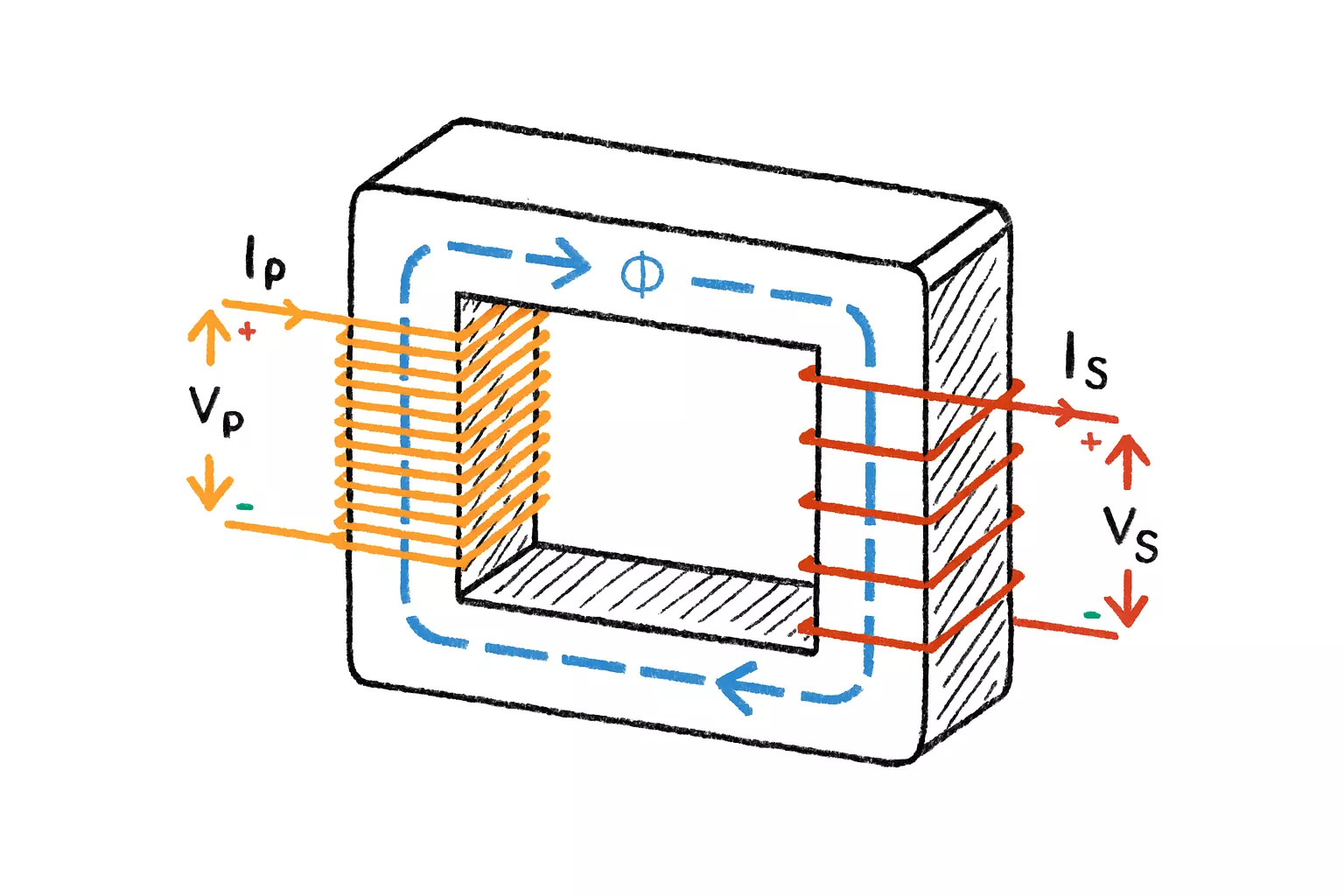
At one of the photovoltaic farms an investor asked with a slight smile:
“Why does this transformer say 15.75/0.42 kV when our grid is 15 kV? Is that a design error?”
This question comes up surprisingly often. And while it sounds simple, it goes straight to the heart of what designers and contractors in the medium-voltage world grapple with every day: the transformer voltage ratio.
Because the ratio is not just about “what goes in and what comes out.”
It is a mathematical promise that voltage and current will behave exactly as required by the grid, the inverter, and the Distribution System Operator.
In this article, we will explain what a transformer voltage ratio is, where common ratios come from, how to interpret them, and what they really mean for the efficiency and safety of your installation.
You will also learn why those “odd numbers” on the transformer nameplate are sometimes exactly what saves your investment from overvoltage issues and grid non-compliance.
Estimated reading time: approx. 8 minutes.
What is a transformer voltage ratio and how does it work in a real grid?
The voltage ratio of a transformer is one of those terms that sounds harmless—almost like the proportion of ingredients in a pancake recipe. And yet, in practice, it is a key parameter that determines whether the transformer will function properly or simply become an expensive piece of decoration in the substation.
By definition: what exactly is it?
The transformer voltage ratio defines the relationship between the voltage on the primary (input) side and the voltage on the secondary (output) side.
If we have a voltage ratio of 15,000 V / 400 V, it means the transformer steps the voltage down from 15 kV to a safe level of 400 V—suitable for end-use devices such as inverters, servers, machines, pumps, or even a humble electric kettle in a production hall.
According to the law of conservation of power (neglecting losses), the transformer must "balance" voltage and current. If voltage goes down, current goes up—and vice versa.
How does it work in a real grid—not just in the textbooks?
In theory, it’s simple: the grid supplies 15 kV, the transformer steps it down to 0.4 kV, and that’s it. But in reality, things look a bit different. The grid doesn’t hold the voltage steady.
On a hot day, with a million air conditioners running, voltage drops. At night, when barely anything is drawing power, voltage rises. Add solar panels pushing excess energy back into the grid on sunny days, and… you get a rollercoaster.
This is why transformer designers have to account for these fluctuations.
A 15/0.4 kV ratio might work in theory—but what if the grid voltage rises to 15.4 kV? On the low-voltage side, that becomes 411 V instead of 400 V—and that could exceed the tolerance of the inverters.
This is where the magic of engineering comes in: tap changers.
The transformer is equipped with the ability to adjust its voltage ratio by ±2×2.5%—meaning it can raise or lower the input voltage without physically changing the windings.
It works like a thermostat: the transformer adapts to real operating conditions.
A good voltage ratio is one that:
fits the actual voltage at the point of connection (not just on paper),
provides the proper voltage for inverters and loads,
includes a margin for regulation,
allows appropriate selection of protection and switching devices without oversizing.
And that is exactly why transformer nameplates often show values like 15.75/0.42 kV instead of the “neat” 15/0.4 kV.
Because the world isn’t uniform, and the transformer needs to understand that.
Where do typical voltage ratios come from — a story of compromise, grid maps, and engineering flexibility
Imagine an electrical map of Europe, but not with mountains and rivers, but with voltage levels:
10 kV, 15 kV, 20 kV, 30 kV, 13.2 kV…
Each country has built its own system, its own habits, and its own standards—often due to historical, technological, and logistical reasons.
On this map, the transformer is like a multilingual translator who must speak the dialect of a given country, not just in words (voltage), but in tone (current, regulation, tolerances).
Typical voltage ratios—such as 10 kV / 0.69 kV, 15.75 kV / 0.42 kV, 20 kV / 0.4 kV are the result of three forces that every transformer manufacturer must balance:
Local medium voltage (MV) grid levels.
In Poland, the most common voltages are 15 kV and 20 kV.
In Germany, you will find 10 kV, 15 kV, and 30 kV.
In Spain, 13.2 kV and 21 kV are often used.
The transformer must “fit into” this local grid reality, which is why part of the voltage ratio comes directly from the region’s MV level.Output voltage—what the equipment needs.
These are typically around 0.4 kV, 0.42 kV, or 0.69 kV—depending on the installation design, device requirements, and local low-voltage standards.
The output voltage must match what PV inverters or energy storage systems need to operate efficiently.Voltage buffer, tap changer range, and network tolerances.
The grid rarely delivers exactly 15,000 V—it’s often 15,200 V, 15,400 V, or even 14,900 V.
The transformer must include a margin for tap changer adjustments (± a few percent).
That’s why you’ll often see numbers like 15.75 kV—slightly above nominal—to allow room for adjustment without losing synchronization with the inverter.
Those fractions (like 0.75 kV) are not a mistakes, they are a result of engineering precision.
Examples of typical voltage ratios and when to use them
In the world of medium-voltage transformers, there are certain classics—ratios that show up on construction sites as reliably as coffee at 6 a.m. in a design office. Each one has its own logic and technical rationale, shaped by decades of practice, grid conditions, and real-world experience.
Let’s break them down—not just by the numbers, but by their personalities.
The first evergreen: 10 kV / 0.69 kV
This one is a favorite in environments where high power meets smart electronics—think large-scale energy storage systems or EV charging stations.
Why? Because many industrial inverters operate at a nominal voltage of 690 V AC, which aligns perfectly with this ratio.
What makes this setup so effective is its low voltage ratio, which keeps secondary current at manageable levels without overloading the windings. Less stress on copper means better performance and a longer lifespan.
In simple terms: if your project includes power electronics with big appetites, this ratio offers pure stability on a silver platter.
The engineers’ favorite: 15.75 kV / 0.42 kV
Call this one the sweet spot for solar farms in Poland and Germany.
It’s a smart compromise between:
MV grids typically running at 15 kV, and
inverters working best around 400–420 V.
The extra 0.75 kV on the primary side gives headroom for voltage regulation, especially when tap changers come into play. This makes it easier to hit that Goldilocks zone on the LV side—not too high, not too low, just right.
It’s like finding perfect tire pressure for your electric car: quiet, efficient, and ready for any terrain.
This ratio is often chosen when engineers need grid synchronisation and inverter compatibility without the drama of last-minute design changes.
The all-time classic: 20 kV / 0.4 kV
This duo has been powering European infrastructure for decades.
You’ll find it across public distribution systems, municipal buildings, industrial parks—anywhere where compatibility, reliability, and simplicity are king.
It’s a straightforward setup:
20 kV primary, straight into the grid, and 0.4 kV secondary, ready for standard low-voltage panels.
There’s nothing fancy about it—but that’s exactly the point. It’s the transformer equivalent of a solid handshake: dependable, familiar, and trusted by generations of engineers.
Each of these voltage ratios is like a language dialect—speaking the same physics, just with a different accent.
One speaks fluent inverter.
Another chats easily with distribution grids.
The third bridges both worlds with confident ease.
And that’s why the world of transformers is never boring. Behind those neat numbers on the rating plate lies a dance of engineering pragmatism, grid diplomacy, and yes—just a touch of poetry.
How transformer voltage ratio works – in a nutshell
Put simply, a transformer’s voltage ratio defines the relationship between the primary (input) voltage and the secondary (output) voltage.
If a transformer is rated at 15,000 V / 400 V, it means that for every 15,000 volts on the medium-voltage side, there will be 400 volts available on the low-voltage side.
From a user’s perspective, this means the transformer:
steps down the voltage from the MV grid to a safe level for downstream equipment, and
increases the current on the LV side inversely proportional to the voltage ratio.
In other words:
The higher the voltage ratio, the higher the current on the low-voltage side—and vice versa.
This is why we calculate transformer power using the formula:
S = U₁ × I₁ = U₂ × I₂
Where:
S – apparent power (in kVA)
U – voltage (in V)
I – current (in A)
Let’s look at a real-world example:
A transformer rated at 1000 kVA, with a 15/0.4 kV voltage ratio:
Primary current (MV side):
I₁ = S / (√3 × U₁) ≈ 1000 / (1.732 × 15,000) ≈ 38.5 ASecondary current (LV side):
I₂ = S / (√3 × U₂) ≈ 1000 / (1.732 × 400) ≈ 1443 A
As you can see, the same transformer delivers dramatically different currents depending on the voltage.
That’s why selecting a voltage ratio without understanding the load characteristics, protection devices, and grid conditions is a fast track to problems—like tripping breakers, overheated windings, or inverter synchronization failures.
In transformer design, math is not optional—it’s your first line of defense.Phase configurations and their impact on voltage ratio
Sometimes, the winding connection scheme (such as Y-Δ, Δ-Y, Δ-Δ, Y-Y, etc.) affects the effective voltage ratio in a way that differs slightly from the nominal nameplate values.
For example, in Dyn11 configurations (a star-delta transformer with a 30° phase shift), the actual voltage ratio may require correction compared to what’s printed on the rating plate—especially when you're considering line-to-line versus phase voltages.
And if the configuration includes a neutral point (like Dyn11 with "n"), things get even more interesting. The presence of the neutral introduces new considerations for grounding, fault behavior, and voltage balancing. It’s one of those "small details" that turns out to be not so small when your system doesn't behave as expected.
Taps and voltage regulation
Most modern transformers offer tap changers on the primary winding, typically allowing ±2 × 2.5% adjustment range. This enables tuning of the input voltage to match real-world conditions.
So, when you see a transformer rated at 15.75 kV, don’t assume that’s a rigid number. It’s actually the center point of an adjustable range, giving engineers room to fine-tune voltage levels to ensure compatibility with both the grid and downstream inverters.
Think of it like a tone control knob on an amplifier—just enough to correct the pitch without needing to redesign the whole orchestra.
Losses, efficiency and standards
Every transformer design aims to minimize losses—both no-load (core) and load (copper) losses.
European regulations like Ecodesign 548/2014 require new transformers within specified power ranges to meet strict efficiency standards (e.g. Energy Efficiency Level 2 – EEF2).
And here's where the voltage ratio plays a surprisingly indirect role:
A poorly chosen ratio can lead to higher conductor losses,
reduced efficiency in voltage regulation,
and increased heat generation within the windings.
It’s a domino effect. One decimal point off in your voltage ratio, and suddenly your whole installation is dealing with hotter cables, louder hum, and unhappy electronics.
Bottom line?
The voltage ratio is more than a number on a plate—it’s a fine-tuned parameter that balances thermal performance, energy costs, and compliance with regulations.
Why voltage ratio is key to synchronizing with the DSO grid
Distribution System Operators (DSOs) have very precise requirements when it comes to nominal voltage levels at connection points. That’s why a transformer’s voltage ratio must reflect the actual voltage present in the local grid, which often isn’t exactly 15,000 V but rather values like 15,750 V or 15,400 V.
This is crucial to ensure:
Stable operation of PV inverters, which require a supply voltage strictly within the 400–420 V AC range,
Maintaining medium voltage (MV) levels within the ±5% tolerance,
Compliance with standard PN-EN 50160 on voltage quality parameters.
This is precisely why designers often select a 15.75/0.42 kV voltage ratio. It offers enough headroom for safe tap changer regulation (±2 × 2.5%), without risking loss of synchronization or breaching inverter specifications.
Differences between grids in Poland, Germany and Spain
Europe is a mosaic of medium voltage levels.
In Poland and the Czech Republic, the most common voltages are 15 kV and 20 kV.
In Germany, you often find 10 kV, 15 kV, and 30 kV networks.
In Spain, the typical values are 13.2 kV, 15 kV, and 21 kV.
As a result, a substation designer must not only know the nominal parameters of the grid, but also understand the “philosophy” and legacy of local distribution system operators.
For example:
In Germany, there are still 10/0.4 kV networks in operation, where transformers with a 10.5/0.4 kV ratio are commonly used. This allows for proper tap regulation and coordination with old and new infrastructure.
In Spain, 21/0.42 kV transformers are often used because the nominal voltage of 21 kV stems from historical 3×12 kV networks that were later modernized to a 21 kV standard. It’s a legacy system with modern adaptation.
In Poland, the 15/0.4 kV ratio remains the standard in most cases. However, for industrial energy storage systems and high-power inverters, the 20/0.69 kV configuration is gaining popularity due to improved current distribution and lower cable losses.
These variations help explain why the same transformer might be labeled differently depending on the country of delivery.od kraju dostawy.
We design our units in standard voltage ratios like 10/0.4 kV, 15.75/0.42 kV, and 20/0.69 kV, with voltage regulation options of ±3×2.5% or ±2×2.5%, to meet the technical requirements of DSOs in Poland, Germany, and Spain.
Ask us about a configuration tailored to your project.
Once upon a time: the voltage ratio that saved the project
During the commissioning of a PV farm in Lower Silesia (Poland), the team discovered that the actual voltage at the point of connection was 15.6 kV, not the expected 15 kV.
If the transformer had a 15/0.4 kV ratio, the low-voltage side would have supplied 416–418 V to the inverters – exceeding their acceptable input range.
As a result, the system would have shut down every time the grid slightly boosted the voltage.
The use of a transformer with a 15.75/0.42 kV voltage ratio completely solved the issue. That seemingly small 0.75 kV margin on the MV winding turned out to be critical for stable operation and DSO compliance.
For the investor, this made the difference between a running PV farm and one that was non-operational.
Voltage ratio and protection equipment selection
The voltage ratio also determines the rated currents, which affects the selection of cables, current transformers (CTs), circuit breakers, and protection relays.
In real-world practice, an incorrect voltage ratio assumption can flip the entire logic of the project:
Too small a ratio = too high current on the LV side = cable overheating, higher I²R losses, and accelerated aging of insulation.
Too large a ratio = too low LV voltage = inverter undervoltage errors, disconnections, or decreased energy yield.
That’s why standards such as PN-EN 60076-1 and EN 50588-1 recommend that designers always consider the actual voltage at the point of connection, including ±5% tolerance, and the load characteristics (resistive, inductive, capacitive).
In PV and EV systems, an additional factor comes into play: dynamic voltage ratio performance. This refers to the transformer’s ability to compensate for fast changes in voltage, caused by inverter activity or rapid load variations from DC chargers.
It is no longer just about steady-state values – modern transformers must adapt to dynamic grid behavior in real time.
How to select a transformer voltage ratio – a practical example
Let’s assume you are designing a 2 MW substation for a PV farm connected to a 15 kV network, using inverters operating at 420 V AC.
You are choosing between two transformer voltage ratios: 15/0.4 kV or 15.75/0.42 kV.
For an apparent power of 2000 kVA:
15/0.4 kV configuration:
I₁ = S / (√3 × 15 000) = 77 A
I₂ = S / (√3 × 400) = 2887 A
15.75/0.42 kV configuration:
I₁ = S / (√3 × 15 750) = 73 A
I₂ = S / (√3 × 420) = 2747 A
The differences may seem small, but in practice they result in lower LV current, reduced power losses, and lower operating temperatures for the windings.
Over time, this translates into improved system performance and extended equipment lifespan.
Smart and adaptive transformers
A transformer is no longer a passive component in the power network – it has become an active player in maintaining system balance.
Integrated voltage regulators continuously analyze real-time values on both MV and LV sides and adjust the voltage ratio within a ±5% range.
This allows the substation to maintain optimal output voltage, even when loads fluctuate due to inverter operation or DC charging cycles.
This functionality is crucial in next-generation projects, where energy flows both to and from the grid.
In PV farms, battery storage systems, or e-mobility hubs, where the direction of power flow shifts constantly, a transformer with an adaptive voltage ratio becomes the system’s stabilizing core.
Moreover, an increasing number of distribution system operators (DSOs) across Europe are incorporating such features into their grid connection requirements.
It makes perfect sense. As networks become more distributed and less predictable, they require equipment that can think and react.
From an investor’s standpoint, this is not just about performance – it is about pure economics:
Lower energy losses
Reduced O&M costs
Longer inverter lifespan
No need for manual corrections – the substation begins to learn its own load profile.
In a world heading toward smart grids, the voltage ratio becomes a strategic parameter, not just an electrical one.
It defines your system’s energy efficiency, grid compliance, and resilience.
You could say that the transformer of the future is made not only of steel and copper, but also of logic and algorithms.
The future
Just a decade ago, voltage ratios were considered set in stone.
Once selected, a transformer would operate for 30 years unchanged, regardless of network variations or load shifts.
Today, that is no longer the case.
Modern designs – such as Energeks MarkoEco2 – offer automatic voltage regulation based on real-time load conditions.
This means the voltage ratio is no longer fixed – it can adapt within a ±5% range, keeping the LV side voltage stable even when the MV grid fluctuates.
Such solutions are now often required by DSOs in large-scale PV plants, energy storage systems, and EV charging stations.
As a result, the voltage ratio is evolving from an electrical specification into a strategic asset for ensuring system efficiency and long-term reliability.
If you are planning to invest in a transformer that understands the new logic of the grid, take a look at our offer:
→ Medium voltage transformers – full Energeks portfolio
You are also welcome to join our Energeks LinkedIn community, where we share knowledge, real-world experiences, and insights into the future of energy – always with gratitude for every partnership.
Because while technology builds the hardware, it is people and relationships that create a system that truly works.
Źródła:
European Commission – Regulation (EU) 2019/1783 supplementing Regulation (EU) 548/2014: Ecodesign requirements for power transformers
Forbot: Transformator – budowa, zasada działania i zastosowanie
Transformers in stock
Shipped from our warehouse in Poland within 2–3 working days, 5-year warranty. Full range 25–2500 kVA in the shop (prices in PLN).
No-load losses in Tier 2 transformers. Iron, heat and capacitors, the hidden cost nobody sees.
Imagine a kitchen tap dripping once every few seconds.
For a week you ignore the noise. After a month you stop hearing it.
After a year you find out that you paid a water bill that doesn’t match your real usage.
No-load losses in transformers work in a similar way. A transformer connected to the grid consumes energy even when there is no load on the low-voltage side. It is the breathing of the core. It is the magnetization of the laminations. It is heat that quietly escapes and turns into the operating cost of the installation.
Tier 2 tightened the requirements on losses and made it possible to finally measure these differences objectively. This is good news for investors, contractors, designers and asset managers, provided they know which numbers matter and how to read them. In this text we serve it on a plate.
If you are looking for specifics, here you will find formulas, regulatory thresholds, examples of numerical calculations and practical tips on how to read catalog sheets and test reports according to IEC.
We will show you when a difference of a few hundred watts in P0 is worth the effort, and when it is better to invest in better steel, a larger core or a different insulating medium, because the whole TCO will drop already in the first years of operation.
We will also explain the role of capacitors. Let me spoil the ending right away. Capacitors do not reduce the no-load losses of the core, but they can lower currents in the grid and improve the balance of load losses as well as contractual penalties for cosφ.
What you will find inside.
First, briefly and in plain language, I explain what no-load losses are and where they come from.
Then we organize the Tier 2 requirements in the European Union and show what the permissible loss tables really change.
Next we move to money. We calculate how much each additional kilowatt of P0 costs in a year and over a horizon of twenty-five years.
Finally, we check where and when capacitors make a difference and how to select them so as not to fall into resonance and not worsen the situation.
Reading time. About 10 minutes
What no-load losses are and why they always occur
Let us start with the basics.
No-load losses P0 are the power lost by a transformer when it is energized at its rated voltage, while the secondary winding carries no load.
Put simply, this is the price you pay for the very fact that the core is being magnetized by a field at fifty hertz. P0 is mainly composed of losses in the magnetic core laminations.
There are two main mechanisms at play.
First, hysteresis, which is the energy required to take the material through its magnetization cycle. Second, eddy currents, tiny circulating currents induced in the plane of the steel sheets, which dissipate energy as heat.
In practice, P0 remains largely constant from no load to full load under sinusoidal supply, because the core essentially sees the same voltage and frequency. This is why P0 is often colloquially called iron losses. The measurement definition for P0 under no-load conditions and rated voltage can be found in IEC 60076 Parts 1 and 7.
Why this is a fixed cost
Because in real life transformers are rarely switched off.
In medium-voltage substations, PV farms, data centers and industrial switchgears, they run around the clock. That means 8760 hours per year, during which every additional 100 watts of P0 consumes 876 kilowatt-hours of energy.
Over a 25-year horizon, this amounts to 21,900 kilowatt-hours from just that tiny fraction of a kilowatt.
Now let’s put a European number on it. If the combined energy and distribution price is about €0.12 per kilowatt-hour (roughly €0.08–0.20 across EU countries in 2025, depending on sector and contract), then an extra 100 watts of P0 costs around €2,628 over the transformer’s lifecycle.
That means one extra kilowatt of no-load losses equals 8760 kilowatt-hours annually – a merciless factor. For comparison, that is the yearly consumption of a typical European household of 2–3 people.
Where differences in P0 between transformers come from
The shortest answer: from the quality and grade of steel, the technology of cutting and stacking the core, the core size, and the working flux density chosen by the designer.
Higher-quality material and a larger core mean lower no-load losses, but they also imply greater mass and a higher purchase price. The real decision therefore is not about buying cheaper or more expensive, but how to optimize the total cost of ownership (TCO) for the specific load profile.
With Tier 2, manufacturers were required to lower loss thresholds. As a result, many modern transformers achieve P0 values clearly below the tabular limits. We will explore those limits in the next section.
How do capacitors relate to P0?
This is the question that tempts many to search for a shortcut.
Unfortunately, capacitors have no influence on the core losses, because P0 is determined by the material, geometry, applied voltage and frequency. Reactive power compensation lowers currents in lines and windings, which can improve the balance of load losses and reduce penalties for cosφ, but it does not reduce the P0 component.
We will return to the role of capacitors in more detail in a dedicated section, together with resonance risks and sizing guidelines.
A practical control question
Suppose the price difference between two transformers is €3,000–€4,000, but the more expensive version has 300 watts less P0. Which option is cheaper after five years in a continuously operating installation?
In many cases, by the third year the higher-efficiency transformer breaks even, and by the fifth year it begins to generate real savings.
That is why, in Europe’s current energy landscape – with electricity costs rising and climate policies tightening – Tier 2 no-load loss optimization is no longer just a technical matter, but a financial and strategic one.
Tier 2 in practice. What the EU loss tables changed and how to use them
The Ecodesign regulations for transformers in the European Union brought long-awaited order to the topic of transformer losses.
First came the initial stage, Tier 1, effective from 1 July 2015. Then, from 1 July 2021, stricter limits known as Tier 2 were introduced. These include maximum permissible no-load losses (P0) and load losses (Pk) for medium-power transformers up to 3150 kVA, with a distinction between oil-immersed and dry-type designs.
The regulation also requires that documentation specifies the rated power, P0, Pk, and the Peak Efficiency Index (PEI) where applicable. This makes it easier to compare offers directly against the normative tables instead of relying solely on marketing declarations.
How to read the tables and not get lost in the symbols
Take, for example, a three-phase transformer rated 2000 kVA with a high-voltage winding up to 24 kV and a low-voltage winding up to 1.1 kV.
For this configuration, the Tier 2 table for oil-immersed units shows maximum no-load losses of about 1.305 kW. For dry-type designs of the same power, the corresponding Tier 2 table allows P0 of about 2.34 kW.
In practice, permissible values vary with voltage combinations and specific cases. For instance, for 36 kV windings or dual-voltage designs, correction factors apply that increase the permissible limits.
It is therefore crucial to compare offers within the same voltage class and under the same design assumptions. Otherwise, you are comparing apples to pears.
What about units above 3150 kVA?
For larger transformers, the regulation focuses primarily on minimum PEI values. This does not mean that P0 stops being important.
On the contrary. PEI depends on both P0 and Pk, as well as on the load point at which efficiency is maximized.
Documentation should include both the PEI and the load level at which it occurs. If in doubt, demand from the manufacturer a complete data sheet with test results and calculation methods in accordance with IEC standards.
From regulation to money
Now comes the most pleasant part, because numbers simplify decisions.
Let us assume you are comparing two transformers in the same voltage class and with the same rating. One has P0 = 2.0 kW, the other P0 = 2.6 kW. Both are within the permissible Tier 2 limits for the configuration, but the second is 0.6 kW worse.
The difference in energy consumption due to no-load losses is 0.6 kW × 8760 hours = 5256 kWh annually.
At a total price of around €0.12 per kilowatt-hour (average combined energy and distribution cost across EU member states), you are paying about €631 every year just for that difference. Over 25 years, that adds up to roughly €15,780.
Even if the transformer with better steel is heavier and costs more in transport, the total cost of ownership (TCO) often drops significantly, especially where transformers are never switched off. It sounds simple – because it is – but only with Tier 2 did these comparisons become repeatable and quantifiable.
Why investors sometimes overvalue Pk at the expense of P0
Load losses Pk are most painful on sunny days and during production peaks, so they appear more visibly in reports. P0, on the other hand, keeps adding costs silently every day, including during idle periods and off-season.
If the installation runs continuously, every excess in P0 is a guaranteed expense.
It therefore makes sense to split the strategy. For facilities with highly variable loads, you should optimize Pk together with voltage regulation and cooling. For facilities operating seven days a week, you need to pay more attention to P0, because it dictates the baseline bill.
IEC documents define the measurement of P0 in a repeatable way, and Ecodesign enforces transparency of data in catalogues and nameplates.
A note on data quality
It happens that some offers list values like P0 ≤ 2600 W. Such a statement does not tell you what the manufacturer actually achieves in testing. Always demand figures with decimals and type-test reports according to IEC 60076.
This is not nitpicking against manufacturers, but standard purchasing practice for assets that will stay with you for decades.
Why a 5 kW difference means hundreds of thousands of euros over 25 years
No-load losses and the investor’s wallet
From the perspective of an investor or asset manager, every figure in the loss table translates directly into money. Imagine a 2000 kVA transformer with no-load losses of 15 kW. Another manufacturer offers a similar transformer, but with P0 = 20 kW. On paper, 5 kilowatts may look like a minor detail. In practice, it means an extra 5 kW drawn continuously for 8760 hours per year – that is 43,800 kilowatt-hours of energy that no one used but someone must pay for.
A 25-year calculation
At an average European electricity price of €0.12 per kWh (energy plus distribution), the annual cost difference is €5,256. Over 25 years, that adds up to €131,400.
This is not an abstraction. It is the equivalent of a new electric vehicle, an additional solar tracker for panels in a PV farm, or even a year’s maintenance budget for an entire transformer substation.
Why do tenders often overlook this?
Because most of the attention focuses on the transformer’s purchase price, transport, or foundation costs. No-load losses get lost in the table among dozens of other parameters. On top of that, sales teams often state values like “≤20 kW” without giving the actual measured figure.
It is like buying a car with a brochure that says, “consumption no more than 10 l/100 km”. In reality, it could be 7 or 9.9. Both are technically within the spec, but over years the cost difference becomes enormous.
The takeaway
A small difference in P0 is not a detail – it is money leaking systematically. Anyone comparing offers should convert watts into euros over a 20–30 year horizon before making a decision.
The role of capacitors – hidden ally or unnecessary ballast?
Capacitors and no-load losses
Let’s bust a myth first. Capacitors do not reduce core no-load losses. P0 is determined by the physics of iron, not by reactive power flows. The only way to reduce P0 is by improving the core material, its mass, or the manufacturing technology.
Where capacitors really make a difference
Capacitors play a key role in reactive power compensation. They improve the power factor (cosφ), which lowers currents in cables and transformer windings. This, in turn, reduces load losses (Pk), which are proportional to the square of the current. In other words, capacitors won’t touch P0, but they can significantly improve the loss balance of the whole installation.
How much capacitor power is needed?
That depends on the load profile and type of consumers. If a medium-voltage substation supplies equipment with a large share of induction motors, compensation may require several hundred kvar. In PV farms or energy storage facilities, values are usually smaller but still relevant – often in the range of 50–200 kvar. The rule of thumb is clear: capacitors should be sized to keep cosφ at the level required by the distribution system operator, typically above 0.95.
The resonance trap
Care must be taken to ensure that compensation does not enter resonance with network harmonics. Sometimes capacitors, instead of helping, worsen the situation by causing overvoltages or overheating. This is why modern substations often use detuned capacitor banks with reactors, or even active power factor correction systems.
Capacitors and investment strategy
So, are capacitors worth investing in? Yes – but not as a magic solution for P0. Their role is to reduce load-related losses, improve energy quality, and avoid penalties from the grid operator. In a well-designed system, capacitors can lower total energy losses by 5–10%, improving the transformer’s economic efficiency, particularly under heavy inductive loads.
How to read transformers technical data sheets and manufacturer offers
“≤30 kW” versus “exactly 28.7 kW”
At first glance, both notations look correct. The problem is that the “≤” symbol gives the manufacturer a wide margin – in reality, the transformer may have no-load losses of either 19 or 29.9 kW. In both cases it complies with the standard, but the difference in operating costs amounts to tens of thousands of euros. That is why you should always demand a precise value with a decimal point. This is not a whim – it is standard engineering practice.
IEC type test reports
A catalogue is one thing, but an IEC 60076-compliant type test report is another. The report shows the actual measured loss values, not just the manufacturer’s declarations. In tenders and technical acceptance procedures, it is worth requesting such documents. It is similar to demanding certified fuel consumption tests from a car manufacturer – only then can you be sure the data is real.
Language and marketing traps
In offers you will find terms such as “optimized core”, “innovative design” or “energy-efficient construction”. They sound good, but until you see a hard P0 figure, it is just marketing. Always look at the loss table, not the adjectives.
How to compare offers step by step
Select transformers with the same rated power and voltages.
Place P0 and Pk values in a table with accuracy to the watt.
Multiply the differences by 8760 hours per year and the electricity tariff.
Project the result over 25–30 years of operation.
Compare the total with the purchase price difference between transformers.
This simple algorithm shows that “more expensive at the start” very often means “cheaper over the entire lifecycle”.
The myth of the heavier transformer – does heavier always mean better?
More iron = fewer losses?
In many technical discussions there is a myth that the heavier the transformer, the better it is. There is some truth in this. A larger core with more laminations allows for lower flux density and lower no-load losses. But a heavier transformer also means higher costs for transport, foundations, and installation.
A comparative example
Suppose we have two 2500 kVA transformers. The first weighs 6.5 tonnes and has no-load losses of 5.8 kW. The second weighs 7.5 tonnes and its P0 is 5.1 kW. The 0.7 kW difference means about 6130 kWh saved annually. At a European average price of €0.12 per kWh, this equals about €735 per year. Over 25 years, that is roughly €18,375.
The question is: will the extra transport and foundation cost for the heavier transformer outweigh these savings? Often not – but you have to do the calculation.
When lighter beats heavier
If a project requires installation in a hard-to-reach location, where transport and cranes are extremely costly, a lighter transformer may be preferable despite higher losses. This is especially true in prefabricated transformer substations, where mobility and limited space matter – in such cases, weight becomes a real factor.
Heavier does not always mean better. Instead of evaluating by tonnes, you should evaluate by the balance of total cost of ownership (CAPEX plus OPEX). Then it becomes clear that sometimes it pays to add 100 kg of steel, and sometimes it is smarter to optimize logistics and foundation costs.
No-load losses are not a detail, but a strategic decision
No-load losses in transformers are not just “a tiny number in the datasheet”. They are a fixed cost that runs day and night, regardless of the load. Tier 2 standards have enforced greater transparency, but only a conscious approach by the investor, designer, and asset manager turns those numbers into real savings.
We have shown that just 1 kW of no-load losses equals nearly 9 MWh per year.
Over a 25-year perspective, this means hundreds of thousands in currency that can either stay in the budget or silently vanish into electricity bills. We also discussed the role of capacitors. They are not a tool for reducing P0, but a key element in reactive power compensation and in stabilizing the entire installation.
Well-designed capacitor banks reduce load losses, help avoid penalties from the grid operator, and improve the economic performance of the transformer.
For the investor, the key lesson is simple: look at the total cost of ownership (TCO), not just the purchase price.
Datasheets must be read critically, IEC test reports demanded, and watts converted into money. The transformer’s weight, price, or size is only part of the puzzle. Only by summing up all elements do you get the true picture.
Our approach
At Energeks, we have been designing and delivering medium-voltage transformers, prefabricated substations, and switchgears for years. In our portfolio you will find Tier 2 medium-voltage oil-immersed transformers as well as dry-type transformers, all designed to optimize no-load and load losses throughout the entire lifecycle. We support our partners at every stage of project execution – from concept, through transformer selection, to commissioning and service.
If you are looking for a partner who will not only deliver a transformer but also help you realistically calculate and optimize costs over decades – let’s talk.
Join the Energeks community of energy enthusiasts and professionals on LinkedIn
Sources:
EUR-Lex. Commission Regulation EU No 548/2014/ Loss Tables Tier 1 i Tier 2.
IEC 60076. Definitions of no-load loss measurement and test principles.
Schneider Electric. Transformer reactive power compensation and the role of capacitors.
Transformers in stock
Shipped from our warehouse in Poland within 2–3 working days, 5-year warranty. Full range 25–2500 kVA in the shop (prices in PLN).