2 Jun
2026
Energeks
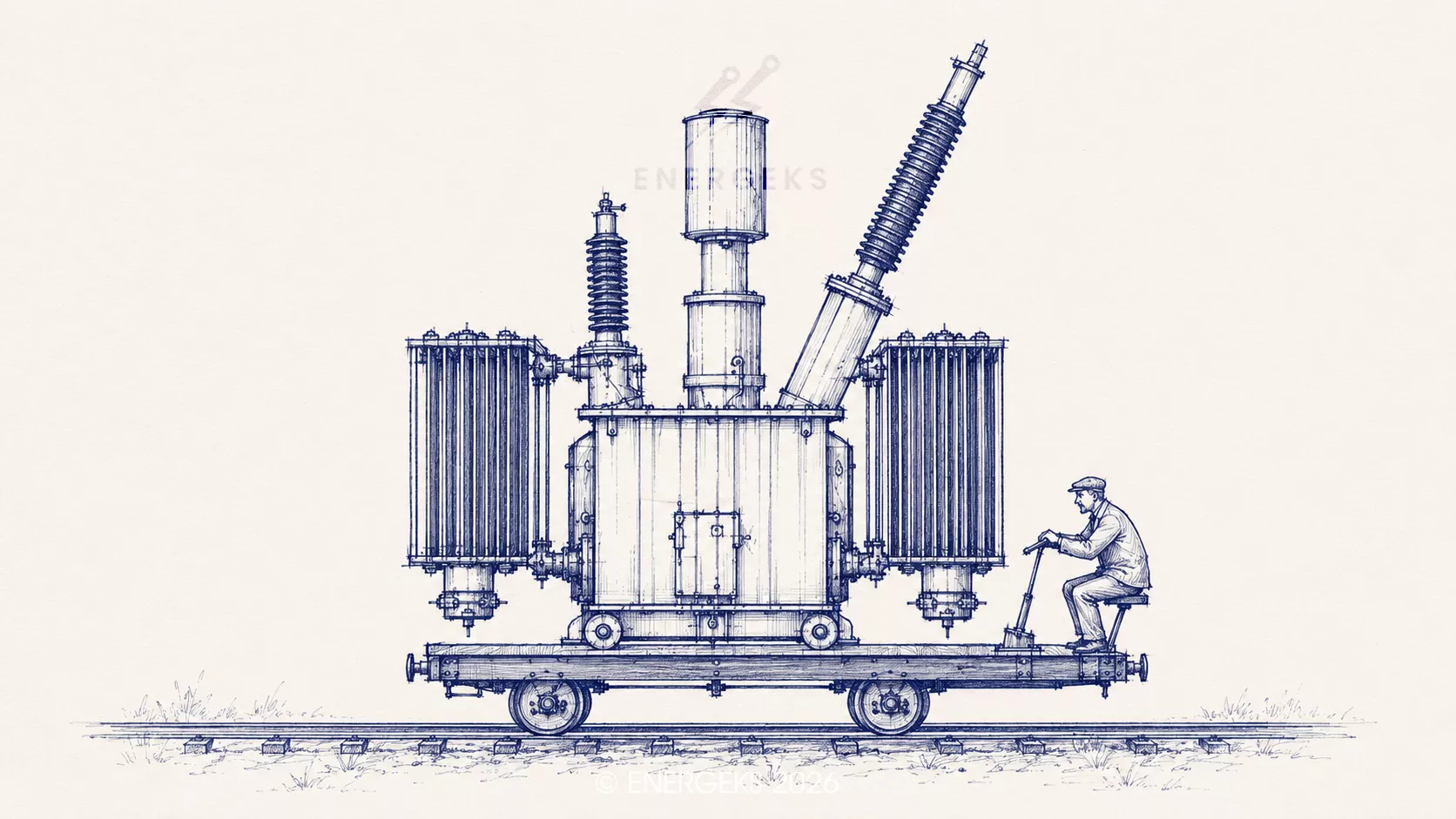
From this article you will learn how the transport of a power transformer is planned, what in practice dimensions of about 9.2 m length, 3.4 m width, 4.0 m height and a weight of about 165 tonnes without oil mean, how unloading looks, and why post‑delivery inspection protects the entire investment.
Power transformer transport is not a delivery. It is a technical operation.
There are loads that arrive on a pallet.
There are those that a courier leaves at the gate.
And there are those at which the gate itself starts asking existential questions.
A power transformer with a length of about 9.2 m, width of about 3.4 m, height of about 4.0 m and a transport weight without oil of about 165 tonnes does not travel like ordinary equipment. It does not "drive". It is led along the route like a technical operation on a living organism of infrastructure.
A powerful tractor and good intentions are not enough.
You need a route that really has a margin.
You need a trailer matched to the pressures.
You need an unloading plan that is not made over coffee five minutes before the manoeuvre.
You need people who know that 165 tonnes do not like sudden ideas.
At Energeks, we take this topic seriously, because a power transformer is not an ordinary delivery item.
It is the future heart of a power supply system.
Before it starts working, it must safely pass through transport, unloading, post‑delivery inspection, positioning and preparation for commissioning.
And that is what this text is about.
About logistics that looks spectacular but in practice is precision.
About unloading where patience weighs more than steel.
About post‑delivery inspection that tells you more than the best assurances.
And about why good power transformer transport is not an add‑on to the investment, but one of its first quality tests.
Reading time: about 9 minutes.
In power transformer transport, the numbers are not decoration in the documentation.
They are the instruction manual for the survival of the whole operation.
9.2 m length is not just information that the load is long. It is a forecast of how the whole combination will behave on curves, roundabouts, intersections, plant gates and the last metres to the foundation.
3.4 m width means that the comfort of a normal traffic lane ends. Logistics begins where the driver, pilot, traffic management and travel plan must act as one organism. At this width, even an ordinary road sign can suddenly become a technical problem.
4.0 m height forces you to look not only ahead but also upward. Bridges, overhead wires, gates, canopies, process pipelines and structures on the plant site cease to be scenery. They become a checklist.
And 165 tonnes of transport weight without oil?
That is no longer a number.
That is a character.
The weight of a transformer determines axle loads, trailer selection, lashing method, suspension behaviour, ground preparation, unloading options, support points and whether the foundation is really ready to meet a device of this class.
That is precisely why a transformer is not a load that simply needs to be transported.
It is an object that needs to be understood.
The most important thing is the centre of gravity. It does not look spectacular. It does not have its own nameplate with fanfares. Yet it decides how the transformer will behave during lifting, braking, turning, tilting, moving and positioning.
If the centre of gravity is treated superficially, you can have excellent equipment and still create a situation that no sensible person wants to see up close.
It is a bit like carrying a huge wardrobe with a hidden safe on one side. From the outside you see a rectangle. In your hands you feel the truth.
A transformer also has its truth. And you need to know it before the first move.
That is why transport drawings, marking of the centre of gravity, lifting points, lashing points, support points and manufacturer's instructions are so important. This is not paperwork. It is the nerve map of the whole operation.
In power transformer transport, the shortest route does not win.
The route that does not pretend to be ready wins.
On paper, everything may look innocent. The road exists. The bridge exists. The gate exists. The curve exists. But a combination with a 165 tonne transformer does not ask whether something exists. It asks whether it can safely pass that way.
You need to check turning radii, bridge load‑bearing capacities, culverts, shoulders, height restrictions, overhanging wires, roundabouts, intersections, road surface, entrance to the site, and the last metres to the unloading point.
And those last metres can be the most malicious.
The transformer may travel hundreds of kilometres, passing bridges, gates and roundabouts, and then stop a few dozen metres from its destination because the ground is not ready, the turning radius is too tight, or the unloading equipment has no room to work.
That is why not only the public road is analysed. The plant site, site roads, manoeuvring areas, access to the foundation and the working area of the crane or sliding system are also analysed.
In heavy logistics, the map is the beginning. Reality always needs to be examined more closely.
From the outside, transformer unloading may look simple.
A crane arrives. We attach. We lift. We move. Done.
A beautiful fairy tale.
In the real world, 165 tonnes do not respond to optimism. They respond to geometry, centre of gravity, working radius, ground load‑bearing capacity, lifting points, sling angles, sequence of movements and quality of communication between people.
It is not about having a big crane.
The crane must be selected for the specific operation. For the specific weight. For the specific radius. For the specific height. For the specific position of the transformer and the specific working space.
Rated capacity looks good in a table, but during unloading the real configuration counts. The larger the working radius, the more the available capacity drops. The more difficult the ground, the more important the outriggers become. The less space around, the more every decision begins to resemble a game of chess with gravity.
And gravity does not lose through inattention.
That is why before unloading you need to know where the transport combination will stand, where the lifting equipment will stand, where the supports will be, how the load will pass, who gives the commands, what the safety zones are, and what we do if conditions cease to be ideal.
The moment the transformer is in the air is the worst moment for creativity.
Good unloading looks almost boring. And that is a compliment.
No shouting. No guessing. No sudden corrections. No people running in different directions. Everyone knows where they stand. Everyone knows when to speak. Everyone knows who makes the decision. Everyone knows when to stop the operation.
With large masses, speed is not evidence of professionalism.
Control is.
When the transformer is finally in place, many people think that the hardest part is behind them.
That is exactly when one of the most important stages begins.
Post‑delivery inspection.
It sounds modest. Almost official. In practice, it is a moment of truth.
A transformer may look good and still require thorough verification. It may also arrive with minor transport traces that are harmless, but they need to be assessed correctly. The mere presence of the device on site does not yet mean that everything is ready.
It means that you can start checking.
Post‑delivery inspection includes visual inspection of the tank, paint coatings, nozzles, valves, seals, lashing points, transport securing, separately delivered accessories and completeness of documentation. If the transformer was transported without oil, you also need to check the protection conditions of the active part, for example dry air or nitrogen pressure and tightness.
One of the key elements is the shock recorder.
A small device with great significance. Its task is to record events that could have stressed the transformer during transport, transhipment, parking or unloading. We are talking about shocks, vibrations, accelerations and sometimes also tilts. In more modern systems, there is also time stamping, GPS location and temperature.
The shock recorder acts like the transformer's black box.
It is not interested in who said that everything went gently. It records what really happened.
This does not mean that every recorded event is a disaster. But every significant event requires assessment. You need to combine the recorder data with the external condition of the device, transport documentation, information from the crew and the manufacturer's recommendations.
It is not about looking for sensation.
It is about a technical decision.
Because a power transformer has inside it a core, windings, connections, insulation, a tap changer and a whole precise internal architecture. Not everything that matters is visible to the naked eye.
That is why post‑delivery acceptance should not be based on faith.
It should be based on data.
The transformer has arrived.
It has been unloaded.
Now it needs to be positioned.
It sounds like the finale of the whole story.
In practice, this is the moment when many earlier decisions come to light. Not in theory. In the real contact of 165 tonnes with a prepared place.
The foundation for a power transformer is not a piece of concrete. It is part of the system.
It must carry static and dynamic loads. It must maintain geometry. It must work with support points, rails, rollers or a sliding system. It must enable operation, service, possible replacement and safe management of transformer oil if we are talking about an oil‑filled unit.
A transformer does not load the world generally.
It loads it specifically.
Through specific points, in a specific place, at a specific time. Therefore, the general load‑bearing capacity of the foundation is not enough. Local load under specific support points also matters.
Then there is levelling.
It is not cosmetic. It is not about the device looking nice in a photo. Incorrect positioning can affect load distribution, accessory assembly, access to valves, cooling performance, cable routing, earthing and future maintenance.
A power transformer should not fight with its own stand.
It is supposed to work on it.
That is why the positioning site must be ready earlier. Not almost ready. Ready. With an accepted foundation, checked level, prepared working space, provided service access, solved oil drainage and completed earthing.
With 165 tonnes, the word "almost" starts to become very expensive.
This is one of those questions to which the honest answer is: it depends on how much reality likes to complicate logistics.
The cost of power transformer transport is not calculated like ordinary freight per kilometre. Here you do not pay only for the journey from point A to point B. The pricing includes the weight of the device, its transport dimensions, the route, the number of axles in the combination, escort, permits, analysis of bridges and viaducts, possible removal of road infrastructure, trailer selection, preparation for loading, unloading, crane or sliding system, and sometimes also additional securing, technical stops and the work of several teams simultaneously.
Therefore, transport of a power transformer weighing several dozen tonnes will be a completely different operation than moving a unit weighing about 165 tonnes without oil. In the first case, we are talking about demanding logistics. In the second, about an operation where every metre of the route, every turning radius and every support point begins to have financial significance.
The greatest impact on cost usually comes from:
transformer weight
transport length, width and height
distance of transport
number of countries and formalities along the way
need for escort
difficulty of the last metres of access
selection of crane or unloading system
ground and foundation preparation
working time of technical teams
post‑delivery inspection requirements
In practice, the cheapest transformer transport is rarely the best news. If the quote looks too light for the weight of the device, it is worth asking what is missing. Does it include unloading? Does it cover route analysis? Does it include escort? Is a shock recorder foreseen? Has anyone checked the last section to the foundation? Is the lifting equipment selected for real conditions, not for an optimistic scenario?
Because with a power transformer, transport cost is not just a line item in the budget. It is part of the protection of the whole investment.
A well‑planned transport may seem more expensive at the beginning, but it often saves money where it really hurts: in delays, damage, additional cranes, foundation corrections, assembly downtime and nervous decisions made already on site.
In short: power transformer transport costs as much as the calm delivery of a very expensive, very heavy and very necessary device without improvisation along the way.
And that is one of the things that sensible people do not try to do accounting magic on.
Power transformer transport looks spectacular, but its real value lies not in photos from the road.
It lies in preparation.
In a route that has been checked. In equipment selected for the real weight and dimensions. In people who understand centre of gravity, lifting points, pressures, tilt and movement sequence. In post‑delivery inspection that relies not on impression but on data. In a foundation that is ready to receive the device without nervously writing the plan at the last minute.
A power transformer is not ordinary cargo. It is the future heart of a power supply system. Before it starts working, it must safely pass through transport, unloading, acceptance, positioning and preparation for commissioning.
And that is why good logistics is not an add‑on to the investment.
It is its first quality test.
If you are planning a project involving transformers, transformer stations, switchgear or solutions for power infrastructure, it is worth checking the full Energeks offer and seeing how broadly you can approach power supply from a technical, design and delivery perspective.
Depending on the working conditions, installation location and system requirements, a good starting point may be the choice between an oil‑immersed transformer and a dry‑type transformer. Each of these solutions has its specific applications, its advantages and its requirements, so the decision should result from real working conditions, not a random choice from a catalogue.
And if the project does not like to wait, it is also worth checking which transformers are available off the shelf.
Because sometimes the best news in power engineering is not a big promise, but concrete equipment availability when the schedule really needs it.
More technical inspiration, projects and power engineering specifics can also be found on the Energeks LinkedIn page.
references:
CIGRE Technical Brochure 673, Guide on transformer transportation
Mammoet, Transformer transport services
Hitachi Energy, Install and Commission
Shipped from our warehouse in Poland within 2–3 working days, 5-year warranty. Full range 25–2500 kVA in the shop (prices in PLN).
No reviews!