29 Jun
2026
Energeks
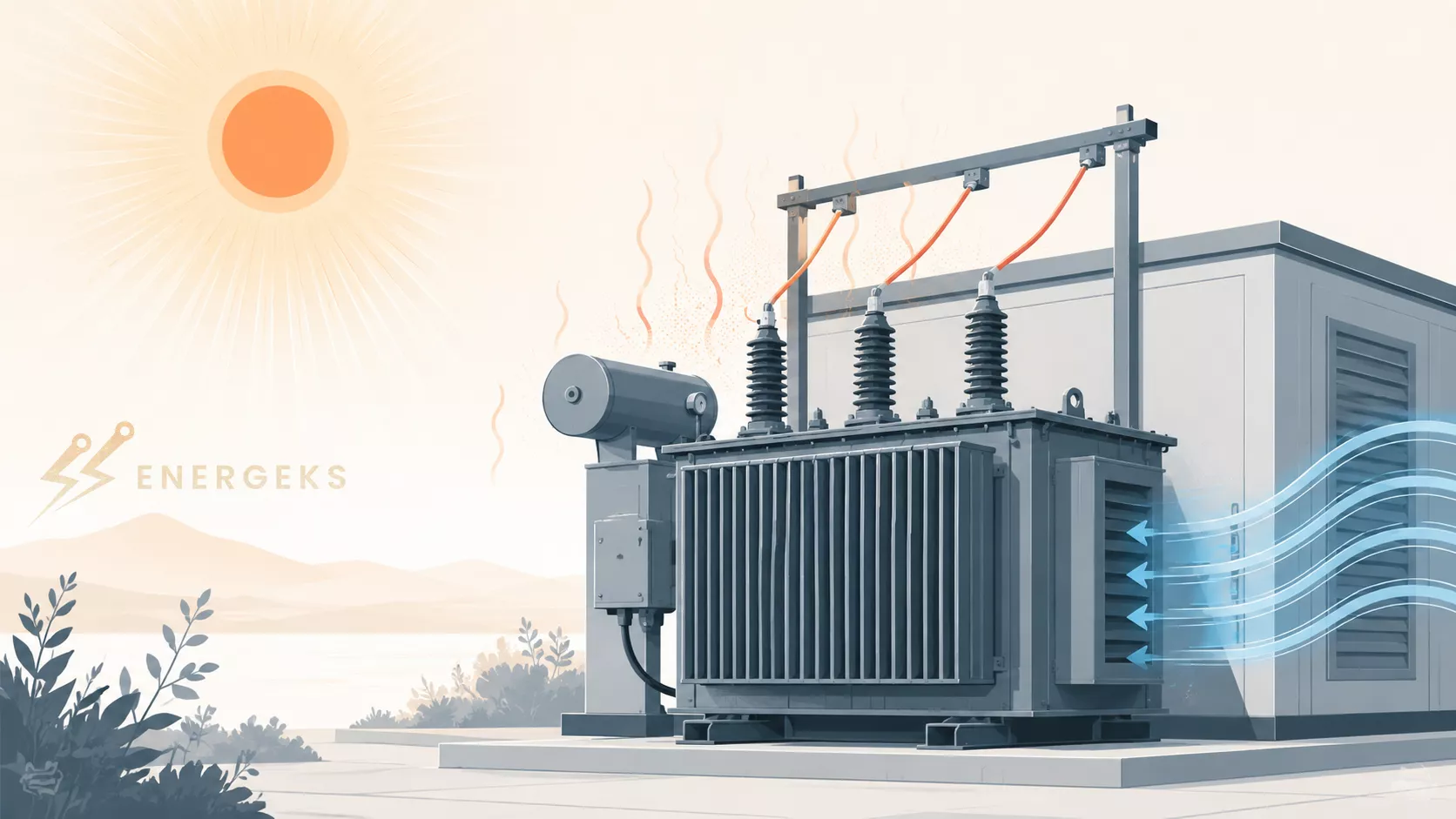
Heatwaves are returning. Transformers remember every one of them.
When the air temperature exceeds 35°C, most electrical devices simply work harder. Air conditioners draw more current. Refrigerators don't rest. Industry runs at full capacity because deadlines chase deadlines.
And the transformer stands in the corner of the switchgear station, in a container or in a building basement, and does its job. Without a word of complaint. Up to a point.
That point has a name: critical winding temperature.
When you exceed it, the transformer does not always shut down elegantly with an error message. Sometimes it just accelerates its ageing. Quietly. Invisibly. Day after day, throughout the hot summer.
This text is about what really happens to a transformer during a heatwave, why standard parameters can be misleading, and what exactly is worth checking before high temperature does it for you.
Reading time: about 9 minutes.
First, some physics without which the rest makes no sense
When a spectacular explosion of a power station appears in the media — like recent well‑known footage from the Enstedværket site near Aabenraa, a facility linked to Energinet infrastructure — it is easy to focus on the effect itself: the flash, the bang, the smoke, the scale of destruction.
Photo via LinkedIn on profile of Emil Mahler Larsen
But in power engineering, such images are only the finale.
The end of a process.
Before a failure, before protection trips, before an electric arc, fire or mechanical damage to equipment, physics always happens first. Sometimes over seconds. Sometimes over months. Sometimes over years.
And that is precisely why the conversation about transformer overheating in heatwaves is not seasonal scaremongering. It is a conversation about what happens inside the device long before the problem becomes spectacular.
A transformer produces heat. Not by accident, but by the very nature of its work.
Core losses. Copper or aluminium winding losses. Eddy currents. Leakage fluxes. All of this turns into heat that must go somewhere.
In oil‑immersed transformers, this heat is taken up by the oil, which circulates naturally or with pumps and releases energy to the surroundings through radiators or tank fins.
In dry‑type transformers — and we will focus on these here, because they stand in buildings, indoor substations, data centres and industrial halls — this heat is released to the air.
And here the problem begins.
Air in summer is warm.
Warm air absorbs heat less effectively than cold air.
A transformer that calmly operates with a winding temperature of 80°C in winter can reach 95–100°C in summer at the same load. Or more.
Every additional 10°C above the rated value translates into roughly twice as fast insulation ageing. This is not an opinion — it is the well‑researched Arrhenius law, used in electrical engineering for decades.
Insulation that should last 30 years, with regular exceedance of the permissible temperature, can end its life in half that time.
Reason 1: Ambient temperature higher than the design assumed
Most dry‑type transformers are designed for a maximum ambient temperature of 40°C. This is a standard value, often visible in the technical documentation.
What does this mean in practice?
That the manufacturer designed the cooling so that at 40°C in the room, the transformer does not exceed the permissible winding temperature.
When the ambient temperature exceeds 40°C — which in Poland's climate during the summers of 2024 and 2025 happened increasingly often — the transformer begins to operate outside its rated thermal capabilities.
There is no fault in that. It is simply physics.
If you have a dry‑type transformer and you do not know what the actual temperature is in its room on a hot day, you are in the situation of a driver who does not know the engine oil temperature on a climb up to the Tatra Mountains. The engine may get you there. But it may not come back intact.
What is worth doing: check what the actual ambient temperature is at the transformer on the hottest days. Not in the office. Not outside the building. At the transformer, at 3:00 PM, when the sun has been heating the walls and roof for several hours.
Reason 2: Room ventilation that cannot keep up
A dry‑type transformer cannot dissipate heat into a vacuum. It dissipates it into the air in the room. That air must go somewhere — and must be replaced by cooler air.
If the room ventilation is too weak, the air temperature at the transformer rises. The transformer dissipates heat into increasingly warmer air, which means it itself becomes increasingly warmer.
This is a vicious circle and can lead to overheating even at a load well below rated power.
Summer heat does one specific thing here: it heats the air outside the building, which is the source of cooling. If the ventilation intakes draw air from the south, and the sun heats the south wall of the building — the intake air temperature can be 5–10°C higher than the air temperature in the shade.
And that is before the air even reaches the transformer.
What is worth doing: assess whether the ventilation openings are well placed and whether the grilles are not blocked by dust, dirt‑clogged protective meshes or accidental storage of items. Check whether the airflow actually passes through the room, rather than circulating in a closed loop.
Reason 3: Load increases together with temperature
This is the paradox of summer that hurts double.
When it gets hot, the demand for electricity rises. Air conditioning. Ventilation. Cooling systems. Food industry at full speed. Refrigerators, freezers, server room cooling systems — everything wants its share of power.
This means that transformers are more loaded in summer than in winter.
And at the same time they have a worse ability to dissipate heat.
Higher load → more losses in windings → more heat to dissipate. Higher ambient temperature → worse cooling conditions → slower heat dissipation.
These two effects act at the same time and in the same direction.
A transformer in July therefore works under a double unfavourable condition. It produces more heat and dissipates it more slowly.
What is worth doing: check historical load data for the transformer from previous years during the summer months. If the load has increased in recent years (because more air conditioning, new equipment or facility expansion has been added), the thermal margin may have shrunk.
Reason 4: Temperature sensors that do not alarm in time
A modern dry‑type transformer should be equipped with winding temperature sensors. These can be PT100 or PTC sensors, which work with a thermal relay. The relay sends an alarm signal at the first threshold and disconnects the transformer at the second — critical — threshold.
Sounds good.
But in practice, three problems appear.
First: the sensor measures temperature at a specific point on the winding. If it is poorly placed or outdated, it may not reflect the actual temperature at the hottest point of the coil.
Second: some transformers, especially older or cheaper installations, have alarm settings set too high. The alarm appears when the insulation has already been operating in excessive heat conditions for weeks.
Third: the alarm signal goes to the building's BMS system or to a local panel. If no one is actively monitoring this in summer, the alarm may burn unnoticed for several hours.
What is worth doing: check when the sensor system was last calibrated and tested. Check the alarm settings in the documentation and compare them with the temperature for class F insulation (155°C) or class B (130°C). Ensure that the alarm reaches someone who responds — not just logged in a file.
Reason 5: Overload during the summer peak
Transformers have the ability for short‑term overload — even up to 120–150% of rated power for a specified time. This is a design option, useful for temporary demand peaks.
Only this capability is calculated on the assumption that the transformer operated for some time at low load before the overload and is relatively cold.
In summer, the transformer can be warm around the clock. Cool nights, which in winter gave it time to rebuild its thermal margin, may not provide sufficient cooling in summer.
When such a transformer enters a peak load state — say, during a hot afternoon when air conditioning is pulling full power — it starts from a higher base temperature. The margin to critical temperature is smaller. An overload that would be fine in winter can be risky in summer.
What is worth doing: if the transformer is often used close to its rated power limits, review the overload curves in the technical documentation and check how they change with ambient temperature. Manufacturers provide this data. It is worth reading before August, not after.
Reason 6: Dust and dirt in summer block cooling ducts
Dry‑type transformers dissipate heat through air ducts in the windings and between structural elements. These ducts must be clear.
In summer, when windows and doors are open more often, fans work more intensively, and nearby construction and renovation work generates more dust — the amount of dust in the air increases.
Dust settles on the windings and in the ducts. If the winding is of the open‑wound or VPI type, dust can gradually restrict airflow. The thicker the dust layer, the worse the cooling.
In cast‑resin transformers, the problem is smaller — the epoxy resin creates a closed shield around the windings. But here too, dust on the external surfaces blocks heat exchange.
Additionally, dust saturated with moisture can pose a risk to insulation — especially if it contains metallic particles or chemical substances from production.
What is worth doing: check the cleanliness of the transformer and its surroundings. If previous inspections showed excessive contamination, it may be worth planning cleaning before the summer peak, not after.
Reason 7: The transformer simply has years on it
Transformer insulation ages. This is not an opinion — it is a technical and economic fact worth taking into account.
With each year of operation, with each heatwave, with each overload and each heating and cooling cycle, the insulation loses its properties. It becomes brittle. Loses flexibility. Its dielectric strength decreases.
A transformer that is 15–20 years old and for half its life has operated in difficult thermal conditions may have insulation in a condition corresponding to a much older device.
No one sees this with the naked eye. The insulation may look good and at the same time be on the verge of breakdown.
Heat is not a problem in itself. Heat is a test.
If the insulation is in good condition, the test will pass without complications. If it is tired — heat may be the moment that finalises what began several years earlier.
What is worth doing: if the transformer is over 15 years old and has not undergone diagnostics in the last few seasons, it is worth considering insulation measurements. Insulation resistance measurement, absorption coefficient, and in the case of oil‑immersed transformers — oil analysis — are tools that give a real picture of the device's technical condition.
What to specifically do when a heatwave arrives
Below is a practical list of actions that make sense before and during high temperatures. There is nothing exotic here — only things that really affect the safety of transformer operation.
Before the summer season:
Check the temperature in the transformer room from the previous summer, if you have such data. Compare it with the ambient temperature assumed in the documentation.
Assess ventilation: are the grilles clear, is the airflow correct, is the intake air not coming from places excessively heated by the sun?
Check the temperature sensor settings and test whether the alarm signal actually reaches the responsible person.
Assess historical load — is the transformer being increasingly loaded year on year?
If the transformer is over 15 years old, consider a diagnostic inspection before the season.
During a heatwave:
Monitor the temperature in the transformer room regularly — not just once a week.
If the transformer has forced cooling (AF fans), check whether the fans are working correctly and whether their operation is triggered at the right time.
If you have the ability to temporarily distribute the load or reduce non‑productive loads during the temperature peak, consider it.
Do not ignore a temperature alarm, even if it has always turned out to be false before. In summer, every alarm needs checking.
Dry‑type vs oil‑immersed transformer — does this change the situation?
Yes, but not as many think.
An oil‑immersed transformer has oil that carries heat away from the windings to the tank walls and radiators. This allows for higher thermal capacity and slower winding temperature rise during short‑term peaks.
But the oil also has its own critical temperature. At too high ambient temperature and too weak cooling — for example with blocked tank fins or a damaged cooling pump — an oil‑immersed transformer will also overheat.
A dry‑type transformer reacts faster to ambient temperature changes because it does not have the thermal buffer of oil. On the other hand, there is no risk of oil leakage, no risk of oil fire, and it is generally less complex to operate.
In both cases, the principle is the same: high ambient temperature reduces the transformer's ability to dissipate heat. And in both cases, ignoring this for several seasons leaves a mark on the insulation.
A few words about what is not worth doing
It is not worth relying solely on the fact that "it has always worked."
Transformers are unfailingly patient devices. They can operate in poor conditions for months and years without giving clear signals. And then the failure happens suddenly — often during the first major overload or an especially long heatwave.
It is also not worth assuming that since the transformer has a temperature sensor, the problem will solve itself. A sensor can warn — but it cannot improve ventilation, reduce load or repair insulation that is already tired.
And it is not worth comparing a transformer to a device where "if it breaks, we will buy a new one." MV transformers are investments for decades. Premature failure is not only the cost of buying a new device — it is downtime, installation cost, risk of burnouts in the installation, potential production loss and a lot of nerves at the station.
Heat is not an enemy of the transformer if you help it
A heatwave is a test of the power infrastructure.
Most transformers that are in good technical condition and operate in well‑designed conditions will get through the summer without problems. These are devices built for long‑term operation.
But those that are a dozen or so years old, operate in poorly ventilated rooms, are increasingly loaded and have not been regularly checked — have much less margin in summer.
The good news is simple: most of these problems can be checked, assessed and improved. Ventilation. Load. Cleanliness. Sensors. Insulation condition.
This is not complicated diagnostics. It is taking care of a device that serves the entire installation and has no replacement during a failure.
If you do not know what condition your transformer is in and how it will react to the next heatwave — this is a good time to find out.
Want to check your transformer before the season?
At Energeks, we help select transformers for real operating conditions and assess whether an existing device has the right margin for summer peaks.
If you are planning a transformer replacement, station modernisation or want to check whether the current unit has the right power reserve, see:
—> our range of dry‑type and oil‑immersed transformers
—> transformers available off‑the‑shelf in our warehouse
—> further technical analyses on the Energeks LinkedIn profile
In a well‑designed transformer station, summer should not be a lottery.
It should be just another working season.
sources:
Energinet — Ensted–Kiskelund / Enstedværket przy Aabenraa
IEC 60076-7:2018 — Loading guide for mineral-oil-immersed power transformers
Shipped from our warehouse in Poland within 2–3 working days, 5-year warranty. Full range 25–2500 kVA in the shop (prices in PLN).
No reviews!