25 Feb
2025
Energeks
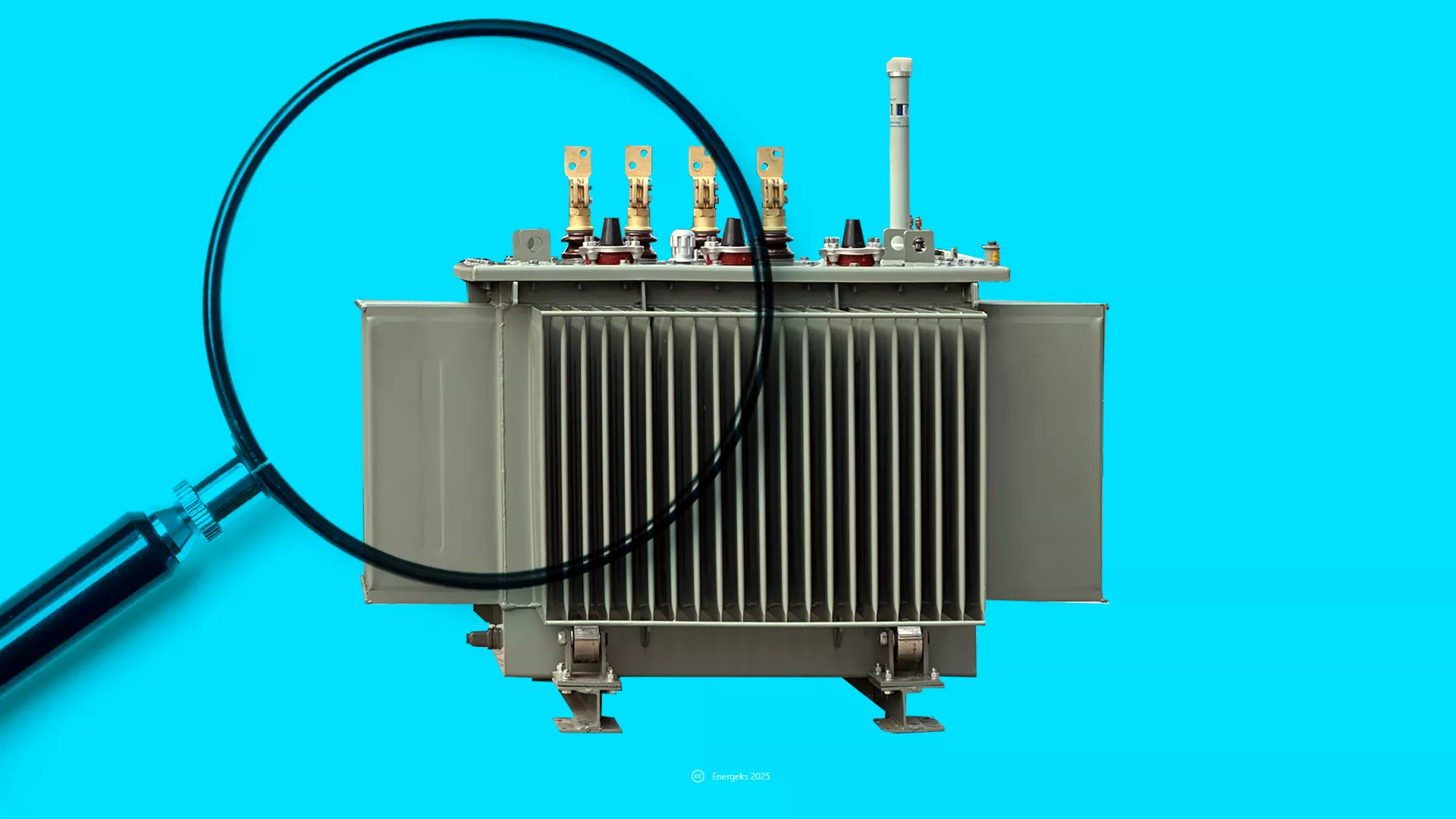
A transformer is the backbone of modern power engineering—it enables long-distance energy transmission, minimizes losses, and adjusts voltage to meet consumer demands. But how do engineers predict its behavior without fully loading the device? The key lies in the equivalent circuit, a mathematical model that replicates the real parameters of the transformer. This model allows for the analysis of power losses, operational efficiency, and the impact of temperature on performance.
To accurately determine the parameters of the equivalent circuit, two key tests are conducted:
✅ The no-load test, which measures core losses and magnetizing current.
✅ The short-circuit test, which determines winding losses and short-circuit impedance.
The results of these tests enable engineers to optimize the transformer for energy efficiency and compliance with IEC and IEEE standards. How are these measurements performed? How do they influence transformer design and operation? You'll find the answers in the following sections.
Reading time: 2.5 minutes.
Engineers understand that no real electrical machine behaves like its ideal counterpart. Power losses, impedance, and the non-ideal reluctance of the core are all factors that influence a transformer's performance. To predict its behavior accurately, engineers use the equivalent circuit—a mathematical representation that reflects the key parameters of the transformer. But how is this circuit determined, and what does it reveal about the efficiency of the device? The answers lie in two fundamental tests: the no-load test and the short-circuit test.
The equivalent circuit of a transformer is a mathematical model of its electrical properties, allowing for performance analysis without the need for real-world load testing. By incorporating passive elements, such as resistances (which account for power losses) and reactances (which model the impact of the magnetic field), engineers can predict transformer behavior across various operating conditions with high accuracy.
This model enables engineers to:
✅ Determine power losses—both in the windings and in the core—directly affecting the transformer's efficiency.
✅ Calculate the magnetizing current (I_m)—essential for maintaining the magnetic field within the core.
✅ Analyze the impact of load variations—predicting how the transformer responds to different operating conditions.
An ideal transformer, in theory, has no losses—its windings have zero resistance, and its core has infinite magnetic permeability, meaning all electrical energy is transferred without any dissipation.
In reality, however, every transformer is subject to several inefficiencies:
🔹 Copper losses (I²R losses)—resulting from the resistance of the wires wound around the core. The greater the current flowing through the windings, the more energy is converted into heat, impacting efficiency and temperature control.
🔹 Core losses—caused by the continuous magnetization and demagnetization of the core material. These include:
• Hysteresis losses, which occur due to the material’s resistance to repeated magnetic reversals.
• Eddy current losses, induced by circulating currents within the core that generate unwanted heat.
🔹 Magnetic losses (leakage flux)—not all the magnetic flux is confined to the core; some of it leaks through surrounding air or structural elements, leading to additional energy losses.
By implementing the equivalent circuit model, engineers can optimize transformer parameters as early as the design phase and accurately predict its performance during operation. This approach is a crucial tool in power engineering, enabling informed decisions that enhance the efficiency of entire electrical networks.
Imagine a transformer as a system of interconnected vessels, designed to evenly distribute water (electrical energy) between various points. In an ideal world, there are no leaks—all the water flows precisely where it is needed. However, real transformers resemble water distribution systems with small leaks (power losses) and varying pipe resistance (reactance and resistance), affecting the overall flow. Transformer modeling allows engineers to "seal these leaks" and optimize energy transfer, ensuring minimal losses.
A theoretical transformer model helps engineers predict its behavior, determine efficiency, and assess how well it adapts voltage to consumer requirements. By analyzing its equivalent circuit, they can pinpoint key sources of energy loss that impact performance:
🔹 copper losses (I²R) – these can be compared to heat generated in an electrical wire when current flows through it. The higher the resistance of the windings (R₁ and R₂), the more energy is converted into heat instead of being delivered to the load. It’s like riding a bike with underinflated tires—you need to put in more effort, but you get less output.
🔹 core losses – the transformer's core is its heart, undergoing continuous magnetization cycles. The two primary loss mechanisms are:
• hysteresis losses, similar to metal fatigue—each change in the magnetic field makes the core material resist these changes, consuming energy.
• eddy current losses, acting like tiny stray currents flowing within the core, generating heat and wasting energy. This is similar to heat loss in central heating pipes—the poorer the insulation, the greater the waste.
🔹 magnetic losses (leakage reactance X₁ and X₂) – imagine trying to fill a bucket using a funnel, but some of the water splashes out. The same happens in a transformer—not all magnetic flux stays confined within the core. Some of it escapes into the surrounding air, leading to incomplete coupling between the windings and increasing voltage drops.
By identifying and mitigating these losses through transformer modeling, engineers can improve efficiency, enhance design precision, and ensure reliable operation in real-world conditions.
In an ideal transformer, all energy is transferred without losses—voltage and current pass seamlessly from the primary winding to the secondary winding, based on the turn ratio (N₁/N₂). However, real-world transformers can never achieve this level of perfection.
This is why engineers rely on transformer modeling to:
✅ Optimize design parameters—minimizing power losses and improving efficiency.
✅ Analyze voltage regulation—assessing how load variations impact the output voltage.
✅ Increase the device’s lifespan—designing windings and cores in a way that reduces overheating and thermal losses.
Transformer modeling not only improves operational efficiency but also significantly reduces maintenance and energy costs, which is essential in modern power systems. By leveraging precise models, engineers can predict how a transformer will behave under different operating conditions—just like an architect anticipates how a building will respond to changing weather conditions.
Every transformer, regardless of its design and purpose, loses a portion of energy during operation. These losses directly impact efficiency—the higher the losses, the less energy reaches consumers, and the more is converted into heat. In practice, this necessitates effective cooling systems and optimized construction to minimize unnecessary energy waste.
🔹 winding losses (copper losses, I²R) – each winding coil has an inherent resistance, causing a fraction of electrical energy to be converted into heat. It’s like an electrical wire that is too thin—the higher the resistance, the more energy is lost along the way.
🔹 core losses – caused by the continuous magnetization and demagnetization of the core material. These include:
• hysteresis losses—similar to kneading a piece of clay—each time the magnetic field changes, the core material resists the change, consuming energy.
• eddy current losses—tiny circulating currents form within the core, heating the material and leading to additional energy dissipation.
🔹 magnetic leakage losses – in an ideal transformer, the entire magnetic flux circulates within the core, ensuring efficient power transfer between the windings. In reality, some of this flux escapes into surrounding air or structural elements, failing to contribute to power transmission—similar to heat escaping from an uninsulated house during winter.
The no-load test is one of the most crucial assessments in transformer analysis. It helps determine core losses and key parameters of the equivalent circuit. The test is performed by applying rated voltage to the low-voltage winding, while the high-voltage winding remains open. During the test, engineers measure voltage, current, and active power, which allows them to calculate:
Core losses (Pm) – dependent on voltage and core temperature.
Magnetizing current (Io) – the small current required to sustain the magnetic field in the core.
Core loss resistance (Rc) and magnetizing reactance (Xm) – key parameters used in transformer modeling.
These losses occur whenever the transformer is energized, even if it is not supplying a load. Minimizing no-load losses is crucial for improving efficiency. By analyzing these parameters, engineers can evaluate core quality and performance under different voltage and temperature conditions.
To meet industry standards, test results must be adjusted to a sinusoidal voltage waveform.
Corrected no-load losses (Po) are calculated using the formula:
Po = Pm × (1 + d)
where:
Po = corrected no-load losses
Pm = measured no-load losses
d = deviation of the measured voltage from the effective value
A different method is used, taking into account hysteresis and eddy current losses:
Po = Pm ÷ (P1 + k × P2)
where:
P1 = unit hysteresis loss (typically 0.5)
P2 = unit eddy current loss (typically 0.5)
k = factor depending on voltage
Additionally, for temperature variations, a correction factor is applied:
Pr (Tr) = Po × [1 + (Tm – Tr) × KT]
where:
Tm = top oil temperature during the test
Tr = reference temperature (usually 20°C)
To ensure reliable results, IEC and IEEE standards define correction factors to compensate for:
✅ Voltage waveform distortions – harmonics in the supply voltage can influence reactive power readings and core loss calculations.
✅ Oil temperature fluctuations – core and copper losses change with temperature, so test results are adjusted to a standard reference condition of 20°C.
Applying these corrections ensures that the test results accurately reflect real operating conditions, allowing for precise efficiency calculations.
Industry standards define the acceptable deviation between measured and declared transformer losses:
IEC standard → losses cannot exceed manufacturer specifications by more than 15%, and total losses must not be more than 10% over catalog values.
IEEE standard → losses cannot exceed 10%, and total losses must not be more than 6% over declared values.
These limits help ensure that transformers operate efficiently and reliably within expected performance margins.
A transformer is a long-term investment—its reliability and efficiency directly impact the stability of the power grid and, ultimately, the security of energy supply. To ensure that a transformer performs as expected, it undergoes rigorous testing, evaluating its efficiency and resistance to various load conditions.
Open-circuit and short-circuit tests are not just routine procedures—they are the foundation of transformer diagnostics. These tests allow engineers to:
✅ Accurately determine losses and efficiency – identifying where energy is lost and how effectively the transformer converts power.
✅ Simulate performance under different load conditions – predicting how the transformer will respond to varying operational scenarios.
✅ Optimize operational parameters – preventing overloads and extending the transformer’s lifespan.
✅ Ensure compliance with international IEC and IEEE standards, guaranteeing that the transformer meets the highest quality requirements.
The equivalent circuit of a transformer is one of the most valuable engineering tools, enabling loss prediction, performance optimization, and regulatory compliance. However, modeling alone is not enough—precise testing is essential, providing real-world performance data.
At Energeks, our transformers undergo comprehensive testing, including no-load and short-circuit tests.
To learn more about the detailed tests our products undergo, click here:
Thanks to this, every transformer leaving our production lines is thoroughly verified for efficiency and ready to operate under the most demanding conditions. You can rely on our expertise and precision—let us know how we can support your business!
Sources:
IEC 60076-1:2011 - Power Transformers – General Requirements
IEEE C57.12.90-2015 - IEEE Standard Test Code for Transformers
EPRI - Electrical Power Research Institute - Transformer Testing Guide
Shipped from our warehouse in Poland within 2–3 working days, 5-year warranty. Full range 25–2500 kVA in the shop (prices in PLN).
No reviews!