4 Nov
2026
Energeks
Energeks · guide
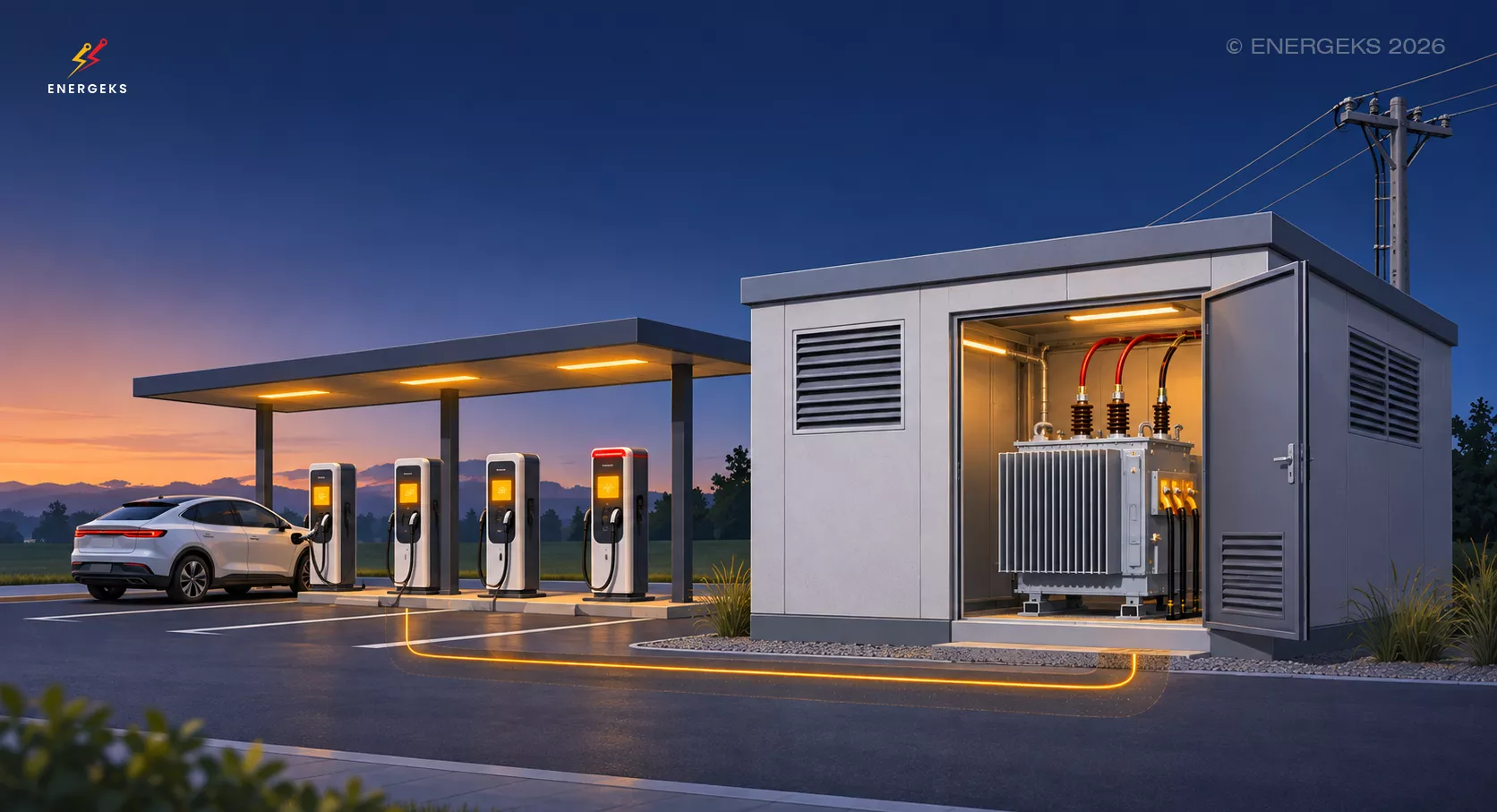
A substation for EV chargers works differently from one that supplies an ordinary consumer. It has many high-current LV feeders, often runs close to its rated power and will almost certainly be expanded. Here is how to choose the rating, the feeders, the transformer panel, the metering and the reserve for expansion.
2,500 kVA
top rating in the E-mobility line of the configurator
16
LV outgoing feeders per switchboard section
228 A
drawn by a 150 kW DC charger at 400 V
how much charger power a transformer of a given rating can supply,
which NH fuse base to choose for 50 to 300 kW chargers,
when two transformers make sense,
how the transformer panel, main LV device and busbars change with the rating,
how a target rating prepares the substation for expansion,
which documents the configurator generates for the design and the tender.
The starting point is the total power of the chargers that can run at the same time. With a power factor of 0.95, a transformer rated S kVA supplies chargers with a total active power of up to about 0.95 × S kW. The Energeks station configurator has a separate E-mobility line for this application: from 630 to 2,500 kVA, up to 16 LV outgoing feeders, also with two transformers.
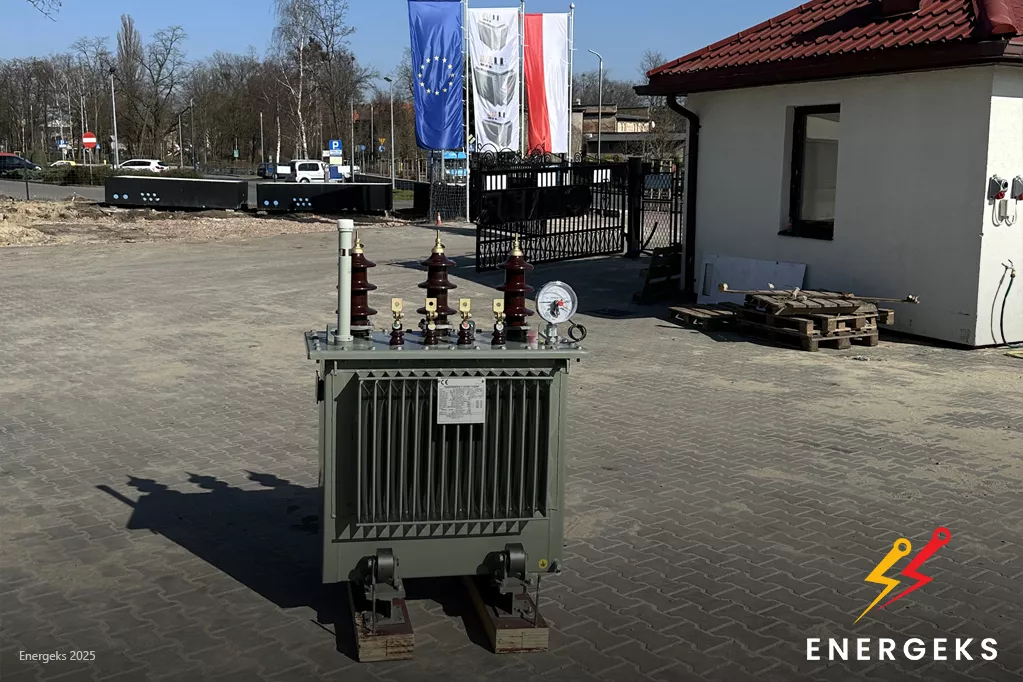
The table shows this directly, without a simultaneity factor and without load management. Oil-immersed units for these ratings are in our MarkoEco2 transformer range.
If the chargers have load management or do not all run at once, the designer can apply a simultaneity factor and connect more charging points. In any case, the connection capacity is set by the network operator's connection conditions.
A 150 kW DC charger draws about 228 A from the 400 V network, and a 300 kW charger about 456 A, both at a power factor of 0.95. The NH fuse bases in the LV switchboard are chosen for these currents, and option N in the station code sets the feeder size.
The fuse base needs a margin over the charger current, so for 150 kW choose NH2 rather than NH1. NH2 is the default feeder size in the E-mobility line. Fuse links, cable cross-sections and selectivity with the MV-side protection are chosen by the designer.
Higher-power chargers, such as 400 kW units, need a separate feeder solution, so describe them in your request for quotation. Example: 8 NH3 feeders for 300 kW chargers give the code ENG-E1000-15S-LPV-08-KN3.
In the E-mobility line you choose from 4 to 16 outgoing feeders plus spare panels, with up to 24 panels in the LV switchboard in total. For example, ENG-E1000-15S-LPV-16+08-K means 16 feeders and 8 spare panels.
With two transformers, from 2 × 630 to 2 × 1,000 kVA, the LV switchboard has two sections with a normally open bus coupler and an interlock against parallel operation of the transformers. The number of feeders applies to each section. Two transformers are also a reserve: if one fails, some of the chargers keep working.
The higher the rating, the higher the LV currents and the short-circuit currents on the busbars. This is how the configurator engine sizes the substation for a 15 kV network with its operating voltage range.
At 15 kV the configurator uses a circuit breaker instead of a fuse switch-disconnector in the transformer panel from 1,000 kVA upwards. The HH fuse link for this rating is at the limit of typical 24 kV switchgear, as we explain in the article on sizing a substation by transformer rating.
Metering in a charger substation is usually on the MV side, in metering panel P. The highest LV metering threshold in the standards of the five Polish network operators is 400 kVA. The details are in our article MV or LV metering?
Charging hubs and depots grow in stages. Option D in the station code (target rating) sizes the enclosure, oil sump, ventilation, main LV device, busbars and the connection between transformer and LV switchboard for a higher rating, while the initial transformer can be smaller. We cover planning for growth in more detail in MV transformers and future expansion of the installation.
In practice
Replacing the transformer with a 1,600 kVA unit then does not require rebuilding the enclosure. An increase in connection capacity, however, is decided by new connection conditions from the network operator.
In the E-mobility line the configurator proposes telecontrol preparation by default (T1 in the code). The line panels of the MV switchgear are prepared for 24 V DC motor operators, switch position signalling and measurements, without dismantling the switchgear.
You can also choose short-circuit fault indicators (T2) and remote control of the line panels with a controller and a buffered power supply (T3).
For every configuration you can download, without registration, the technical design for adaptation by the designer and a data sheet in PDF, drawings, a single-line diagram, a bill of materials and the tender specification in DOCX and PDF. The interface is in Polish.
In the E-mobility line the tender specification states the purpose of the substation in its title: supply of electric vehicle charging stations. The configuration from this article, 1,000 kVA with 12 NH2 feeders, MV metering, a 1,600 kVA target rating and telecontrol preparation, opens with the code ENG-E1000-15S-LPV-12-KD1600T1.
At a power factor of 0.95, a 1,000 kVA transformer supplies about 950 kW of chargers running at the same time, which means 6 chargers of 150 kW. With load management or a simultaneity factor the designer can connect more charging points, within the connection capacity set by the network operator.
A 150 kW charger draws about 228 A at 400 V. NH1 rated 250 A leaves too little margin, so the E-mobility line uses NH2 rated 400 A as the default feeder size.
Usually MV metering, in metering panel P. The highest LV metering threshold in the standards of the five Polish network operators is 400 kVA, and the E-mobility line starts at 630 kVA.
Send us your charger list, your expansion plan and the connection conditions, and together we will work out a substation that fits today and still fits in three years. We share more from charging hubs and substation projects on LinkedIn, so come and follow us there
Sources
Energeks station configurator selection engiine, version 0.8 (October 2026): currents, switchgear, busbars, enclosures and oil sumps in the tables.
Charger current: I = P / (√3 × 400 V × 0.95); charger power in simultaneous operation 0.95 × S.
These are the author's assumptions, to be verified by the designer against the charger data.
Tender specification template from the configurator, version 1.0 (October 2026).
No reviews!