15 Jul
2025
Energeks
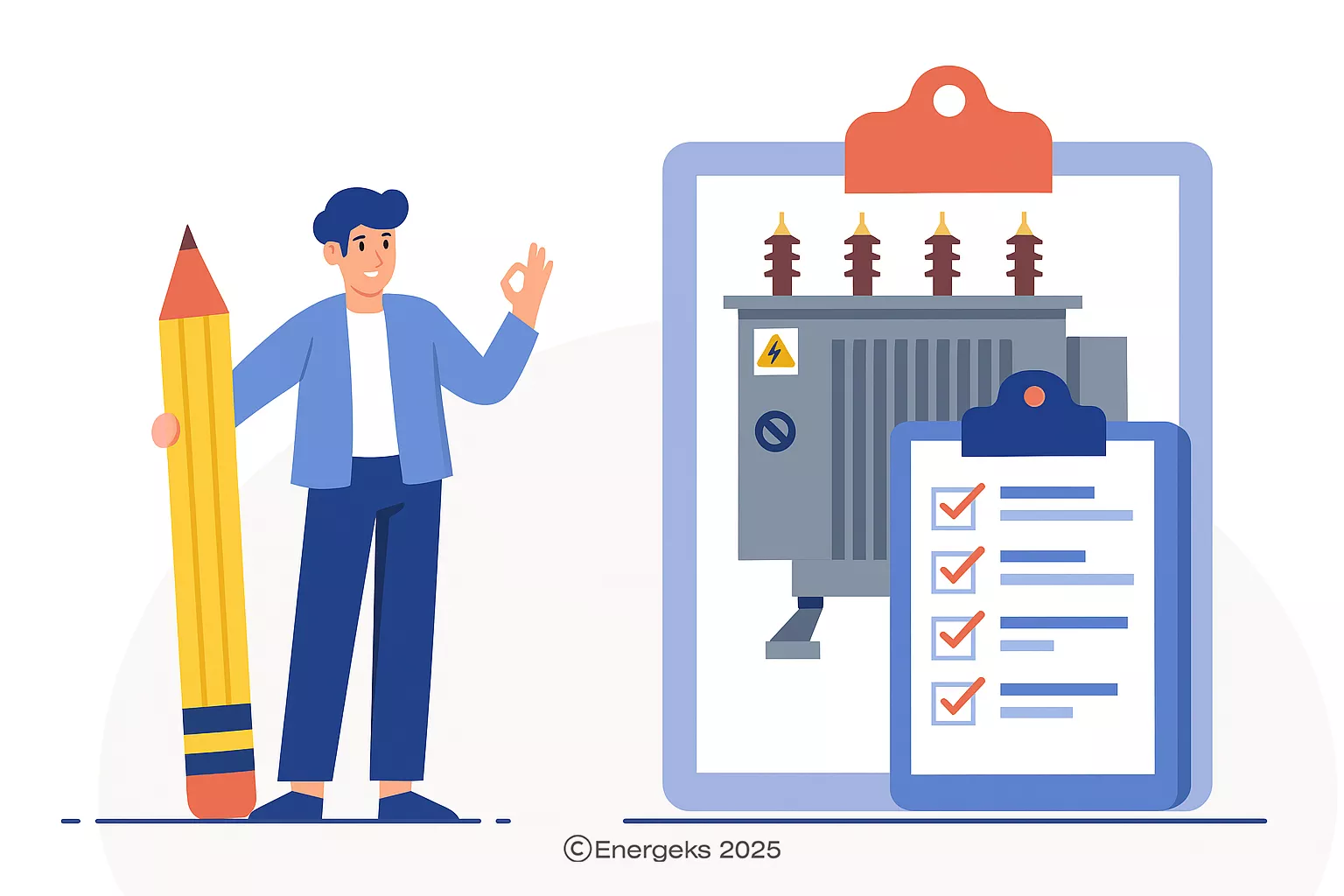
Step by Step Through All the Documents Required by the Grid Operator, Technical Inspection Authority – and Your Own Safety Standards
The transformer arrives on site.
New, gleaming, with a precisely engraved nameplate.
Everything seems in order – and yet, something is missing. Commissioning is delayed for days, sometimes even weeks.
Because somewhere, a single document is missing. Or maybe two.
We know exactly what that feels like in practice. The site manager calls: “The registration is missing.”
The grid operator demands: “Please submit the complete test report.”
The investor asks: “Why haven’t we received a wiring diagram with serial numbers?”
These may seem like minor details – but they are exactly the details that determine whether a project stays on schedule or falls behind.
At Energeks, we experience this daily – through conversations with dozens of companies that have implemented hundreds of projects and still regularly ask themselves:
“Do we really have all the documents needed for commissioning?”
And that question alone is a sign of quality. Because this isn’t just about a transformer.
It’s about responsibility.
If you are:
responsible for ordering a medium-voltage unit and want to avoid unpleasant surprises during acceptance,
planning or managing an electrical installation where every detail matters,
preparing technical documentation for the grid operator or technical inspection authority,
or simply have a transformer currently on a truck and don’t know what to look out for during commissioning,
— then this guide is exactly for you.
We’ll show you which documents are absolutely essential in your transformer documentation package to ensure commissioning runs smoothly – and the unit can be operated legally, safely, and with peace of mind.
No regional guesswork. No hidden requirements.
You’ll learn:
why technical documentation is an investment – not just a bureaucratic formality,
what content must be included in the technical datasheet of a medium-voltage transformer (and what’s often missing),
what a complete documentation set looks like, including operating instructions and test protocols,
which documents are required by grid operators in different countries,
when a transformer must be reported to the technical inspection authority,
and how to prepare a full operational package that supports the transformer across its entire life cycle.
Reading time: approx. 13 minutes.
Why technical documentation for an MV transformer is far more important than it might first appear – and what risks you face when it’s incomplete.
“Why all the paperwork? The transformer works fine, the readings are spot on, there’s no oil leakage, the nameplate looks perfect…” Sound familiar?
This is how costly stories often begin. Documentation is initially underestimated. Then come the frantic calls – to the planner, the service team, the manufacturer, and eventually complaints management. Usually the day before commissioning… or already after a fault has occurred.
Here’s the truth: the documentation of a medium voltage transformer is like an aircraft’s black box – it records everything from the moment of manufacture to final installation. Without it, you're essentially operating an unregistered vehicle – without a licence, registration, or manual.
It’s not just an operating manual.
It’s a comprehensive package of documents that:
forms the foundation for technical acceptance by the investor and the distribution network operator (DNO),
is essential for any warranty or claims procedure,
enables compliant operation under LVD, EMC, RoHS, and CE regulations,
and contains critical data for operation, maintenance, and regular inspection.
If even one of the following documents is missing – for example:
the electrical schematic,
the type test report,
or the registration with the relevant inspection body (e.g. UDT in Poland),
— the consequences may include:
project delays of several weeks,
rejection of the commissioning by the DNO,
invalidation of the manufacturer’s warranty,
and serious insurance issues in the event of an incident.
In Poland, this is often referred to as the DTR – Dokumentacja Techniczno-Ruchowa, which roughly corresponds to the operating and maintenance documentation in the German-speaking world. However, it goes far beyond a standard instruction manual or CE sheet.
In Germany, Austria, and Switzerland, equivalent requirements are governed by various terms and standards, including:
the Operating Manual as per the Machinery Directive 2006/42/EC,
Technical documentation in accordance with the Product Safety Act (ProdSG),
Declarations of Conformity as per DIN EN 60204 or IEC 60076,
and, where applicable, additional proof for approval by an authorised inspection body (ZÜS), such as TÜV, DEKRA, or Bureau Veritas – especially for oil-filled, hermetically sealed transformers classified as supervised equipment under national safety regulations.
In practice, “complete documentation” means a bundled dossier containing:
all technical specifications and tolerances of the transformer,
connection diagrams and connection conditions,
definitions of operational limits and environmental factors,
test protocols as per IEC 60076-1 or VDE 0532-76,
instructions for maintenance, cleaning, servicing, and decommissioning,
plus disposal and recycling guidelines in line with WEEE and national legislation.
Additionally, utility providers across the DACH region (e.g. Bayernwerk, Netze BW, Westnetz, or Wiener Netze in Austria) often require:
standardised manufacturer declarations,
certificates for insulating oils (e.g. based on CIGRE test procedures),
and proof of energy efficiency classes according to Ecodesign Regulation EU 2019/1783.
So this isn't merely regulatory red tape. It's:
proof of warranty and product liability,
the basis for commissioning and DNO acceptance,
legal documentation in the event of incidents or audits,
and above all, a tool for safe, economic operation throughout the asset’s lifespan.
Imagine buying a new company car. You receive the keys and logbook – but there’s no service history, no warranty card, no EU type approval. Sure, you can drive it – until the first roadside check or first breakdown. That’s exactly what a transformer without documentation is like.
A transformer without proper paperwork is an expensive gamble. Will it work? Sure. But for how long? Under what conditions? Who is responsible if something goes wrong? What can your technician repair – and what needs the manufacturer’s approval?
From our ongoing conversations with engineers, contractors, and investors, we know that certain documents are frequently missing:
incomplete nameplate data (or inconsistencies between the plate and the technical documents),
missing electrical schematics – without which proper commissioning is nearly impossible,
absent test reports – despite being a basic requirement for DNO acceptance,
incomplete CE declarations, often lacking the manufacturer’s name or serial number.
All of these can be addressed before delivery, clearly defined in the contract, and provided upfront. But only if you know what to look for – and that’s exactly why we created this guide.
Because only a complete technical documentation set enables a transformer to cross the threshold legally – from production into operation in your energy infrastructure.
In the sections that follow, we’ll walk you through:
what a correctly completed technical datasheet should look like,
what a full operations manual and test protocol should contain,
and how to avoid getting lost in DNO bureaucracy.
A transformer’s technical datasheet is like its CV. You skim over it, compare key figures, glance at the performance values – but are you reading it with the eye of an engineer, or in the rush of a logistics manager?
In practice, this is where the quality of the entire investment begins. Planners use it to select protection devices. Installers base foundation layouts on it. Grid operators check connection parameters. Harmless? A single incorrect line can cost hundreds of thousands – if the transformer doesn’t match the station or fails to meet DNO requirements.
Let’s break it down point by point – with examples and practical context.
The transformer’s power (e.g. 1000 kVA) represents its nominal transmission capacity. But without the cooling method, you won’t know whether this is a “paper rating” or real performance under load. If the manufacturer quotes 1000 kVA under ONAN (natural oil and air cooling) but your application needs ONAF (forced cooling), the unit may overheat within hours of continuous operation.
→ Ideally stated as: 1000 kVA (ONAN) / 1250 kVA (ONAF) – this tells you the unit can deliver higher output with fans.
A 15/0.4 kV transformer? Classic. But a savvy planner asks: what’s the tap range? Voltage regulation on the primary winding (e.g. ±2×2.5%) allows for grid fluctuation compensation. Without this detail, you're risking mismatched voltages on the low-voltage busbar.
→ If the datasheet only states nominal voltages, ask specifically about tap positions.
Dyn5? Yzn11? Not spy codes, but winding configurations. Why does it matter? They define the phase shift between HV and LV sides and impact grid compatibility.
→ Choosing the wrong vector group = synchronisation and protection headaches.
ONAN, ONAF, AN, AF – not a game of Scrabble. Different settings demand different cooling concepts. A forest-side station differs from one in an industrial hall. Dry-type units are safer for fire, but noisier. Oil-filled types run quieter but require maintenance and leak control.
→ Check if the unit uses eco-friendly insulation such as ester fluid – increasingly relevant for EU-funded projects.
No-load losses (P₀) arise from core magnetisation – even without load. Load losses (Pk) appear under current flow.
→ For a 1000 kVA unit, a 100 W difference over 20 years can mean thousands in energy cost. Always compare based on EN 50588-1 efficiency classes – e.g. Tier 1 or Tier 2.
For a 1000 kVA transformer, standard impedance is around 6% ±10%. Too low = high fault currents. Too high = large motors may not start properly.
→ Planners need this value to size protection correctly. If it’s missing, commissioning becomes guesswork.
When large motors start or grid faults occur, the transformer must withstand serious stress. Without these values, there’s no guarantee the device won’t fail at the first surge.
→ Check overload thresholds for 1 and 5 seconds.
A 1000 kVA transformer can weigh between 1800 and 2500 kg. The difference: insulation type, oil volume, housing. The planner needs to know the total weight (with/without oil) and exact dimensions.
→ Not just for logistics – but crucial for crane choice and base design.
IP23, IP44, IP54 – different levels of protection against solids and moisture. A factory floor has different needs than an outdoor unit.
→ IP54 protects against water spray from all directions – a key factor in ensuring long-term reliability.
Look for references to the EN 60076 series (Parts -1 to -22). These ensure both technical quality and legal compliance (CE marking, national requirements).
→ Without these, no DNO registration or market surveillance approval.
Sounds obvious? Yet it’s not uncommon for the nameplate to show a serial number different from the one in the docs. No match = no acceptance and doubts about authenticity.
→ Make sure all documents are issued and signed by the manufacturer.
Energy Efficiency Class – increasingly demanded by grid operators and ESG-focused investors.
Winding conductor cross-sections – important for protection, cooling, and terminal compatibility.
Oil type – e.g. MIDEL 7131, mineral oil, silicone – each affects performance.
Safety features – e.g. pressure relief devices, temperature sensors, leakage detectors.
A great project begins with a great datasheet. It’s not a sales brochure – it’s the instruction manual for 30 years of peace of mind.
In the next section, we’ll guide you through the operating documentation and test protocols that every transformer needs.
The operating manual of a medium-voltage (MV) transformer is not some throwaway document destined to sit unread in a site manager’s binder. It’s the official “passport” of your transformer – a comprehensive technical record that accompanies the unit from the factory floor through to the end of its service life (and sometimes beyond).
It’s not without reason that it’s often referred to in the industry as “the queen of MV documentation.”
Within the operating manual, you’ll find everything required to:
install the transformer safely,
commission it in compliance with relevant standards,
operate it efficiently and with legal assurance,
and correctly hand it over for servicing or decommissioning.
Not just a repetition of the datasheet, but an in-depth overview: tolerances, temperature classes, detailed specifications, circuit diagrams, and, where applicable, special notes on the build or design.
These must refer to up-to-date standards – in Germany, for example, DIN EN 60076 (equivalent to IEC 60076:2011 ff.), or SN EN / SIA standards in Switzerland, depending on the application field.
This includes acceptable temperature ranges, humidity levels, altitude, and short-term overload capacity – all crucial for safe operation and accurate planning.
Often custom-made for the specific unit – and critical for seamless integration into your substation infrastructure. Any error or omission here can lead to costly commissioning delays.
These form the technical foundation for acceptance by investors, DNOs (Distribution Network Operators), and statutory authorities.
With intervals, tools, and recommended procedures clearly specified. Particularly important for oil-filled units, where oil ageing, loss and regeneration must be monitored.
Clearly stated and legally compliant: what’s covered, what isn’t, and how to proceed in the event of a fault.
In line with EU directives WEEE, RoHS, etc., including handling guidance for waste oil, magnetic cores, windings, and casing components.
The routine test report – also referred to as the factory acceptance test (FAT) – is an essential part of the operating manual. It cannot be replaced by a mere handwritten tick on the enclosure.
This document confirms that the specific transformer (not just the model series) meets the stated performance values and safety criteria.
Standard contents include:
Winding Resistance Measurements
For each winding, corrected to reference temperature – vital for long-term service diagnostics.
Short-Circuit Voltage / Impedance Measurements
Directly affects network protection and must be known to calibrate protection relays properly.
High-Voltage Withstand Test (50 Hz)
Verifies the insulation’s dielectric strength – mandatory for all transformers rated above 1 kV.
No-Load Losses and No-Load Current
Should match the datasheet values. Any deviations could indicate manufacturing flaws or out-of-spec tolerances.
In certain scenarios – particularly where higher technical or environmental demands apply – the test protocol may also include:
Type Tests in accordance with EN 60076-1,
Noise Level Measurements, especially for use in urban areas,
Leakage Current Tests, relevant for EMC compliance,
Real-Condition Short-Circuit Tests, to prove mechanical robustness.
A transformer without its operating manual is like an aircraft without its flight log – you might take off, but you’re not certified to land.
In the next section, we’ll explore what individual test protocols must contain, how they tie into grid compliance, and why documentation can’t be treated as paperwork – because it’s protection, reliability, and your long-term peace of mind.
Take a look at how we test our transformers at Energeks. You won't find this information on Google:
How do we test our transformers? A symphony of factory quality!
Whether your transformer is bound for Bavaria, Birmingham or Bergen, one truth remains: proper documentation isn’t a bureaucratic nuisance – it’s your device’s visa to operate legally, safely and efficiently.
In countries like Germany, Austria and Switzerland, the documentation expectations are crystal clear and strictly enforced. A medium-voltage transformer without its full suite of documents – including operating manuals, factory test certificates, and CE compliance declarations – is like trying to board a flight with no passport, no ticket and a scribbled boarding gate. The result? No commissioning by the TÜV, no grid connection from your local DSO (like Bayernwerk or E.DIS), and no payout from your insurer if things go wrong.
Move west to the UK or north to Scandinavia, and the principle shifts slightly in name but not in weight. In these regions, what’s expected is the as-built documentation – a full and final technical dossier that must be handed over to the client upon project completion. Forget to include a type test or wiring diagram, and you’re not just risking a frown from the engineer – you may face contractual penalties or even be disqualified from manufacturer warranties.
And what about across the pond? In the United States, the standards may run on ANSI/IEEE rather than IEC, but the demands are no less firm. For any transformer above 600 V, Operation & Maintenance Manuals and Factory Test Reports are non-negotiable. Major players like GE Grid Solutions, ABB USA and Siemens Energy US won’t touch a project without them.
So what’s the common thread? Across borders and time zones, full documentation is the golden key. It unlocks commissioning, grid integration, safety assurance, and long-term reliability – and ensures your transformer doesn’t become a very expensive lawn ornament.
Before signing the handover or acceptance protocol for a medium-voltage transformer, we recommend checking the following:
Does the documentation include all key components listed above?
Do the values match the nameplate and the product datasheet?
Have the measurements been taken for the exact serial number of the delivered unit?
Is the documentation signed and stamped by the original manufacturer?
A complete operating manual is not just a formality – it’s your legal, technical, and operational shield.
You’ve received the technical datasheet, operating manual and factory test report for your medium-voltage transformer? Excellent – but you’re only halfway there. Just as important – and in practice often even more decisive – are the formal requirements of the relevant Distribution System Operator (DSO), who is responsible for the technical approval and grid connection of your equipment.
Depending on the country, region and network characteristics, operators may impose varying requirements for connection documentation, certification, and the format of technical data. And these differences aren't just cosmetic – they are rooted in national legislation, safety regulations, system compatibility and operational accountability.
The bad news?
The requirements vary widely.
The good news? They’re predictable – and you can prepare for them in advance.
DSOs generally require a complete, standards-compliant and internally consistent documentation package, usually consisting of the following:
Certificate of Compliance with International Standards
Typically, compliance with the IEC 60076 or DIN EN 60076 series (Europe) is required, or ANSI/IEEE standards for non-European markets.
The certificate must confirm that the transformer meets all structural, electrical and operational requirements of the relevant standard.
Factory Routine Test Report
A mere declaration is not enough – concrete test results for the delivered unit must be provided. Ideally, these are conducted in the presence of a DSO representative or an accredited independent testing body (depending on the country).
Declaration of Conformity with Regulations
This document must confirm that the product complies with:
– Low Voltage Directive (LVD),
– Electromagnetic Compatibility Directive (EMC),
– RoHS Directive (Restriction of Hazardous Substances),
– Ecodesign Directive (Energy Efficiency / EcoDesign).
Outside the EU, equivalent national declarations or certificates from recognised organisations (e.g. UL, TÜV, SGS) may be required.
Installation Documentation – Technical Description and Wiring Diagrams
This includes details of the site, installation method, connection type, operating data and internal wiring. It is often submitted as an annex to the grid connection request or the formal acceptance process.
Proof of Compliance with Technical Oversight Requirements (if applicable)
For transformers with conservators, flammable insulating mediums or installations in explosive environments, evidence may be required that the equipment has been registered or reported to a technical regulatory authority.
Within the EU, this usually involves CE documents with full construction-level documentation.
Certificates of Manufacturer or System Integrator Quality Assurance
Commonly accepted proofs include:
– ISO 9001 (Quality Management),
– ISO 14001 (Environmental Management),
– ISO 45001 (Occupational Health & Safety),
– and factory audit certificates or conformity approvals based on market requirements.
Operating Manual + Wiring Diagrams + List of Auxiliary Devices
If the transformer is part of a compact or containerised substation, the DSO may request full documentation for all components delivered with the unit:
Switchgear, protection devices, meters, secondary circuits, measurement systems, etc.
Unfortunately, these situations occur more often than you might expect. The consequences?
Rejection of technical approval by the grid operator,
Costly rework or repeated testing,
Delays in grid connection – sometimes lasting weeks,
Contractual penalties for the investor, loss of warranty for the contractor,
And in the worst-case scenario: dismantling or complete replacement of the unit.
Only those who understand the requirements can prepare confidently.
In the next section, we’ll show you how to structure your documentation to ensure smooth approval – both nationally and internationally.
We invite you to read our article:
1. Identify the grid operator’s requirements before the project even starts
Even in regions with supposedly harmonised standards, it’s always worth downloading or requesting the current version of the DSO’s technical connection requirements (known in Germany as Technische Anschlussbedingungen, or TAB). These documents define exactly what your transformer needs to comply with to be connected to the local grid.
2. Inform the manufacturer or supplier about the intended installation site and the specific DSO requirements
From the very first request for quotation or tender documentation, make it clear that the documentation must be delivered in the format required by the relevant grid operator. Surprises can be charming – but not when they derail your acceptance protocol.
3. Check that the quote includes a complete documentation package
Look carefully at the proposal:
– Is the documentation offered in both printed and digital format?
– Are all required test reports included (routine tests, and where applicable, type tests)?
– Are the wiring diagrams complete?
– Are all components clearly labelled with reference to the transformer nameplate?
4. Request a full list of materials and components with certificates and approvals
This includes cables, bushings, transformer oil, protection relays, liquid level indicators and temperature monitoring devices.
Some DSOs demand not just a parts list, but also compliance documents (e.g. CE, IEC, or national test marks).
More and more manufacturers now offer documentation in a “Ready-to-Submit” or “Ready-to-Connect” format. What does this mean in practice?
You don’t have to compile the documents yourself, chase additional certificates, or sign off forms at the last minute. The complete documentation package is delivered pre-checked, fully coordinated and signed by authorised parties – ready to be handed over to the DSO or inspector.
If you value a smooth grid connection process, fewer errors and a predictable approval timeline, it’s worth including this as a contractual requirement when placing your order.
In the next chapter, we’ll address the question of registration with technical oversight authorities and CE labelling – and how to ensure that your transformer is legally approved for operation across the European Union (and beyond).
It’s a question many investors and project managers don’t ask until the very last minute:
“Does this transformer actually need to be registered or inspected by an authority?”
The knee-jerk response is often: “Well, it’s not a steam boiler, is it?”
And that’s precisely where problems tend to begin.
Depending on the transformer type, location, and operating environment, a medium-voltage transformer may very well be subject to inspection, registration or even approval – in Germany, Austria, Switzerland, and many other countries.
Here are some common scenarios where notification or regulatory registration may be required:
Use of flammable or environmentally hazardous fluids
For example, with hermetically sealed units or conservator transformers filled with mineral oil, silicone fluid or natural esters.
Installation in critical infrastructure
Hospitals, airports, tunnels or military facilities often fall under strict supervisory regulations.
Operation in potentially explosive atmospheres (ATEX zones)
In sectors like chemicals, refineries or mining, all electrical equipment must meet special safety requirements.
Presence of safety-relevant components
If the transformer is equipped with pressure relief valves, monitoring sensors, oil level indicators or advanced ventilation systems, it may be classified as subject to inspection.
Depending on the local regulations, the following may be required:
Notification form including registration number, equipment designation and site address
Engineering drawings of the tank, safety devices and protective housing
Description of environmental and operating conditions (temperature, humidity, explosion protection)
Risk assessments or safety data sheets (e.g. for PCB content)
Certified translations of technical documents (if required)
Factory audits by accredited inspection bodies
Evidence of regular maintenance and safety inspections
Failure to register or certify a qualifying transformer can have serious consequences:
Rejection of commissioning or connection to the grid
Orders to dismantle or remove the equipment
Denial of insurance claims in case of failure or damage
Fines or administrative penalties
Criminal liability in the event of endangerment to human life or the environment
The CE mark ("Conformité Européenne") indicates that the product complies with relevant EU directives.
For medium-voltage transformers, it’s not just a sticker – it’s a legal obligation if the unit is to be placed on the EU market or operated within the EU.
Key directives include:
Low Voltage Directive (LVD) 2014/35/EU
EMC Directive 2014/30/EU
RoHS Directive 2011/65/EU
EcoDesign Directive 2009/125/EC + Regulation (EU) 2019/1783
What’s required?
A signed EU Declaration of Conformity from the manufacturer or authorised EU representative
A list of applied harmonised standards, such as IEC/EN 60076 or EN 50588-1
The unit’s serial number, model and type
Contact details of the responsible party within the EU
Before placing your order, clarify the following:
Does this transformer require notification or oversight under local law?
Will the supplier provide full CE documentation – and, if needed, national registration paperwork?
Is the CE mark clearly displayed on the nameplate?
Whether your unit is headed for Germany, Poland or elsewhere, one thing is certain:
Documentation and regulatory compliance are what stand between your transformer and legal operation.
Because a transformer isn’t just made of steel, copper and oil.
It also carries responsibility
It’s been installed, connected and energised – your transformer begins its new life in a substation, switchroom, factory hall or photovoltaic plant. But don’t be fooled: this doesn’t mean the paperwork is over. On the contrary – this is where the long-haul journey truly begins.
From this moment on, operators, maintenance teams and service technicians rely on a completely different set of documents – not for commissioning, but for daily operation, emergency response, scheduled inspections and long-term servicing.
This section explains which documents should always accompany a medium-voltage transformer to ensure safe and forward-looking operation – not just today, but in 5, 15 or even 25 years. Because while a transformer may seem like a silent background actor, its life cycle is long. And every act in the script deserves proper documentation.
Good warranty documentation is about more than just duration. It should include:
Coverage period (typically 24 months, up to 60 months for premium manufacturers),
Claims process: whom to contact, what info to provide, format of fault reporting,
Contact details for technical support or authorised service partners,
Clear exclusions: e.g. unauthorised modifications or missed maintenance intervals.
Internationally, such documents are often titled Limited Warranty Statement (US, UK) or Manufacturer Warranty Terms in Europe.
Even if the unit arrives “ready to run”, energisation should be a structured process – especially for oil-filled or hermetically sealed transformers.
Documentation should cover:
Pre-energisation steps (e.g. earthing checks, insulation resistance, tank venting),
Seasonal, annual and multi-year maintenance intervals,
Actions for oil contamination, leakage or overheating,
Guidelines for operation in demanding environments (e.g. high humidity, dust, ATEX zones).
EU standards typically reference IEC 60076-7 and EN 60505 as the basis.
Not always required, but incredibly valuable – a logbook (ideally digital and printable) should include:
Scheduled maintenance records,
Service visits and repair notes,
Oil level and temperature measurements,
Overload or disturbance events,
Notes on faults and corrective actions taken,
Names of inspecting engineers or technicians.
This documentation helps verify regular care and supports warranty claims and preventive maintenance planning.
Transformers can be overloaded – but only for defined durations and within safe limits.
Your documentation should include:
Overload curves and permissible durations,
Critical temperature thresholds and actions required,
Oil condition indicators (colour, pH, dissolved gases),
Contact details for DGA (Dissolved Gas Analysis) and furan tests.
In DACH countries, DGA and furan testing are standard practice for units >1 MVA.
Even if dismantling is decades away, disposal instructions should be clear from day one – especially for components with environmental implications:
Oil: does it contain PCBs? Can it be regenerated?
Windings: copper or aluminium – recyclable?
Tank, magnetic core and insulation: how to handle safely?
In the EU, the WEEE Directive (2012/19/EU) applies. In the Americas, national agencies like the EPA issue strict rules on PCB handling and disposal.
To protect both staff and warranty validity, the documentation should clearly differentiate between:
Permitted actions by operators: checking oil level, cleaning insulators, reading nameplate.
Specialist-only tasks: tap changer adjustment, sensor replacement, relay calibration.
Many manufacturers make their warranty conditional on proper handling by qualified personnel.
It might run for a while – but no one knows for how long.
A well-prepared set of operational documents:
Ensures long-term safety and quality control,
Reduces the risk of unexpected failure,
Simplifies troubleshooting and emergency repair,
Protects the interests of operators, service teams and manufacturers alike.
In short: documentation isn’t paperwork – it’s peace of mind.
A transformer is more than a technical device.
It’s a promise – of continuity, efficiency and operational security. But that promise only holds when there’s more behind the steel, the windings and the oil: a complete, structured and understandable set of documentation. One that speaks a common language – to investors, grid operators, inspectors and service technicians alike. One that leaves no room for guesswork.
At Energeks, we believe that quality starts in the details. That’s why we deliver our medium-voltage transformers not just with a nameplate – but with a story, a future, and… a phone number where someone will actually pick up the call when it matters most.
If you're looking for more than just a product – if you want the confidence that everything is ready for commissioning, grid connection and long-term operation – we invite you to explore our current range:
→ View our transformer catalogue
Have questions? Need a sample document or a commissioning checklist?
We’re happy to share our expertise.
Join our growing community on LinkedIn, where we talk openly about documentation practices, utility requirements, and transformers without secrets:
Thank you for helping us set a new standard.
You are shaping a market where quality is no longer a bonus – it’s the baseline.
References:
IEC Standards Database – IEC 60076 series: Power Transformers
EU Legislation: CE Marking & Technical Documentation Requirements
IEEE Standards Association – Transformers and Electrical Equipment Standards
No reviews!