10 Jul
2025
Energeks
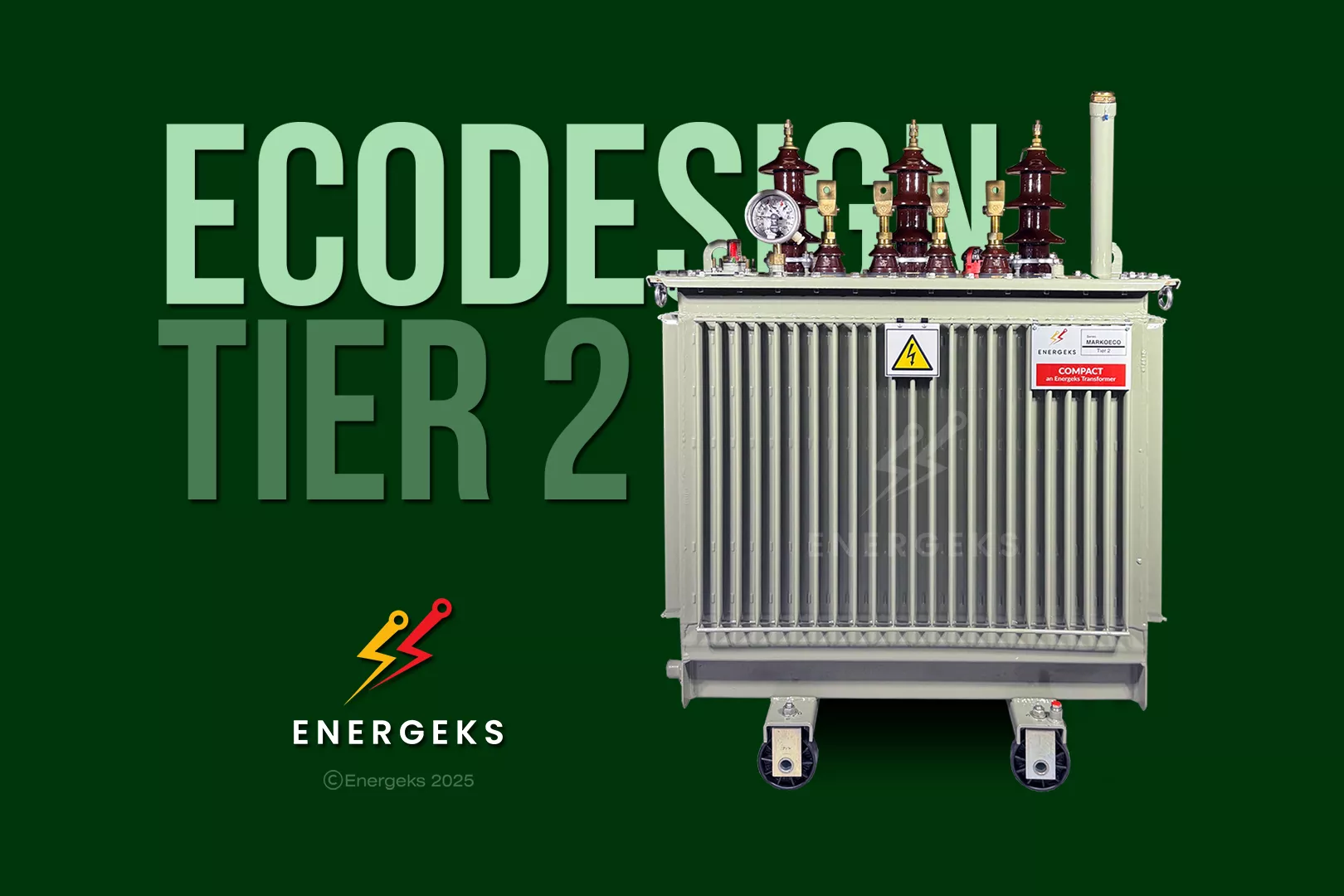
A transformer can no longer "just work."
In the past, it was enough for a transformer to simply operate. It ran without failure, hummed quietly in the background, and no one really asked questions. But times have changed. Today, power equipment must not only be reliable but also energy-efficient.
And a transformer that consumes electricity at night just to stay on standby must now justify itself. To the client. To the auditor. To the planet.
The EU’s Ecodesign Tier 2 directive is not a bureaucratic whim. It’s a real paradigm shift: if something wastes energy, it has no right to exist. Since July 2021, new rules have been in force and they’ve changed the game for all transformer manufacturers.
And for investors and designers? It’s a test of attention to detail: what are you really buying, and how much does it actually cost over the product’s lifetime?
In this article, we’ll cover:
what a Tier 2 compliant transformer is
what the requirements and standards are
how it differs from previous models
what it delivers in practice and in your budget
how to translate energy savings into something more tangible than “kWh”
Reading time: 8 minutes
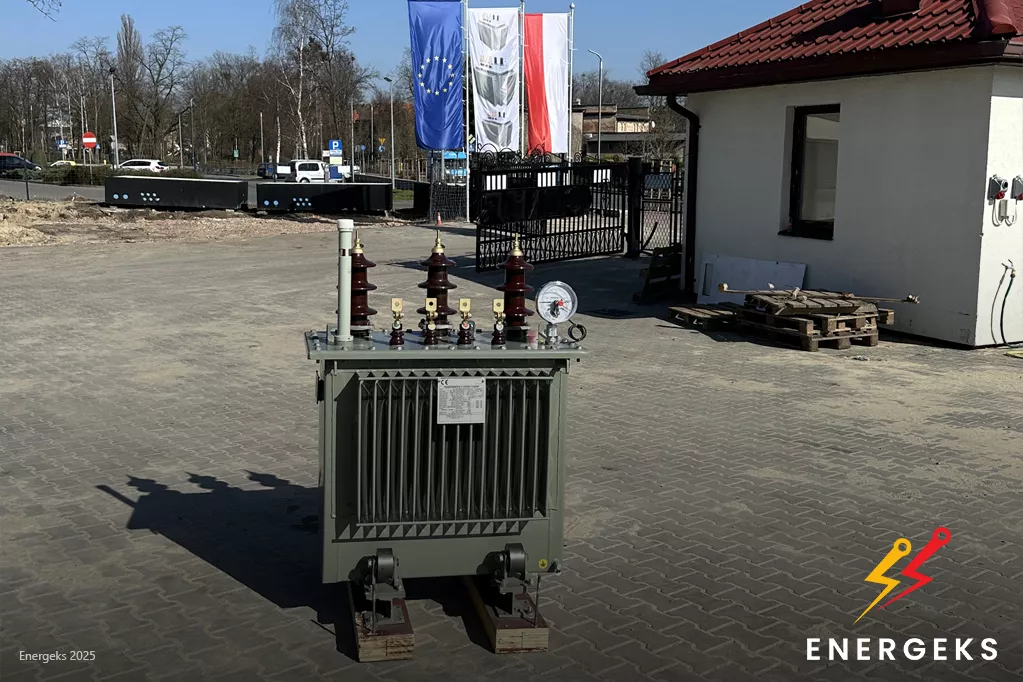
In short? It’s about reducing energy losses in standby mode and under load. A transformer compliant with Tier 2 must meet stricter energy efficiency requirements defined by Commission Regulation (EU) 2019/1783.
That means:
significantly lower no-load losses, i.e. the energy consumed when the transformer is energized but not transmitting power
optimized load losses, related to current flow through windings and voltage drop
a special core design – often based on high magnetic induction and low-loss steels, such as HI-B (High-Grade Grain-Oriented) or amorphous metals (metglass), which have 70–80% lower magnetic losses compared to standard materials
What does this mean in practice?
Take, for example, a 1000 kVA MV transformer. An older Tier 1 compliant design may generate 12,000 kWh of no-load losses annually. This means that even when it’s not transferring energy – it’s using electricity. Like a refrigerator running with nothing inside.
The Tier 2 version reduces those losses to 8,000 kWh per year – saving 4,000 kWh. At an average price of 0.80 PLN/kWh, that’s 3,200 PLN annually. In euros? Around €740 per year. Over 30 years? €22,200 in avoided losses. And we’re talking about just one transformer.
What does that mean in real-world terms?
We like to convert savings into something tangible:
4,000 kWh is about 5 months of electricity for an average household (in the EU, annual consumption is around 8,000 kWh)
€22,200 is enough to build a multi-use sports field for students in a rural municipality
or: more than 42,000 loaves of bread (€0.50/loaf)
or: 8 years of free LED lighting for a high school
So?
If your company operates ten transformers, switching to Tier 2 means potential savings of €220,000 – enough to sponsor an entire village with green energy
Lower magnetizing current – thanks to reduced magnetic hysteresis in HI-B steels, the transformer needs less energy to “wake up”
Better passive cooling – lower losses = less heat = less work for the cooling system
Larger winding cross-sections = lower resistance = reduced Joule losses
This isn’t innovation for the sake of trendiness. It’s engineering done right – once and for all. Because true efficiency isn’t about miracles. It’s about good decisions and long-term thinking.
EU Regulation 2019/1783 does not beat around the bush: since July 1, 2021, all new transformers placed on the EU market must meet the Ecodesign Tier 2 requirements. What does that mean? Time to say goodbye to “energy chewers” that just sit and hum while consuming electricity like an old bathroom heater.
What exactly does the regulation say?
The requirements are precise – these are not “recommendations” or “goals to consider,” but hard limits:
No-load and load losses – must be below the Tier 2 limit values, depending on the transformer type (oil-immersed, dry-type, distribution).
Core and winding design – you can’t “do it the old way” anymore. Modern materials are required (e.g., B23R080-grade steel, amorphous metals), and often more copper mass too.
CE marking and declaration of conformity – without these, the product cannot be legally placed on the market.
Ban on using cooling fans to meet the limits – only passive efficiency counts, no artificial "fine-tuning."
Technical documentation – must include detailed performance and loss data measured according to EN 50708-1-1.
If you're designing a transformer station, you need to know during the tender or ordering phase whether a model meets these limits. Because you can’t “tighten efficiency” later like a bolt. It all starts with the core geometry and number of turns.
What’s more – the documentation must include specific parameters measured at 75°C. And no – they cannot be “rounded up.” That’s why many manufacturers redesigned their transformers from scratch instead of “lifting” old constructions.
With an average loss reduction of 3,000–5,000 kWh annually (compared to older models), and a cost of €0.20/kWh, the savings amount to €600–1,000 per transformer per year. And that’s just one!
For a medium-sized industrial plant with five transformers? That’s up to €5,000 saved annually – the cost of a new forklift, equipment for a production hall, or... full funding for an energy monitoring system.
Imagine you have a fleet of company cars, and each one consumes 1 liter of fuel per day... idling. No one’s driving, no work is being done, but the tank is draining. Over a year, that’s hundreds of liters. And what – you turn a blind eye because “that’s how it’s always been”?
Tier 2 is the decision not to look away. To stop wasting electricity on idle operation.
To make sure every kilowatt-hour makes sense. Not out of obligation – out of common sense.
The Ecodesign Tier 2 requirements don’t exist in a vacuum. They’re based on very specific technical standards that determine whether a transformer can legally be placed on the EU market. And no – this isn’t a matter of the manufacturer’s “good will.” It’s strict certification that cannot be bypassed. And for a designer or investor? A clear warning: if a device lacks full documentation compliant with the standard – don’t even touch it with a stick.
EN 50708-1-1 – the core standard for power transformers. It defines acceptable losses, test procedures, reference temperature (75°C), measurement accuracy, and design requirements. The backbone of Tier 2.
EN 50588-1 – covers distribution transformers up to 3150 kVA. Regulates how to test efficiency, including lab conditions, temperature compensation, and the effect of rated voltage. Applies especially to dry-type and MV transformers in compact substations.
ISO 50001 – the energy management standard. It doesn’t deal with transformer construction, but if you want your entire installation to be ESG or Green Deal compliant – a Tier 2 transformer is simply a must.
What does “standard compliance” mean in practice?
The standards specify:
how to calculate losses (reference conditions, calibrated instruments),
how to convert data for catalogues (e.g., to 20°C or 75°C),
how to present technical data (you can’t list power at a voltage other than nominal without annotation),
how to document test results – lab reports must include margin of error, certification, and the measurement pathway.
In other words: a transformer that doesn’t have verified compliance is not only a financial risk – it’s a risk for the entire investment. In an audit, this is the first thing they check: documentation from tests compliant with EN 50708. No docs? Out.
Standards are not just paperwork – they mean real gains
Some treat a “standard” like an unnecessary PDF attachment.
But do you know what non-compliance means?
You might not get funding (many grant programs require Tier 2 transformers).
Your insurer may refuse compensation after a failure – because the device wasn’t certified.
The entire investment could be rejected at handover.
And that’s serious money: tens of thousands of euros in delayed payments, schedule delays, penalty fees.
Do you really need to know EN 50708?
It’s like traffic rules.
You don’t need to know all of them to drive. But if you don’t know what “no left turn” means, you’ll get a ticket sooner or later.
If you’re an investor, site manager, or project engineer – knowing EN 50708 won’t make you an energy law expert. But it will save your skin during project acceptance.
And that’s just smart business.
On paper? It’s just a different column in the loss limits table.
But in reality?
It’s like driving a car from the 90s versus a modern electric vehicle.
Both will take you from point A to B.
But one will guzzle fuel and growl, while the other does it quietly, efficiently, and economically.
Example: MV transformer 400 kVA 15/0.4 kV
A transformer compliant with Tier 1 (the older standard valid until 2021) generates no-load losses of about 550 W and load losses of 4,200 W. Over a year, this translates to roughly 39,700 kilowatt-hours of lost energy. At an average price of 0.20 euros per kWh, this means an annual loss cost of about 7,940 euros.
By comparison, a 400 kVA 15/0.4 kV transformer compliant with Ecodesign Tier 2 requirements has lower losses: 400 W in no-load state and 3,700 W under load. Annual losses are about 34,400 kilowatt-hours, translating to a cost of around 6,880 euros per year.
Annual gain? 1,060 euros. Roughly the cost of a new LV switchboard for a workshop hall.
Or five years of LED lighting in an office.
Example: MV transformer 630 kVA 15/0.4 kV
A 630 kVA Tier 1 transformer has no-load losses of about 800 W and load losses reaching 7,000 W. Per year, that’s around 62,500 kilowatt-hours of lost energy. At 0.20 euros per kWh, total loss cost is approximately 12,500 euros.
A 630 kVA transformer meeting Tier 2 requirements performs better:
600 W no-load losses and 6,200 W load losses. Annually, this equals about 55,000 kilowatt-hours of loss, with a cost of around 11,000 euros.
Gain? 1,500 euros per year. Enough to cover the cost of yearly inspections and oil testing in an entire transformer station.
Example: MV transformer 1600 kVA 15/0.4 kV
A large 1600 kVA Tier 1 transformer has no-load losses of about 1,800 W and load losses of 17,000 W. Annually, this means about 140,000 kilowatt-hours of energy lost as heat. At 0.20 euros per kWh, that’s a loss cost of 28,000 euros per year.
A 1600 kVA Tier 2 transformer reduces these values to 1,400 W in no-load state and 15,500 W under load. Annual losses amount to about 127,000 kilowatt-hours, with a cost of around 25,400 euros.
2,600 euros per year – that’s the gain. And over 30 years? 78,000 euros. Enough to afford a decent energy storage system for an entire production hall.
Magnetic sheets: Tier 1 uses standard grain-oriented steel, sometimes with lower induction. Tier 2 typically employs HI-B or even amorphous cores – reducing losses by 30–70%.
Windings: Tier 2 often uses thicker copper wire, lowering resistance and thermal losses. The transformer is heavier – but significantly more efficient.
Geometric design: Tier 2 requires more precise construction – better magnetic dispersion, reduced connection losses, optimized cooling.
Purchase price vs life cycle cost (LCC): Tier 1 units used to be 5–10% cheaper upfront. But after just a few years of operation, Tier 2 pulls ahead – and leaves its predecessor behind.
When we say "transformer profitability," most people think: "Well, the purchase cost, maybe transport, installation, and... that’s it." But that’s the real issue. The actual money doesn’t disappear during purchase. It quietly evaporates during operation – through unnecessary energy losses.
And that’s exactly what the EU’s Ecodesign Tier 2 regulation aims to fix.
What does higher efficiency bring?
A transformer compliant with Ecodesign Tier 2 is by design:
more energy-optimized,
loses less heat (hence less energy),
has a longer lifespan thanks to lower operating temperatures,
requires no additional cooling (lower maintenance costs),
and generates a lower Total Cost of Ownership (TCO).
This isn’t opinion – it’s fact.
A transformer with 20% lower losses pays for itself in 3–6 years, and from then on… it works for you. For free.
Fewer failures – lower operating temperatures reduce the risk of overheating.
Better compatibility with automation and inverters – Tier 2 offers more stable voltage parameters, improving energy quality.
Higher ESG rankings – for companies that publish sustainability reports, every saved kilowatt-hour improves their image – and investor score.
Install 20 new LED lamps in the production hall.
Fund annual maintenance for your entire machine park.
Or simply hire an energy technician part-time – to monitor other loss sources.
These aren’t "green daydreams" – they’re hard numbers. And the more energy you produce, transmit, or store – the more it pays off.
Transformers are like tires: even bad ones keep you moving… but they’re burning your money.
If you’ve made it this far – thank you. That means transformer efficiency matters to you. And rightly so.
Because modern energy is no longer about "buy and forget." It’s about conscious choices that deliver returns not only financially, but also environmentally. Tier 2 is not just a regulation – it’s a direction. And at Energeks, we know how to turn that direction into concrete solutions.
At Energeks, we design medium-voltage transformers that:
comply with Tier 2 requirements,
genuinely reduce energy losses,
are ready for integration with PV systems, storage, and e-mobility,
and most importantly – work for you, not against your bottom line.
If you’d like to learn how to choose a Tier 2 transformer for your investment, check out our offer:
See Energeks transformers.
Thank you for being with us.
Join our community on LinkedIn.
That’s where we share knowledge, solutions, and… a human approach to engineering.
Sources:
European Commission – Ecodesign for Transformers (Regulation (EU) 2019/1783)
International Energy Agency – The Role of Efficient Transformers in Grid Decarbonisation
CENELEC – EN 50708 Series for Power Transformers
Shipped from our warehouse in Poland within 2–3 working days, 5-year warranty. Full range 25–2500 kVA in the shop (prices in PLN).
Need a complete MV/LV substation? See ready-made transformer substations in the shop or configure your own in the free station configurator (technical design, data sheet, configuration code; in Polish).
No reviews!