9 Jan
2026
Energeks
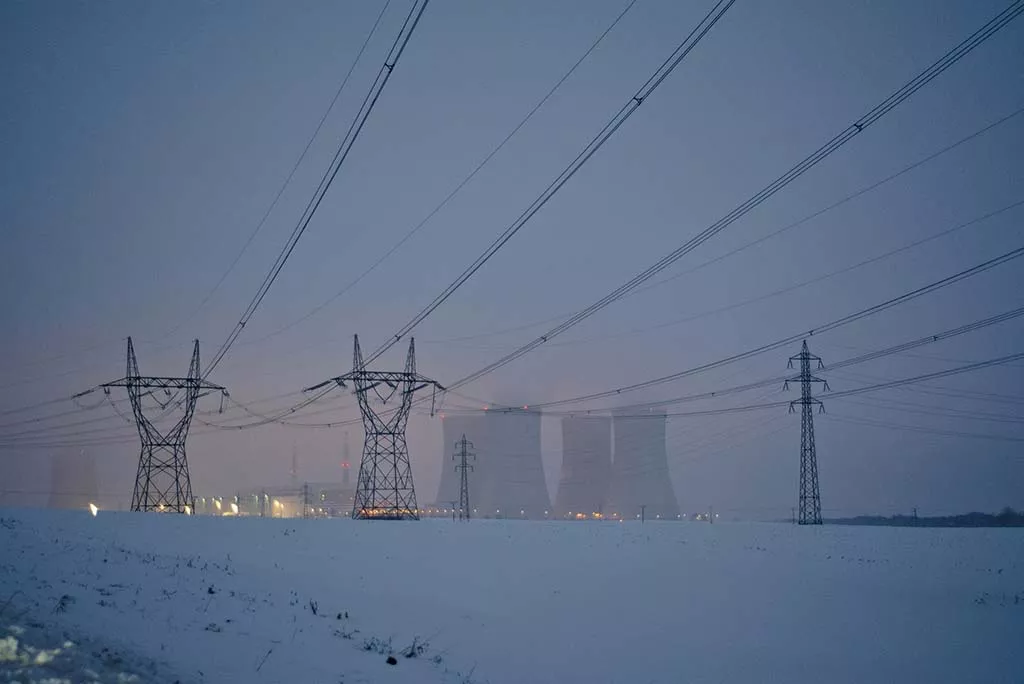
Winter is when everything comes to light.
For most of the year, the installation works correctly.
The oil transformer has a power reserve. Voltage stays within limits. There are no complaints, no alarms, no phone calls from users.
And then the first cold wave hits, and suddenly something no one planned for begins to happen.
Flickering lights. Notifications about voltage being too low.
Heat pumps that shut down exactly when they are needed most.
In the background, a transformer that according to the documentation "should handle this," but in reality is operating on the edge of stability.
This isn't a story about faulty technology.
It's also not a tale of user errors.
It's a story about the collision between a new way of using energy and infrastructure that was designed under completely different circumstances.
Heat pumps have changed the network load profile.
They did it quickly, massively, and often without a parallel shift in thinking about medium voltage transformers. The annual energy consumption still adds up. The nameplate power looks reasonable.
And yet, in winter, voltage drops, alarms, and questions arise that are difficult to answer in a single sentence.
Why do problems start precisely when the temperature drops below zero?
Why does an oil transformer, which operates calmly in summer, react completely differently in winter?
And why does the classical approach to power rating selection stop being sufficient in a world of mass-scale heat pumps?
This article was created to organize these phenomena.
Without scaremongering about failures. Without oversimplifying the physics. Without shifting blame to one side.
We will show what the load generated by heat pumps really looks like during the heating season, how an oil transformer reacts to it, where voltage drops occur, and why they are not random.
And what can be done before the only answer becomes a costly modernization.
If you are responsible for the network, a project, a facility, or investment decisions, this text will help you look at the problem from a broader perspective. One that considers both the technology and the real operating conditions.
Reading time: approximately 13 minutes
In summer, a heat pump is almost invisible to the grid.
It operates sporadically, mainly for domestic hot water. Its momentary power draw is moderate, and its load profile blends into the background of other consumers. An oil transformer sees it as just one element among many in the landscape.
In winter, the situation changes radically.
The heat pump stops being an add-on. It becomes the primary source of thermal energy, and therefore a device operating for long periods, intensively, and often in sync with hundreds of other similar installations on the same network.
One key word here is: momentary power.
Project documents most often analyze annual consumption. The kilowatt-hours add up, the SCOP coefficients look good, and the energy balance seems reasonable. The problem is that a transformer doesn't see kilowatt-hours. It sees amperes, here and now.
And in winter, "here and now" looks different than in summer.
When the temperature drops below zero, the demand for heat increases. The heat pump's compressor runs longer and more frequently. Its momentary efficiency drops, so generating the same amount of thermal energy requires more electrical energy. Add to this the defrost cycles of the evaporator, which generate short-term but repetitive power draw spikes.
On the scale of a single house, this still looks innocent.
On the scale of a housing estate, a facility, or an area supplied by one MV/LV transformer, the cumulative effect begins.
Everyone heats at the same time.
The coldest days mean peak load occurs at exactly the same morning and evening hours. The grid has no time to "breathe," and the transformer enters prolonged operation near the limits of its thermal and voltage capabilities.
This is where the first paradox appears, which often surprises investors and designers.
An oil transformer may not be overloaded in terms of power, yet it can still cause problems.
Why?
Because the problem isn't always exceeding the nameplate rating. Often, it is the voltage drop resulting from the nature of the load.
Heat pumps, especially inverter-driven ones, are not linear loads. Their current draw changes dynamically. At low temperatures, the current on the low-voltage side increases, and every additional ampere means a greater voltage drop across the transformer's impedance and the supply line.
In summer, the same transformer operates at a higher secondary voltage, lower current, and with a large regulatory margin. In winter, that margin disappears.
If we add to this networks designed decades ago with the assumption that the main loads would be lighting, appliances, and occasional electric heating, the picture becomes clear.
This isn't a failure.
This is a change in boundary conditions that the infrastructure simply wasn't designed for.
In the next part, we'll take a closer look at how an oil transformer reacts to such a load from a physics perspective. Without myths about "overheating in winter" and without magical explanations. Only what really happens in the core, windings, and oil when the grid starts breathing frost.
From the outside, a transformer looks the same in July and January.
The same enclosure. The same oil. The same parameters on the nameplate.
The difference begins on the inside.
An oil transformer does not react to winter in an intuitive way. The low ambient temperature is not a problem in and of itself. Quite the contrary. Cooling is more efficient then. The oil dissipates heat to the surroundings more easily, and the thermal headroom seems larger than in summer.
And it's right here that a false sense of security is born.
Because in winter, the problem is not the transformer's temperature. The problem is voltage and current.
When the load on the low-voltage side increases, the current in the windings rises. Along with it, copper losses—proportional to the square of the current—increase. This phenomenon is well known and accounted for in design.
But simultaneously, the voltage drop across the transformer's impedance increases.
Every transformer has its short-circuit impedance. This is not a flaw or a random feature. It is a design parameter that determines how the transformer will behave under load and during a short-circuit.
The greater the current, the greater the voltage drop.
In summer, this drop is hardly noticeable. In winter, under prolonged load close to peak, it begins to be felt by the connected equipment.
Heat pumps are particularly sensitive to this.
The inverters controlling the compressors have their own lower voltage thresholds. When the voltage drops too low, the electronics react immediately. First, it limits power. Then it goes into an alarm state. Finally, it shuts the device down.
From the user's perspective, this looks like a random failure.
From the transformer's perspective, it's a logical consequence of operating under conditions the network wasn't designed for.
A further domino effect occurs.
When some heat pumps shut down due to low voltage, the load temporarily decreases. The voltage bounces back up. The devices attempt to restart. The inrush current appears simultaneously at many points in the network.
The transformer receives a series of load impulses that further destabilize the voltage.
This is not an overload in the classical sense.
It is an operational instability resulting from the nature of the loads and their synchronization.
This often leads to a question about the transformer's tap changer.
If the voltage is dropping, maybe it's enough to raise it.
Sometimes this helps. Sometimes it just shifts the problem elsewhere.
Raising the secondary voltage increases the margin for heat pumps, but it also raises the voltage during hours of lighter load. This can lead to exceeding permissible voltage levels for other consumers. Especially where the network is short and has low impedance ("stiff").
A transformer does not operate in a vacuum. It is a part of a system.
If the system has changed, the transformer begins to reveal its weak points.
In the next part, we will examine why classical methods for selecting transformer power ratings are becoming insufficient in a world of mass-scale heat pumps and what warning signs appear long before the first winter alarm.
For years, everything was logical and predictable.
Selecting a transformer was based on installed power, simultaneity factors, and annual energy consumption. Add a small safety margin—sometimes 10 percent, sometimes 20. In most cases, that was enough.
Because the loads were passive and spread out over time.
Lighting, motors, household appliances. Each had its own operating rhythm. Even if several devices turned on at the same time, the scale of the phenomenon was limited.
Heat pumps have changed this order.
Not because they are faulty. Not because they draw "too much current." They changed it because they introduce a strong temporal correlation of load.
When it gets cold, they all want to run. At the same moment. For many hours without a break.
Classical simultaneity factors begin to lie. On paper, everything adds up. In reality, the network sees nearly the full load for a long time, not short inrush peaks.
Another element, often overlooked in analyses, comes into play.
A transformer is selected based on active power. Winter problems very often start with reactive power and the nature of the current.
The inverters in heat pumps improve the power factor (cos φ), but they don't completely eliminate current distortions. Harmonics, especially lower-order ones, increase the effective current without a proportional increase in active power. The transformer sees a greater current load, even though the energy meter doesn't show it directly.
This is another reason why "the kW adds up," but the voltage drops.
In practice, this means a transformer selected perfectly according to the old methodology can operate in winter under conditions no one considered. Not as a short-term exception, but as a new norm.
The first warning signs appear early.
They are not failures or protection tripping.
They are subtle symptoms that are easy to ignore.
Voltage at the lower limit of the norm in the morning hours. An increased number of voltage alarms in the inverters. User complaints that "something sometimes flickers." Logs from monitoring systems showing long periods of high load without distinct peaks.
This is the moment when the network is still working. But it has no margin left.
Many investment decisions are made only after the first serious problem appears. In winter, under time pressure, user dissatisfaction, and weather conditions. This is the worst possible moment for a calm analysis.
That's why, in the next part, we will move on to what can be done earlier.
What diagnostic tools truly provide answers, how to distinguish a power problem from a voltage problem, and when a transformer is actually undersized, versus when it's simply poorly matched to a changed network.
In winter, the network doesn't forgive illusions.
If the first signs of instability appear, it means physics has already sent a warning signal. It's just not screaming yet.
The most common mistake is trying to answer with a single parameter. Transformer power rating. Cable cross-section. Protection setting. However, winter problems rarely have a single cause.
It starts with measurements. But not the kind that last a few hours on a random day.
A seasonal picture is needed.
Load profiles from summer and winter periods. At least several weeks of data. Preferably with fifteen-minute or shorter resolution. Only then can you see whether the load is impulsive or continuous. Whether the voltage drops slowly or collapses sharply at specific times.
A transformer rarely lies. It simply shows what the network is doing to it.
The next step is to analyze voltage at several points in the low-voltage network, not just at the transformer terminals. The voltage drop at the transformer might look acceptable, while at the end of a supply line it exceeds permissible limits.
This is especially important where heat pumps have been added to existing buildings without upgrading lines and distribution boards.
It's also worth looking at what happens with reactive power and effective current.
If the current rises faster than the active power, it's a signal that the transformer is being loaded in a way that isn't visible in standard energy consumption summaries. Harmonics, phase imbalance, and uneven switching of loads can eat up the margin faster than you think.
A frequently overlooked element is voltage regulation.
Transformer tap settings are often based on historical conditions, from before the facility's modernization. Changing one tap step can improve the situation in winter, but only if preceded by an analysis of voltages across the entire load range. Otherwise, the problem will shift to summer.
This brings us to an important distinction.
Not every winter problem means the transformer is too small.
Sometimes its power rating is sufficient, but it's operating in a network with too high impedance. Sometimes it's correctly sized, but the load is too strongly time-correlated. And sometimes the limit has indeed been exceeded, but no one wanted to call it by its name earlier.
A good diagnosis allows you to choose the right tool.
Upgrading the transformer is one of them. But it's not always the first, nor the most sensible, option.
We've covered this topic in more detail in a separate article:
Renovate or replace? The last chance for your transformer!
In the next part, we'll show which action scenarios are realistic in practice. From the simplest operational adjustments, through changes in network configuration, to investment decisions that only make sense when they are based on data, not winter panic.
The biggest change in recent years hasn't been about the transformers themselves.
It's about the way we think about the network.
For decades, design was an attempt to predict averages. Average consumption. Average peaks. Average customer behavior. This model worked as long as appliances had different rhythms and didn't respond en masse to the same stimulus.
Heat pumps respond to temperature. Simultaneously. Without negotiation.
This means the network must be designed for extreme scenarios, not just for the annual balance.
A transformer ceases to be merely a source of power. It becomes an element of voltage stabilization under conditions of prolonged load. This changes the selection criteria.
Increasing importance is placed not only on the nameplate rating, but on the transformer's impedance, its voltage regulation characteristics, and its cooperation with the rest of the infrastructure. Two transformers with the same power rating can behave completely differently in winter if they have different short-circuit impedances or different regulation capabilities.
Operation also requires a new approach.
Instead of reacting to failures, it's worth observing trends. Are minimum voltages dropping year by year? Is the operating time under high load lengthening? Is the number of power electronic loads growing faster than assumed?
These are signals that appear long before a crisis.
A well-designed network with oil transformers is not afraid of winter. It has a margin. It has flexibility. And above all, it has the awareness that the way energy is used has already changed and will not return to the state before mass-scale heat pumps.
Therefore, the key question today is not: will the transformer survive this winter?
The question is: will it still operate stably in five years within a network that is increasingly reactive to weather, automation, and simultaneity?
If the answer isn't clear, the best time to act is now. Calmly. With data. Without winter panic.
Because winter will always come. And the network should be ready for it before it gets truly cold.
In the end, it's worth putting a period in a place that doesn't close the topic, but opens up possibilities.
In the reality of mass-scale heat pumps, it becomes a tool for conscious management of voltage, losses, and network stability. A well-chosen, properly configured unit that meets current Ecodesign Tier 2 requirements — like the MarkoEco2 from Energeks — can regain the margin that is most sorely missed in winter. Not through oversizing, but through better power quality, lower load losses, and a true match for modern operating profiles.
Our current transformer offering has been designed precisely for such scenarios, where the network must operate stably not only today but also in the heating seasons to come.
It includes both oil transformers, proven in demanding operating conditions and resilient to prolonged winter loads, and dry-type transformers, chosen where fire safety, environmental conditions, or indoor installation are of key importance.
In both cases, the starting point is the same. Voltage stability, low losses, compliance with current energy efficiency requirements, and a genuine fit for modern load profiles—where heat pumps are no longer the exception, but the norm.
Thank you for your time and attention. If you are interested in such analyses, real project experiences, and thoughtful conversations about how the energy sector is changing from within, we invite you to our community on LinkedIn.
Sources:
International Energy Agency (IEA)
https://www.iea.org/reports/the-future-of-heat-pumps
ENTSO E
https://www.entsoe.eu/publications/system-development-reports/
Shipped from our warehouse in Poland within 2–3 working days, 5-year warranty. Full range 25–2500 kVA in the shop (prices in PLN).
No reviews!