4 Aug
2025
Energeks
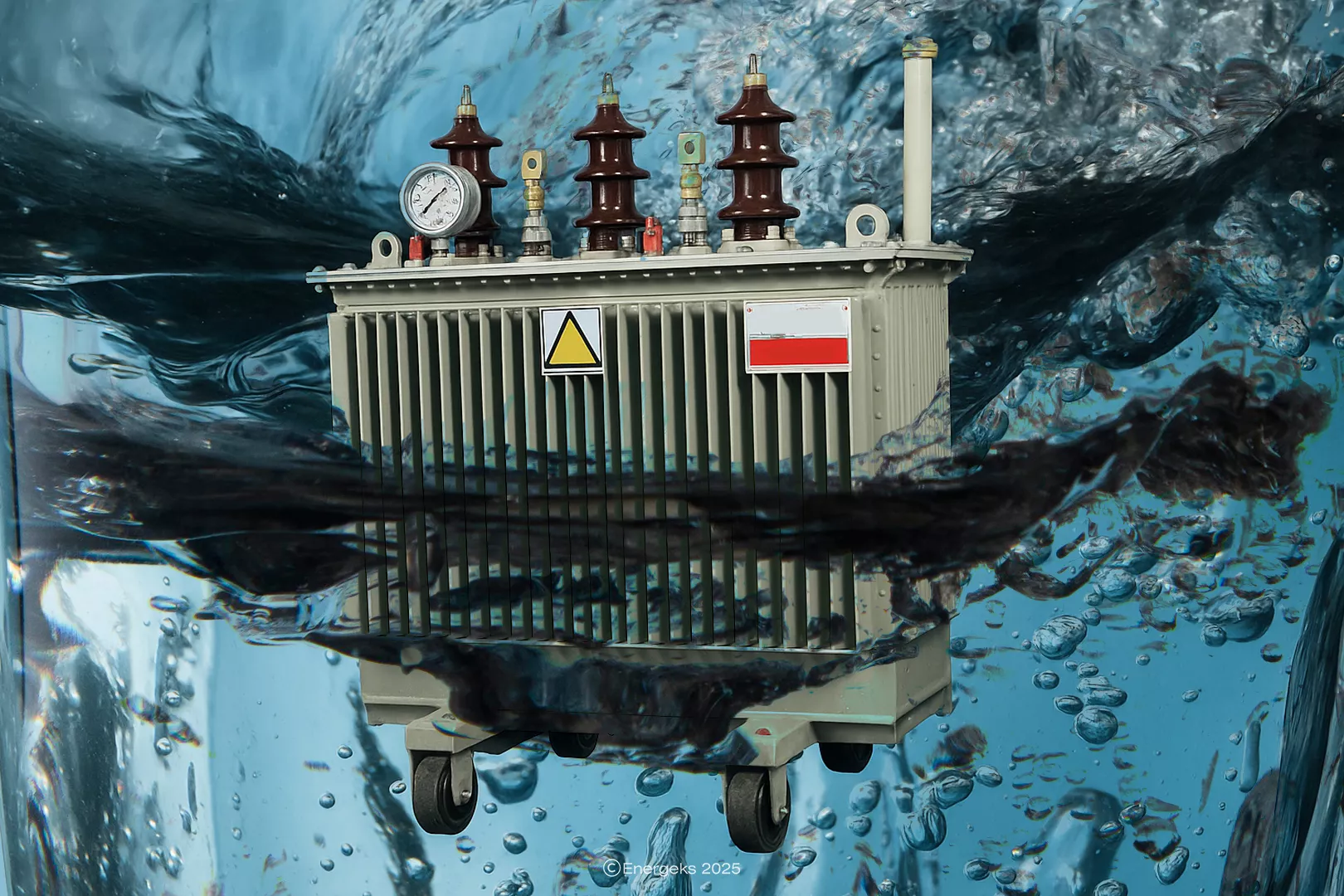
July 2025 goes down in history as a weather rollercoaster: record-breaking heat alternating with torrential rain and local flooding.
It takes just one afternoon with a once-in-a-century storm for a prefabricated transformer substation to turn into a puddle and its heart – a medium voltage transformer – into a drowning victim.
And then? Silence. And tension. Both literally and figuratively.
In such moments, there is no room for panic or improvisation. What counts is procedure, competence and a quick assessment: can the unit be saved or is it better to disconnect it and say goodbye.
Why are we the ones writing about this?
Because we have rescued more than one “drowning victim”. Energeks specializes in MV transformers, prefabricated transformer substations and energy storage systems. We know the pain: hectares of flooded infrastructure, a million-euro transformer under water and an investor asking if it can be saved. Sometimes it can – but only if you know what you are doing. We are glad you are here.
Who is this article for and what will you gain?
This article should be read by anyone who:
manages power infrastructure
designs or operates MV substations
is responsible for the energy security of a manufacturing plant, PV farm or warehouse hall
By reading this you will:
learn the critical signs of damage after flooding
discover how to properly dry a transformer
understand when repairs are a waste of time
learn the current standards and manufacturer recommendations
Here is what lies ahead:
Heavy rain in an MV substation: what happens when the transformer is knee-deep in water
Damage assessment: which components suffer the most
Moisture, insulation and standards: how water affects safety
Drying or replacement: making the technical and financial decision
How to carry out an intervention step by step
Manufacturer recommendations, O&M manuals and what to look for in service records
Reading time: approx. 12 minutes
This is not a textbook scenario. It is something that actually happens – especially in July when asphalt temperature reaches 52°C and after 6 p.m. the city is hit by a wall of rain mixed with walnut-sized hail. Water floods the lowest points of the terrain, including prefabricated transformer substations.
Although engineers anticipate a lot, nature can always outpace the design. So what happens to a medium voltage transformer when the water level reaches its base or even the main tank.
Voltage in water: literally and figuratively
A transformer is not a hermetically sealed device. Even so-called hermetic units have components through which moisture can enter. Rainwater – often contaminated with dust, salts and petroleum residues from roads – is conductive. This means one thing: increased risk of short circuits, corrosion, insulation damage and uncontrolled current leakage.
If water enters the transformer, it affects key components:
bushings
low and medium voltage windings
magnetic core
cooling systems and conservator
It is particularly dangerous when the MV connection compartment is flooded. This compartment is often located at ground level and is not fully protected against rainwater ingress.
Prefabricated substation and water retention
A prefabricated transformer substation, whether concrete, container-type or metal, is installed according to best practices. However, if it is not equipped with an effective drainage system, technical ducts, sumps and drains, it becomes a rainwater trap. Water collects around the foundation and during prolonged rainfall can enter through leaky doors, cable openings or an unsealed roof.
In practice, after just one hour of intense rain, the transformer can be standing in several centimeters of water. If the level reaches 25–30 cm, the lower connections, switchgear panels and low voltage winding ends are submerged. And that is enough to trigger a chain reaction of damage.
The sponge effect: moisture in the dielectric and paper structure
One of the least visible but most damaging consequences of water contact is moisture penetrating the insulation systems. Both the insulation paper used in windings and the transformer oil (mineral or synthetic, e.g. MIDEL) have specific moisture absorption classes. Even a small presence of water can lead to:
reduced breakdown voltage
partial discharge activity
accelerated aging of insulation materials
In the worst case, this leads to internal breakdown, marking the end of the transformer's life.
Electricity and water: a deadly mix
From the operator's perspective, water in the substation is a hazard not only for the equipment but primarily for people. Moisture in an energized substation poses a risk of electric shock or even explosion. This is why every flooded substation should be immediately switched off and cordoned off before anyone enters.
DSO guidelines are clear: in the event of flooding, insulation resistance, grounding resistance and breakdown voltage measurements must be performed before the substation is put back into service. Even if the transformer appears “dry” at first glance.
Water does not always leave with the rain
The biggest problem is not the rainwater itself but the moisture that remains. Even after pumping out the water, microscopic amounts can remain in the transformer structure and surroundings. It penetrates absorbent elements such as rubber gaskets, insulation paper and insulating varnishes. This moisture is invisible to the naked eye but can cause gradual damage for months.
That is why it is crucial to:
test the transformer for insulation moisture content
perform DGA (dissolved gas analysis)
analyze operational history to check if past high temperatures or overloads have weakened internal protection
Flooding of an MV substation is not just a weather incident. It is a full-scale failure that requires a systemic response. It is necessary to assess not only what has been flooded but also to understand the long-term effects. A transformer that has been “knee-deep in water” may continue to operate for several months only to fail suddenly later – costly and hard to predict.
In the next section we will look closely at how to assess damage after flooding and what to focus on during visual and electrical inspection.
The moment the water level recedes is not the end of the problem. It is only the beginning of the diagnosis. A medium voltage transformer that has been flooded may look intact. But from a service engineer’s perspective, it is like a car accident victim stubbornly claiming they are fine because they can still walk. The problem is that internal injuries are not visible to the naked eye. And in the case of transformers, such injuries can be fatal for the entire installation.
The most common consequences of flooding affect five structural areas of the transformer:
Bushings and MV insulators
Contaminants from rainwater settle on the surface of porcelain or composite bushings, forming a thin conductive layer. The effect is increased leakage currents and a risk of surface discharges. In extreme cases this can lead to tracking and flashovers. Bushings must be thoroughly cleaned, dried and checked for insulation resistance values.
Connections and cable accessories
Moisture entering cable joints, terminations and technical ducts is a silent cause of later short circuits. This is especially true in older installations with non-hermetic MV cables. If water has entered the terminations, replacement or full refurbishment is required.
Enclosure and metallic components
Corrosion progresses rapidly if no anti-corrosion treatment is applied after water contact. Particularly sensitive are:
grounding and bonding connections
pins and busbars
mounting frames
conservator valves and breathers
Each of these components must be dismantled, cleaned, inspected and preserved.
Cooling system and oil tank
Depending on transformer design, water may enter the tank or cooling channels. Even if the oil looks clean, a microscopic amount of water can reduce the oil breakdown voltage from 60 kV to unacceptable values (below 30 kV). In such a case full filtration or oil replacement is required. According to PN-EN 60422, water content in oil should not exceed 20 mg/kg.
Windings and magnetic core
These are the hardest areas to assess. Moisture inside the winding insulation paper is difficult to remove. Even after surface drying, moisture can remain in the structure for many weeks. This means specialised testing is necessary:
dielectric dissipation factor (tangent delta) measurements
dissolved gas analysis (DGA)
breakdown voltage and insulation resistance measurements
If the transformer was energised at the time of flooding, the windings should also be examined for mechanical displacement.
After any flooding incident, an integrated technical assessment procedure should be applied. Depending on the level of moisture and exposure time, Energeks recommends the following steps:
insulation resistance measurement using PI (polarisation index) and DAR (dielectric absorption ratio) methods
DGA testing
oil breakdown voltage measurement according to PN-EN 60156
water content analysis using the Karl Fischer method (PN-EN 60814)
if in doubt, remove the cover and carry out a visual inspection of the transformer interior
These results will clearly determine whether the transformer is fit for further operation or requires repair or replacement.
What about documentation and responsibility?
It is also important to immediately document the flooding incident. An incident report, photographic evidence and records from environmental condition monitoring systems may be crucial in case of a dispute with the manufacturer or insurer. In most transformer O&M manuals you will find a clear statement that the unit must not be operated in ambient relative humidity exceeding 95 percent or in the presence of standing water. Exceeding these conditions may void the warranty unless the flooding was due to force majeure, in which case it is worth checking the insurance policy.
Water and a transformer are a pair that should never meet. However, when they do, one phenomenon becomes critical that most operators only become aware of during a failure: moisture penetration into insulation systems. In this chapter we dive into the micro world where a drop of water can decide million-dollar losses and a seemingly dry winding can hide a ticking dielectric time bomb.
Water in the transformer: the invisible enemy of dielectrics
The insulation system of a transformer typically consists of a combination of electrical grade paper and oil. Both materials are hygroscopic, meaning they absorb moisture from the surrounding environment. It only takes the relative humidity level in the substation air to exceed 75 percent without being reduced through ventilation or dehumidifiers. If flooding occurs, this level can reach 100 percent.
In real operating conditions, it is enough for the water content in insulation paper to rise from 0.5 percent to 2 percent to:
reduce winding breakdown voltage by 30 percent
shorten the expected transformer lifespan by 50 percent
increase the risk of partial discharges on winding surfaces
accelerate cellulose aging (depolymerisation)
Why oil does not always protect
Many assume that transformer oil forms a protective barrier preventing moisture ingress. Unfortunately, this is only partially true. Even the best mineral or synthetic oil has a moisture saturation limit. For example, mineral oil reaches saturation at about 40 to 60 mg/kg at 25°C. Beyond that, moisture begins to precipitate as droplets that can settle directly on the windings.
At low temperatures this effect is even more dangerous because moisture condenses faster. In a flooded transformer left unheated for several days, a thin layer of condensed water can appear on winding surfaces. Nominal voltage alone is enough to trigger an arc discharge.
Tangent delta and breakdown voltage: how to measure moisture in insulation
Assessing moisture impact on transformer safety requires precise testing methods. The two most commonly used are:
Dielectric dissipation factor measurement (tangent delta)
This test shows how much the insulation system loses energy as heat, indicating the extent to which its dielectric properties have been degraded by moisture, contamination and aging. For MV transformers, typical tangent delta values for windings should be less than 0.5 percent under reference conditions. An increase above 1.5 percent is an alarm signal.
Oil breakdown voltage measurement
Performed according to PN-EN 60156, this involves placing an oil sample in a test vessel and gradually increasing the voltage until breakdown occurs. Reference values are:
for mineral oil: minimum 30 kV
for synthetic oil (e.g. MIDEL): often above 50 kV
Oil after a substation flood often contains micro-particles of water and contaminants that can reduce this value to a critical level within just a few hours of exposure.
What standards and manufacturers say
International standards clearly define acceptable parameter limits for transformers in humid conditions:
PN-EN 60076-1: transformer should operate in an environment with relative humidity not exceeding 95 percent without condensation
PN-EN 60422: water content in transformer oil should be between 10 and 30 mg/kg depending on oil type and equipment age
IEC 60599: dissolved gas analysis (DGA) can indicate the presence of water through increased hydrogen (H2) and carbon monoxide (CO) content
MV transformer manufacturers such as Siemens Energy, Schneider Electric and Efacec state in their O&M manuals that:
the presence of water in the equipment structure can lead to irreversible damage to the core and windings
after flooding the transformer should be taken out of service until full diagnostics have been completed
the warranty may be voided if the user fails to document appropriate action after a water incident
How long does insulation drying take
If the decision is made to save the transformer, drying must begin immediately. Depending on the moisture level and equipment design, this process may take:
3 to 7 days for surface-level moisture using mobile heating systems
up to 21 days for deep moisture in insulation paper requiring vacuum drying chambers
Drying methods include:
resistive heating with forced ventilation
cyclic heating and vacuum steam removal
vacuum drying at around 90 to 110°C
Not all service companies have the equipment for this type of work, so it is worth establishing cooperation in advance with an external diagnostics laboratory.
In the next section we will address the question every operator asks after flooding: is it worth drying the transformer or is it better to replace it?
This is one of those moments where rationality must go hand in hand with experience. After a medium voltage transformer substation is flooded, you have to answer a question of great importance for the entire investment: can the transformer be saved, or should it be replaced.
Although emotions may push you to “try drying it”, service practice and diagnostic data often suggest something quite different. In this section we analyse when it is worth attempting to save the unit and when it is better to end its operation and plan for replacement.
Drying can be considered only when:
Flooding level has not reached critical working zones
If the water has not reached the windings and only cable ends, external bushings and the housing have been submerged, there is a chance the transformer interior has remained dry.
Transformer oil shows no signs of degradation
Breakdown voltage, water content and DGA results are within acceptable limits. For example: breakdown voltage above 45 kV and water content under 20 mg/kg, with no increase in hydrogen or CO in gas analysis.
The transformer has high technical value and relatively low wear
If the unit has been in service for less than 10 years, has a confirmed service history and its energy efficiency exceeds Ecodesign Tier 2 requirements, the investor can consider regeneration as a cheaper and faster alternative.
Technical conditions allow for effective drying
It is possible to dismantle the transformer and transport it to a vacuum drying facility, and the operator has a spare unit or can provide temporary backup power during the operation.
When replacement is a better option
From the perspective of Energeks and service companies, transformer replacement is recommended when:
There is internal moisture in the insulation paper
Even advanced drying methods cannot completely remove moisture from deep layers of cellulose. The transformer may still appear to work correctly for months before suffering sudden insulation breakdown.
DGA analysis reveals cellulose degradation products
Increases in CO, CO₂ and furan (2-FAL) in the oil indicate degradation of insulation paper. After flooding, these values often exceed IEC 60599 alarm thresholds, suggesting irreversible damage.
The unit does not meet current energy efficiency requirements
A transformer older than 15 years, with efficiency below Ecodesign standards, is not cost-effective in long-term operation. Even if it can be dried, its no-load and load losses will be higher than those of a new unit within a few years.
Logistical constraints make drying impractical
For large transformers (e.g. 2.5 MVA and above), dismantling, transporting, drying and reinstalling may cost more than purchasing a new unit. This is especially true if the installation site is hard to access or cannot accommodate temporary disconnection.
Time is working against the investment
Drying can take from several days to over two weeks. If the transformer supplies a production line, cold store, PV farm or critical backup system, every hour of downtime generates significant losses. In such cases, purchasing and installing a transformer from the manufacturer’s stock may be more cost-effective than time-consuming regeneration.
When comparing costs, it is important to look beyond the price of the drying service or the purchase of a new transformer. The final decision should take into account not only the service invoice but also the economic impact of downtime, the risk of future failures and the value of energy security.
Drying costs include:
removal of the transformer from the prefabricated substation
transport to a service facility with a vacuum drying chamber
drying process (from 3 to 21 days depending on moisture level)
oil filtration or replacement
reinstallation, acceptance testing and commissioning
In practice in 2025, the full regeneration cost of an MV transformer (1–2.5 MVA) typically ranges from 30–50% of the price of a new unit. For hermetic transformers, the cost may be higher due to the more demanding process of accessing the interior.
Replacement costs include:
purchase of a new transformer (depending on power and efficiency class, starting from several tens of thousands of euros)
factory transport
installation and acceptance testing
possible adaptation of connections and foundations if the new unit differs in size
The advantage of replacement is that you get equipment fully compliant with current standards (e.g. Ecodesign Tier 2), with a full manufacturer’s warranty and virtually zero risk of damage related to previous flooding. The disadvantage is the higher upfront expense and delivery time, which for non-standard models can range from a few weeks to even 6–8 months.
Risk factor – drying a transformer after flooding always carries some uncertainty. Even the best diagnostic laboratory and the most experienced service team cannot guarantee that microscopic traces of moisture in the insulation will not cause problems in a year or two. A new transformer offers much greater predictability.
Downtime cost – this often determines the choice. If the transformer supplies a production line or facility where every hour of downtime costs hundreds of thousands of euros, quick replacement with a unit from stock is usually more profitable than drying that takes two or more weeks.
From experience, regeneration makes the most sense when:
the transformer is relatively young
its power and parameters are optimal for the facility
access to the unit and logistics are straightforward
downtime can be organised or minimised without major loss
Replacement is recommended when:
the transformer is older
it already shows signs of wear and efficiency loss
it serves an installation critical for operational continuity
In the next section we will move on to practice – what the step-by-step intervention procedure looks like after flooding of a prefabricated transformer substation. This is the moment when engineers take charge and the clock starts ticking.
On this occasion, you may also be interested in our article:
When a prefabricated transformer substation is drowning in water, speed matters, but even more important is the correct sequence of actions. This is not the time for improvisation. Every mistake can make the situation worse, put people at risk, or turn equipment that could have been saved into scrap.
Step 1 – Safety of people first
The first action is to disconnect the substation from the power supply and restrict access to unauthorized persons. Moisture and electricity are a deadly mix. No work can be carried out until there is absolute certainty that the equipment is de-energized.
Step 2 – Document the incident
Photos, video, report. Record the water level, the condition of the substation, traces of water ingress, and visible damage. This data will be needed for diagnostics, insurance claims, and any potential warranty disputes.
Step 3 – Remove the water
Pumps, wet vacuums, drainage. The key is to lower the water level to zero as quickly as possible. The longer it stands, the deeper it penetrates insulation materials and structural components.
Step 4 – Initial visual inspection
Without dismantling the transformer, check the condition of bushings, connections, enclosure, and cooling system. Look for signs of corrosion, flashovers, deposits, and any leaks.
Step 5 – Electrical and oil diagnostics
Measure insulation resistance, oil breakdown voltage, water content with the Karl Fischer method, and perform DGA. These results will help determine whether drying is feasible or replacement should be planned.
Step 6 – Technical decision
Based on measurements and inspections, decide whether to regenerate or replace. It is important to make this decision in consultation with the manufacturer’s service team and the distribution system operator.
Step 7 – Implement the actions
If regeneration is chosen, the transformer goes to a vacuum drying chamber while anti-corrosion work and oil filtration are carried out in parallel. If replacement is chosen, order a new unit and prepare the installation site.
Medium voltage transformer manufacturers take a zero-tolerance approach to this issue: water in a transformer substation is a red alert. Not orange, not yellow, but the one that makes you drop everything and run to the switch. Even if your transformer hums like a cat and looks content, after flooding it must be treated like a patient who just took a dive in a muddy pool.
In technical manuals, the wording is as subtle as “do not stick a fork in the socket”:
maximum allowable relative air humidity 95%, but without condensation because water vapor is also an enemy
no work in the presence of standing water, even if it is “just” a puddle
after any contact between transformer and water, full electrical and oil diagnostics without excuses
What to do with a transformer after flooding
after flooding, disconnect from the grid and set the station keys aside until a qualified team handles it
diagnostics is not a single multimeter reading — you need insulation resistance measurements, DGA, Karl Fischer oil analysis, and an internal inspection
drying is only for laboratory conditions, preferably in vacuum chambers — a hair dryer will not do the job
for hermetic transformers, any regeneration attempt must comply with manufacturer procedures — otherwise the warranty may vanish faster than steam from a kettle
This is where our favorite part comes in — reading the unit’s history like a detective novel.
Service records are your investigation log:
has elevated moisture in oil been reported before
has the substation “swum” during local heavy rains in the past
when was the last oil filtration or tangent delta measurement done
has anyone reported cooling system repairs or leaks
If the answers suggest your transformer and water have met before, it is a sign the problem is systemic.
It may be time to improve the substation drainage, install proper water diversion, or relocate the unit to a spot where the only water will be in the technician’s coffee cup.
Water in a transformer substation is not a guest you want to see. It comes uninvited, causes damage, and leaves you with the question: what now. But believe us — it does not have to be the end of your MV unit.
Yes, sometimes replacement is the best solution. But often, before you write off the transformer, it is worth checking the facts. Proper post-flood diagnostics give you a clear picture of the situation and allow you to make a decision without unnecessary costs or risks.
At Energeks, we like these moments. Because we know that well-prepared infrastructure can withstand more than a summer storm. And sometimes such a crisis is the beginning of new, better solutions.
Find out more:
Sources:
No reviews!