26 Mar
2026
Energeks
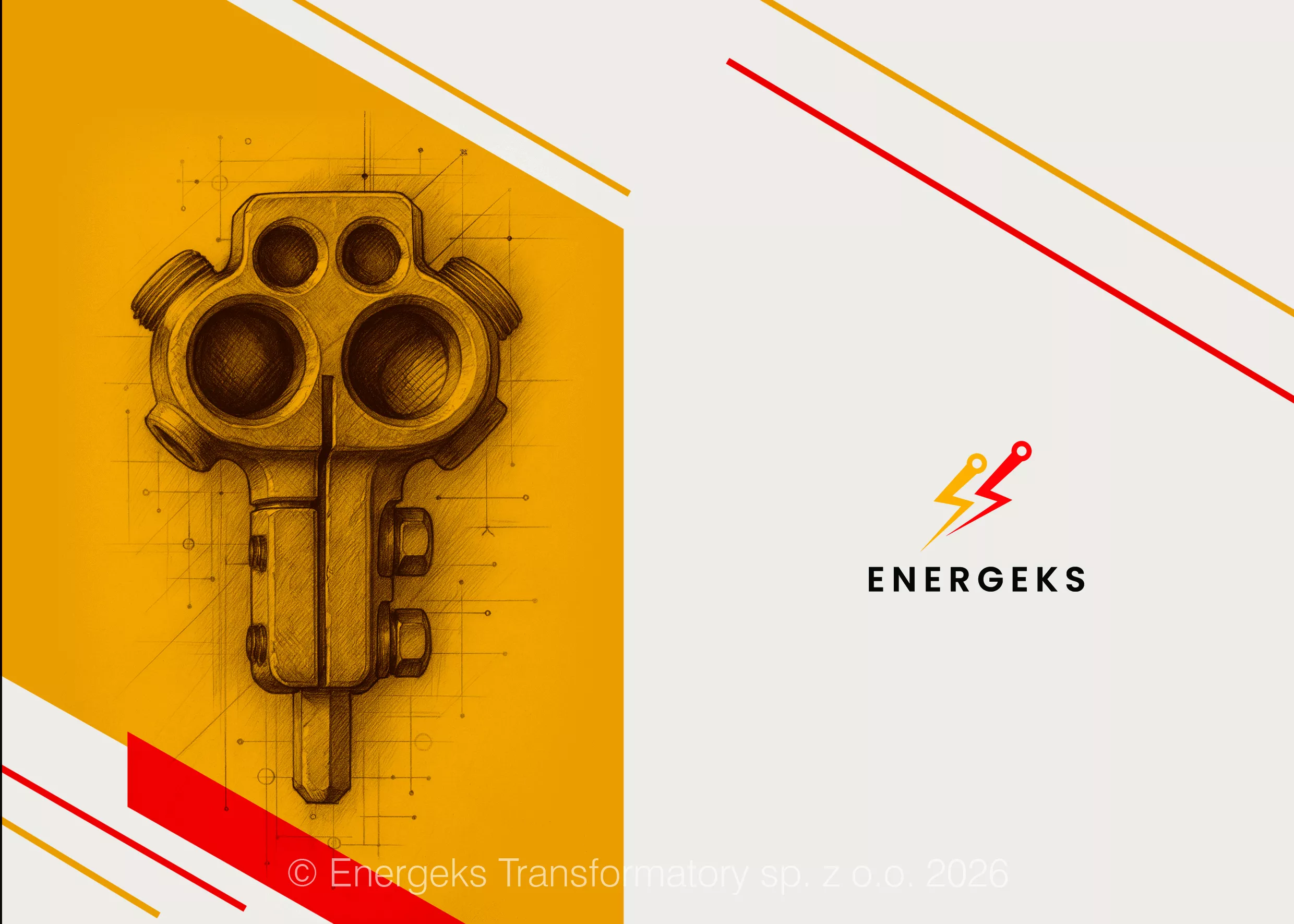
The power industry loves paradoxes.
The largest devices in the power system very often depend on the smallest details. A transformer can weigh several tons, have a power rating of several megavolt-amperes, and operate continuously for 30 years. Yet the part that often decides its reliability is only a few centimetres in size.
It is the transformer terminal.
More precisely, the component that connects the medium voltage cable to the transformer bushing.
To someone outside the industry, it looks like an ordinary piece of metal with a few bolts. A detail that few people pay attention to, as long as everything works.
For a power engineer, it is a completely different story. It is one of the most critical points in the entire installation. Right here, high currents meet, mechanical forces from heavy cables act, temperature changes occur, and the very practical question arises: will this connection safely withstand years of operation in real conditions?
Transformer terminals are connection components mounted on the bushings of a medium voltage transformer. They enable safe connection of MV cables, increase the contact surface area of the conductors, and improve the mechanical stability of the connection.
This brings very concrete benefits.
Lower contact resistance.
Lower risk of connection overheating.
Greater predictability of transformer operation over a long service life.
That is why TOGA-type transformer clamps are often used in medium voltage transformers. They are not an aesthetic detail or a marketing add-on. They are a solution born from a very practical need. The need to better manage current, temperature, and connection mechanics in a place that looks unremarkable but in practice is of enormous importance.
And this article is about those issues.
We will show what TOGA-type transformer clamps are and how they are built.
We will look at why conventional cable connections at transformer bushings can be problematic.
We will explain how the clamp construction affects current, temperature, and contact resistance.
We will also examine why grid operators increasingly require stable connection solutions.
We will show, through examples, in which installations transformer clamps become fundamental to the reliability of the entire station.
Reading time: ~11 minutes
Anyone who has ever stood next an open medium voltage transformer knows that moment.
You look at the massive machine. Several tonnes of steel, a magnetic core, oil, windings. Everything looks calm, heavy, almost majestic.
Then your eyes stop on something the size of a hand.
The clamp.
And this is where real engineering begins.
Because this is not an ordinary piece of metal.
It is a component that must flawlessly carry hundreds of amperes, withstand temperature changes, vibrations, and mechanical forces from cables, while maintaining very low contact resistance for years.
A TOGA-type transformer clamp acts as an adapter between two worlds.
On one side we have the transformer and its bushing – the point where energy exits the tank.
On the other side we have the medium voltage cable, often thick, heavy, and not very flexible.
The clamp introduces an additional conducting element between them, most often made of copper or its alloys. This element increases the contact surface, stabilises the conductor, and distributes mechanical forces over a larger area.
From the point of view of physics, three important things happen:
The current has a larger surface area through which to flow.
The metal-to-metal contact pressure is more even.
The connection is less susceptible to movement and stress.
The effect is simple: less heat, fewer problems, more operational peace.
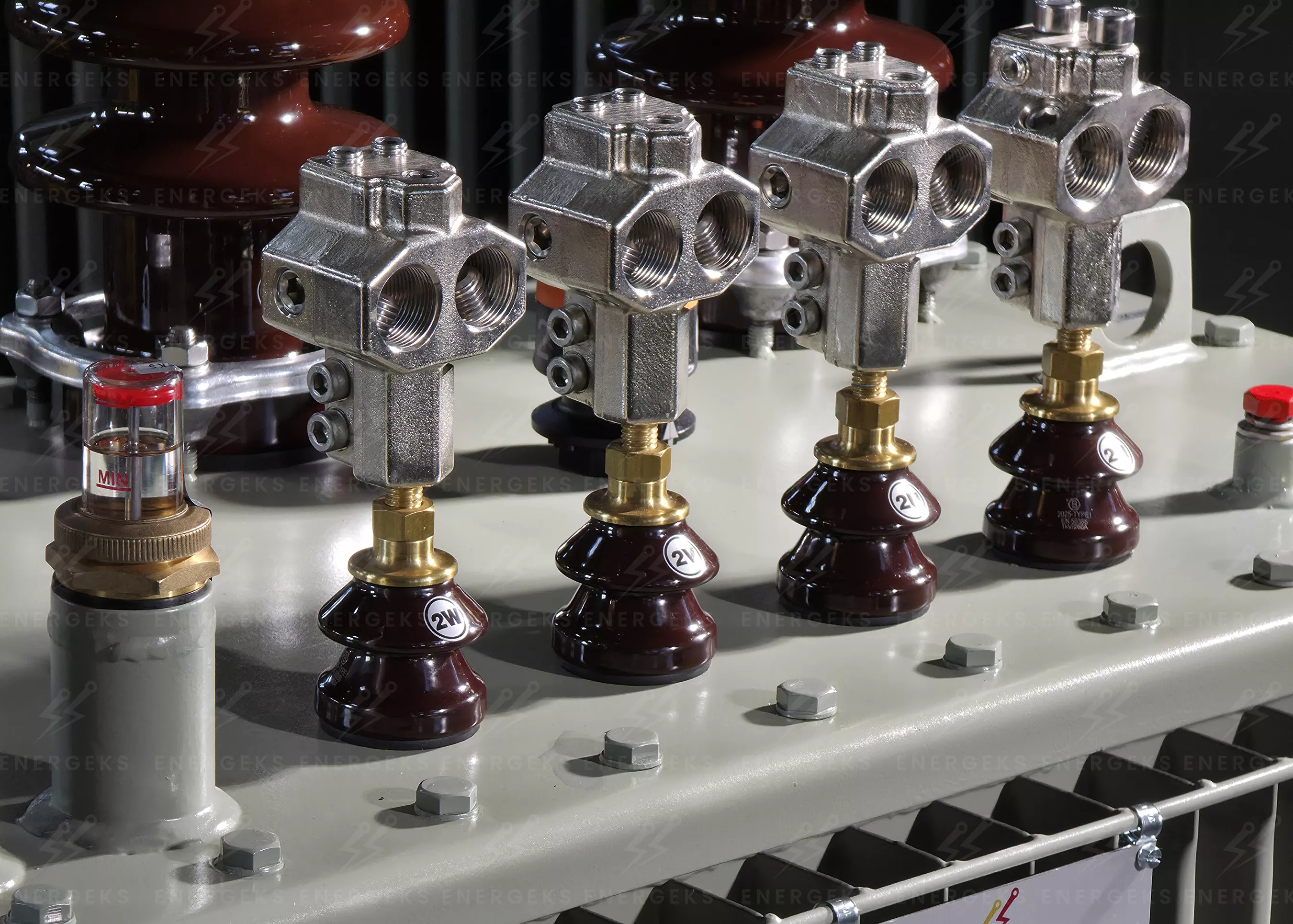
The photo shows a set of medium voltage transformer clamps mounted on the porcelain bushings of an oil‑immersed transformer. Each clamp serves as the connection point for the MV cables, enabling safe and stable connection of the conductors to the transformer winding. The massive construction of the metal connection blocks increases the contact surface area and allows even current flow, which limits local heating and reduces the risk of energy losses. At the same time, the clamps take up the mechanical loads from the heavy cables, protecting the bushings from stress.
It is in this unremarkable place that all the physics of the transformer’s operation comes together – current, temperature and connection durability – which must remain stable for decades of service.
Photo CC: ENERGEKS 2026
Cable lug, bolt, tighten – done.
On paper, it works perfectly.
In reality, three very concrete problems appear.
The first is the weight and stiffness of the cable.
Medium voltage cables with large cross-sections are not delicate. They are heavy, springy constructions that very often do not want to go exactly where the design intended. If the cable comes in at an angle or is under tension, it starts acting like a lever and loads the bushing terminal.
The second problem is the contact surface area.
Metal does not make ideal contact with metal. Current flows through microscopic contact points. If there are few such points, current density increases, and along with it, temperature.
And suddenly, a small resistance starts turning into a local heat source.
The third problem is time.
A transformer does not operate in a perfect vacuum. There are vibrations, temperature changes, material expansion and contraction, short-term overloads. If the connection relies on only a single pressure point, micro‑movements can occur over time.
And micro‑movements in power engineering have a bad reputation.
Because they always end with degraded contact.
And this is precisely where the need for better solutions begins.
But even then, the story is not over.
Because once we have improved the mechanics and the electrical connection, another level of challenges appears. One that does not arise solely from current, bolts and cable geometry, but from the fact that the transformer works in the real world, not in a sterile laboratory. In an open station, in an environment full of moisture, dust, temperature variations and all that unwanted biological activity that power engineering knows all too well.
At first glance, they look a bit like little black hoods.
And that is why they are easy to dismiss. Someone looks at the transformer, sees the bushings, clamps, porcelain, metal, and treats these covers as an extra. A technical trifle that just happens to be there.
Yet in power engineering, such trifles very often do the dirty work that allows everything else to operate calmly.
MV bushing covers are installed to protect the most sensitive area of the transformer connection point. This is where we have live parts, metal components, and relatively small insulation clearances. Exactly the kind of combination we do not want to expose to chance, weather and the creativity of nature.
Most often they are referred to as bird guards. And this is no exaggeration or industry legend. Birds really can cause trouble in a transformer station. All it takes is for one to perch in an unfortunate spot, brush a wing, come close to two points at different potentials, and physics immediately takes over. An arc appears, protection trips, and suddenly we have an outage that nobody planned.
It sounds unremarkable, but this is exactly what some of the most irritating operational problems look like. Not a major failure from a movie. Just a small incident that stops the equipment.
And this is where bushing covers come in.
All black, without any unnecessary fanfare. 😎
Their role is very simple. They make accidental contact with live parts more difficult and reduce the risk that something or someone creates a bridge between potentials.
A bird, a small animal, a branch, a metal object, and sometimes even a tool during service work – all of this can become a problem if it gets too close to where theory ends and medium voltage begins.
A cover does not, of course, make the transformer armoured and indifferent to the whole world. But it very effectively reduces the risk of the simplest, most absurd and, unfortunately, entirely real events. The kind after which one looks at the report and thinks: really? because of that?
Well, yes.
That is why MV bushing covers are no gimmick. They are a practical safeguard that supports the reliability of the transformer from its most mundane side. They do not improve the catalogue glamour of the device. They improve its chances of calm, long-term operation in the real world.
And the real world, as we know, does not always cooperate.
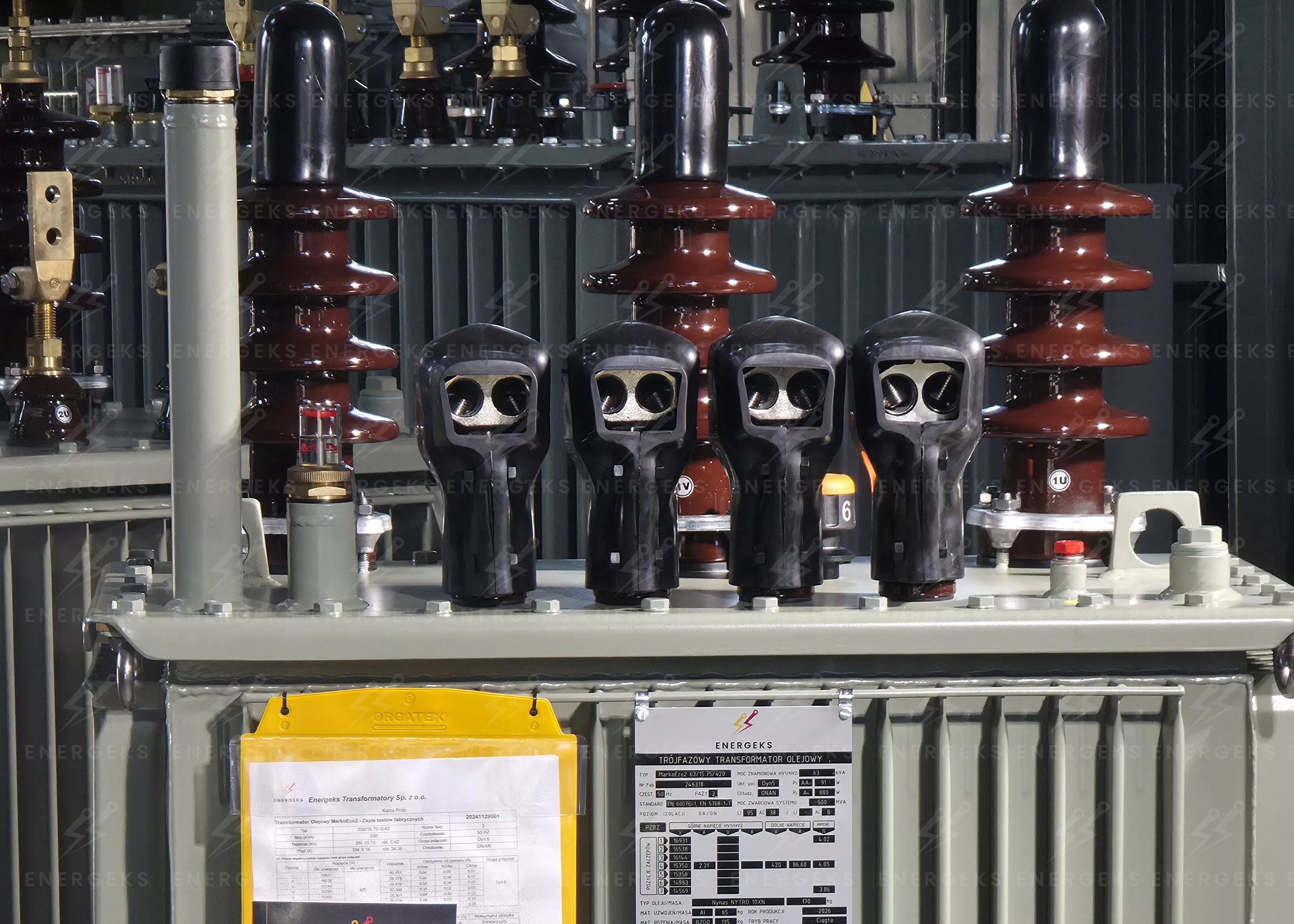
The photo shows medium voltage bushing covers installed on an oil‑immersed transformer. These unassuming black covers protect the critical connection points against accidental contact with live parts and reduce the risk of flashovers caused by birds, small animals and other external factors. They are a simple but very important protective element that supports the safety and operational reliability of the transformer in daily service.
Photo CC: ENERGEKS 2026
From a project perspective, the most sensible approach is when the entire connection system can be selected as a coherent solution, rather than assembled later from random components. Depending on the needs of the investment, these can be transformers equipped with terminal clamps, clamps for a specific type of connection, or MV bushing covers that increase operational safety. Such solutions are available in the Energeks offer; therefore, for a specific project, it is best to simply discuss the configuration and match it to the real operating conditions of the station – and the easiest way to do this is to contact us directly.
Here begins that part of power engineering that looks unremarkable from the outside but is pure physics on the inside.
And as is the case with physics, you can disagree with it, but it will do its job anyway.
At first glance, a transformer clamp is simply a metal component that connects the cable to the transformer. Except that current does not behave as politely as we would like to imagine. It does not flow ideally through the entire contact surface like a beautifully spread sheet of water.
In reality, it flows through those places where metal truly touches metal. And there are far fewer of those contact points than intuition suggests.
That is exactly why the construction of the clamp matters so much.
If the contact surface is larger and the pressure is more evenly distributed, more actual contact points appear. This in turn lowers contact resistance. And lower contact resistance means one thing: less heat where we least want to see it.
Because resistance and temperature are a pair that very quickly show their claws. Joule’s law clearly states: the power dissipated in the connection increases with the square of the current. This means that even a small resistance, under a high operating current, can turn into a local source of heating. First, a few extra degrees appear. Then the material starts to operate hotter, ages faster, and the connection gradually loses its original parameters.
A transformer clamp does three very important things at once.
First, it increases the contact surface area, so the current has more space to flow calmly.
Second, it distributes the contact pressure better, so the connection does not rely on only one small fragment of metal.
Third, it stabilises the whole assembly over time, reducing the risk of micro‑movements that, over the years, can degrade the quality of the contact.
The effect is simple, though extremely valuable from an operational point of view. The current does not concentrate in one tight spot but spreads over a larger area. The temperature of the connection remains lower. And a lower temperature means calmer, more predictable transformer operation.
It can be compared to traffic. The same number of cars squeezed onto a single narrow street quickly creates chaos. When they are given a wide road, everything flows much more calmly. Current behaves similarly. It also likes to have space.
That is why a well‑designed clamp is not a technical detail for the sake of principle. It is a component that helps keep three things in check at once: current, temperature and connection durability. And for a transformer operating for decades, that is truly no small matter.
Grid operators have one big advantage over the rest of the market.
They do not see a single transformer; they see a whole repeated picture of operation.
For the designer, a transformer is a device selected to meet technical parameters. For the investor, it is an element of a larger puzzle. For the grid operator, it is part of a system that must operate calmly not for one or two years, but for 30, sometimes 40 years.
And it is this perspective that changes everything.
Because when you look at thousands of devices operating in different locations, under different weather conditions and different loads, you very quickly see which solutions age well and which only look good on the day of acceptance.
Every failure, every thermal imaging report, every overheated connection and every case of degraded contact goes into the analysis. At first, it is a single event. Then a second. A third. A tenth. And suddenly it becomes clear that this is no longer a coincidence, but a recurring pattern.
And power engineering does not like recurring problems.
That is why operators are increasingly looking not only at the transformer’s power, loss levels or insulation parameters, but also at how the cable connections are designed. Whether the connection is mechanically stable. Whether the contact surface is sufficient. Whether the arrangement can withstand the stresses from heavy cables, vibrations, temperature changes and years of operation.
Because practice shows something very interesting.
In many cases, the transformer itself, as a machine, works flawlessly. The windings are in good condition, the oil maintains its parameters, the core operates stably. The problem does not begin in the heart of the device.
The problem begins at its interface with the outside world.
Exactly where the cable connects to the transformer.
And that is the moment when a detail ceases to be a detail.
It becomes an element of the entire station’s reliability.
It is from this logic that the operators’ technical requirements arise. The more operational experience, the more attention is directed to the construction of bushings, the method of making cable connections, the stability of clamps and the resistance of the whole connection system to real operating conditions.
Because ultimately, the operator does not buy just the transformer.
The operator buys operational peace.
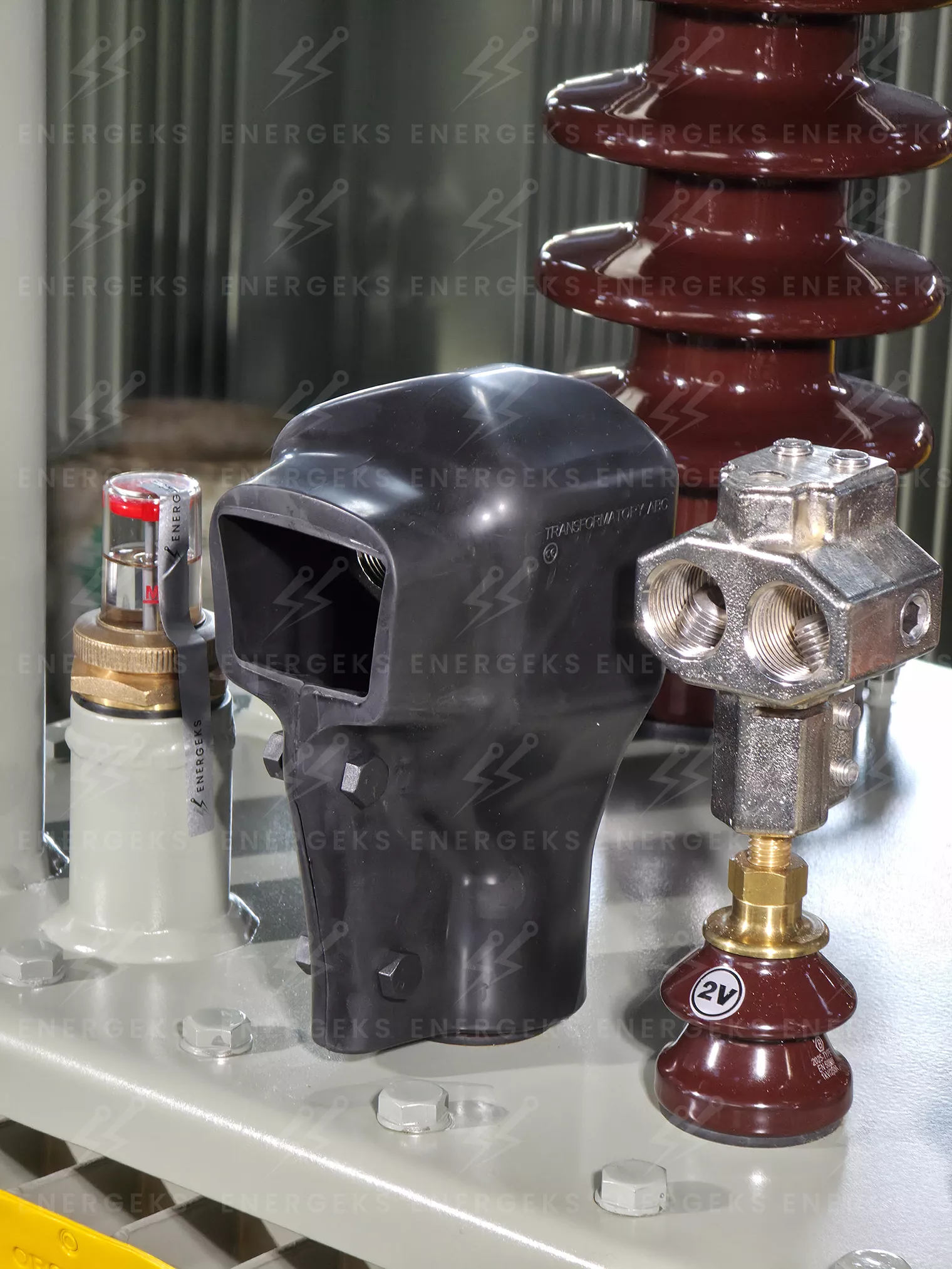
The photo shows a set of medium voltage transformer connection components: a transformer clamp, a porcelain bushing and a bushing cover that protects the critical point from environmental influences. It is here that current, mechanics and operating conditions meet, which is why each of these components must be consciously selected and work as a coherent system. In practice, this means one thing: reliability begins with a detail, and a well‑designed connection is not an accident but the result of properly selecting all the components that together create a safe and durable connection.
Photo CC: ENERGEKS 2026
There are installations where the transformer has a rather comfortable life. It runs steadily, the cable arrives without too much acrobatics, the load does not do a rollercoaster every day, and everything looks as neat as in the nice drawing from the project.
But there are also places where reality quickly verifies whether the connection at the transformer was designed with intelligence or simply so that it could be bolted together and the matter closed.
And there, transformer clamps cease to be a technical curiosity.
They become a very practical test of the quality of the whole solution.
Everything seems simple.
There is energy production, there is a transformer, there is a power output to the grid. End of story. Except that the transformer in a PV farm operates under conditions that like to test the patience of materials. In the morning the system wakes up, then power rises, then full sun comes, a cloud passes, sun again, ambient temperature does its thing, and along with it the operating conditions of the connections change. This is not the calm, uniform life of an old distribution transformer that does roughly the same thing for half a day. Here current and temperature can change dynamically, and each such cycle means work for the material, the contact pressure and the contact interface.
Add to this the cables. Thick, heavy, serious, with character. Cables that have no intention of lying down gently just because someone drew a nice route on the plan. If the connection at the bushing is weak or too sensitive to stress, the PV farm will show it quickly. And it will do so without sentiment.
Here the emotional stakes rise even higher, because on the other side of the cable there is often a process that really does not like downtime.
Steelworks, foundries, chemical plants, large logistics centres, data centres, plants with production lines operating in continuous mode. In such places, the transformer does not supply an abstract power from a table. It supplies concrete work, concrete machines, concrete money that either flows or stops flowing. If the connection at the transformer starts to heat up, age or lose stability, it is no longer a minor technical defect. It is the beginning of a problem that can affect the entire facility.
That is why, in industry, no sensible person wants the critical point of the system to behave like a moody paving stone after the first winter. The connection has to be stable, predictable and boring in the best possible sense. It simply has to work.
The place where theory very quickly meets tight reality.
Here every centimetre matters. Cables enter from below, the switchgear stands close, the transformer has its dimensions, and the person responsible for installation suddenly discovers that the planned geometry was beautiful until the real cable appeared. Not the one from the brochure, but the real one – stiff, heavy and moderately interested in cooperating.
Under such conditions, even a good connection can get out of breath if it does not have adequate stabilisation. The cable rarely comes in perfectly straight, the manoeuvring space is limited, and every unnecessary stress‑inducing twist later affects the terminal and the quality of the contact. This is where a well‑designed clamp shows its true value. Not in a folder, but when you have to manage physics, space and cable weight all at once.
For example facilities with large temperature variations, outdoor infrastructure, or locations where the transformer has to operate in an environment of dust, moisture and constant changes of conditions. There, every detail of the connection matters even more, because the connection does not work in a comfortable laboratory but in a world that regularly checks whether everything was done properly.
That is precisely why solutions that increase the contact surface and mechanical stability are not a luxury for hardware aesthetes. They are simply a sensible response to operating conditions.
Because the truth is rather amusing, though for operation it is less amusing.
The transformer can be excellent.
The core solid, the windings well‑made, the oil within spec, everything looks as it should.
And then all that majesty of several tonnes of equipment can be put to the test by a few centimetres of metal at the connection point.
A related topic worth knowing:
Why an MV transformer bushing terminal has one or two holes?
f you want to better understand why even such a small detail as the cable attachment method matters, take a look at our article about the construction of MV bushing terminals. We show there where the difference between one and two mounting holes comes from and how it affects the stability of the connection and its durability over time.
And here we come to a very practical question.
Because theory is theory, physics is physics, and temperature curves look beautiful in an article, but in the end someone has to close the topic.
You need to select the transformer.
You need to select the clamps.
You need to plan the bushing covers. You need to make sure that everything fits together not only in the catalogue but also later on the real station, with the real cable, real installation and real operator requirements.
And this is where the difference begins between assembling a system from random components and designing a solution that makes sense as a whole.
You can look at the transformer as a separate product, the clamps as separate hardware, and the covers as yet another add‑on to order. But in power engineering practice, these things do not work separately. They meet at the same place, on the same connection, under the same current, temperature and the same pressure of reality.
That is why the most sensible approach is to think about them together.
In the Energeks offer you can find both low‑loss medium voltage oil‑immersed transformers and cast‑resin dry‑type transformers. You can contact us about selecting transformer clamps and medium voltage bushing covers.
In this way, the entire system can be selected coherently, for a specific project, for the cable routing method, for the installation conditions and for the requirements of a given installation. Without guessing, without improvisation at the end of the investment and without nervously wondering whether all the components will really work together as they should.
And that really matters in power engineering.
Because sometimes the reliability of a transformer is not only decided by what is inside the tank.
What happens on the outside can be just as important. On the bushings, on the clamps, at the interface between the cable and the device. In all those places that do not make a great impression in a long‑distance photo, but which can make a great difference after several years of operation.
If you like technical stories from the power industry told without pomposity but with respect for detail, we also invite you to our LinkedIn.
Referencje:
IEEE Power Transformer Handbook
Pfisterer – Technical documentation (MV connection technology)
Shipped from our warehouse in Poland within 2–3 working days, 5-year warranty. Full range 25–2500 kVA in the shop (prices in PLN).
No reviews!