26 Feb
2026
Energeks
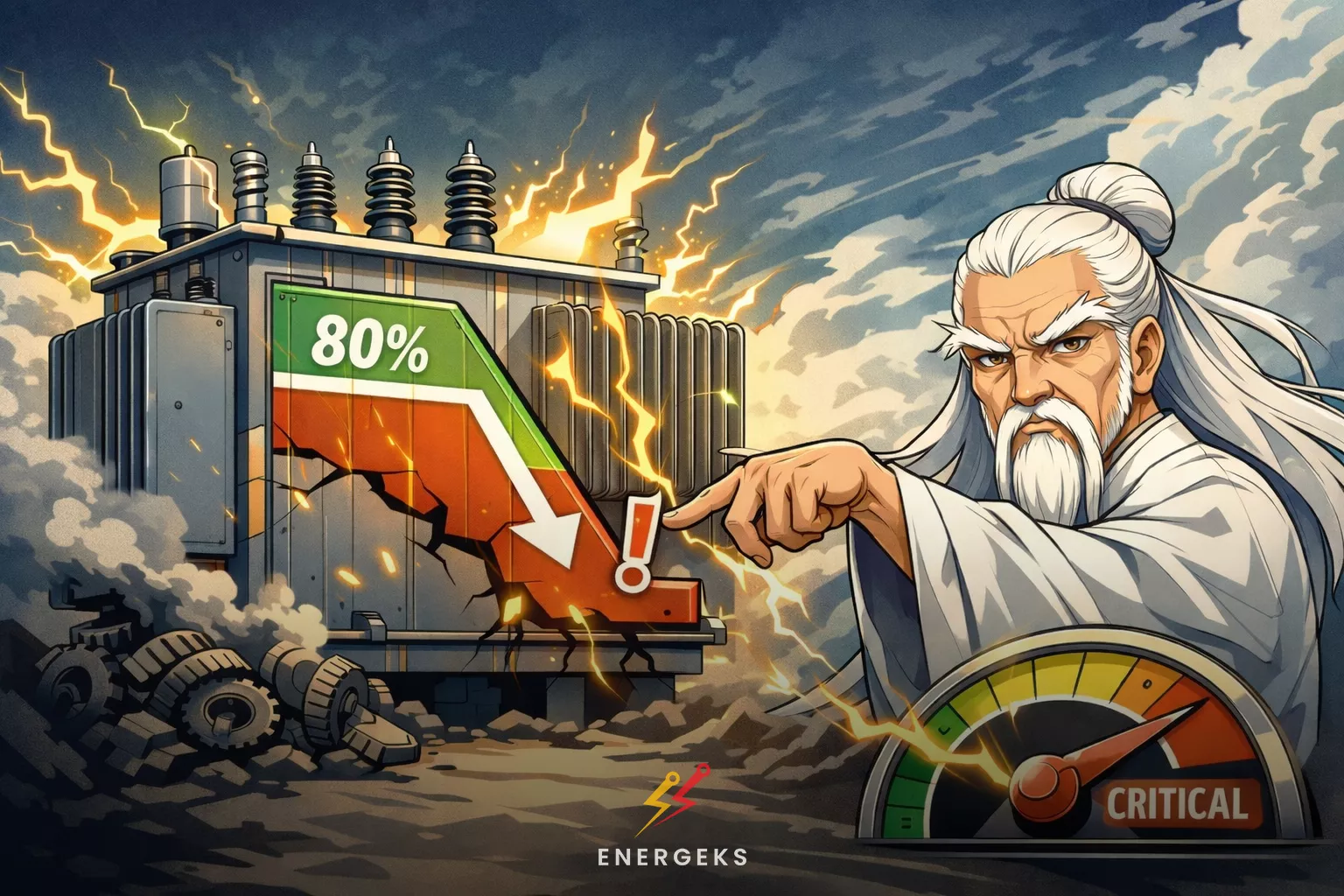
It can pretend for years that everything is under control.
And then, in a very short time, it reminds you that the hard sciences also have a hard memory 🫣
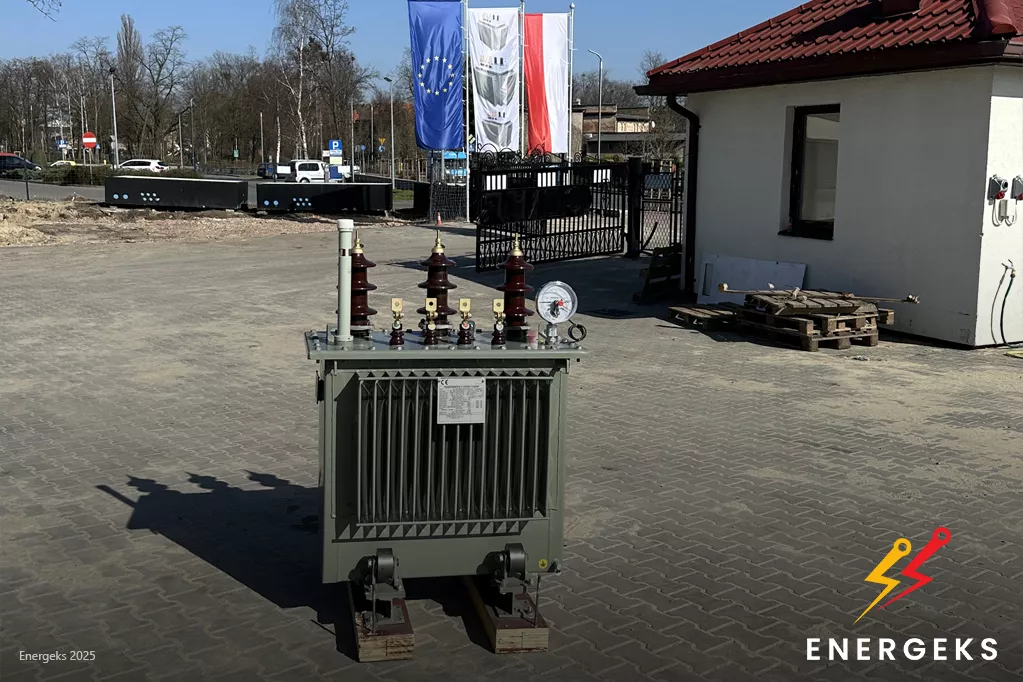
A medium voltage transformer is a master of patience.
It can endure more than the table suggests. Work longer than someone planned.
Survive decisions that were borderline but were supposed to work out.
And that's precisely why it can be treacherous.
It doesn't break when things are really bad.
It breaks when, for a long time, things were almost good.
When the power margin was slowly dwindling, and no one noticed the moment when physics started charging interest.
This text isn't about failures.
It's about how to maintain control before the last 20% of margin disappears faster than you expect.
We see it more and more often.
Grids are working more intensively.
Load profiles are sharper.
Renewable sources, energy storage, chargers, inverters introduce dynamics into the system that older design assumptions simply didn't foresee.
The trusty old transformer copes and keeps working.
Only it's operating in a different world than the one it was selected for.
And that's not an unsolvable problem; it's a phenomenon to be understood.
This article is for those who prefer to know sooner rather than replace later.
For people who treat a transformer not like a grey box, but as an element of an energy strategy.
If you read on, you'll see how to recognize the moment when overload stops being flexible, why short episodes have long consequences, and how to make decisions that genuinely extend a transformer's life instead of heroically shortening it.
We'll look at why transformer aging accelerates non-linearly.
We'll explain how much operating outside rated parameters really costs.
We'll debunk the myth of momentary overload and show why many failures are the logical consequence of earlier choices, not equipment malice.
It'll be interesting, so stay until the end, where a small bonus also awaits you🥰.
Reading time: about 9 minutes
Every medium voltage transformer has a certain tolerance.
The designer isn't naive.
They know life won't be a catalog table.
They know load will spike temporarily, that summer will be hotter than the standard average, that someone will add another charger or inverter.
And for a long time, everything indeed works.
The problem begins when overload stops being flexible and starts being structural. The difference is subtle.
Flexible overload is an episode.
A dozen or so minutes of higher current, after which the transformer returns to thermal equilibrium. Structural overload is a situation where the operating point permanently shifts closer to the thermal limit.
The key indicator isn't the power percentage itself, but the hot-spot temperature of the winding.
IEC 60076 and IEEE guidelines clearly show that the aging rate of cellulose insulation increases exponentially with temperature.
An increase of 6 to 8 °C can double the aging rate.
This isn't a linear relationship. It's a chemical reaction accelerated by temperature.
In practice, the critical moment is recognized by several signals: shortened cooling time after a load peak, more frequent fan activation, an increase in no-load and load losses measured indirectly through active and reactive power analysis.
Add to this the analysis of gases dissolved in the oil, which shows whether the insulation is starting to react.
A transformer doesn't shout. It whispers in the data.
If we don't look at load profiles on an hourly and seasonal basis, it's easy to miss the moment when 80% of rated power stops being safe because the operational context has changed.
And today, context changes faster than ever.
Many investors think like this:
It was only 30 minutes.
Nothing happened.
From an operational point of view, they're right.
From the point of view of insulation chemistry, not necessarily.
Paper insulation in a transformer ages due to cellulose depolymerization.
Every temperature increase accelerates this process. A short episode of high load raises the hot-spot temperature. The cellulose chain molecules shorten.
We cannot reverse this process.
If there are a few such episodes a year, the impact may be negligible.
If they repeat daily during peak hours, we start building a permanent loss of dielectric strength. The transformer still works, but its safety margin decreases.
It's a bit like metabolic debt in the body. One sleepless night doesn't cause a revolution. Hundreds of such nights change biological parameters.
In systems with a high share of RES, high-load episodes often combine with higher-order harmonics generated by inverters.
Harmonics cause additional losses in the core and windings.
Losses mean heat. Heat means accelerated aging.
A short episode can mean a few percent of annual insulation life loss.
No one will see this at the moment of the event. We'll see it a few years later in the form of a failure that seems sudden.
Physics doesn't forget. It accumulates.
And at a certain point, a very specific question arises: since the transformer is still working, is it better to modernize it, regenerate it, or plan for replacement?
This isn't a zero-one decision.
Factors include oil analysis results, the degree of insulation polymerization, energy efficiency, compliance with Ecodesign Tier 2 requirements, and the real costs of losses.
Sometimes renovation makes sense and allows regaining several years of stable operation.
Sometimes economics and safety clearly indicate that it's better to replace the unit before a failure does it for us.
If you're facing such a dilemma, we discuss this topic more broadly in the article:
Is it worth investing in a new transformer when the old one still works?
It's a good complement to this conversation, especially when the decision concerns the next 20 years of installation operation, not just the upcoming season.
The most important decision is moving away from catalog thinking.
Rated power isn't an absolute.
It's a reference point for specific conditions.
If a transformer operates in an environment with higher ambient temperature, variable load profiles, and an increased harmonic level, this must be accounted for in the life model.
In practice, this means temperature monitoring, power quality analysis, and periodic oil diagnostics.
Decision number two is planning reserve with the future in mind, not just based on construction loads.
If we know that within three years, energy storage and high-power DC chargers will be added, it's worth planning for a transformer with a higher thermal class or greater power.
Decision number three is peak management.
EMS systems and energy storage control can realistically flatten the load profile.
Sometimes investing in intelligent control is cheaper than premature transformer replacement.
Extending a transformer's life isn't heroism.
It's consistent data management.
An MV transformer can work for 30 or even 40 years.
Provided we don't treat it like an unlimited resource.
Here we get to the heart of the matter.
The aging of paper-oil insulation is described by the Arrhenius law.
Simply put, it states that the rate of a chemical reaction increases exponentially with temperature.
If at 98 °C a transformer uses one unit of life per year, then at 110 °C it may use two or three. At 120 °C, the rate of increase is even greater.
The last 20% of the power margin often means operating in a temperature range where aging acceleration is dramatic compared to the nominal range.
That's why we talk about non-linearity.
In the first 60% of load, changes are gentle.
Near the limit, they become abrupt.
That's precisely why a transformer can work without problems for years, and then, in a short time, enter a phase of rapid degradation.
This isn't a whim of the device. It's a consequence of materials physics.
And it's at this moment that the real dilemma appears.
Should we still invest in renovation, drying, oil replacement, or is this already the stage where insulation parameters directly state that the construction is approaching the end of its technical life?
If the topic concerns units with 30, 40 years of operation, it's worth looking more broadly at the technical and economic aspects of such a decision.
We discuss them in detail in the article:
Refurbish or replace? Your transformer's last chance!
It's a natural complement to this part of the conversation, especially when you want to understand where cost-effective regeneration ends and responsible replacement planning begins.
The cost isn't limited to the energy bill.
First, we shorten the device's technical life.
If the designed service life is 30 years, and we realistically achieve 22, then the missing 8 years have their own capital value.
On the scale of a PV farm or industrial plant, this means millions of PLN shifted in time.
Second, the risk of unplanned downtime increases.
And the cost of downtime often exceeds the cost of the transformer itself.
Third, power quality parameters deteriorate.
Higher temperatures mean higher losses, higher losses mean lower efficiency.
Differences of one or two percent in large installations translate into significant annual amounts.
Operating outside rated parameters doesn't have to be a mistake.
It can be a conscious decision. There's one condition. We must know its price.
We hear this often. The transformer is oversized; momentary 110% won't hurt it.
It will hurt it or not, depending on the context.
If momentary overload occurs at low ambient temperature and the transformer has cooling reserve, the impact may be minimal. However, if it's 110% on a hot day, with an already elevated harmonic level, the effects are completely different.
The myth lies in looking at the power percentage, not at the thermal and electrical conditions.
A transformer doesn't feel %%. It feels temperature and electric field.
Momentariness isn't a time category. It's an energy category.
A failure is rarely a single event.
It's the result of a sequence of decisions.
Power selection on the edge. Failure to update load analysis after installation expansion.
Abandoning monitoring because nothing happened for years.
Each of these decisions is rational at the time it's made.
The problem arises when the system changes, but the assumptions remain old.
A transformer doesn't know the budget. It only knows the laws of physics.
That's why we say many failures are the logical consequence of earlier choices.
That's good news. Since they're logical, they can be prevented.
In many projects, an MV transformer appears in the budget as a purchase item.
Power, voltage, delivery date, price.
Ordered, installed, connected.
It's supposed to work.
But the moment we start looking at it as a strategic asset, the conversation changes tone.
A transformer isn't just a device for changing voltage levels.
It's the energy node of the entire installation.
Every decision about power expansion, every new DC charger, every additional inverter, every energy storage unit passes through it.
If it's minimally selected, the company's entire energy strategy starts being constrained by one grey box in the station.
Life cycle planning means more than just writing "30 years" into the documentation.
It means analyzing how the load profile will change, what the power growth scenarios are, how the structure of loads will change. Today, a production plant has a specific consumption.
In 3 years, it might have a line that's 40% more energy-intensive.
If the transformer has no room for such a change, investment in development starts with infrastructure replacement.
TCO analysis, or total cost of ownership, often brings surprising conclusions.
A cheaper transformer with higher losses generates greater energy costs over 20 years than the difference in purchase price. A unit non-optimally selected for harmonics may operate with reduced efficiency and age faster. In the long-term balance, savings at the start turn out to be an illusion.
When energy storage enters the system, the transformer ceases to be a passive element.
It becomes part of the power control system.
You can smooth peaks, limit overloads, consciously manage reactive power.
That's specific kilowatts less during critical hours and specific degrees Celsius less in the winding.
In this perspective, the last 20% of power ceases to be a free reserve.
It's a zone we treat as an area of high responsibility.
We enter it when we know why, for how long, and with what consequences.
Not because it "still fits somehow."
This isn't a conservative approach. It's a mature approach.
Does a transformer always have to operate below 80% power?
No. The key factors are temperature, load profile, and cooling conditions.
In many cases, 90% is safe if it's well calculated and monitored.
Does oil change extend a transformer's life?
It can help if the oil has degraded, but it won't reverse paper aging.
That's why diagnostics must be comprehensive.
Is it worth installing online sensors in older units?
In many cases, yes.
The cost of monitoring is small compared to the value of information about temperature and gases in the oil.
Does oversizing always pay off?
Not always.
Sometimes a better solution is intelligent load management or support from an energy storage system.
Transformer aging isn't linear.
The last 20% of power often tempts, because it looks like a safe reserve.
In practice, that's precisely where the technical cost grows fastest.
Fortunately, we aren't helpless. Data from monitoring, temperature and power quality analysis, sensible power planning, and updating design assumptions allow us to keep the situation under control. Without drama. Without fighting fires at the last minute.
An MV transformer can be just another device in the station. It can also be a consciously managed asset that works stably for decades. The difference lies in decisions made earlier, not in the failure itself.
As Energeks, we support investors, designers, and operators in the selection and modernization of MV units based on real work profiles.
Our offer includes oil transformers and resin-insulated transformers, all in Ecodesign Tier 2 standard, designed for high efficiency and a long life cycle. We also deliver complete transformer stations and solutions integrated with energy storage.
If the topic concerns your installation, it's worth talking sooner rather than later.
On our website and LinkedIn, we share knowledge from projects and implementations, showing how to approach a transformer not emotionally, but strategically.
References:
IEEE Std C57.91 Guide for Loading Mineral Oil Immersed Transformers
A classic document that details the relationship between temperature, load, and accelerated insulation aging. You'll find thermal models, life loss calculations, and a practical approach to short-term and long-term overloads.
CIGRE Technical Brochure 761 – Condition Assessment of Power Transformers via https://www.scribd.com/
A very concrete study on assessing the technical condition of transformers, interpreting oil tests, diagnostics, and making decisions about modernization or replacement based on data, not intuition.
Shipped from our warehouse in Poland within 2–3 working days, 5-year warranty. Full range 25–2500 kVA in the shop (prices in PLN).
Need a complete MV/LV substation? See ready-made transformer substations in the shop or configure your own in the free station configurator (technical design, data sheet, configuration code; in Polish).
No reviews!