13 Nov
2025
Energeks

There is a moment of silence before the first ampere trembles.
On the screen glows a 3D visualization, where the core consists of thousands of thin laminations, and the windings resemble precisely laid ribbons.
This is where the life of an oil transformer begins, long before it reaches a substation and powers a residential district or a production line.
A good story isn't magic; it's engineering told in the right sequence.
That is exactly what we are doing today.
At Energeks, we work with medium-voltage transformers, prefabricated transformer substations, switchgear, and energy storage systems every day.
We combine practical experience with the requirements of standards and the expectations of investors.
This text is the result of numerous conversations with designers, technologists, and assembly teams.
We present the process in a way that helps make better decisions and predict outcomes at the concept stage.
If you design, purchase, order, or will be operating an oil transformer, understanding the production chain of cause and effect will save you time, money, and nerves.
In the end, you will know why a specific requirement in the technical specification translates into particular operations, risks, and performance parameters for decades.
Agenda:
Design and digital visualization
CRGO lamination core and step lap configuration
Windings. Conductor selection and geometry
Insulation system. Kraft paper and DDP
Active part assembly and preparation for testing
Tank. Corrugated or with radiators
Surface treatment and anti-corrosion protection
Drying of the active part and moisture control
Vacuum oil filling and heat cycling
Routine tests and readiness for shipment
Reading time: ~20 minutes - just right for some worthwhile reading during your afternoon coffee and biscuit break!
Every transformer begins with an idea, which looks less like a magical spark and more like... Excel, CAD, and... coffee at three in the morning.
The process of designing an oil transformer is a precise puzzle where physics meets mathematics, and everything must fit inside a tank with specific dimensions and weight.
Before anyone even orders steel or copper, the design team creates a digital model of the transformer, also known as a digital twin.
In this model, they test how the magnetic field will behave under different loads, how heat flows, where mechanical stresses will occur, and what the no-load and load losses will be.
This is not just a "nice 3D visualization of a transformer"—it's a virtual testing laboratory that saves months of work and hundreds of thousands of EUR.
The designer must reconcile several worlds:
The electrical world: parameters like voltages, ratios, and vector groups.
The mechanical world: short-circuit forces and cooling.
The material world: because CRGO steel has different properties than amorphous steel.
And finally, the environmental world: ambient temperature, humidity, and altitude above sea level.
This is where the engineering dance between theory and practice begins.
For example: increasing the number of turns improves voltage stability but raises the winding resistance and thus the losses. Reducing the conductor cross-section lowers costs but impairs cooling. As always—the devil is in the details, and the angel is in the tolerance table.
In modern factories, the transformer design doesn't end on paper. Digital visualization allows for simulations in environments like ANSYS Maxwell or COMSOL Multiphysics, where one can check how the transformer will behave during a short-circuit, overheating, or a lightning impulse. It's a bit like training—it's better for the equipment to "take a beating" in the computer than in the power grid.
Thanks to such models, it's also easier to adapt the construction to a prefabricated transformer substation, where every centimeter counts. The designer can see in advance if the mounting holes, coolers, tap-changers, and accessories will fit without collisions. This is the magic of 3D transformer design—a virtual factory before the real one is built.
A well-designed digital transformer already has a full data package defined at the design stage:
Technical documentation, a bill of materials, a winding schedule, and a detailed cooling plan.
This shortens production time by up to 20% and minimizes the risk of errors.
At the heart of every transformer lies its core – the magnetic core.
It doesn't glow or shine, but its quality determines whether the device will purr like a cat or hum like a refrigerator from the 1980s. The core is precisely what dictates no-load losses, noise levels, and overall energy efficiency.
And it all starts with a material known by a three-letter acronym every electrician memorizes:
CRGO – Cold Rolled Grain Oriented Steel.
This silicon steel, with grains oriented in a single direction, has a unique gift:
It conducts magnetic flux like a well-designed channel conducts water.
As a result, hysteresis losses (the energy consumed with every reversal of the magnetic field) are even 30–40% lower than in ordinary hot-rolled steel.
From an engineer's perspective, it's like an engine running at lower throttle but delivering the same power.
During the production of the transformer core, CRGO laminations are cut with laser or knife-edge precision to within tenths of a millimeter.
It is crucial that they have no burrs or micro-cracks, which could become sources of loss or vibration.
Here, not only geometry matters but also the stacking sequence. Modern designs use a so-called step-lap configuration – a technique of overlapping the lamination edges, resembling roof tiles.
The effect? Magnetic flux flows smoothly, without abrupt "jumps" between segments, which reduces noise and improves efficiency.
Imagine the core as a labyrinth where the magnetic field seeks the shortest path.
Every gap, every misalignment is like a hole in the path = energy escapes as heat and sound.
This is why the following are so critical:
• High-quality laminations (low core loss, e.g., 0.9–1.1 W/kg at 1.5 T and 50 Hz),
• Precision cutting and stacking,
• And solid joints between yokes and limbs that eliminate micro-gaps.
In large units, the core is assembled in segments: first the limbs, then the yoke, and the whole structure is clamped with steel frames.
Some manufacturers use bonded interlayer insulation systems that limit vibration and improve the coherence of the core package. Amorphous cores, which are even more energy-efficient though more difficult to process, are also becoming increasingly popular.
From a user's perspective, you can hear the difference between a "good" and a "bad" core.
Literally. A transformer with a perfect step-lap configuration and the right CRGO steel can be several decibels quieter, meaning in practice you can hold a normal conversation next to the operating equipment. For urban substations installed near buildings, this isn't a minor detail, but a condition for project acceptance.
An interesting fact
Some production lines use algorithms to optimize the core cutting angles based on the working flux density.
This is pure field mathematics: the better the grain orientation, the smaller the magnetic distortions and the lower the losses at high voltages. As a result, the transformer gains a few percentage points in efficiency without additional material costs.
This is how the foundation of the entire device is created – both literally and figuratively.
The CRGO lamination core is an engineering compromise between physics, economics, and the quiet that speaks of perfection.
If the core is the transformer's heart, then the windings are its muscles – they carry the energy, and their shape, material, and insulation determine how effectively they do so. In theory, it's simple: we have a primary winding, a secondary winding, the right number of turns, and Faraday's law of induction. In practice, it's a world of hundreds of nuances that can determine whether the transformer survives its first short-circuit.
First, the choice of metal. Copper or aluminium?
Contrary to myths, it's not just about price.
Copper has higher conductivity (approx. 58 MS/m), but it's heavier and more expensive.
Aluminium (approx. 35 MS/m) requires a larger cross-section but facilitates cooling thanks to better temperature distribution. For transformers with powers up to a few MVA, the choice often depends on material availability and client requirements. You can find more about differences in conductivity and material properties in analyses by the International Copper Association, which has been researching the efficiency of copper in the power industry for years.
Shape and geometry – a dance between the magnetic field and oil
The low-voltage (LV) winding is most often made from paper-insulated rectangular strip or wire, wound in layers. The high-voltage (HV) winding – from round or rectangular wires, also in paper, but with a more complex geometry. All this is done to minimize the stray field and distribute temperature evenly in the oil.
The principle is simple: the shorter the current path, the smaller the losses. But engineers know that reality is rarely straightforward. HV windings often use helical, cylindrical, or disc-type arrangements, which allow for controlled magnetic field distribution and oil cooling through microchannels.
In laboratories, you can see how such a winding in cross-section somewhat resembles a multi-layer cake – except instead of cream, we have cellulose Kraft paper and epoxy resin.
Insulation secrets – cellulose and DDP in action
Every winding needs protection from voltage and temperature. This is where Kraft paper and its enhanced version, DDP (Diamond Dotted Paper), come into play. This is a material where micro-dots of resin are arranged in a regular grid – during the heating process, they create a "weld" between the winding layers. The result? A rigid structure resistant to vibration and discharges. The layer insulation made from DDP paper has another advantage: it allows for precise control of the so-called "creepage distance." A high value for this parameter reduces the risk of flashover, which is crucial at voltages of 15–36 kV.
Insider jokes
In the industry, they say that "a winding can be made beautifully, but only once" – because if something goes wrong during the winding process, there is no second chance. Too much pressure? Damaged insulation. Too little? Vibration. That's why winding machine operators often have the status of artists – they can feel the tape's resistance with their fingers before a sensor shows any deviation.
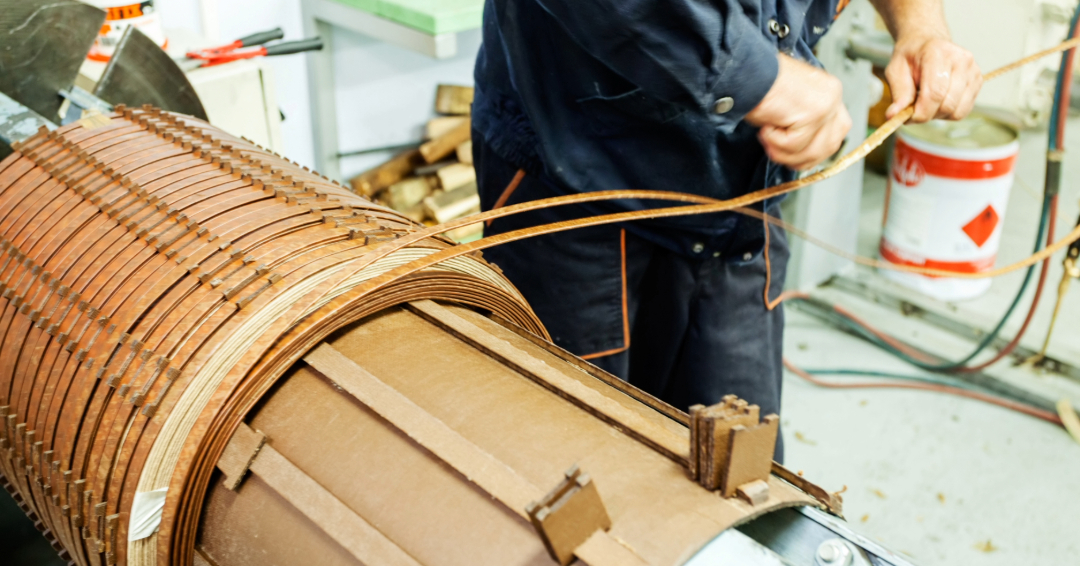
Anyone who has had the chance to see the winding of an oil transformer coil live knows it's like watching a watchmaker at work on an XXL scale.
Precision, rhythm, and focus – all so that the current can flow for decades in perfect rhythm
Manual winding of oil transformer coils using copper conductors and DDP paper insulation.
A key manufacturing stage ensuring transformer efficiency and long-term reliability.
Insulation in a transformer is somewhat like skin in a living organism – invisible from the outside, but absolutely crucial for the life of the entire system.
Without it, even the most beautifully designed core and windings wouldn't stand a chance of surviving the first overvoltage. And just as human skin relies on elasticity, resistance, and regeneration, the most important properties in a transformer are dielectric strength, mechanical stability, and resistance to thermal aging.
The primary material that meets these requirements remains Kraft paper – a cellulose classic with an extremely long history.
It is made from wood fibers of high chemical purity, which ensures low ash content and excellent electrical strength. In transformers, it is used in the form of tapes, sleeves, and spacers. In contact with mineral or synthetic oil, the paper swells minimally, maintaining dimensional stability, and its micropores allow for the exchange of gases and oil.
But the world of insulation has taken a step further. In higher voltage windings, DDP (Diamond Dotted Paper) is used, coated with a regular grid of micro-dots of epoxy resin. When the winding enters a vacuum oven and reaches the appropriate temperature, the resin melts, fusing the paper layers into a rigid, homogeneous structure.
The result? Insulation that doesn't shift even under severe electromagnetic transients and vibrations. It is this "glue" that prevents the transformer from "humming" during the startup of large drives.
A properly designed insulation system isn't just about the paper. It also involves vacuum impregnation, which removes air bubbles, and protective layers made from pressed cellulose boards that absorb mechanical stresses. A key parameter remains the breakdown voltage – values in the range of 40–60 kV/mm indicate the quality of the material and the purity of its structure.
A well-chosen insulation system for an oil transformer is an investment in peace of mind for maintenance crews for the next 25–30 years. It determines whether the equipment can withstand not only voltage overloads but also thousands of heating and cooling cycles, which act like slow, yet relentless, fatigue tests.
A tidbit from high-voltage laboratories
Modern research on dielectrics shows that even a slight increase in the paper's moisture content from 1% to 3% can reduce its electrical strength by over 50%. This is why drying and controlling the water content in cellulose is a topic that will reappear later in this article.
At this point, the transformer begins to resemble more than just a collection of parts – it slowly becomes a living organism.
The active part assembly stage is an engineering orchestra, where every element has its place, its specific torque, and its tolerance. The precision of these actions determines whether the device will operate without vibrations or failures for decades to come.
The active part is the combination of the core, windings, yokes, spacers, and insulation – everything responsible for conducting and transforming energy.
First, the low-voltage and high-voltage windings are placed over the core limbs.
Some designs require additional electrostatic screens or grading rings, which distribute the electric field evenly along the entire length of the winding.
Once the windings are in place, it's time to assemble the yoke, the top part of the core. It's like closing the lid of a well-fitted watch. Here, wedges, clamping frames, and spring-loaded bolts are used to mechanically stabilize the structure.
The whole assembly must be rigid, but not overly so – a transformer needs a minimal degree of flexibility to withstand short-circuit forces without cracking the insulation.
Next, the tap changer (OLTC or NLTC) is installed – this is what enables voltage regulation on the high-voltage side, compensating for fluctuations in the grid. In large units, it is mounted in a separate oil compartment; in smaller ones, directly on the cover.
Each tap changer is tested electrically before the oil is filled, as access to it becomes difficult after final assembly.
Stability, tightness, and cleanliness
Three words that govern this phase. Every speck of dust, every under-torqued yoke, every poorly positioned wedge can turn a future transformer into a potential source of failure. This is why assembly takes place in clean, controlled conditions – often in halls with positive pressure to prevent dust ingress.
After the active part is assembled, it's time for preliminary tests.
These are "dry tests" that ensure everything is according to design:
Winding resistance measurement,
Vector group verification,
Ratio measurement,
Inter-system insulation check.
These tests are the first moment the transformer "speaks" – its parameters begin to form graphs and numbers.
Find out how we test our transformers at Energeks, insider knowledge you won't find on Google:
How do we test our transformers? A symphony of factory quality!
A short digression on vibrations and patience
In experienced assembly teams, a rule prevails:
"Don't rush the clamping – the transformer will reward you with quietness."
Properly torquing the yokes and selecting the right elastic elements ensure the device does not produce unwanted sounds during operation.
After all, sound is energy that could have been better utilized – for example, for transmitting current instead of an acoustic concert in a substation.
Where theory meets practice
It is at this stage that many young engineers understand for the first time that a transformer is not just a CAD project, but a physical machine with its own dynamics, weight, and rhythm.
In theory, every current transformer, coil, and screen can be described by equations.
In practice – you need an eye for detail and respect for mechanics.
For those who would like to explore the topics of short-circuit forces and the stability of the active part in greater depth, I recommend publications from Transformers Magazine, in which experienced designers analyse the influence of assembly on the mechanical overload resistance of transformers.
Every transformer needs armor. Not to look combat-ready, but so its interior—full of windings, cores, and insulation—can peacefully bathe in oil and avoid interacting with the external environment.
This armor is the tank of the oil transformer, a steel vessel that provides cooling, tightness, and safety for the entire structure.
Simply put, the tank is the transformer's "shell of life." Its construction must withstand vibrations, temperature differences, and pressure, while remaining absolutely sealed for decades. This is why designers choose between two main types: the corrugated tank and the tank with radiators.
Corrugated tank – the master of compact solutions
A corrugated tank somewhat resembles an accordion made of steel sheet. Each of its "ribs" acts as a natural radiator, increasing the oil's cooling surface area. When the internal temperature rises, the oil expands, and the corrugated walls flex elastically, compensating for the volume changes.
No conservator, valves, or breather pipes are needed – everything happens within a hermetic space.
This solution is ideal for distribution transformers and applications where compactness and maintenance-free operation are key. The lack of a conservator reduces the risk of moisture ingress and oil oxidation, thus extending its lifespan. Fewer moving parts also mean quieter operation and a smaller service footprint – engineers like that, and accountants even more so.
Tank with radiators – industrial-grade classic
For larger units (typically above 2.5 MVA), corrugated walls are insufficient.
This is where plate radiators come into play – vertical panels welded to the sides of the tank. They work like car radiators: hot oil rises, flows through the panels, transfers heat to the air, and then descends, creating a natural circulation (ONAN – Oil Natural Air Natural) or a forced one (ONAF – Oil Natural Air Forced) with fans.
Radiators can also be easily replaced and expanded, making this system more serviceable.
The downside is greater weight and the need for regular checks of weld integrity, but it offers better thermal stability under heavy loads. High-class designs additionally feature safety valves, thermometers, oil level gauges, and Buchholz relays, which react to gases generated during internal faults.
From steel to tightness – the engineering of precision welding
The foundation of every tank is steel with high purity and controlled carbon content. After the sheets are cut, the tank is welded using MAG or TIG methods, and the welds are tested with non-destructive methods – most commonly ultrasound or penetrant testing. Factories also perform pressure tests: the tank is filled with compressed air or helium and immersed in water to observe for any bubbles. Simple, yet effective.
After leak tests, the tank is chemically cleaned and degreased. The interior is coated with a special varnish resistant to transformer oil, while the exterior receives an anti-corrosion coating system tailored to the environmental category – from C2 for urban areas to C5-M for marine environments.
The sustainable direction – recycling and hot-dip galvanizing
Modern production increasingly emphasizes tank corrosion resistance and material recyclability. Hot-dip galvanizing can increase the coating's lifespan up to five times, which is particularly important in coastal and industrial areas. Interestingly, some manufacturers are also testing powder coatings based on nano-ceramics – lighter but just as durable as classic zinc.
For those interested in the details, it's worth visiting the Hydrocarbon Engineering portal, where research on protective coatings and welding techniques for the power industry is published.
At this stage, the transformer resembles an astronaut before a mission – ready, sealed, dry, and waiting only for the medium that will allow it to live.
That medium is transformer oil, which serves two functions: cooling and insulating.
Without it, the transformer would be like an engine without oil – it would overheat, lose its parameters, and fail faster than it could receive a serial number.
Oil under vacuum – the physics of pure calm
The process of vacuum oil filling is an engineering spectacle of Swiss watch precision. The active part of the transformer, now enclosed in its tank, is placed in a chamber where a deep vacuum is first created – typically below 1 mbar.
Why? Because even microscopic air bubbles trapped in the windings or insulation could later cause partial discharges and local overheating.
When the pressure reaches the required level, the slow filling with oil begins, usually from the bottom. The oil penetrates every gap, displacing the air. Sometimes the entire process takes several hours – especially for large power transformers requiring thousands of liters of oil.
The fill rate is strictly controlled to prevent the formation of gas pockets or pressure differentials that could damage the delicate insulation.
After filling, the unit is left undisturbed, still under vacuum conditions, to allow all micro-bubbles of gas time to rise and dissipate. Only then can the transformer be said to be "impregnated" – ready for the first flow of current.
Heat cycling – a spa for the windings
After filling comes the heat cycling process, which has two goals: to stabilize the structure of the paper and resins and to reduce residual moisture to an absolute minimum.
The transformer is maintained at a temperature of around 80–90°C for several hours. During this time, the oil and insulation reach a state of thermal and moisture equilibrium.
This isn't a stage visible from the outside – but it's when the transformer "matures." Every layer of paper, every impregnation, acquires its final structure. After this process, a key quality parameter is measured: the oil's breakdown voltage.
A value above 60 kV for a 2.5 mm gap indicates a perfect insulation system.
Oil quality and purity control
High-grade transformer oil (e.g., mineral oil like Nynas, Shell Diala, or synthetic fluid like MIDEL) undergoes a series of tests before use: measurement of dielectric strength, viscosity, dissipation factor (tan δ), and dissolved gas content.
Some manufacturers use Chromatographic Dissolved Gas Analysis (DGA), which can detect even trace amounts of hydrogen, carbon monoxide, or methane – signals that something might later go wrong inside the transformer.
Learn more:
Gas laws in DGA transformers: 5 rules that will warn you of a failure
To maintain its parameters for years, the oil must be perfectly clean – even a single drop of water or a dust particle per liter can reduce the breakdown voltage by several thousand volts.
Therefore, after filling, the system is hermetically sealed, and all bushings, breathers, and plugs are secured against contact with air.
When oil becomes a witness to history
An interesting fact for enthusiasts: in service, transformer oil retains a memory of the unit's life. Analyzing its composition allows experts to read how long the equipment operated under overload, if it experienced a short-circuit, and even what temperatures it reached in recent years.
In maintenance laboratories, it's from the oil that the first signs of insulation aging are read – long before any smoke appears from the tank.
Now that the transformer is sealed, filled and cooling down after heating, the final stage of its journey through the factory remains – routine tests and final checks that will determine whether it can be shipped out into the world and power its first network.
An oil transformer may look ready – closed, filled with oil, and shining with fresh paint. But until it passes its tests, it's merely a candidate for a transformer, not a full-fledged participant in the power grid. In the world of electrical power, final tests are like a state exam: there's no room for a second attempt.
Routine tests – or "mandatory exams of everyday life"
According to the IEC 60076 standard, every transformer must undergo a set of so-called routine tests before leaving the factory. Their goal is to verify that the device operates exactly as designed – without compromises, shortcuts, or guesswork.
Winding resistance measurement – A test that detects interturn short circuits, connection discontinuities, and assembly errors. Even a small resistance difference between phases can reveal a loose terminal.
Vector group and ratio verification – Checking that the voltage on the secondary side has the exact ratio specified in the design. This test immediately detects mistakes in the winding direction of the coils.
No-load and load loss measurement – A true barometer of the quality of the core and windings. If values exceed norms, it indicates excessive magnetic losses (core) or resistive losses (windings).
Impedance voltage measurement – A test simulating a short-circuit on the secondary side, checking the mechanical and electromagnetic stability of the system.
Dielectric tests – One of the most critical tests, checking the insulation's resistance to impulse voltages and long-term operating voltage.
Every measurement is recorded and compared with the design values. A transformer that passes everything within tolerance receives a Factory Acceptance Test (FAT) certificate.
Additional tests for demanding applications
Depending on the voltage class and customer requirements, type tests (on reference units) or special tests are also conducted, for example:
Sound level measurement to confirm compliance with environmental requirements (for urban units, this is often a condition for acceptance).
Measurement of magnetic circuit losses at different temperatures.
Partial Discharge (PD) test, assessing the cleanliness of the insulation and the quality of impregnation.
These tests are particularly important for transformers intended for use in sensitive networks or in prefabricated substations where the level of interference must be minimal.
Engineering Aesthetics: Preparation for Shipment
After passing all tests, the transformer enters a stage underappreciated in textbooks but highly valued by installation crews – preparation for transport.
This includes:
Draining excess oil and filling hermetic tanks with nitrogen.
Sealing all openings and securing transport fittings.
Installing lifting lugs, sensors, and the rating plate.
A final visual inspection of coatings and welds.
At this stage, the transformer looks ready for a parade: painted, labeled, tested, and packed in a steel transport frame. But before it hits the road, engineers perform a final vibration and leveling check to ensure nothing loosens or shifts during transit.
Documentation – The Transformer's DNA
Along with the unit, the customer receives a complete set of documents:
Technical and operational documentation.
Measurement and test reports.
Oil test results.
Material certificates for components used.
Certificates for weld quality and anti-corrosion coatings.
This is the transformer's DNA – a record of its entire "life" from design to the final test. In practice, this documentation determines whether the unit will be approved for operation by the Distribution System Operator (DSO).
More on transformer testing standards and certification can be found in publications from the IEC Webstore, where current editions of the IEC 60076 standards and guidelines for routine and special tests are available.
And so its factory journey ends – the transformer, which has been through design, core, windings, tank, drying, oil, and tests, is ready to hear the hum of the grid for the first time and to see the world not through an engineer's microscope, but through the current that begins to flow within it.
The production of an oil transformer is a fascinating journey from an idea to a finished source of energy – a journey where engineering meets patience, and precision meets practice. Every stage – from design to final testing – is a testament to the fact that reliability is not born by chance, but from consistency and a respect for detail.
For years, we have supported designers, contractors, and grid operators in selecting solutions that will stand the test of time and operating conditions. We help choose the right type of transformer, optimize cooling, select oil and insulation systems for specific environments, and plan maintenance over the entire lifecycle of the equipment.
If you are working on a project where reliability, energy efficiency, and compliance with Ecodesign Tier 2 are crucial, we are here to translate technical requirements into real-world solutions.
Discover Energeks’ middle voltage transformers solutions, including:
MarkoEco2 Ecodesign Tier 2 Oil Transformers – Selection of power rating, parameters, and cooling for specific environmental conditions.
TeoEco2 Tier 2 Cast Resin Transformers – For facilities with high safety requirements and limited space.
Units available immediately, full documentation, 60-month warranty – for selected medium voltage models.
If you want to stay updated with our technical analyses, practical tips, and case studies from construction sites, join the Energeks community on LinkedIn. It's a place where we share knowledge without marketing fluff – substantively, practically, and with respect for the industry we help build.
Thank you for your trust and the opportunity to be part of projects where sense, precision, and safety are as important as innovation. If you need to clarify technical requirements, select a model, or prepare an acceptance checklist for your investment – just send us a message.
Let's do it together.
References:
Shipped from our warehouse in Poland within 2–3 working days, 5-year warranty. Full range 25–2500 kVA in the shop (prices in PLN).
Need a complete MV/LV substation? See ready-made transformer substations in the shop or configure your own in the free station configurator (technical design, data sheet, configuration code; in Polish).
No reviews!