4 Sep
2025
Energeks
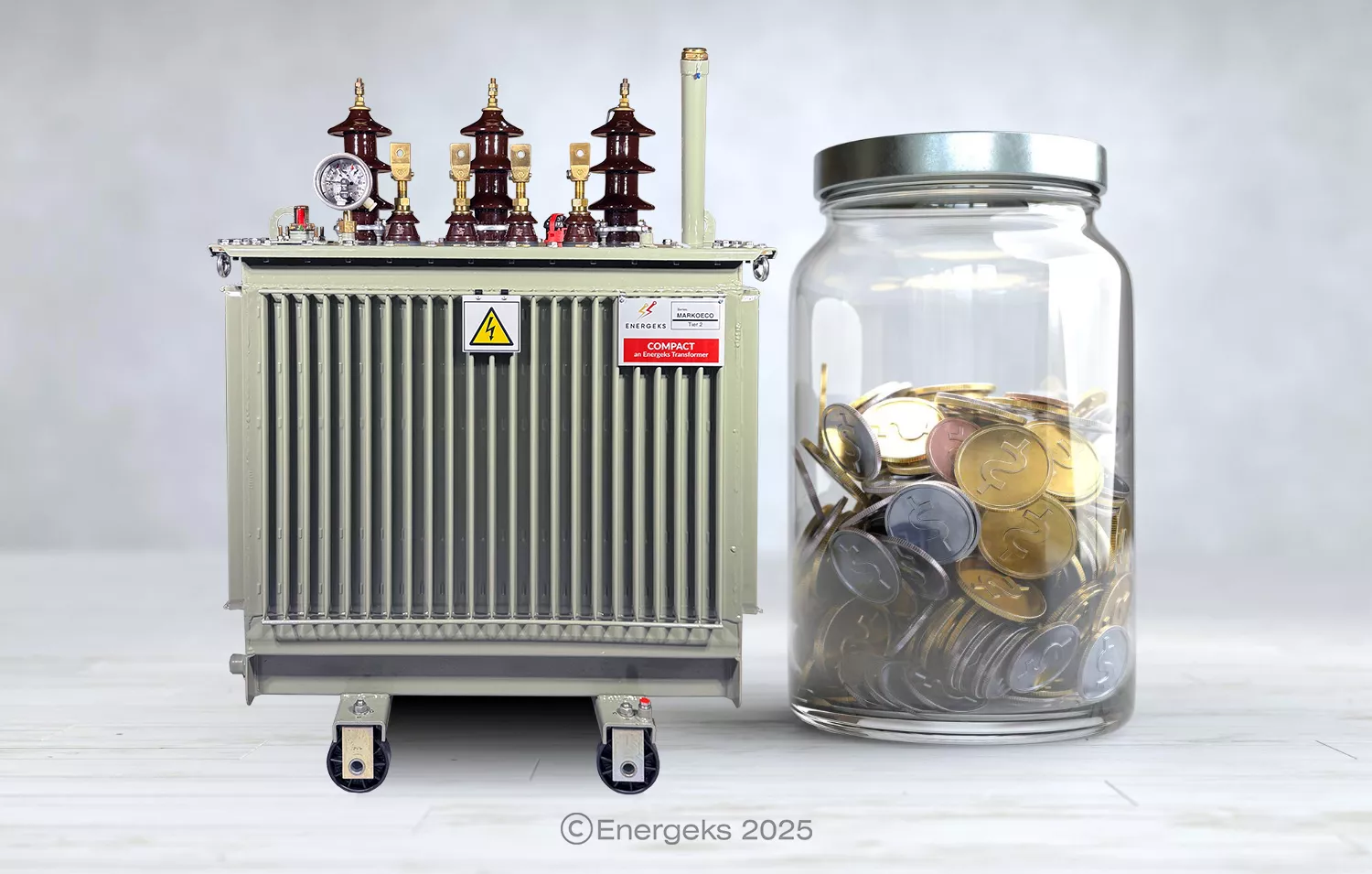
Imagine a kitchen tap dripping once every few seconds.
For a week you ignore the noise. After a month you stop hearing it.
After a year you find out that you paid a water bill that doesn’t match your real usage.
No-load losses in transformers work in a similar way. A transformer connected to the grid consumes energy even when there is no load on the low-voltage side. It is the breathing of the core. It is the magnetization of the laminations. It is heat that quietly escapes and turns into the operating cost of the installation.
Tier 2 tightened the requirements on losses and made it possible to finally measure these differences objectively. This is good news for investors, contractors, designers and asset managers, provided they know which numbers matter and how to read them. In this text we serve it on a plate.
If you are looking for specifics, here you will find formulas, regulatory thresholds, examples of numerical calculations and practical tips on how to read catalog sheets and test reports according to IEC.
We will show you when a difference of a few hundred watts in P0 is worth the effort, and when it is better to invest in better steel, a larger core or a different insulating medium, because the whole TCO will drop already in the first years of operation.
We will also explain the role of capacitors. Let me spoil the ending right away. Capacitors do not reduce the no-load losses of the core, but they can lower currents in the grid and improve the balance of load losses as well as contractual penalties for cosφ.
First, briefly and in plain language, I explain what no-load losses are and where they come from.
Then we organize the Tier 2 requirements in the European Union and show what the permissible loss tables really change.
Next we move to money. We calculate how much each additional kilowatt of P0 costs in a year and over a horizon of twenty-five years.
Finally, we check where and when capacitors make a difference and how to select them so as not to fall into resonance and not worsen the situation.
Reading time. About 10 minutes
Let us start with the basics.
No-load losses P0 are the power lost by a transformer when it is energized at its rated voltage, while the secondary winding carries no load.
Put simply, this is the price you pay for the very fact that the core is being magnetized by a field at fifty hertz. P0 is mainly composed of losses in the magnetic core laminations.
There are two main mechanisms at play.
First, hysteresis, which is the energy required to take the material through its magnetization cycle. Second, eddy currents, tiny circulating currents induced in the plane of the steel sheets, which dissipate energy as heat.
In practice, P0 remains largely constant from no load to full load under sinusoidal supply, because the core essentially sees the same voltage and frequency. This is why P0 is often colloquially called iron losses. The measurement definition for P0 under no-load conditions and rated voltage can be found in IEC 60076 Parts 1 and 7.
Because in real life transformers are rarely switched off.
In medium-voltage substations, PV farms, data centers and industrial switchgears, they run around the clock. That means 8760 hours per year, during which every additional 100 watts of P0 consumes 876 kilowatt-hours of energy.
Over a 25-year horizon, this amounts to 21,900 kilowatt-hours from just that tiny fraction of a kilowatt.
Now let’s put a European number on it. If the combined energy and distribution price is about €0.12 per kilowatt-hour (roughly €0.08–0.20 across EU countries in 2025, depending on sector and contract), then an extra 100 watts of P0 costs around €2,628 over the transformer’s lifecycle.
That means one extra kilowatt of no-load losses equals 8760 kilowatt-hours annually – a merciless factor. For comparison, that is the yearly consumption of a typical European household of 2–3 people.
The shortest answer: from the quality and grade of steel, the technology of cutting and stacking the core, the core size, and the working flux density chosen by the designer.
Higher-quality material and a larger core mean lower no-load losses, but they also imply greater mass and a higher purchase price. The real decision therefore is not about buying cheaper or more expensive, but how to optimize the total cost of ownership (TCO) for the specific load profile.
With Tier 2, manufacturers were required to lower loss thresholds. As a result, many modern transformers achieve P0 values clearly below the tabular limits. We will explore those limits in the next section.
This is the question that tempts many to search for a shortcut.
Unfortunately, capacitors have no influence on the core losses, because P0 is determined by the material, geometry, applied voltage and frequency. Reactive power compensation lowers currents in lines and windings, which can improve the balance of load losses and reduce penalties for cosφ, but it does not reduce the P0 component.
We will return to the role of capacitors in more detail in a dedicated section, together with resonance risks and sizing guidelines.
Suppose the price difference between two transformers is €3,000–€4,000, but the more expensive version has 300 watts less P0. Which option is cheaper after five years in a continuously operating installation?
In many cases, by the third year the higher-efficiency transformer breaks even, and by the fifth year it begins to generate real savings.
That is why, in Europe’s current energy landscape – with electricity costs rising and climate policies tightening – Tier 2 no-load loss optimization is no longer just a technical matter, but a financial and strategic one.
The Ecodesign regulations for transformers in the European Union brought long-awaited order to the topic of transformer losses.
First came the initial stage, Tier 1, effective from 1 July 2015. Then, from 1 July 2021, stricter limits known as Tier 2 were introduced. These include maximum permissible no-load losses (P0) and load losses (Pk) for medium-power transformers up to 3150 kVA, with a distinction between oil-immersed and dry-type designs.
The regulation also requires that documentation specifies the rated power, P0, Pk, and the Peak Efficiency Index (PEI) where applicable. This makes it easier to compare offers directly against the normative tables instead of relying solely on marketing declarations.
Take, for example, a three-phase transformer rated 2000 kVA with a high-voltage winding up to 24 kV and a low-voltage winding up to 1.1 kV.
For this configuration, the Tier 2 table for oil-immersed units shows maximum no-load losses of about 1.305 kW. For dry-type designs of the same power, the corresponding Tier 2 table allows P0 of about 2.34 kW.
In practice, permissible values vary with voltage combinations and specific cases. For instance, for 36 kV windings or dual-voltage designs, correction factors apply that increase the permissible limits.
It is therefore crucial to compare offers within the same voltage class and under the same design assumptions. Otherwise, you are comparing apples to pears.
For larger transformers, the regulation focuses primarily on minimum PEI values. This does not mean that P0 stops being important.
On the contrary. PEI depends on both P0 and Pk, as well as on the load point at which efficiency is maximized.
Documentation should include both the PEI and the load level at which it occurs. If in doubt, demand from the manufacturer a complete data sheet with test results and calculation methods in accordance with IEC standards.
Now comes the most pleasant part, because numbers simplify decisions.
Let us assume you are comparing two transformers in the same voltage class and with the same rating. One has P0 = 2.0 kW, the other P0 = 2.6 kW. Both are within the permissible Tier 2 limits for the configuration, but the second is 0.6 kW worse.
The difference in energy consumption due to no-load losses is 0.6 kW × 8760 hours = 5256 kWh annually.
At a total price of around €0.12 per kilowatt-hour (average combined energy and distribution cost across EU member states), you are paying about €631 every year just for that difference. Over 25 years, that adds up to roughly €15,780.
Even if the transformer with better steel is heavier and costs more in transport, the total cost of ownership (TCO) often drops significantly, especially where transformers are never switched off. It sounds simple – because it is – but only with Tier 2 did these comparisons become repeatable and quantifiable.
Load losses Pk are most painful on sunny days and during production peaks, so they appear more visibly in reports. P0, on the other hand, keeps adding costs silently every day, including during idle periods and off-season.
If the installation runs continuously, every excess in P0 is a guaranteed expense.
It therefore makes sense to split the strategy. For facilities with highly variable loads, you should optimize Pk together with voltage regulation and cooling. For facilities operating seven days a week, you need to pay more attention to P0, because it dictates the baseline bill.
IEC documents define the measurement of P0 in a repeatable way, and Ecodesign enforces transparency of data in catalogues and nameplates.
It happens that some offers list values like P0 ≤ 2600 W. Such a statement does not tell you what the manufacturer actually achieves in testing. Always demand figures with decimals and type-test reports according to IEC 60076.
This is not nitpicking against manufacturers, but standard purchasing practice for assets that will stay with you for decades.
From the perspective of an investor or asset manager, every figure in the loss table translates directly into money. Imagine a 2000 kVA transformer with no-load losses of 15 kW. Another manufacturer offers a similar transformer, but with P0 = 20 kW. On paper, 5 kilowatts may look like a minor detail. In practice, it means an extra 5 kW drawn continuously for 8760 hours per year – that is 43,800 kilowatt-hours of energy that no one used but someone must pay for.
At an average European electricity price of €0.12 per kWh (energy plus distribution), the annual cost difference is €5,256. Over 25 years, that adds up to €131,400.
This is not an abstraction. It is the equivalent of a new electric vehicle, an additional solar tracker for panels in a PV farm, or even a year’s maintenance budget for an entire transformer substation.
Because most of the attention focuses on the transformer’s purchase price, transport, or foundation costs. No-load losses get lost in the table among dozens of other parameters. On top of that, sales teams often state values like “≤20 kW” without giving the actual measured figure.
It is like buying a car with a brochure that says, “consumption no more than 10 l/100 km”. In reality, it could be 7 or 9.9. Both are technically within the spec, but over years the cost difference becomes enormous.
A small difference in P0 is not a detail – it is money leaking systematically. Anyone comparing offers should convert watts into euros over a 20–30 year horizon before making a decision.
Let’s bust a myth first. Capacitors do not reduce core no-load losses. P0 is determined by the physics of iron, not by reactive power flows. The only way to reduce P0 is by improving the core material, its mass, or the manufacturing technology.
Capacitors play a key role in reactive power compensation. They improve the power factor (cosφ), which lowers currents in cables and transformer windings. This, in turn, reduces load losses (Pk), which are proportional to the square of the current. In other words, capacitors won’t touch P0, but they can significantly improve the loss balance of the whole installation.
That depends on the load profile and type of consumers. If a medium-voltage substation supplies equipment with a large share of induction motors, compensation may require several hundred kvar. In PV farms or energy storage facilities, values are usually smaller but still relevant – often in the range of 50–200 kvar. The rule of thumb is clear: capacitors should be sized to keep cosφ at the level required by the distribution system operator, typically above 0.95.
Care must be taken to ensure that compensation does not enter resonance with network harmonics. Sometimes capacitors, instead of helping, worsen the situation by causing overvoltages or overheating. This is why modern substations often use detuned capacitor banks with reactors, or even active power factor correction systems.
So, are capacitors worth investing in? Yes – but not as a magic solution for P0. Their role is to reduce load-related losses, improve energy quality, and avoid penalties from the grid operator. In a well-designed system, capacitors can lower total energy losses by 5–10%, improving the transformer’s economic efficiency, particularly under heavy inductive loads.
At first glance, both notations look correct. The problem is that the “≤” symbol gives the manufacturer a wide margin – in reality, the transformer may have no-load losses of either 19 or 29.9 kW. In both cases it complies with the standard, but the difference in operating costs amounts to tens of thousands of euros. That is why you should always demand a precise value with a decimal point. This is not a whim – it is standard engineering practice.
A catalogue is one thing, but an IEC 60076-compliant type test report is another. The report shows the actual measured loss values, not just the manufacturer’s declarations. In tenders and technical acceptance procedures, it is worth requesting such documents. It is similar to demanding certified fuel consumption tests from a car manufacturer – only then can you be sure the data is real.
In offers you will find terms such as “optimized core”, “innovative design” or “energy-efficient construction”. They sound good, but until you see a hard P0 figure, it is just marketing. Always look at the loss table, not the adjectives.
Select transformers with the same rated power and voltages.
Place P0 and Pk values in a table with accuracy to the watt.
Multiply the differences by 8760 hours per year and the electricity tariff.
Project the result over 25–30 years of operation.
Compare the total with the purchase price difference between transformers.
This simple algorithm shows that “more expensive at the start” very often means “cheaper over the entire lifecycle”.
In many technical discussions there is a myth that the heavier the transformer, the better it is. There is some truth in this. A larger core with more laminations allows for lower flux density and lower no-load losses. But a heavier transformer also means higher costs for transport, foundations, and installation.
Suppose we have two 2500 kVA transformers. The first weighs 6.5 tonnes and has no-load losses of 5.8 kW. The second weighs 7.5 tonnes and its P0 is 5.1 kW. The 0.7 kW difference means about 6130 kWh saved annually. At a European average price of €0.12 per kWh, this equals about €735 per year. Over 25 years, that is roughly €18,375.
The question is: will the extra transport and foundation cost for the heavier transformer outweigh these savings? Often not – but you have to do the calculation.
If a project requires installation in a hard-to-reach location, where transport and cranes are extremely costly, a lighter transformer may be preferable despite higher losses. This is especially true in prefabricated transformer substations, where mobility and limited space matter – in such cases, weight becomes a real factor.
Heavier does not always mean better. Instead of evaluating by tonnes, you should evaluate by the balance of total cost of ownership (CAPEX plus OPEX). Then it becomes clear that sometimes it pays to add 100 kg of steel, and sometimes it is smarter to optimize logistics and foundation costs.
No-load losses in transformers are not just “a tiny number in the datasheet”. They are a fixed cost that runs day and night, regardless of the load. Tier 2 standards have enforced greater transparency, but only a conscious approach by the investor, designer, and asset manager turns those numbers into real savings.
We have shown that just 1 kW of no-load losses equals nearly 9 MWh per year.
Over a 25-year perspective, this means hundreds of thousands in currency that can either stay in the budget or silently vanish into electricity bills. We also discussed the role of capacitors. They are not a tool for reducing P0, but a key element in reactive power compensation and in stabilizing the entire installation.
Well-designed capacitor banks reduce load losses, help avoid penalties from the grid operator, and improve the economic performance of the transformer.
For the investor, the key lesson is simple: look at the total cost of ownership (TCO), not just the purchase price.
Datasheets must be read critically, IEC test reports demanded, and watts converted into money. The transformer’s weight, price, or size is only part of the puzzle. Only by summing up all elements do you get the true picture.
At Energeks, we have been designing and delivering medium-voltage transformers, prefabricated substations, and switchgears for years. In our portfolio you will find Tier 2 medium-voltage oil-immersed transformers as well as dry-type transformers, all designed to optimize no-load and load losses throughout the entire lifecycle. We support our partners at every stage of project execution – from concept, through transformer selection, to commissioning and service.
If you are looking for a partner who will not only deliver a transformer but also help you realistically calculate and optimize costs over decades – let’s talk.
Join the Energeks community of energy enthusiasts and professionals on LinkedIn
Sources:
EUR-Lex. Commission Regulation EU No 548/2014/ Loss Tables Tier 1 i Tier 2.
IEC 60076. Definitions of no-load loss measurement and test principles.
Schneider Electric. Transformer reactive power compensation and the role of capacitors.
Shipped from our warehouse in Poland within 2–3 working days, 5-year warranty. Full range 25–2500 kVA in the shop (prices in PLN).
No reviews!