3 Oct
2025
Energeks
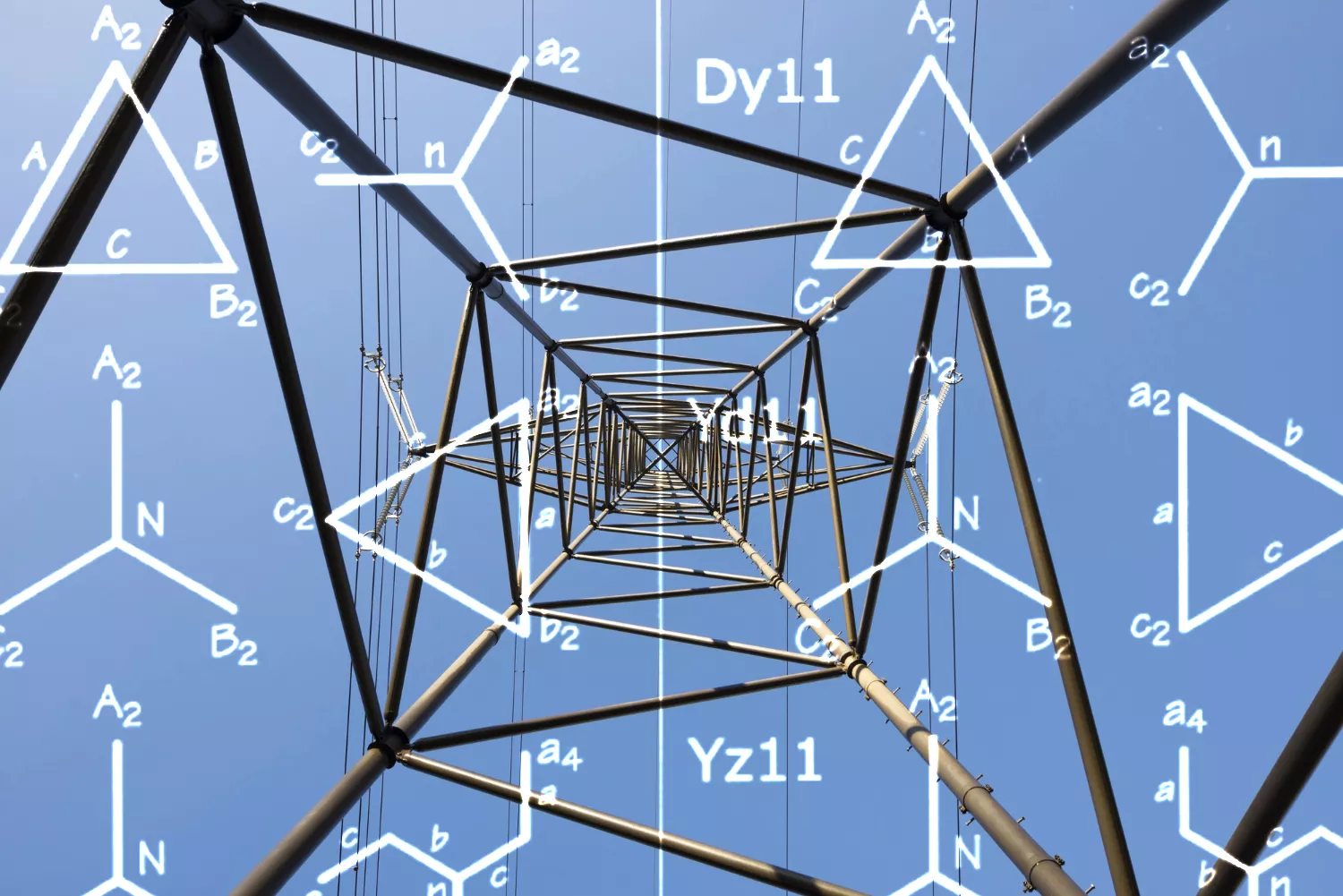
A transformer without the right winding connection works a bit like a football team without formation. Everyone runs, but instead of a match you get chaos.
You can have the best players (meaning top quality copper and steel), but if you place them in the wrong setup, instead of victory you end up with exhaustion and frustration.
It is the connection choice that decides whether voltage will distribute evenly, whether the installation can handle unbalanced loads, how the grid will cope with persistent harmonics, and whether the neutral point will stay stable or float around like a cork on water.
In practice, this is the difference between an installation that ticks like a Swiss watch and one that buzzes and irritates like a bargain alarm clock.
And the consequences? Very real. A poorly selected connection can cause the distribution system operator to reject your grid connection, protections to trip at the slightest disturbance, and energy losses to quietly drain your budget.
No wonder questions about the difference between star and delta, or why delta-star transformers are so common, come up in designers’ conversations as often as coffee on a construction site.
This article is for EPC contractors, industrial engineers, grid designers, renewable energy developers, and anyone who has ever wondered:
“Which transformer connection is used at 100 kVA?”
If you are looking for answers about the difference between star and delta in transformers, the purpose of a delta-star transformer, or what codes like Dyn11 or Yzn5 really mean, you will find clear and practical explanations here.
Article agenda:
How to read nameplate symbols: Y, D, Z, n and clock numbers
Examples and practice: Dyn11 vs Dyn5 — compatibility, parallel operation, European realities
Yzn for 25–250 kVA: why “small giants” prefer zigzag on LV
Zigzag as a hidden pillar of the grid: creating neutral, damping triplen harmonics, operational data
100 kVA in rural and urban settings: connection choices and numbers that truly matter
Myths and half-truths: grounding delta, pitfalls of Yy, Dyn11 ≠ the only EU standard
2025/2026 — RES and EV: inverters, charging hubs, and the hybrid transformer trend
What we can do for you: offer, Tier 2 Ecodesign standard, contact and community
Reading time: ~14 minutes
The first encounter with a transformer nameplate feels like stepping into a foreign world: a few letters, a few numbers, all looking like a cryptographer’s code.
You see “Dyn11”, “Yzn5” or “Dyn5” and wonder: is it a safe combination, or maybe a spare part catalogue number?
In fact, behind these three characters lies the entire story of how the transformer will cooperate with your network.
Every letter plays a role in the theatre of energy.
“Y” – star — means that the windings are connected in a common neutral point. Thanks to this, each winding “sees” only the phase voltage, which reduces insulation requirements and costs.
“D” – delta — works the other way: it is a closed loop whose greatest strength is resistance to unbalanced loads and the ability to “negotiate” between phases.
“Z” – zigzag — sounds exotic, but it is the master of cleaning up harmonics and stabilising the neutral, especially in times when electronics can throw quite a mess into the grid.
Small “n” — indicates that the neutral point is not locked inside the tank but brought outside, ready for connection.
And finally, the most interesting part of the puzzle:
The clock number, such as 0, 5 or 11. These are not meeting times but phase shifts, each of 30°.
This is not a random code but a precise instruction manual for how the transformer will behave in your network:
D – the winding on the high voltage (HV) side is connected in delta. This gives the medium voltage grid stability and protection against third-order harmonics.
y – the winding on the low voltage (LV) side is connected in star, which makes it possible to bring out the neutral* and supply both single-phase and three-phase loads.
n – the neutral* is actually available outside. It is not left locked in the tank but waits for the N or PEN conductor.
11 – the clock number. It means that the low voltage winding lags 30° behind the high voltage winding. This arrangement is considered the standard in Europe because it simplifies synchronization and allows multiple units to be paralleled without issues.
Dyn11 is a classic distribution transformer: delta on the medium voltage side (for stability and harmonic mitigation), star on the low voltage side (for an accessible neutral), and a phase shift that ensures compliance with grid requirements.
That is why a vast number of MV/LV transformers in Europe, especially in the 250 kVA and above range, carry this designation today.
When we say “it allows the neutral to be brought out,” we are talking about the neutral point of the transformer, which is the physical place where the ends of the windings meet in a star (Y) configuration.
In a star connection (Y), each of the three phase conductors (L1, L2, L3) has a winding. One end of each winding meets in a single common point – this is the neutral point.
This point can either be left “closed” inside the transformer (in which case no N conductor is available outside), or it can be brought out to a terminal on the transformer, giving us an accessible neutral (N) conductor for the low voltage network.
Why is this important?
Because the neutral (N conductor):
allows single-phase loads to be supplied (for example, household 230 V installations),
stabilises phase voltages with respect to earth,
enables the creation of network systems such as TN-S, TN-C-S, or TT, according to DSO requirements.
In simpler words:
“Bringing out the neutral” = the transformer gives access to the common star point, which becomes the N conductor in the low voltage network.
This is also not a random string of letters and numbers but a precise piece of information about how the transformer will behave in your network.
We already know D, y and n well: delta on the medium voltage side provides resistance against load asymmetry and “locks in” third-order harmonics, star on the low voltage side makes it possible to bring out the neutral so that both single-phase and three-phase consumers can be supplied, and n means that this neutral is actually available outside, waiting for the N or PEN conductor.
The entire difference lies in the digit 5 – this is the clock number, the way the phases are shifted with respect to each other. In Dyn5 the low voltage winding is shifted by as much as 150° relative to the high voltage winding.
This is completely different from Dyn11, where the shift is only 30°.
In practice, this means that Dyn5 does not play in the same “orchestra” as Dyn11.
They cannot be paralleled, but in many countries of Central and Southern Europe this very 150° shift is the grid standard.
That is why Dyn5 is not an exotic choice or an exception to the rule, but a fully fledged distribution transformer used every day in hundreds of substations.
Delta, star and neutral plus phases shifted by 150° – this configuration has been proven in practice for decades, and operators and manufacturers know that in their grids it simply works best.
In technical literature and European standards you will most often read that the distribution standard is Dyn11 – and indeed, you will encounter this arrangement in many Western European countries.
But if you look wider, you will see the full picture: in a vast part of Central and Southern Europe it is Dyn5 that serves as the ordering standard.
Why did this happen?
Historical background: in the 1970s and 1980s many countries adopted Dyn5 as their base connection group. The transformer fleet in the grid was built for decades around this standard, so new units must remain compatible – otherwise parallel operation would be impossible.
Reduction of short-circuit currents: the 150° phase shift in certain topologies allows short-circuit values to be reduced, which is crucial in dense industrial and urban networks.
Local synchronization: Dyn5 fits the characteristics of certain national distribution grids where different criteria from those of Western Europe were adopted decades ago.
Export and market demand: manufacturers in Europe know that customers in the south and center expect Dyn5 just as much as customers in Germany or France expect Dyn11.
It is not a matter of one being better or worse, but of compatibility with the local grid.
Dyn11 – a 30° shift, the standard in Germany, France and the United Kingdom, allows easy parallel operation and is well documented in technical standards.
Dyn5 – a 150° shift, preferred in many Central and Southern European countries, equally common in practice, although less frequently described in textbooks.
The most important point: these two groups cannot be operated in parallel.
If the entire grid in a given region is based on Dyn5, the new transformer must also be Dyn5 – otherwise circulating currents and stability issues will appear.
The truth is that Europe is not one single standard but a mosaic.
In some countries Dyn11 dominates, in others Dyn5, and a competent transformer supplier must understand both groups and know when each is required.
Yzn5 and Yzn11 connections are particularly popular in low and medium power transformers – from 25 kVA to 250 kVA, which means pole-mounted units and compact distribution substations.
These are solutions that distribution system operators often choose in rural and suburban areas. The core and copper work in the same way as in Dyn, but the way the windings are connected makes a huge difference to what happens at the far end of a long line in a village, on a farm, by a fire station or on the edge of an industrial park.
They combine insulation economy on the medium voltage side with high stability of the neutral on the low voltage side.
The star on the MV side limits insulation requirements, which, with hundreds of similar points in the network, has budgetary significance.
On the LV side the zigzag enters the stage, that is, a winding consisting of two halves on two columns, connected in such a way that the fundamental frequency components add up to the phase voltage, while the third harmonic components and other harmonics can cancel each other out.
The practical effect is very prosaic, yet invaluable.
The neutral point stops “floating”, and the phase voltages hold their level even when the load of each phase is different, and the electronics of consumers throw third and ninth harmonics into the network with the zeal of a night-time charger and LED lighting.
The star on the MV side (Y):
insulation works only at phase-to-neutral voltage,
reduction of insulation costs and simplification of construction,
compatibility with typical 15–20 kV lines in Europe.
The zigzag on the LV side (Z):
neutral point stable even with heavily unbalanced load,
effective elimination of third harmonic currents (the so-called triplens),
improved voltage quality for sensitive loads (LED, computers, inverters).
The neutral brought out (n):
possibility of configuring TN-S, TN-C-S or TT systems,
simple earthing solutions in accordance with local DSO requirements.
Clock number (5 or 11):
Yzn5 – 150° phase shift, preferred in many Central European countries,
Yzn11 – 30° phase shift, more commonly used in Western Europe.
Nonlinear loads are an everyday reality today. In a typical town some houses run on switch-mode power supplies, the workshop has a few inverters, and on a winter afternoon all the street and home lighting is LED.
In a star network without zigzag these “triplens” tend to add up in the neutral conductor, which sometimes causes flickering of lights and the characteristic complaint along the lines of the difference between star and delta connection is probably just a textbook theory.
In Yzn a significant part of these currents closes inside the zigzag windings, and at the phase terminals there is less nervousness and more order. For the engineer it means fewer surprises on the power quality recorder, for the user more stable operation of loads, and for the operator fewer phone calls in the evening.
Power range: most often 25–250 kVA (pole-mounted and small free-standing substations).
Typical voltages: 15/0.4 kV or 20/0.4 kV.
Unbalanced loads: Yzn keeps the phase voltages within limits even when the load difference reaches 30–40% between phases, which in pure star systems would be critical.
Harmonics: reduction of neutral current by as much as 50–70% in the case of dominant third harmonics from nonlinear loads.
Losses: the zigzag winding requires more material (more copper), which means higher load losses by 2–4% compared to the classic Dyn system, but this is an acceptable compromise for improved stability.
Let us assume that a 0.4 kV line is loaded mostly single-phase, and the third harmonic current in each phase accounts for about one-fifth of the fundamental current.
In a pure star system the neutral current can reach three times the third component from the phases, which in total gives a significant share in the cross-section and heating of the N conductor.
In Yzn part of this current closes within the winding system, which makes the effects of the same load chemistry less visible in the neutral conductor and at the load terminals. This is not a miracle, only the geometry of the connections, which acts like a passive filter embedded in copper.
This is not a duel for victory but a matter of compatibility with the environment.
The clock number tells how the low-voltage phases are aligned with respect to the medium voltage. In many regions the operator requires Yzn5, in others Yzn11, and sometimes leaves the choice provided that the new transformer can operate in parallel with its neighbor without problems.
It is worth remembering a simple rule. For parallel operation the “clock” and the type of connections must match. Connecting Yzn with Dyn to balance power on one busbar is asking for circulating currents and an expensive lesson in vector basics. So if the surrounding grid is built on Yzn5, the new unit should also be Yzn5.
The same logic applies to Yzn11. This is not the stubbornness of a bureaucrat, but mathematics.
Operators in rural areas like Yzn. Here resilience to real life counts. Low-voltage lines are long, cross-sections are chosen economically, loads are uneven. In such a topology the stability of the neutral and the suppression of triplens are invaluable.
Yzn closes the loops for zero-sequence currents inside the transformer, thanks to which at the ends of the line the voltage reacts more calmly to the connection and disconnection of large single-phase loads.
This matters for everything, from starting a pump on a farm, through a rectifier in a workshop, to sensitive IT equipment at home.
Long LV lines (0.4 kV) – voltage drops are critical, so a stable neutral reduces the risk of light flicker and equipment failures.
Single-phase consumers – households, workshops, shops – introduce strong unbalances. The zigzag mitigates the effects of these differences.
Nonlinear loads – LED, consumer electronics, IT, chargers – introduce triplens, which Yzn effectively neutralizes.
Operation – small transformers (25 kVA, 63 kVA, 100 kVA) in Yzn networks can be easily replaced, maintaining compliance with the “clock” and the operating philosophy of the rest of the grid.
A small pole-mounted unit supplying a few houses, a shop, or perhaps a small pumping station lives in the rhythm of daily peaks and evening LED waves. The zigzag keeps the neutral under control, so light bulbs do not “float”, inverters do not complain, and protections do not get a nervous hiccup. On top of that comes operational convenience. Replacing a small unit in a network built on Yzn is simple.
You insert the new transformer, connect it, and you have the guarantee that its vector will align with the vector of the rest of the stations within a radius of several kilometers.
A 25 kVA transformer in a Yzn configuration is a typical choice for:
supplying several single-family houses,
small shops, workshops, fire stations,
dispersed consumers at the end of a line.
Why Yzn at this rating?
Because even with a few single-phase loads connected randomly to the phases, the voltages hold their level and the neutral does not “float”. It is the simplest way to have a network that works properly without excessive intervention.
Yzn provides a neutral ready for configuration according to the local operator’s policy, from TN systems to variants with a grounding resistor.
This is important where the selection of the earth-fault current has an impact on the choice of protections and the coordination with network automation. The zigzag does not relieve you from thinking about selectivity, but it does provide a very stable reference point, thanks to which the designer can stick to their calculations without surprises.
In summary, Yzn is a tool for everyday tasks, not a gadget.
It works best where the network is long and capricious, single-phase consumers dominate, and nonlinear loads are the daily bread. That is why a Yzn5 or Yzn11 transformer in the 100–250 kVA class, or even in the modest 25 kVA version, is considered a sensible choice in a vast number of pole-mounted substations.
At this power rating, what matters is practice, and practice speaks clearly:
stable neutral,
reduced impact of triplen harmonics,
predictable behavior under load,
compliance with operator expectations.
The rest are execution details that a good manufacturer and a good contractor will take care of.
When you look at a zigzag diagram, the first thought is often: “who had the patience to complicate it like this?”. Windings split in half, arranged in a zigzag across two columns, instead of a simple star or delta. And yet, this “strange” geometry turns out to be one of the most practical solutions in power distribution. The zigzag is a system that does not play first violin, but without it the orchestra of the network quickly begins to play out of tune.
Let’s start with the basics. The zigzag has one main task: to keep the neutral in check.
Regardless of whether the phases are equally loaded or one village hangs on L1 and another on L2, the neutral point remains stable.
And in places where electronics throw the third, ninth, or fifteenth harmonic into the network with the enthusiasm of a cheap charger, the zigzag simply “closes” these currents within itself.
Creates a neutral in a network without one
In networks where the HV side is in delta (for example Dd0), there is no natural neutral point. The zigzag makes it possible to artificially create a neutral and ground it, which opens the way to TN-S or TT configurations on the LV side.
Suppresses third-order harmonics (triplens)
Triplens have the tendency not to disappear but to add up in the neutral conductor. Thanks to its construction, the zigzag creates “escape paths” for these currents, which close within the windings. The result is that the neutral does not overheat and phase voltages remain more stable.
Stabilizes the network under unbalanced loads
Farms, workshops, small industries – everywhere the load on one phase may differ greatly from another. The zigzag “holds” the neutral at the center instead of letting it drift away.
Protects against large harmonic content
In steelworks, facilities with welding machines, arc furnaces, or a large number of drives, harmonics can turn the network upside down. The zigzag works as a passive filter – not a miracle, but an effective reducer of the mess.
Power range: the zigzag is used from several kVA in auxiliary substations up to several hundred kVA in industrial grounding systems.
Applications:
grounding transformer,
part of the Yzn configuration in distribution transformers,
load balancing systems in data centers and EV charging hubs.
Operational effects:
reduction of neutral current by up to 50–80% in the presence of triplens,
mitigation of light flicker in LED and IT loads,
stabilization of phase voltages with load differences of up to 40%.
Imagine a small 25 kVA station at the end of a 0.4 kV line. One phase supplies a workshop with a frequency inverter, another feeds several households, and the third powers LED street lighting for the entire street.
In a pure star connection, the neutral “floats” and lamps can flicker like a strobe light. The zigzag does something that is hard to notice – it stabilizes the voltages and keeps the neutral under control. As a result, the workshop runs without disturbances and the neighbor does not call the operator in the evening asking, “why is my light flickering?”.
The zigzag does not draw attention.
It does not increase the transformer’s power or improve efficiency in the catalog. Its effect becomes visible only in operation: fewer failures, fewer customer complaints, fewer service interventions. It is the kind of device that does not play first violin, but without it the orchestra would quickly fall out of tune.
This is not an exotic curiosity but a foundation of stability in networks with a large number of single-phase and nonlinear loads. In a Yzn connection it provides an advantage in rural areas, and in industrial applications it is often indispensable.
It is an element whose importance will continue to grow: the more electronics, inverters, and EV chargers, the greater the demand for the zigzag.
You may also be interested in the topic:
Transformer K-factor: the key to protection against harmonics
The question “what transformer connection is used for 100 kVA?” comes back like a boomerang on construction sites, in projects, and in conversations with operators.
Why? Because 100 kVA is a borderline power – the transformer is still relatively small, but already significant enough to supply dozens of consumers, influence the stability of the local grid, and comply with the requirements of the distribution system operator (DSO).
In practice, the choice of connection is not a matter of the designer’s taste, but a consequence of the connection conditions and the specifics of the network in which the transformer will operate.
In real-world operation, a 100 kVA transformer sits exactly at the boundary between small pole-mounted units and more serious distribution substations.
On the low-voltage side, this gives about 144 A of rated current at 0.4 kV, which is enough to supply several households as well as a small service facility. The real challenge, however, lies in the nature of the loads.
In rural networks, strong imbalance is very common – one phase may be loaded 30–40% more than the others. Under such conditions, a classic star connection causes the neutral point to drift and results in sharp deviations of the phase voltage. The Yzn connection stabilizes this point, ensuring that even with significant asymmetry, the voltages remain within the acceptable range.
Harmonics are equally important.
In a pure star system, the neutral current can reach 50–70% of the phase current if nonlinear loads generate strong third-order components. These are the very harmonics that heat the neutral conductor and cause disturbances in equipment operation.
In Yzn transformers, a significant portion of these currents closes inside the zigzag windings, which typically reduces them on the neutral conductor to 20–30% of the phase current. This can be clearly seen in power quality recorder measurements – the neutral curve becomes much more stable.
Of course, this stability comes at a price: more copper and a more complex winding design. Load losses in Yzn transformers are on average 2–4% higher than in Dyn units. However, in operational balance this is an acceptable cost.
Fewer failures, more stable voltages, and a lower risk of customer complaints make Yzn often the more economical choice, especially for 100 kVA units operating in rural and suburban networks.
Typical power: 100 kVA = 144 A on the LV side (0.4 kV).
Single-phase loads: in rural networks, phase imbalance often reaches 30–40% – Yzn keeps the neutral stable in such conditions.
Neutral current: in a pure star it can reach 50–70% of the phase current with a high share of triplens. In Yzn it drops to 20–30%.
Losses: Yzn has load losses 2–4% higher than Dyn, but gains in stability and reduced failure rate.
In rural and dispersed areas, you will most often encounter Yzn5 or Yzn11.
Why?
Long 0.4 kV lines: aluminum conductors sized “just enough,” stretching for several kilometers. Here every flicker of light or phase imbalance becomes immediately visible.
Single-phase consumers: farms, workshops, small shops – phases are often loaded unevenly, and on top of that there are nonlinear loads.
The zigzag does the work: it stabilizes the neutral, damps triplens, and reduces voltage flicker.
Ease of operation: Yzn can be safely connected into a network where the same units have been operating for years, without the risk of problems in parallel operation.
Example: a 100 kVA pole-mounted substation supplying a dozen houses and a small car workshop. In a classic star connection the neutral current would “go wild,” but in Yzn the neutral stays stable and phase voltages remain within the norm even with a 30–40% load difference between phases.
In cities and industrial facilities, a 100 kVA transformer is often an auxiliary unit or one serving smaller buildings. Here Dyn5 or Dyn11 dominates.
Short LV circuit: lines are short, conductor cross-sections large, so load imbalances are less of a problem than in rural networks.
Uniformity of the network: operators in urban and industrial systems prefer a single standard across the entire transformer fleet.
Synchronization: Dyn11 is common in Western Europe (30°), Dyn5 in Central and Southern Europe (150°). The choice depends on the local “standard.”
Harmonic protection: delta on the HV side traps third harmonic currents so they do not flow into the medium-voltage network.
Example: a 100 kVA indoor substation in an urban area. Consumers are three-phase, loads are more balanced, and the operator requires compliance with the existing fleet. If everything in that region is Dyn5, the new unit must also be Dyn5.
It comes down to compatibility and reliability.
The decision between Yzn and Dyn is about adapting to the environment in which the transformer will operate. For 100 kVA units, the choice of winding connection is always contextual, depending on location, load characteristics, and the standards set by the operator.
In rural areas, Yzn is most often chosen because it provides a stable neutral point and effectively damps harmonics generated by single-phase and nonlinear loads. In practice this translates into fewer problems with voltage flicker and lower risk of neutral conductor overload.
In cities and industry the situation is different – shorter lines, larger cross-sections, and more uniform loads mean that operators prefer Dyn. It is simpler in construction, cheaper in operation, and above all consistent with the standards used in many distribution systems.
Western Europe (Germany, France, UK): the standard is Dyn11 with a 30° shift, enabling easy synchronization and parallel operation.
Central and Southern Europe (Poland, Czech Republic, Slovakia, Balkans): Dyn5 with a 150° shift has been historically entrenched and remains the backbone of transformer fleets.
Rural areas across Europe: in the 25–250 kVA class, Yzn5 and Yzn11 dominate, because a stable neutral and harmonic reduction are more valuable than a few extra kilograms of copper.
The most important rule is that a transformer cannot be a foreign body in the network. It must fit into the logic adopted by the distribution system operator. Only then does it work as part of the bigger puzzle, rather than an element that disrupts the harmony of the whole.
The world of transformers has its own legends, beliefs passed down from generation to generation, which in practice often turn out to be half-truths or plain myths.
Debunking them is not only an intellectual satisfaction, but above all a real saving of time and money in projects.
Every young engineer has probably heard this sentence. Delta by itself indeed has no neutral, so it seems “useless for grounding.”
But once you add a zigzag grounding transformer, it suddenly turns out that delta can be a fully stable element of the system, with its neutral held firmly in place. In steel plants, facilities with arc furnaces, or large PV farms this solution is practically standard.
Delta by itself is excellent at damping third-order harmonics and balancing loads, and with the help of a zigzag it also gains a neutral. In other words: delta not only can be grounded, but in many applications it must be.
It sounds logical: if we have a common point, the neutral should be stable.
But electrical reality tends to be more capricious.
In Yy0 or Yyn0 systems, with a large number of nonlinear loads, harmonics appear that have no path to close.
As a result, the neutral starts “floating,” phase voltages drift outside tolerance, and users report flickering lights and strange device behavior. It is a bit like a bridge on three pillars – stable as long as the loads are even. But when one pillar takes more weight, the whole structure tilts.
That is why star–star is not by definition a bad solution, but it can be deceptively calm. Only adding a zigzag or another method of handling triplens makes the neutral truly reliable.
Indeed, in textbooks and standards you will find Dyn11 as a reference system, easy to describe and unify. But just step down from the theoretical tower and look at the map of Europe to see the mosaic. In Germany, France, and the UK, Dyn11 dominates.
Meanwhile in Poland, the Czech Republic, Slovakia, and Southern Europe, Dyn5 has been the standard for decades. And not in a niche – a huge share of MV/LV transformers operating today in these countries have exactly this connection.
Why?
Because networks built in the 1970s and 1980s were planned from the start with Dyn5, and parallel operation requires consistency. As a result, Dyn5 is doing very well, still produced and delivered at hundreds of MVA every year.
Each of these myths shows something important:
In power engineering it is not enough to repeat formulas, you must understand the context.
Delta can be grounded and provides a stable system, star does not always guarantee a calm neutral, and Dyn11 has not displaced Dyn5. The choice of winding connection is not an academic dispute, but a practical decision on which the reliability of the entire network depends.
And that is what makes the letters and numbers on the nameplate more than just a code.
They are the story of standards, compromises, and local experiences.
Check out our recent article:
How to prepare a PV installation for integration with an energy storage system
Just a decade ago, the topic of winding connections seemed niche, something for designers and network engineers. Yet the years 2025 and 2026 show that those very letters and numbers on a transformer’s nameplate are becoming the foundation of energy stability.
The mix of energy sources and the nature of loads is changing faster than ever.
The development of photovoltaics has now entered a stage where numbers impress more than slogans.
In 2025 the total installed PV capacity in Europe exceeded 400 GW, which means a doubling compared to 2020.
Forecasts for 2026 point to another annual increase of several dozen gigawatts – as if every year we were adding to the grid the equivalent of a dozen large nuclear power plants. And while that sounds impressive, every additional PV inverter is not only a source of clean energy but also a potential source of problems with the quality of that energy.
Inverters operate in a nonlinear way.
In practice this means that apart from the desired 50 Hz frequency they inject harmonics into the grid – particularly the third and ninth, which tend to add up rather than cancel out. When there are hundreds of thousands of inverters, the low voltage network starts to live its own chaotic rhythm. At that point, the question of whether a transformer is Yzn or Dyn is no longer a curiosity.
It is precisely the type of winding connection that decides whether the grid remains stable or turns into a testing ground for active filters and reactive power compensators.
This is where the role of connection systems comes in.
Zigzag, thanks to its geometry, “absorbs” triplen currents and stabilizes the neutral.
Yzn ensures that rural feeder lines, with rooftop PV installations at their far ends, do not collapse under the weight of harmonics and uneven loads.
Dyn, properly chosen, isolates the medium voltage network from problems generated by thousands of inverters on the low voltage side.
In 2025 and 2026, when system operators will be connecting hundreds of new PV farms and thousands of rooftop systems every week, it is the transformer nameplate and its “magic symbols” – Yzn5, Dyn11, or Yzn11 – that will decide whether solar power enters the grid smoothly or with disturbances that force costly upgrades.
One could say that a transformer with the right winding connection becomes not just the “gateway” for green energy, but also the filter that keeps the network in order before harmonics spill over the entire system.
By 2026 the European Union is expected to have as many as 7 million EV charging points in operation.
Behind this figure lies more than driver convenience. It represents a massive revolution in the load profile of distribution networks.
This is especially evident in fast-charging hubs, where a dozen or more vehicles may start charging almost simultaneously.
At such moments the grid sees not only a sudden surge in power demand, but above all a set of highly nonlinear loads that can distort voltage and push the neutral conductor to its limits.
Every fast-charging station is a power electronic converter operating in switching mode. A few in parallel can still be balanced, but when there are a dozen or more, the network begins to experience extreme asymmetries.
On one phase the load can be tens of percent higher than on another, while the neutral conductor, instead of carrying a steady current, suddenly sees a torrent of triplens – the third, ninth, or fifteenth harmonic.
The effects are immediate: heating of the neutral, voltage flicker, and sometimes even tripping of protections that disconnect the entire hub.
In such conditions the winding connection of the transformer feeding the charging station becomes crucial.
It is precisely this connection that decides whether the local network will take the load and remain stable, or collapse under the pressure of harmonics.
Yzn, thanks to the zigzag on the LV side, keeps the neutral firmly in place and “absorbs” a significant portion of triplen currents. As a result, phase voltages stay within the permissible range even under strong load imbalance.
Dyn isolates the medium voltage side from disturbances generated by chargers, trapping in its delta loop the harmonic currents that must not flow upward into the grid.
It can therefore be said that in the era of electromobility the transformer becomes the first and most important quality-of-energy filter. In 2026 the choice between Yzn and Dyn will no longer be a matter of local habits or investment costs. It will be a necessary condition for fast-charging stations to operate without interruptions and for network operators to avoid a wave of complaints and outages.
Ultimately, it is the stable neutral and the ability to suppress harmonics that will decide whether the growth of electromobility goes hand in hand with network stability, or becomes a constant struggle with power quality.
Hybrid multi-winding transformers are already appearing on the market, combining delta, star, and zigzag in a single core.
Thanks to this, one transformer can simultaneously:
provide a neutral point for consumers,
trap third-order harmonics inside its windings,
synchronize with the MV grid according to DSO requirements,
stabilize the operation of PV inverters and EV charging stations.
Ask us about tailor-made solutions.
This is no longer theory. In 2025 the first PV farms in Germany and Spain are testing multi-winding units that enable better microgrid integration with the distribution network. Similar projects are underway in Poland and the Czech Republic, where DSOs are preparing for the growing number of EV chargers in smaller cities.
It is already clear that in 2026 the question of winding connections will no longer be an academic debate about standards. It will be a real factor determining the safety and quality of low voltage networks. A stable neutral and the suppression of harmonics are not optional extras but an absolute necessity in an era where every rooftop and backyard becomes a mini power plant and every shopping center a hub of electromobility.
What only a few years ago seemed like a theoretical subject from a transformer handbook is becoming the daily reality of engineers, designers, and operators in 2025–2026.
Transformers with “intelligent” winding connections – Yzn, Dyn with zigzag, or hybrid designs – will be the backbone of the green transition and the foundation of stable energy systems in the future.
At Energeks we look at transformer winding connections as straightforwardly as we look at PV or storage integration. Our task is not only to deliver equipment but to ensure that the energy you generate and consume actually works for you in the most efficient way possible.
That is why we focus on oil-filled and cast resin transformers compliant with Tier 2 Ecodesign standards, practically lossless and optimized for harmonics. Every kilowatt matters today, and in your plant what counts are real results, not declarations on paper.
Check our store for units available off the shelf, and explore the full Energeks transformer portfolio.
If you are an investor, a designer, or an industrial facility manager and you want to:
increase supply reliability in a grid dominated by PV and EV,
mitigate the impact of harmonics and load asymmetries,
implement Tier 2 technologies and solutions aligned with European standards,
we invite you to work with us. We believe the best results are achieved not alone but in partnership with clients, designers, operators, and suppliers. We offer comprehensive advisory services as well as tailor-made solutions, including the selection of the appropriate connection group.
Thank you for your time and attention in reading this article.
If the future of MV transformers and their integration with modern energy sources is a relevant topic for you, we encourage you to get in touch. Together we can build a system that not only works but operates without losses, without compromises, and in the spirit of forward-looking energy.
Also, join our community on LinkedIn.
Sources:
Networking modelling for harmonic studies” – Technical Brochure CIGRÉ
Renewables 2024 – Analysis – IEA
Global Energy Storage Market Records Biggest Jump Yet – BloombergNEF
Shipped from our warehouse in Poland within 2–3 working days, 5-year warranty. Full range 25–2500 kVA in the shop (prices in PLN).
No reviews!