10 Dec
2025
Energeks
When you stand next to a transformer substation and hear its soft hum, it's hard to believe that within that metal box, the lifeblood of the power network pulses.
And yet, most of us carry within us the same curiosity from childhood: the very same curiosity that made us wonder what was inside a golf ball, a ping-pong ball, or a tennis ball.
Who among us hasn't tried to drill, cut, or pry one open just to see what the "inside of the world" looks like? Let him who has not cast the first fuse ;-)
The transformer operates on this exact same archetypal impulse: the desire to peek where we don't usually look.
Inside a transformer, something fascinating happens. Current transforms as if in an alchemical process, and its heart is cooled by oil of near-laboratory-grade parameters.
What exactly lies beneath the steel cover?
And why does this structure work continuously for decades, despite extreme temperatures, vibrations, and voltages reaching thousands of volts?
At Energeks, we work with medium-voltage transformers every day – from design and testing to field implementations. We know that understanding the inside of a transformer is not just a matter of curiosity, but also of safety, efficiency, and compliance with standards.
This article is for contractors, investors, designers, and technology enthusiasts who want to look inside without the risk of electric shock.
After reading, you will know:
What key components make up an oil transformer.
What role the oil plays and how it works with the magnetic system.
How the construction of a sealed transformer differs from one with a conservator.
Which design flaws most commonly shorten its lifespan.
At the end, a bonus awaits you: a list of 5 operational errors that can destroy even the best-designed transformer.
Reading time: approx. 7 minutes
When you look at an oil transformer from the outside, you see a solid steel box, often enclosed in the concrete housing of a prefabricated substation. But the true life of this device pulses inside – where its iron heart beats: the magnetic core. Without it, a transformer would be like a body without a circulatory system – it would have no way to transfer energy from the primary to the secondary windings.
To understand how this works, we need to briefly revisit basic physics. A transformer doesn't "transmit" current directly between its windings. Instead, it uses the phenomenon of electromagnetic induction. When alternating current flows through the primary winding, it generates a varying magnetic field, which in turn induces voltage in the secondary winding. And all of this happens thanks to the core – the element that guides and concentrates this magnetic flux, like a well-laid highway for the electromagnetic field.
What is a transformer core made of?
Not from "iron," as is commonly said, but from electrical steel laminations – thin, precisely rolled sheets of silicon steel with low magnetic losses.
This is a very special material. Each lamination is coated with insulation to minimize the phenomenon of eddy currents, which could turn the transformer into an unwanted heater.
The thickness of a single lamination is usually 0.23–0.30 mm – about the same as a sheet of technical drawing paper.
The laminations are stacked in layers, like the pages of a book on energy, and clamped into packages.
This is called a laminated core. The thinner the laminations and the higher their quality, the lower the no-load losses – the energy the transformer consumes just to be "on," even without any load.
Two main types of cores are used in oil transformers:
Core-type, where the windings are wound around the vertical limbs of the core.
Shell-type, less common in medium-voltage power systems, where the windings surround the core.
Core-type designs have the advantage of being more compact and dissipating heat better – ideal for use with cooling oil.
What does core assembly look like in practice?
This is where theory ends, and true craftsmanship begins. A transformer core cannot have gaps or air spaces because every such micro-gap is a potential source of losses and noise. Therefore, the laminations are stacked with surgical precision. In large production plants, robots and presses are used for automatic stacking, but in smaller MV transformers, you can still literally see the human hand at work.
The laminations are overlapped in a "step-lap" configuration, which limits losses at the joints and reduces the characteristic hum. That hum you hear when standing by a substation is precisely the micro-vibrations of the laminations under the influence of the alternating magnetic field. For some, it's the sound of a stable, reliable grid; for others – a signal that "the transformer is working as it should."
What is the significance of grain orientation?
This is a term that sounds like it's from a metallurgy course, but it has enormous significance for a transformer's efficiency.
Silicon steel can be either non-oriented or grain-oriented (GO).
The latter has a crystalline structure oriented in one direction, allowing it to conduct magnetic flux more easily.
The result? Lower losses and quieter operation.
A transformer with a grain-oriented lamination core can have no-load losses 30–40% lower compared to older designs.
In practice, this translates to tens of megawatt-hours of saved energy over the entire life of the equipment.
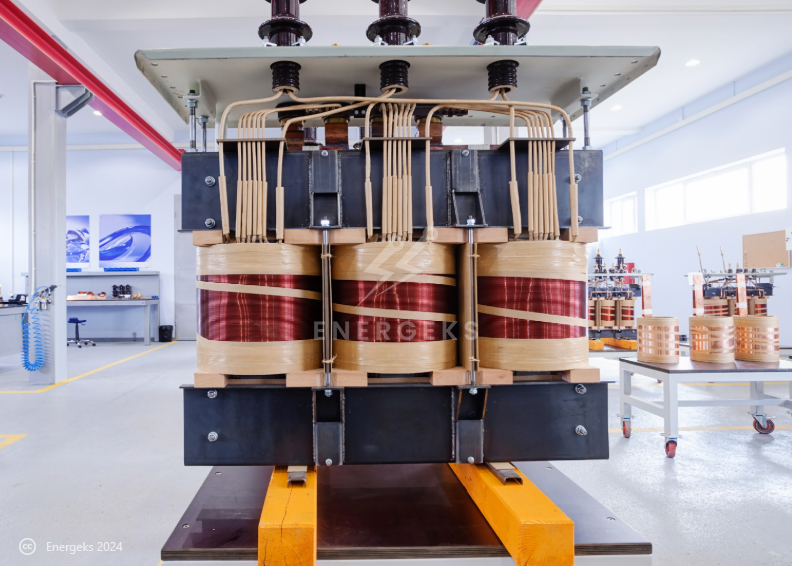
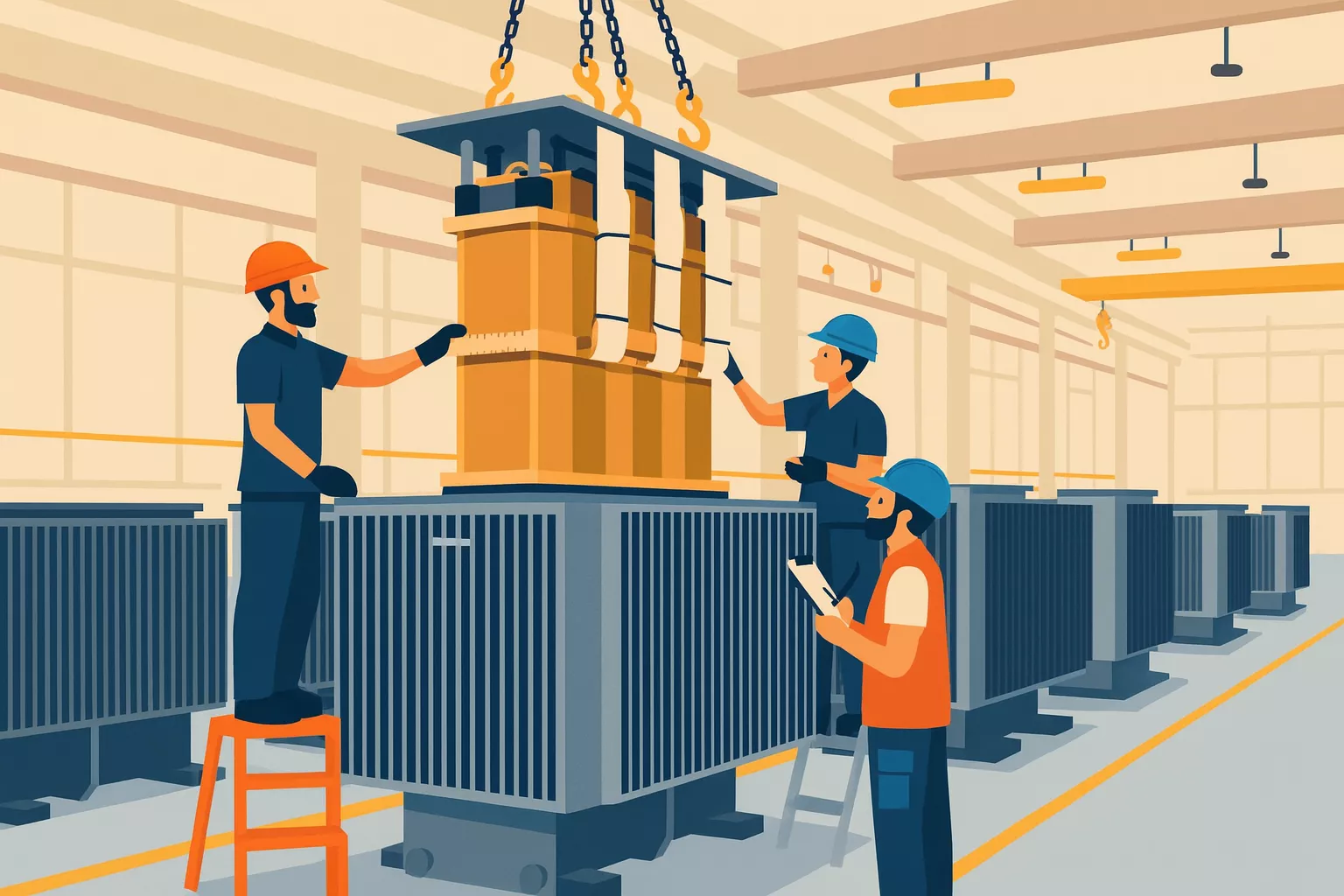
What you see here is the moment when the oil-filled giant stands almost stripped to the bones, showing off its copper muscles without a hint of shame: the copper windings gleam like lacquered alloy rims, the insulation is layered like a perfect haircut from a master barber, and the core serves as the solid backbone of the entire structure. Here, you can see the precision, the craftsmanship, and the obsession with quality that defines this work.
The core is fully immersed in transformer oil, which serves a dual function: insulating and cooling. Heat generated by magnetic losses and eddy currents is absorbed by the oil and transferred to the tank walls, where it is dissipated. Modern transformers use forced oil circulation systems, allowing for higher unit power without overheating the core.
Why does all of this matter?
Because the core is not just a metal skeleton – it is the starting point for the transformer's entire efficiency. Its quality determines:
The level of no-load losses (i.e., the cost of energy the network "consumes" without any load).
Noise and vibration levels.
Operating temperature and the durability of the insulation.
And consequently – the transformer's lifespan.
As assembly floor engineers like to say:
"A bad core will eat up the best oil, the best windings, and the best design."
This is why, before a transformer reaches the substation, its core undergoes tests for inductance, losses, and magnetic permeability.
These are the tests that determine whether the iron heart will beat with a steady rhythm for decades to come.
In the world of transformers, windings are like a bodybuilder's muscles.
They don't shine as much as a lacquered enclosure, nor do they buzz as distinctly as the core, but they do the heaviest lifting. They transform voltage, stabilize energy flow, and do it with a precision that begs for a comparison to martial arts masters: minimum movement, maximum effect.
An oil transformer has two main types of windings.
Primary, which receives high voltage like a gatekeeper at a power plant, and secondary, which outputs current in a form digestible for the network.
Copper – or aluminium – forms neatly layered, multiple turns that somewhat resemble a perfectly layered mille-feuille pastry.
Every layer has its insulation. Every turn must be in its place. Every millimeter matters, because we're talking about electric fields capable of generating voltages that can, in a second, turn a simple assembly error into a fire, an oil blockage, or a flashover nobody wants to witness.
The windings in an oil transformer are also the element that most reveals the manufacturer's character.
A single glance at the geometry, cooling layout, and the way the leads are brought out is enough for an experienced engineer to assess whether they are dealing with top-tier craftsmanship or a budget experiment that probably shouldn't get anywhere near an MV switchgear room.
The winding line tells the truth. It's either clean, uniform, and perfectly wound, or it screams that something was rushed.
It's worth remembering that windings operate at temperatures that can exceed one hundred degrees Celsius. Oil cools, but you can't cheat physics.
This is why insulation materials are so crucial – typically oil-impregnated electrical paper, which acts as both a blanket and a barrier.
The better the impregnation and the more uniform the layers, the longer the transformer will work without complaint. Leaving micro-gaps, overheated copper, or using the wrong insulation class – all these shorten a transformer's life like sleepless nights shorten a human's.
This is precisely where all the magic of voltage conversion happens.
A varying magnetic field arises in the core, which induces voltage in the secondary winding. It's like a dialogue you can't hear, but you see the results – in the form of usable energy that reaches homes, pumps, factories, energy storage systems, and all the other infrastructure we take for granted.
Well-designed windings also guarantee stability during short-circuits and overloads. A transformer that is "copper-resistant" will withstand more, because its windings won't collapse, shift, or break in critical moments.
The difference between a robust and a weak transformer often only reveals itself after the first short-circuit – and then there's no more debate about which copper was "the right one."
Finally, it's worth noting that windings have their subtle charm. There is a certain geometric aesthetic, order, and rhythm to them. A transformer with such windings will reward you with years of quiet operation. It's one of those relationships where precision truly matters.
If you want to see how these windings are created step by step, check out our article:
How a transformer is made: 10 stages of oil transformer production
It's a great complement to this part of the post, as it shows the entire process from the first lamination, through winding the copper, to final testing and assembly. It perfectly rounds out the topic.
If a transformer were a living organism, the insulating oil would be its lifeblood.
A quiet, hardworking substance that doesn't demand attention, doesn't shine, doesn't smell spectacular, but performs a task so vital that without it the entire system would collapse like a house of cards.
This insulating oil stands on the boundary between smooth operation and the kind of catastrophe operators prefer to see only in training scenarios.
Transformer oil serves two main roles.
First, it insulates, pushing voltages apart as effectively as if it stretched an invisible protective net between conductors.
Second, it cools—and it cools literally every element that generates heat.
Copper (or aluminium) and the core have a tendency to heat up their surroundings. The oil absorbs this heat, transports it to the tank walls, and dissipates it to the environment. Without it, the transformer would be like a convection oven, only decidedly less pleasant.
Two main categories of oil dominate the market.
The first is mineral oils, the classic of the power industry. Stable, predictable, cost-effective, with well-researched characteristics.
The second is ester oils. They are increasingly chosen by designers of substations and photovoltaic farms because they are biodegradable and have a higher fire point. In practice, this means an additional safety margin.
For many investors, it also matters that ester oils penetrate the insulating paper better, slowing down its aging.
The operating temperature of a transformer is a complex puzzle.
Every degree increase translates to faster aging of the cellulose insulation. And it's the insulation, not the copper, that determines the longevity of the entire device. Therefore, good oil isn't a fancy extra. It's an investment in decades of stable operation.
Excessive moisture in the oil, contaminants, or chemical degradation can lead to what in the power industry is described succinctly and directly: trouble.
An interesting fact is that transformer oil keeps its own chronicle of the device's life over the years.
Every chemical micro-flaw leaves a trace in it.
This is why DGA testing, or Dissolved Gas Analysis, is like reading a flight recorder.
From the printouts, one can learn whether there is arcing, localized overheating, slow degradation of the insulation, or the beginnings of thermal processes that require attention. An experienced diagnostician can extract more information from this sample than a doctor can from a chest X-ray.
Transformer oil also works as a shock absorber.
It dampens vibrations, protects windings from shifting, and safeguards the system in case of a short-circuit. In sealed transformers, the oil enjoys peace because the entire system is closed. In constructions with a conservator, it "breathes" through a breather system designed to keep moisture at bay.
Why does all this matter?
Because oil quality changes everything. If the oil is clean, dry, and chemically stable, the transformer can work for thirty years without issues. If the oil is neglected, even the best core and the most uniform windings won't save the situation.
At this point, many engineers start treating the oil as a partner, not just a technical medium.
Because when you see how well-impregnated paper, clean oil, and stable temperature translate into quiet operation and low losses, understanding comes naturally. It's this invisible part of the transformer that deserves significantly more attention.
If you're interested in how oil behaves in real operating conditions and how to recognize when something starts to go wrong, it's also worth checking out our article:
Transformer oil leaks – do not ignore these signals
It's a practical guide on the symptoms, diagnosis, and repair of leaks that can determine the fate of an entire transformer.
When we look at an oil transformer as a whole, it's easy to focus on the windings and the core.
That's the heart and muscles, the interior that does the actual work. But all of this interior needs a solid housing.
A body that will protect it, maintain its parameters, and give the transformer a chance to survive three decades even in the most capricious climate.
And here begins the story of the tank, conservator, tap-changers, and thermometers.
Elements that at first glance look like add-ons, but actually determine whether the transformer even has a chance of reaching retirement age.
The tank is the armor that keeps the entire system in check.
Thick steel, often corrugated into radiators, which give the oil a place to dissipate heat. In the field, it looks like an unassuming box, but every designer knows the tank is like a turtle's shell. It withstands overloads, temperature swings, wind gusts, knee-deep snow, and every short-circuit that puts the structure under momentary stress.
Perched atop the tank often sits the conservator, an additional oil reservoir that compensates for volume changes due to temperature. It's like the transformer's technical breath.
When the device heats up, the oil expands and moves into the conservator. When it cools, it returns to the main tank. The presence of a conservator may seem like a detail, but it's a detail that tangibly protects the insulation from moisture. This is precisely why so many specialists seek the answer to the classic question: should one choose a transformer with a conservator or a sealed one?
We've examined both constructions here and encourage you to check out the content:
Transformer with conservator or sealed - when does which make sense?
It's a good reference point if you want to approach an order or substation modernization knowledgeably.
Tap-changers are another key element of the transformer's body.
These small mechanisms allow the voltage to be adjusted to grid conditions. In MV transformers, you most often find off-circuit tap-changers, which are set before the device is energized.
It's a bit like fitting shoes before a long march, because the correct setting determines whether the transformer will start operating smoothly or struggle at voltage limits.
Larger units use OLTCs, or On-Load Tap-Changers.
This is advanced engineering. Mechanics, hydraulics, sparks quenched in oil, and live voltage regulation during operation.
Then we have thermometers, oil level gauges, valves, and relays.
Small components that serve as the transformer's sensory organs. The thermometer shows winding and oil temperature. The oil level gauge signals when something alarming is happening. Valves allow for quick venting or oil draining for testing.
And the Buchholz relay in transformers with a conservator reacts to gas accumulation.
This is a very serious signal. If the Buchholz relay activates, the entire crew knows they must act before a spark turns into a failure.
This entire transformer body is a team that works harmoniously only when every element is perfected.
The quality of the welds.
The tightness of the gaskets.
The mechanical stability of the radiators.
The condition of the anti-corrosion coating.
These are the things you only truly see in the field, especially when faced with November winds, shin-deep snow, and a standard technical inspection where nobody will overlook even a centimeter.
It's right there that the tank and all its accessory family show whether the transformer is a well-thought-out construction or just an attempt to enter the world of power engineering through the back door.
The transformer's body is more than just a metal can.
It is a shield, a shock absorber, a stabilizer, and a guardian that protects the interior. And if it's well-made, the transformer repays it with quiet operation even in places where the weather and loads can be capricious.
Power engineering does not like surprises.
That's why it's so crucial for the devices operating within it to be predictable, tight, and resilient.
An oil transformer can be designed like a dream and produced with the best copper on the continent, but if a design error occurs along the way, the device's life begins to shorten from the very day of assembly.
In the industry, it's sometimes said that a transformer ages not from the number of years, but from the number of misguided design decisions someone once considered a saving or a minor compromise.
And compromises in transformers take revenge slowly but surely.
The most common sin is improper winding layout.
If the copper is laid unevenly, if local stresses appear, or if there are spaces that are later difficult to fill with oil, the transformer starts having problems even before factory testing. Poorly cooled spots heat up faster, and overheated insulating paper ages at a rate that cannot be reversed later.
From a durability perspective, it's like putting a new engine into a car with already worn-out bearings. It will run, but not for long.
The second classic design error is poor cooling system geometry.
Radiators that are too small, poorly positioned, or set at an angle that hinders the natural oil circulation. The consequences are simple. Instead of circulating calmly and dissipating heat, the oil forms hot spots.
In these hot spots, everything ages. The oil. The paper. The gaskets.
The transformer seems to work, but it does so under constant thermal stress. And every degree above the norm shortens the insulation's life exponentially. If someone wants to check how much can be lost due to poor cooling geometry, just look at the oil condition test results after a few years of operation. They reveal everything.
The third problem is tank construction.
It might seem that steel is steel. But not all steel has the same quality, not all welds will withstand the same stresses, and not all connections will remain tight during temperature changes.
Even a slight deformation of a radiator under pressure can alter the oil flow, and a microscopic leak in a weld leads to moisture ingress. Moisture in the oil means an increased dielectric loss factor. An increased dielectric loss factor means the transformer starts working harder. And so on, in a vicious cycle, until the first major alarm.
Another mistake is cutting corners on the sealing system.
In many transformers, the gaskets are the first element to age. Poor rubber quality, ill-fitting rings, lack of proper tolerance for thermal movement. The end result is always the same: oil begins to disappear. And a transformer without oil is a transformer with problems not only for insulation but also for thermal management. It starts working like a furnace with a blocked chimney. Sooner or later, a signal will come, followed by questions about why that gasket cost five złoty less.
A separate category of errors involves poorly thought-out tap-changer designs.
Poorly chosen regulation positions, weak internal insulation, a tap-changer compartment that is too small. All this causes the tap-changers not only to wear out faster but also to create points of risk for arcing. And every spark in oil creates gases. And gases mean a Buchholz relay alarm. And every Buchholz alarm means a phone call from the operator and long discussions about why the device didn't quietly complete another operating cycle.
Finally, it's worth mentioning excessive compromises in noise-reduction design. A poorly designed step-lap configuration, insufficient core bracing, play in the core packages. All this increases vibrations, which over time cause micro-cracks in the insulation.
Even if the transformer doesn't exceed noise limits, vibrations are its internal enemy. Over the years, they do the same thing waves do to a concrete breakwater. Slowly, invisibly, but consistently.
Design errors are like flaws in a building's foundation.
You can't see them on the surface, but they affect everything. Every transformer has its history and its purpose. And the one designed without compromises has the greatest chance of living its twenty-five to thirty years not as a maintenance curiosity, but as a stable network element that simply does its job.
Design is one thing, but a transformer's life truly unfolds in the field.
And here begins the real test of the device's character. Even a perfectly designed and manufactured transformer can be run into the ground if operation goes against common sense.
On construction sites, in substations, and at PV farms, we've seen many situations where the fault lay not with the device, but with human habits, shortcuts, and haste.
And a transformer, though resilient, cannot win against time or operational errors. Here are the most common operational transgressions.
1. The first is ignoring moisture.
A transformer dislikes water in any form. Not in the oil, not in the paper, and not the kind that appears through leaks. When oil's moisture content becomes elevated, its dielectric properties drop drastically. The insulating paper begins to age at a rate comparable to driving a car with the handbrake on. And all of this could be avoided with a single annual oil test and heeding the first warning signs.
2. The second error is overheating the insulation by improper transformer loading.
In power engineering, it's often said a transformer can be overloaded, but with care. The problem is many contractors do it recklessly, assuming that if a transformer has a nameplate with a beautiful MVA rating, it can operate at that level twelve months a year. Meanwhile, every manufacturer provides curves for permissible overloads and temperatures. Ignoring them is like setting a treadmill at too steep an incline and pretending nothing is wrong. Something is wrong. Always.
3. The third problem is a lack of regular mechanical inspections.
Gaskets perish. Bushings get dirty. Valves can be forgotten. Even bolts on radiators can loosen if the transformer is in a location where the wind blows from one direction for half the year. Mechanical neglect leads to leaks, leaks lead to moisture, and moisture leads to failure. A spiral that is quick, predictable, and almost always avoidable.
4. The fourth error is disregarding voltage deviations and power quality.
A transformer that operates at elevated voltage for years is like a person who drinks one too many cups of coffee every day. It will manage, but its heart won't be grateful. Core overheating, increased no-load losses, stressed insulation. In distribution networks, connections are often built quickly and under pressure, causing the transformer to bear the brunt of poorly compensated installations. And what happens at the voltage level later becomes visible in DGA results.
5. The fifth error is unsuitable environmental conditions.
Transformers cope poorly with constant salt exposure, industrial pollution, lack of protection from water running off the installation, and vibrations transmitted through the foundation. If a transformer stands on a poorly executed foundation, every short-circuit impulse and every gust of wind is transmitted to the structure. Over the years, this makes a difference. It becomes visible in the condition of the radiators, connections, bushings, and sometimes even the core itself.
Operational errors are often not the result of ill will, but of routine.
The transformer stands there, works, no alarms are flashing, so "it looks fine." Meanwhile, slow processes are occurring inside that only become visible after years. Good operation isn't just about responding to failures. It's the daily care of a device that repays this care with reliability. A transformer with clean oil, healthy insulation, and stable operating conditions can work so predictably that it's almost boring. And in power engineering, boredom is the highest form of compliment.
Looking inside an oil transformer is a bit like opening that golf ball from childhood. The only difference is that here, instead of a rubber core, we find precision, thermodynamics, oil chemistry, and an architecture that keeps thousands of volts in check.
A transformer is not a "metal box with copper." It is a living, responsive system where every detail determines years of operation. The core. The windings. The oil. The tank. The tap-changers. The diagnostics. The operation. It all contributes to the story of a device with just one task: to work quietly, stably, and without drama.
If you are working on a project where reliability, safety, compliance with standards, and long service life matter, we are by your side. We select the power rating, cooling, insulation type, oil type, and parameters that truly make a difference in the field.
Explore our offering of Ecodesign Tier 2 transformers, including units available off-the-shelf and full documentation packages.We also invite you to our community on LinkedIn.
Thank you for being here with us. And if you'd like to discuss your project, define parameters, or prepare an acceptance checklist for an MV transformer, just send us a message.
Let's do it the way the best things are done in power engineering: calmly, concretely, and together.
Sources:
https://electrical-engineering-portal.com/
Shipped from our warehouse in Poland within 2–3 working days, 5-year warranty. Full range 25–2500 kVA in the shop (prices in PLN).
No reviews!