13 Nov
2026
Energeks
Energeks · stories from the substation
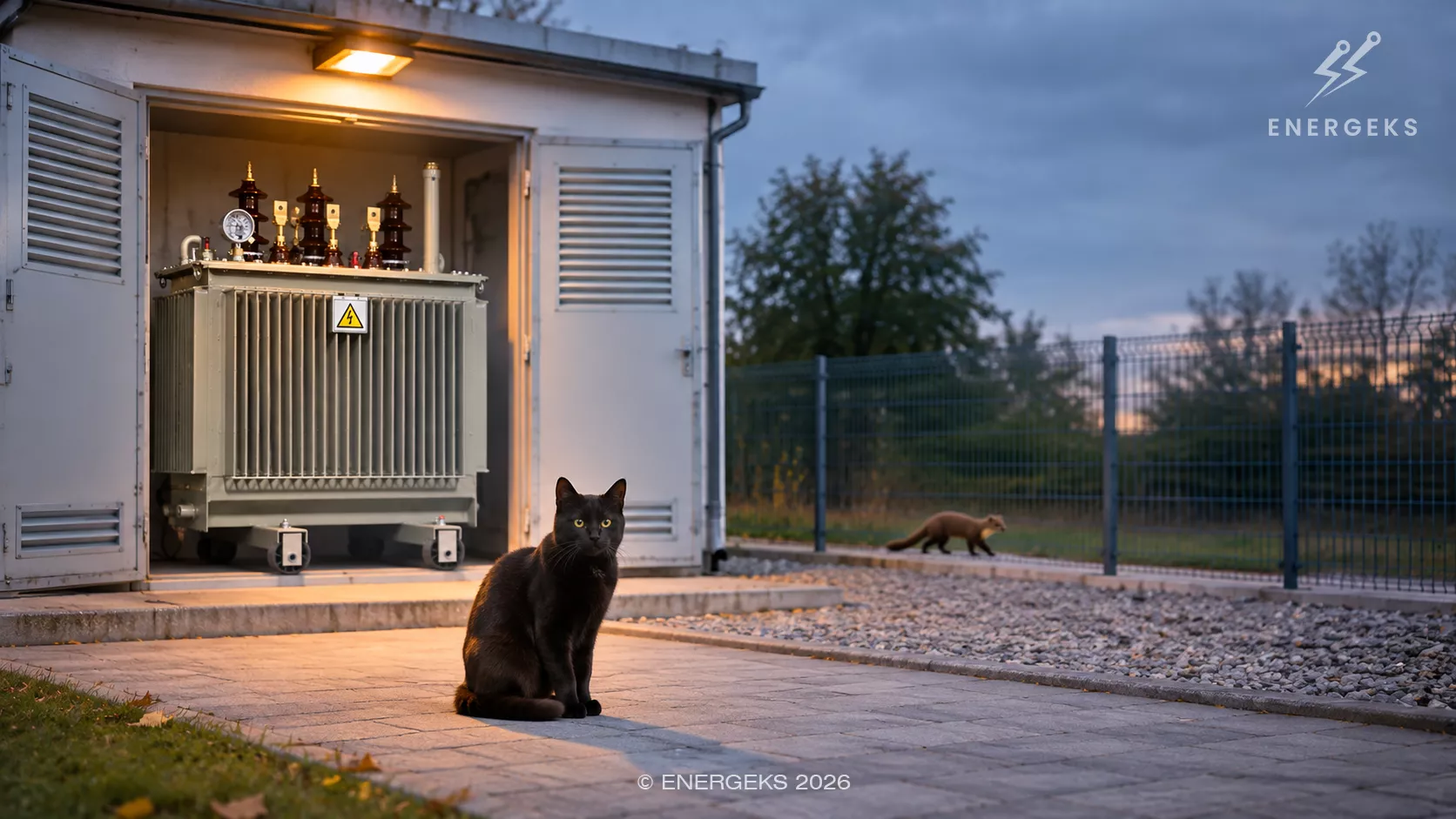
Imagine it is Friday the 13th, 6:40 a.m. The coffee has not kicked in yet, but the phone is already ringing: the hall is down, the substation is dark, and someone spotted a black cat by the fence. Before you write "bad luck" in the report, read this text. Transformer failure almost always has a culprit, and it is rarely the cat.
13 - unlucky breaks from the life of a substation
0 - black cats charged
8,760 h - hours a transformer runs per year, Fridays included
At Energeks we look at transformers from the inside and the outside, in the factory and on the construction site. We know that a unit running 8,760 hours a year does not fail because of a date. It fails because something had been bothering it for months and nobody had time to look.
This post is for electricians, designers, site managers and anyone who will one day hear on the phone: something blew in the substation.
It is also for students who want to see what the power industry looks like outside the textbook.
It will be light, because it is Friday.
It will also be concrete, because behind each of the 13 unlucky breaks there is physics and somebody's decision.
Who really prowls around the terminals. A marten, a loose connection and short circuits on the LV connections.
Bad luck from the desk. Transformer sizing too tight or too generous, a nameplate nobody read, an order placed yesterday for yesterday.
What the transformer is trying to tell you. Hum, oil, ventilation and the tap changer.
How to stop a substation without touching live parts. Paperwork, foundations, the crane and faith in luck.
A Friday checklist. Five things to check in five minutes.
Reading time: about 10 minutes
The fear of Friday the 13th has its own name: paraskevidekatriaphobia. Try saying that out loud next to a switchboard. A transformer does not know the word and does not look at the calendar. It knows temperature, moisture, vibration and the current flowing through a connection that is slightly too loose.
That is why every failure can be written up like a detective story. There is a motive, there are traces, and there is someone who could have reacted earlier. We did the detective work for you and lined up 13 suspects. The cat stands to one side, licking a paw.
We start on the low-voltage side. This is where the largest currents flow and where it is easiest to meet a guest on four legs.
Look at the substation through the eyes of a marten. Warm, dry, quiet, no dogs. A guesthouse with full board, and rodents share the same opinion. Everything is fine until the tenant steps between bare LV terminals. Then comes a flash, a short circuit, a trip, and your phone at 6:40.
Network operators know this scenario by heart, which is why standards for MV/LV transformers include a requirement for covers on the terminals. The fix fits in the palm of your hand: the OZNN insulating cover placed over the LV connections. The marten can keep sightseeing, but there is nothing left to touch. Animals also open the list of ten reasons why a transformer can end its service with a bang: why transformers explode and how to prevent it.
This sentence is heard at every thermal camera where one phase glows like a Christmas tree. Let us do the math. On a 400 kVA transformer, about 550 A flows per phase on the LV side. If the contact resistance rises by just 0.1 mΩ, a single clamp releases about 30 W of heat. Nonstop, day and night. A hot contact oxidizes faster, resistance keeps rising, and you have a heater in the substation that nobody ordered.
The culprit is often pressure applied "by feel", a dirty conductor or a cable hanging its full weight on the stud. For MarkoEco2 oil transformers, the TOC-1 and TOC-2 clamps accept both aluminium and copper conductors. A torque wrench, the manufacturer's instructions and an occasional thermal scan do the rest. If one clamp glows brighter than the others on the thermogram, start here: how to choose a transformer clamp for your transformer rating.
Quite a lot. The next four unlucky breaks are born at the desk, over a spreadsheet, long before delivery. Transformer sizing, reading the nameplate and the order date look harmless until they come back years later.
There will. Next year a compressor arrives, the year after that EV chargers, then a heat pump and a second shift. A transformer calculated to the last kilowatt starts running near its limit, and there the insulation ages noticeably faster. A winding temperature rise of 6 to 8 °C can double the ageing rate.
Instead of optimizing everything for today, think like a chess player: what happens five moves from now. A sensible reserve and one question about expansion plans cost less than replacing the unit. In substations it is worth planning the target rating at once, meaning an enclosure, an oil sump and busbars ready for a larger transformer. The whole range is in our MV/LV transformer offer.
It hurts the wallet. You pay for no-load losses for 8,760 hours a year, even when one light bulb is on in the hall. A MarkoEco2 250 kVA has no-load losses of 270 W, while a 1,000 kVA unit has 693 W. If the site draws a fraction of its power most of the year, the 423 W difference means about 3,700 kWh a year released as heat. Add a higher purchase price, larger switchgear and higher short-circuit currents on the LV side.
To be fair: under a large, steady load a bigger unit can defend itself with lower load losses. That is why the rating is chosen from the load profile, not from the investor's mood.
15.75/0.42 kV, Dyn5, short-circuit impedance 4 or 6%. For a layperson a cipher, for your network a contract. These few symbols decide whether the transformer will get along with the grid and with the unit next to it. Parallel operation of two transformers with different vector groups ends in circulating currents. A wrong ratio gives a voltage that inverters and motors do not like.
The whole bad luck lies in the fact that the nameplate is usually read after the failure, with a flashlight between the teeth. Compare it with the design and the grid connection conditions before ordering. It takes less time than brewing tea.
You know the drill. The project has a schedule, the schedule has an acceptance date, and someone was supposed to order the transformer "when it gets closer". It is closer. Units built to a design need time for manufacturing and testing, so haste ends in compromised parameters or a postponed start-up.
For such situations, typical 15.75/0.42 kV ratings are in the transformer shop, with price and availability visible at once. For non-standard voltages or ratings, write to us earlier. The production calendar does not believe in lucky coincidences.
A transformer rarely fails without warning. More often it repeats the same message for months and nobody listens. Here are four messages that are easiest to miss.
A steady, low hum is the normal voice of the core. The laminations vibrate with the magnetic field, and you hear it mainly as a 100 Hz tone. That is how a healthy transformer sounds. What should worry you is a change: louder than a month ago, a metallic buzz, crackling, a trembling cover. The cause may be excessive voltage, harmonics from inverters, a loose part of the enclosure or wrongly set taps.
The cheapest diagnostics in the world is a question to the people on site: does it sound the same as always. If you hear "not really", it is time for measurements, not for a louder radio in the control room.
Oil in a transformer works two jobs: it insulates and it carries heat away. With age it collects moisture and ageing by-products, and its dielectric strength drops. Think of it as a blood test. A sample sent to the laboratory tells you more about the unit than a look from the outside, because dissolved gas analysis (DGA) reveals overheating and discharges before anything is visible to the naked eye.
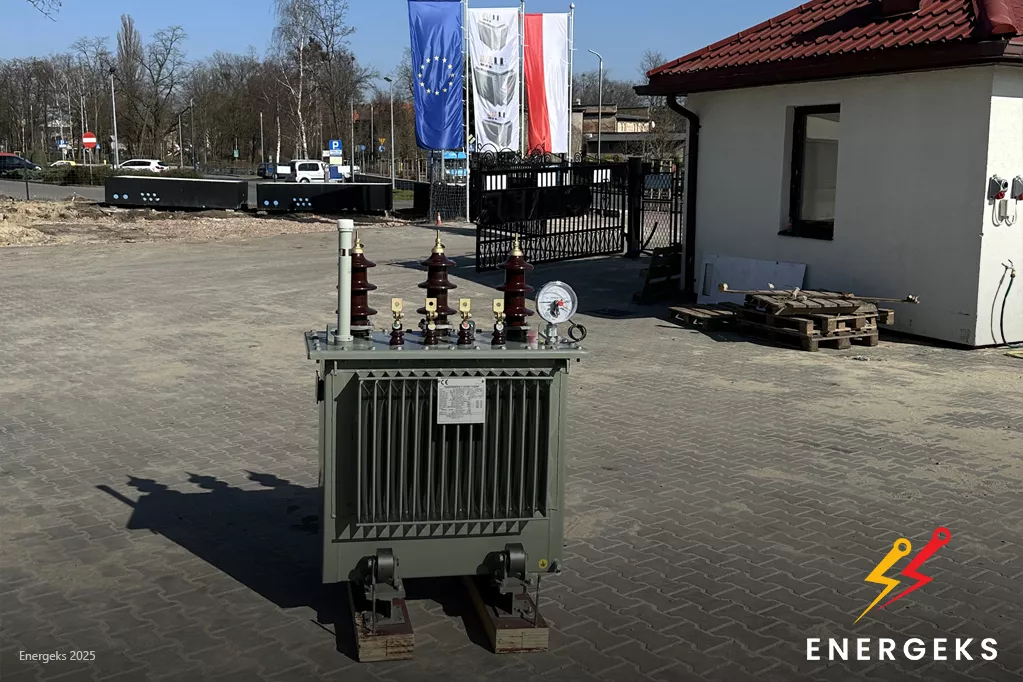
Design matters too. MarkoEco2 oil transformers are hermetically sealed, without a conservator, so the oil does not touch the air and absorbs moisture more slowly. They also have an oil level indicator that takes one glance at every visit to the substation. If your old unit has several decades behind it and the test results look worse each time, replacement is sometimes the more honest calculation. Current ratings and prices are in the MarkoEco2 oil transformers category in the shop. And if you wonder what swims in that oil and why, look inside the tank: what is inside an oil transformer.
Cartons from light fittings, spare cable trays, sometimes a set of winter tyres. The substation room is tempting because it is lockable and dry. Meanwhile a 1,600 kVA transformer gives off more than 13 kW of heat at full load. That is as much as a few household ovens running at once. To get rid of that heat it needs free airflow, and a blocked ventilation grille works like a duvet in July.
Add the fire load and a service technician squeezing through sideways. The rule is short: the transformer room is home to the transformer and its equipment.
Taps let you match the ratio to the voltage that is actually in the grid. On MarkoEco2 the standard is ±3×2.5% regulation, which means seven positions. If the MV voltage at your location is higher than rated and the switch sits in the factory position, the LV side ends up too high. The core hums louder, no-load losses grow and connected equipment lives shorter.
The tap position is set based on measurements and operator guidelines, and changed only with the transformer de-energized. It has nothing in common with a volume knob except its looks.
Warning: all work on clamps, covers and taps is carried out after switching off, verifying the absence of voltage and earthing, by authorized persons and according to the manufacturer's instructions. Friday the 13th is a good day for an inspection and a bad day for shortcuts.
It can be done, in three ways. The last three unlucky breaks need no meter. All you need is a binder, a tape measure and a bit of humility.
Test report, CE declaration of conformity, technical and operating manual, diagrams. Without these papers, acceptance of the substation stops, and years later a service engineer guesses what is actually standing in the room. The most common scenario: the folder left with the site manager for the next project, and ever since everyone "has it by email".
Every transformer we ship leaves with a test report, a CE declaration, a nameplate and technical documentation. Scan it at once and save it where someone can find it in ten years. That person will be grateful, even if you never meet.
Picture the morning of delivery. The transformer sits on the trailer, and on site it turns out that the gate is too narrow, the paved road ends several dozen metres short of the foundation, and the foundation was built for a different unit. A device weighing several tonnes does not negotiate. Neither does the driver.
That is why dimensions, weights and drawings are worth having before the concrete is poured. In the transformer station configurator you configure an MV/LV station from 63 to 2,500 kVA in six steps and immediately download the design and DXF drawings, with no registration. Ready configurations are also in the transformer stations category. Foundations, ventilation and cable bending radii have their own list of sins: 11 design errors in transformer installation that look innocent.
The thirteenth unlucky break is the sum of the previous twelve. "It always worked", so nobody looks. Meanwhile a visual check, thermal imaging of connections, an oil sample and a glance at the covers take a few hours a year. In return you get something no horseshoe over the substation door can give: you know the condition of the equipment.
Superstitions have one advantage: they remind you of the date. If Friday the 13th is to be the day of anything for you, let it be the day you put the inspection in the calendar.
In practice: five minutes is enough to do this from the outside, without touching anything live:
check that the covers on the LV terminals are in place,
listen whether the transformer sounds as usual,
look at the oil level indicator and for traces under the bushings,
take everything out of the room that is not a transformer,
find out where the documentation is and when the last inspection took place.
Rarely a single thing. It is usually a chain: an overheating connection, moist oil, operation near the rating limit, an animal on the connections or an overvoltage. Most links of that chain are visible earlier in an inspection, on a thermogram and in oil test results.
Yes. Martens, rodents and birds look for warmth and shelter in substations, and uncovered LV terminals are within their reach. Insulating covers on the connections and sealed cable entries close the subject for years.
It can be. A larger unit has higher no-load losses that you pay all year, costs more and raises short-circuit currents on the LV side. A power reserve makes sense when it follows from an expansion plan, not from a hunch.
A steady, low hum is normal and comes from core vibration. The signal to check is a change in sound: clearly louder operation, buzzing, crackling or enclosure vibration that was not there before.
Intervals are given in the operating manual and technical documentation, and often also in operator or insurer requirements. The older the unit and the harder the operating conditions, the more often it is worth taking a sample and comparing the results with previous ones.
Three symbols on a nameplate can decide whether two transformers cooperate or quarrel:
Dyn5, Dyn11 or Yzn: how to choose the winding connection of a transformer
The last 20% of capacity looks like a safe reserve and costs the most: ageing of an MV transformer.
And when the unlucky breaks grow to the size of a steelworks, the stakes are counted in millions: rules for building a transformer station for heavy industry.
For several of the unlucky breaks on this list there are answers you can simply order. OZNN covers and TOC clamps are in the transformer accessories, hermetically sealed MarkoEco2 units in typical ratings wait in the Energeks shop, and you can build an MV/LV station in the configurator and download drawings today. The full range, including units made to a design, is in the offer. We select the rating, vector group and equipment based on the design and grid connection conditions, so that thirteen stays just a date in your calendar.
If you made it this far, you are one of those people who prefer to check rather than count on luck. Thank you for spending Friday the 13th with us, and for your time. If even one unlucky break sounded familiar, it was worth writing.
Write to us: we will calculate the rating, check the nameplate and suggest the equipment. We also share stories from construction sites and transformer curiosities on LinkedIn, and we would like to meet you there. And the black cat by the substation can be petted in peace.
No reviews!